
Can Money Buy Happiness? Yes, But Only For 80% Of People

Last updated 03/20/2025 by
Andrew Latham
Summary:
Money can buy happiness, but the impact depends on how happy you are to begin with. Recent research reveals that higher income boosts happiness for about 8 out of 10 people who are already relatively happy. For the least happy 20%, additional income beyond $100,000 doesn’t significantly increase happiness. While income does play a role, other factors like relationships, health, and personal fulfillment have a more substantial impact on overall well-being.
Can money buy happiness? Yes, it sure can. But money alone is not enough. In fact, unless you are already relatively happy to start with having more money may not help at all. Recent research has shed light on this age-old debate, reconciling conflicting studies to reveal a nuanced understanding of how income impacts our emotional well-being. As usual, the devil is in the details. Let’s dive into what this means for you.
Compare Investment Advisors
Compare the services, fees, and features of the leading investment advisors. Find the best firm for your portfolio.
The debate: diminishing returns on happiness vs. “the more the better”
If you’ve paid any attention to research on the relationship between money and happiness, you have probably heard about the famous study by Kahneman and Deaton, which suggested that money’s happiness boost only lasts up to an income of $75,000 per year (to be more specific the data indicated that income stopped influencing happiness after the $60K to $90K range). On the other hand, Killingsworth’s research found no such plateau, indicating a continuous increase in happiness with rising income.
The graph below illustrates well the two views. Figure A shows the steep increase in happiness with income that plateaus into a straight line when income hits $100K. Figure B, on the other hand, shows a straight line that, if anything, gets steeper the more income increases. At first glance, these studies seem diametrically opposed.
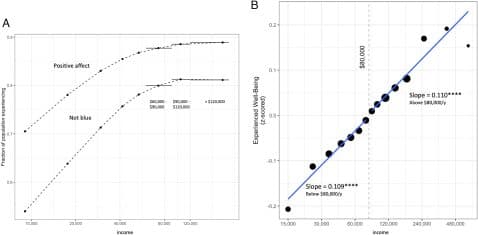
However, a new study carried out by the very same researchers (Kahneman, Deaton, and Killingsworth) to find out why their results were so different reveals a more nuanced understanding of how income impacts our emotional well-being that can help us make smarter personal finance decisions. Let’s dive into what this means for you.
Reconciling the Differences: Key Insights
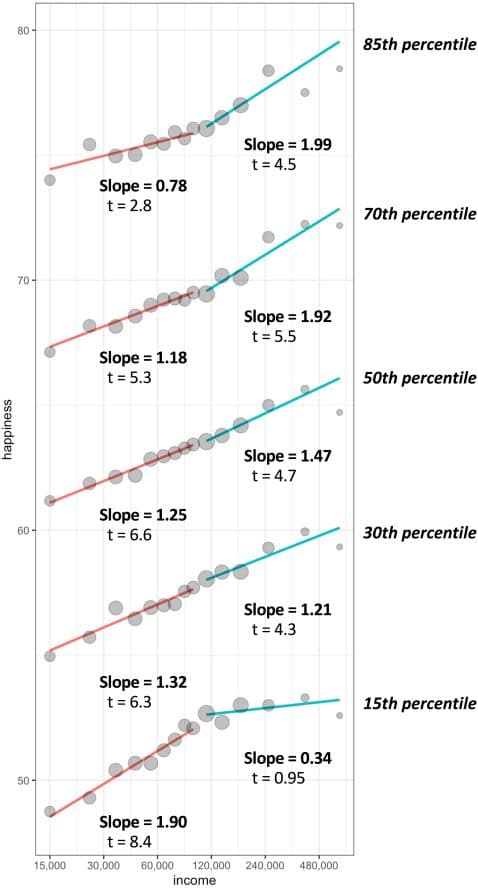
The new study by Kahneman, Deaton, and Killingsworth took a more granular view of the data in their respective research and found that both views on the relationship between income and happiness were correct, they just focused on different segments of the population. Turns out that more money will continue to make you happier as long as you are already relatively happy, which includes around 80% of people. Notice in the graph below the strong correlation between how happy people are to start with and the effect of an income increase on their happiness.
1. The Happy Majority
For the majority (80% of the participants) of people who are relatively happy, the relationship between income and happiness remains linear. As their income increases, their happiness continues to rise. In fact, the happiest individuals see a steeper boost in happiness as their income climbs beyond $100,000.
2. The Sad Minority
For the least happy 20% of people, happiness increases with income up to about $100,000. Beyond this point, additional income does not significantly enhance their emotional well-being. This group includes individuals facing persistent challenges that higher income alone cannot resolve, such as severe mental health issues or significant life stressors.
Bottom line: if you are happy-ish (that’s most of us) more money will make you feel happier. However, if you are miserable because you are facing serious life problems that can’t be resolved with money, such as mental health, the loss of a loved one, or heartbreak, the happiness-inducing effects of money cap out at around $100K.
Putting the Importance of Money for Happiness in Perspective
While money can influence happiness, it’s important to understand that the correlation, though statistically robust, is relatively weak. In simpler terms, having more money can make you happier, but its effect is not as strong as other factors in life.
For example, the correlation between income and happiness is about 0.09 in the experience sampling data. To put this into perspective, the difference in happiness between households earning $15,000 and those earning $250,000 is just about five points on a 100-point scale. Although the difference is substantial, it helps to compare it to other factors:
- Being a caregiver: The effect of caregiving on happiness is about the same as a fourfold difference in income.
- Being married: Marriage has about half the impact on happiness as the difference between low and high income.
- Enjoying weekends: The joy of a weekend is roughly equal to the happiness boost from 4x income.
- A headache: The negative impact of a headache is about three times stronger than the happiness gained from a significant income increase.
Clearly, income does affect happiness, but other aspects of life, such as relationships, health, and leisure time, can have a bigger impact on our overall well-being.
What Determines Happiness
So, if money only helps if you are already relatively happy to start with, what makes us happy? Here is a quick breakdown based on the research of Sonja Lyubomirsky, Ph.D., author of The How of Happiness.
- Genetics (50%): Genetics play the most significant role, accounting for about 50% of our baseline happiness. This genetic set point explains why some people are naturally happier than others regardless of their life circumstances.
- Intentional Activities and Thoughts (40%): About 40% of our happiness is influenced by our intentional activities and thoughts. This includes actions such as practicing gratitude, nurturing relationships, and finding purpose, all of which we have significant control over.
- Life Circumstances (10%): The remaining 10% of our happiness is determined by our life circumstances, such as income, social status, and living conditions. While these factors can influence happiness, they are far less impactful than genetics and intentional activities. Obviously, our intentional activities affect our life circumstances, so according to this model, we have control over about 50% of our happiness.
This breakdown tracks well with the research discussed above. Income continues to help with happiness because it has a huge effect on our living conditions, status, and what fun activities we can do. However, its effect remains modest because it only influences the 10% of happiness that is determined by life’s circumstances. On the other hand, engaging in activities like practicing gratitude, nurturing relationships, and finding purpose can boost happiness more effectively than financial gains alone.
Another key feature that Lyubomirsky highlights and explains our relationship with money and happiness is hedonic adaptation — a fancy way of saying that people tend to return to a baseline level of happiness after positive or negative life changes.
What Does Financial Happiness Mean?
Another factor to consider is that there are different types of happiness. A recent study by Empower focused on what Americans feel about “financial happiness.” Not surprisingly, the study revealed that most Americans believe money can buy happiness (at least financial happiness). What I found interesting is how the participants in the study defined financial happiness. It certainly goes beyond mere net worth. Here is a quick summary of the key takeaways.
Key takeaways
- Money is widely seen as a solution to problems, with 71% of Americans believing more money would solve most of their issues, yet only 17% equate financial happiness to a specific net worth.
- Financial stability matters more than wealth accumulation, with on-time bill payments (67%) and being debt-free (65%) ranking higher in financial happiness than simply having more money.
- Work/life balance is a key factor in financial happiness, especially for younger generations—58% of Gen Z and 55% of Millennials and Gen X stress its importance.
- Financial happiness has a high price tag, with Americans estimating they need $1.2 million to feel financially happy. Millennials set the highest income requirement at $525,000 per year.
- Economic pressures like inflation and rising costs impact financial well-being, with only 58% of Americans satisfied with their overall wealth.
- Many view work as transactional, with 75% of Americans feeling this way, and 64% saying they would quit their job if money were no concern.
- Financial guidance is in demand, as 67% believe employers should offer financial planning, and 72% want financial coaching to reduce stress.
- Financial independence and emergency preparedness contribute to happiness, with Millennials also finding joy in small indulgences, like a $7 coffee (62%).
- Health and wealth are deeply connected, as 79% believe financial happiness enhances overall well-being, productivity, and the ability to build generational wealth.
- A solid financial plan leads to greater happiness, with 73% of Americans agreeing that having a structured financial plan improves their overall well-being.
What This All Means for You
So, what does the research on money and happiness mean for us? Here are some practical takeaways to consider.
1. Focus on Experiences Over Material Possessions
Investing in experiences, such as travel, hobbies, and quality time with loved ones, tends to bring more lasting happiness than buying more stuff. Create a savings account specifically for these activities to ensure you’re prioritizing meaningful experiences. I would recommend opening a high-yield savings account in a bank that is different from your checking account — to reduce the temptation of frivolous spending — and opening an account for each of your major goals, whether it is a camping trip, a wedding, or an around-the-world vacation. The savings accounts below are a good place to start.
2. Build Financial Security
Ensure you have a solid financial foundation by saving for emergencies, investing in retirement accounts, and managing debt wisely. Financial stability can alleviate stress and contribute to overall well-being. Start by paying off high interest debt and saving enough to cover three months of living expenses. Consider these debt consolidation options if you are feeling overwhelmed with your current level of debt.
3. Prioritize Work-Life Balance and Nurture Relationships
Avoid overworking in pursuit of higher income if it compromises your personal well-being. Strive for a balance that allows you to enjoy life outside of work, fostering both professional success and personal happiness. Strong social connections are crucial for happiness. Spend time with family and friends, and invest in your relationships. Emotional support and companionship can significantly enhance your quality of life.
4. Invest In Your Future
Since money does help us be happier, it’s smart to be mindful about how we spend it and put it to work. Keep things simple. Basic but effective budget models that allocate your money based on 1) needs, 2) wants, and 3) savings/debt payments, such as the 50/30/20 (that is 50% of your income for needs, 30% for wants, and 20% for savings and debt payments) work great. If you don’t have a brokerage where you invest a chunk of your monthly income, stop what you are doing and open one. It doesn’t matter if you can only invest $50 or $100, the key is to get started.
Even relatively small amounts can add up. Say you earn $75,000 a year and you manage to invest 20% a month ($1,250) in a portfolio that earns an annual average of 10% (the S&P 500 average over the last 100 years was 10.6%), you would have a little over $1.2 million after 22 years, which apparently is the price tag for happiness according to Empower’s study.
5. Practice Gratitude
It sounds corny, but regularly reflecting on what you’re grateful for can improve your outlook and increase your happiness. Incorporate gratitude practices into your daily routine to foster a positive mindset.
The question of whether money can buy happiness doesn’t have a one-size-fits-all answer. While higher income can enhance happiness for many, its impact varies among different individuals. By understanding these nuances and focusing on meaningful experiences, financial security, and nurturing relationships, we can navigate the complexities of money and happiness to achieve a more fulfilling life.
Key Takeaways
- Higher income can contribute to happiness, but its impact varies among individuals.
- The least happy among us experience a plateau in happiness gains at around $100,000 income.
- For most people, happiness continues to rise with increasing income.
- Focusing on experiences, financial security, work-life balance, and nurturing relationships can enhance well-being.
- Gratitude practices can significantly boost overall happiness.
- Financial happiness involves more than net worth; it includes debt-free status, on-time bill payments, and a good work/life balance.
- A solid financial plan is crucial for achieving greater overall life happiness.
Andrew is the Content Director for SuperMoney, a Certified Financial Planner®, and a Certified Personal Finance Counselor. He loves to geek out on financial data and translate it into actionable insights everyone can understand. His work is often cited by major publications and institutions, such as Forbes, U.S. News, Fox Business, SFGate, Realtor, Deloitte, and Business Insider.
Share this post:
Add as a preferred source on Google
Table of Contents