
FICO’s Monopoly Cracks: New Credit Score Rules Could Open Doors for Millions of Homebuyers

Last updated 07/10/2025 by
Andrew Latham
Summary:
The FHFA’s approval of VantageScore 4.0 for mortgage use marks a major shake-up in credit scoring. After decades of FICO dominance, lenders now have a choice. While industry adoption may be slow, this move cracks open a long-standing monopoly and could transform access to homeownership—especially for those with non-traditional credit histories.
In a landmark shift, the Federal Housing Finance Agency (FHFA) has authorized the use of VantageScore 4.0 for mortgages backed by Fannie Mae and Freddie Mac. For the first time in decades, FICO’s grip on the mortgage lending industry faces real competition. This decision could redefine who gets to access credit and how.
Compare Home Loans
Compare rates from multiple vetted lenders. Discover your lowest eligible rate.
What is VantageScore 4.0?
VantageScore 4.0 is a credit scoring model developed by Equifax, Experian, and TransUnion. What sets it apart is its use of alternative data like rent, utility, and telecom payments—details often excluded from traditional credit reports. This helps score millions of Americans who otherwise wouldn’t qualify for a FICO score.
According to VantageScore, up to 33 million consumers could benefit from this broader, more inclusive credit evaluation.
Why this could change everything for homebuyers
For renters, immigrants, younger borrowers, and others with limited credit histories, this is a game-changer. These groups may pay every bill on time but still remain “credit invisible” under FICO. If mortgage lenders begin adopting VantageScore, many of these individuals could become eligible for home loans for the first time.
In short, this is about financial equity. Giving people credit for paying rent and utilities brings the system closer to fairness—and closer to reality.
The breaking of a credit scoring monopoly
For over 20 years, FICO scores were the only option for loans sold to Fannie Mae or Freddie Mac. That gave FICO an unchallenged hold over the mortgage market—a de facto monopoly. Lenders couldn’t use any other scoring model, even if better ones existed.
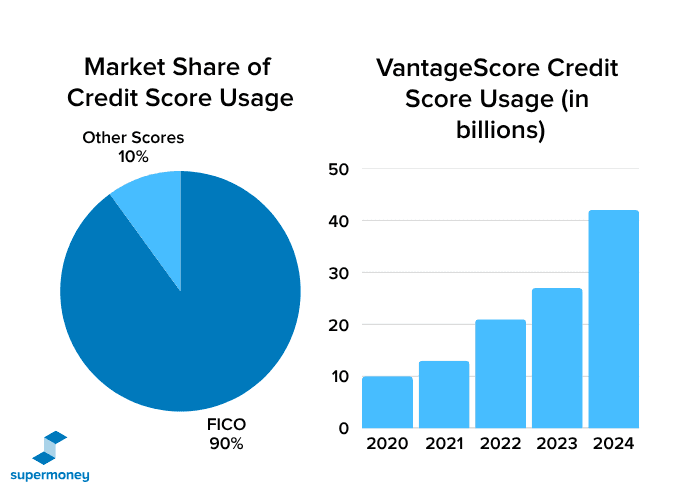
FICO is still used in approximately 90% of all consumer credit decisions, including virtually all mortgages. This massive market share has allowed FICO to set the rules for access to home loans—until now.
The FHFA’s validation of VantageScore 4.0 shatters that dynamic. Lenders now have a sanctioned alternative. While FICO isn’t going anywhere, this marks the end of its monopoly in federally backed mortgage underwriting. The door is now open for innovation, competition, and consumer choice.
Comparing VantageScore vs FICO
Though FICO still dominates mortgage lending, VantageScore’s use is growing rapidly in other areas like personal loans and credit cards. In 2024 alone, 42 billion VantageScore scores were used, up 55% from the year prior.
Here’s how VantageScore usage has grown over time:
Why lenders may still hesitate
Despite the FHFA’s green light, lenders aren’t rushing to change their systems. Here’s why:
- System overhaul: Switching models requires technology upgrades and process changes.
- Unknown risk: Lenders worry about how loans scored with VantageScore will perform.
- Buyback fears: If loans underperform, lenders could face costly repurchase demands from Fannie or Freddie.
- Familiarity bias: FICO has decades of institutional trust. Change isn’t easy in a risk-averse industry.
Why adoption matters
The potential of VantageScore 4.0 isn’t just theoretical. If lenders adopt it, the impact could be profound:
- Fairer access: Renters and low-credit consumers gain recognition for good payment habits.
- Greater inclusion: More Americans could qualify for mortgages.
- Healthier competition: Credit scoring becomes more transparent and accountable.
Frequently asked questions
What is VantageScore 4.0?
It’s a modern credit scoring model that includes rent, utility, and telecom data to score more consumers, especially those without traditional credit.
Why did FHFA approve it?
To introduce competition, improve access to credit, and reflect real-world payment behavior.
Will lenders switch immediately?
Probably not. Despite regulatory approval, lenders may delay adoption due to cost, risk, and regulatory concerns.
How does this impact consumers?
If adopted, millions of renters and underbanked individuals could qualify for mortgages for the first time.
Is this the end of FICO?
No. FICO remains dominant, but for the first time, it faces meaningful competition in the mortgage space.
Key takeaways
- The FHFA approved VantageScore 4.0 for use in Fannie and Freddie mortgages.
- It includes rent, utility, and telecom data, potentially scoring 33 million more people.
- For the first time, FICO no longer has a monopoly in mortgage credit scoring.
- VantageScore usage jumped 55% year-over-year in 2024.
- Lenders are cautious, but the system is finally opening to competition.
Andrew is the Content Director for SuperMoney, a Certified Financial Planner®, and a Certified Personal Finance Counselor. He loves to geek out on financial data and translate it into actionable insights everyone can understand. His work is often cited by major publications and institutions, such as Forbes, U.S. News, Fox Business, SFGate, Realtor, Deloitte, and Business Insider.
Share this post:
Add as a preferred source on Google
Table of Contents