
Over Half of U.S. Homes Just Lost Value — Here’s What That Means for Your Equity and Credit Lines

Last updated 11/29/2025 by
Andrew Latham
Summary:
Over half of U.S. homes—53%—have lost value in the past year, signaling a cooling housing market. This trend could impact HELOCs and trigger credit line reductions, but it may also lead to lower costs for home equity investments (HEIs). Here’s what homeowners, buyers, and lenders need to know.
According to new data from Zillow, 53% of U.S. homes have dropped in value over the past 12 months. This marks the highest level of depreciation since the housing recovery began more than a decade ago.
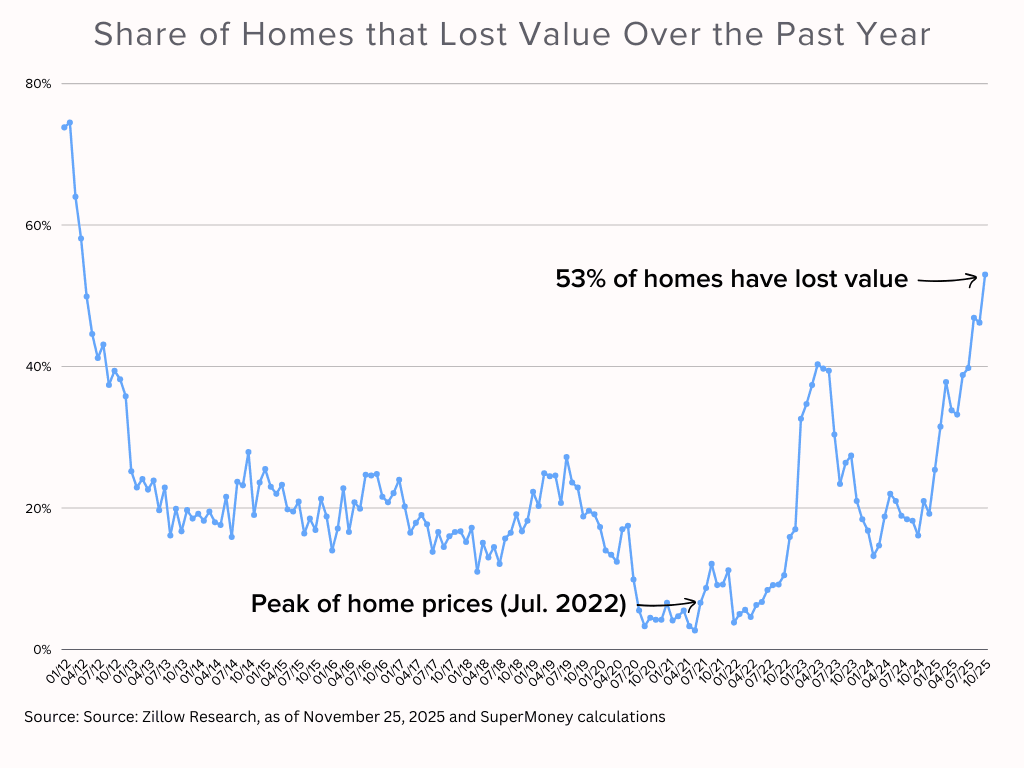
For perspective, that number hovered between 3% and 5% in mid-2022 when home prices peaked. Today, values are sliding in markets across the country. As demand slows and affordability worsens, many sellers are pulling listings or accepting lower offers, putting downward pressure on valuations.
What this means for the real estate market
This reversal in home prices may reshape the housing market heading into 2026. Here’s how:
- Sellers lose leverage: With prices falling, many sellers are delaying listings or cutting asking prices.
- Buyers gain bargaining power: More inventory and lower prices are starting to benefit buyers—especially those with strong credit and cash offers.
- Affordability is still strained: Even with prices softening, high mortgage rates are keeping monthly payments elevated.
Still, it’s important to note that price trends are highly regionalized. Some markets—particularly those that saw explosive growth during the pandemic—are seeing the sharpest drops. Others remain relatively stable, or have only seen modest corrections.
And while the percentage of homes losing value is striking, this is not a repeat of the foreclosure crisis. Unlike 2008, today’s market isn’t flooded with forced sales or underwater mortgages. Tighter lending standards, record levels of homeowner equity, and a strong job market mean most homeowners are in a better position to ride out a correction.
The shift may cool investor activity and put more power back in the hands of traditional homebuyers. But the downside is clear: homeowners who bought recently may now owe more than their homes are worth, at least temporarily.
HELOCs may be at risk if home equity shrinks
With 53% of homes losing value, homeowners who rely on home equity lines of credit (HELOCs) may face a serious wake-up call. Because HELOCs are secured by your home, falling property values can trigger lender action — even if you’ve never missed a payment.
Lenders regularly review HELOC accounts to ensure borrowers maintain enough equity to justify the credit limit. If your home’s value drops significantly, your bank may:
- Reduce your credit limit to reflect the updated loan-to-value ratio
- Freeze your line of credit, blocking any future draws
- Close the account entirely, especially if your home value has plummeted or your credit profile has changed
These actions can happen with little warning and often during times when homeowners need access to funds the most. Fortunately, you’re not powerless if your lender takes action.
What to do if your HELOC is frozen or reduced
The Federal Reserve and industry experts offer the following tips for homeowners dealing with HELOC reductions or freezes:
- Contact your lender: Ask why your credit was reduced or frozen and request a copy of the home valuation used. There may be errors or outdated data.
- Request a re-evaluation: If you’ve made home improvements or your local market has rebounded, you can ask the lender to reassess your home’s value.
- Provide new documentation: Supply recent comparable sales or a professional appraisal to support your case for reinstating your credit line.
- Consider refinancing: If your lender won’t budge, refinancing into a home equity loan or a new HELOC with another lender might restore access to funds.
- Explore alternatives: HEIs, personal loans, or even 0% intro APR credit cards could offer short-term funding while you rebuild equity.
Don’t wait until your credit is frozen to act. If your home has lost value or you sense changes coming from your lender, be proactive. Review your credit usage, contact your bank, and explore other options before you’re caught off guard.
Tip: Under federal law, lenders must send written notice when they change your HELOC terms due to decreased home value. Use this as a trigger to gather updated valuation data and prepare your appeal.
HEIs offer a possible silver lining
As home values fall, homeowners may find it harder to tap into their equity. Home Equity Investments (HEIs)—which offer cash in exchange for a share of future appreciation—are also affected by this trend.
For those applying now, the amount they can access may be lower because there’s less equity available. But there’s a flip side: investors may expect smaller returns, which could lead to lower costs for homeowners who already have HEIs or are entering one during this downturn.
Unlike HELOCs, HEIs come with no monthly payments or interest. That can offer more flexibility, especially when budgets are tight.
- Lower equity = smaller funding amounts
- Lower prices = possibly lower costs for homeowners
- No monthly payments make HEIs less risky for cash flow
While HEIs aren’t right for everyone, they can be a useful option—especially for homeowners looking for flexibility without taking on new monthly debt. Still, they are a long-term commitment and should be considered carefully, particularly if home values bounce back faster than expected.
Frequently asked questions
Why are so many homes losing value right now?
Rising mortgage rates, affordability issues, and slowing demand have contributed to falling home values in many markets. It’s a correction after years of rapid price growth.
Can my HELOC be frozen if my home value drops?
Yes. Lenders have the right to freeze or reduce a HELOC if your home’s equity falls below their required thresholds. This protects them from issuing unsecured loans.
Is now a good time to apply for a HEI?
It depends on your financial goals. Lower home values could reduce the cost of a HEI, but you’ll also be giving up a portion of future appreciation. Review the terms carefully before moving forward.
Will home prices keep falling?
That’s unclear. Some experts predict continued softening in 2026, while others believe the market may stabilize as inventory tightens. It will depend on interest rates, jobs, and economic trends. Regional factors will also play a major role.
Key takeaways
- 53% of U.S. homes lost value over the past year, the highest level since 2012
- Falling home prices may trigger HELOC freezes and reduced credit limits
- Homeowners with HEIs could benefit from lower valuation-based pricing
- Price trends vary significantly by region, and this is not 2008—forced selling is limited
- Experts are watching for stabilization or further declines in 2026
Andrew is the Content Director for SuperMoney, a Certified Financial Planner®, and a Certified Personal Finance Counselor. He loves to geek out on financial data and translate it into actionable insights everyone can understand. His work is often cited by major publications and institutions, such as Forbes, U.S. News, Fox Business, SFGate, Realtor, Deloitte, and Business Insider.
Share this post:
Add as a preferred source on Google
Table of Contents