
Halloween Candy Prices 2026: The Scariest Thing at Your Door Is the Receipt

Last updated 10/13/2026 by
SuperMoney Team
Edited by
Andrew Latham
Summary:
Halloween candy prices are up 8.1% from a year ago and 48.8% since August 2020, far ahead of overall inflation (28.9%). A mixed 100-piece bag now averages $16.96, but per-piece costs at Walmart range from under 3 cents (Tootsie Rolls) to about 30 cents (Reese’s and Kit Kat). Giving two pieces each to 50 trick-or-treaters costs anywhere from $2.55 to $61, depending on what you buy. The scariest thing at your door this year might be the receipt.
It starts the way it always does. A quiet October evening. You wander into the candy aisle, reach for a big bag of Reese’s cups and flip it over. $23.87. Somewhere, a cocoa trader laughs.
Halloween candy prices have climbed faster than almost anything else in your grocery cart. Candy and gum cost 8.1% more in August 2026 than a year earlier, while prices overall rose 3.4%, according to the Bureau of Labor Statistics (BLS), the federal agency that tracks consumer prices. Since August 2020, candy is up 48.8%. Everything else is up 28.9%. Candy didn’t just keep pace with inflation. It escaped.
Don’t turn off the porch light and hide behind the couch just yet. It just means the bag you grab matters more than it used to. I checked current prices, ran the per-piece math, and built a simple way to figure out how much candy to buy and what it will cost. If you’re handing out treats on Oct. 31, here’s your survival guide.
End Your Credit Card Debt Problems
Get a free consultation from a leading credit card debt expert.
It's quick, easy and won’t cost you anything.
Halloween candy prices in 2026: the big picture
Americans plan to spend a record $13.5 billion on Halloween this year, up from $13.1 billion in 2025, according to the National Retail Federation (NRF), the retail industry’s largest trade group. That works out to $115.14 per person, nearly flat from $114.45 last year. Candy accounts for $4.1 billion, and 96% of Halloween shoppers plan to buy some. (The other 4% are presumably the raisin people. We see you.)
| NRF 2026 Halloween survey | 2026 |
|---|---|
| Total spending | $13.5 billion (2025: $13.1 billion) |
| Spending per person | $115.14 (2025: $114.45) |
| Costumes | $4.4 billion |
| Decorations | $4.3 billion |
| Candy | $4.1 billion |
| Greeting cards | $0.8 billion |
| Plan to celebrate | 74% |
| Plan to hand out candy | 61% |
Yes, Americans will spend $800 million on Halloween greeting cards. That’s not the scary part, but it is a little weird. People are watching their budgets, too. In the same survey, 31% said they’d comparison shop if Halloween prices came in higher than expected, and 26% said they’d look for coupons or sales. Discount stores are the most popular place to shop, at 39%.
Why is Halloween candy so expensive? (The call is coming from inside the cocoa market)
Every horror movie needs a monster. This one is chocolate. Cocoa futures hit a record of about $12,931 per metric ton in December 2024 after poor harvests in West Africa, which grows most of the world’s cocoa. Candy makers responded the way you’d expect. Hershey announced price increases averaging the mid-teens to 20% in mid-2025, according to Fortune.
Then the monster seemed to die. Cocoa fell as low as $2,846 per ton in March 2026 and traded around $5,100 at the start of October. So why are candy prices still lurching toward you? Chocolate makers buy cocoa months, and sometimes years, in advance. Ali Furman of the consulting firm PwC told NBC News that cocoa prices have fallen by about half, but lower costs take time to reach store shelves. Classic sequel setup.
That lag shows up in the data. PwC found Halloween chocolate averages $5.67 per package this year, up 15.5%, while non-chocolate candy averages $3.31, up just 1.8%. Market research firm NIQ measured a smaller jump for Halloween chocolate specifically (1.7%) but found chocolate overall up 9.4%. Either way, the message is the same: chocolate is where the price pain lives.
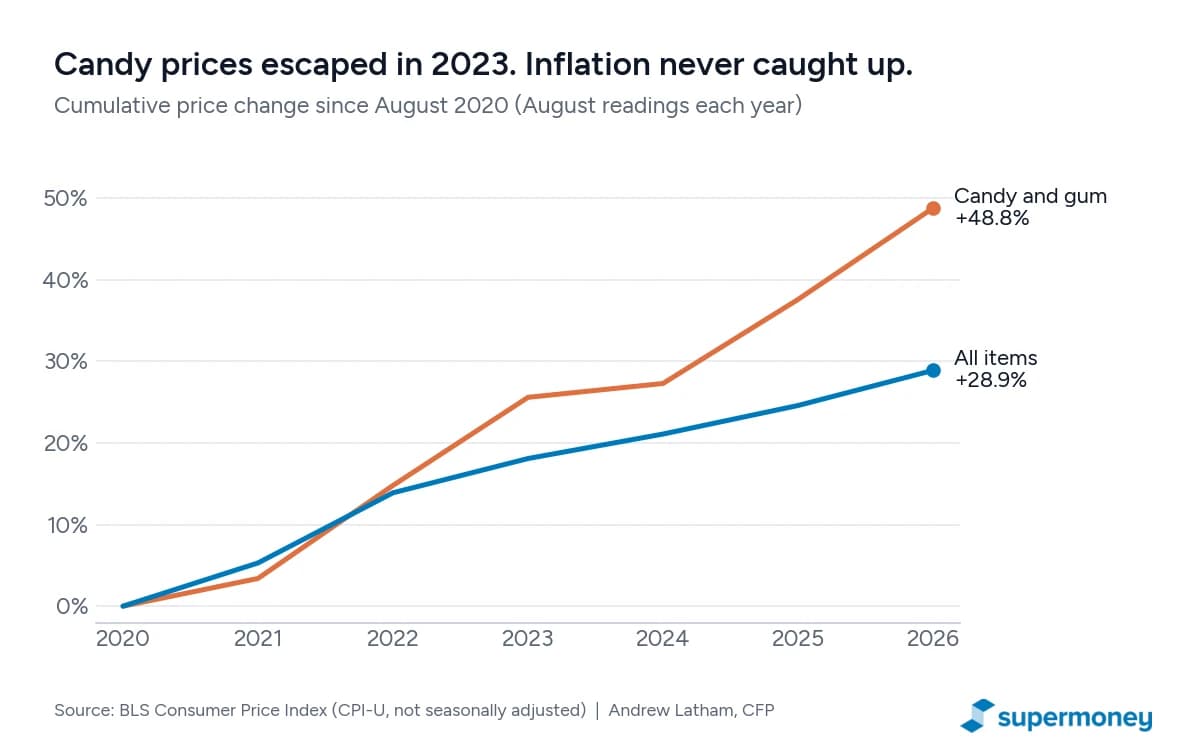
Viewer discretion advised: the next paragraph contains 2020 prices.
Here’s what that gap means in dollars. A basket of candy that cost $50 in August 2020 would cost about $74.41 today. Put another way, your $50 now buys roughly a third less candy than it did five Halloweens ago.
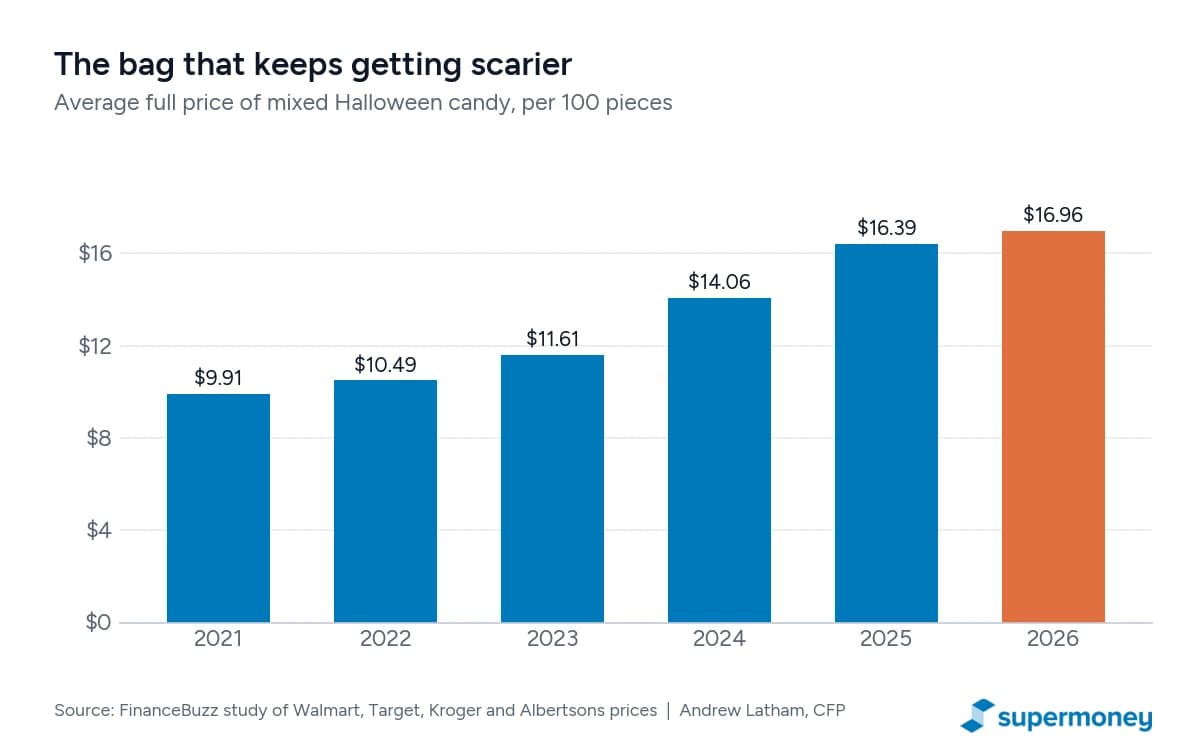
The bag-level data tells a similar story. FinanceBuzz, a personal finance site that tracks regular (non-sale) prices at Walmart, Target, Kroger and Albertsons, found the average 100-piece bag of mixed Halloween candy rose from $9.91 in 2021 to $16.96 in 2026. That’s a 71% jump. A $50 budget bought about 505 pieces in 2021 and about 295 pieces today. About 210 pieces of candy, gone. Nobody knows where they went.
Cheapest Halloween candy: the price-per-piece survival guide
The fastest way to save is to stop comparing bag prices and start comparing price per piece. A $7.94 bag can be a better deal than a $3.96 bag, or a much worse one, depending on how many pieces are inside. Here’s what popular bags cost per piece. Walmart.com prices checked Oct. 13, 2026; your store’s prices may differ.
| Candy | Pieces | Price | Per piece |
|---|---|---|---|
| Tootsie Roll Midgees | 155 | $3.96 | 2.6 cents |
| Charms Mini Pops | 450 | $14.86 | 3.3 cents |
| Frankford Mega Mix XL | 500+ | $19.87 | 4 cents or less |
| Hershey bulk assortment | 275 | $29.97 | 10.9 cents |
| Snickers, Skittles and more variety pack | 205 | $24.87 | 12.1 cents |
| Hershey assortment | 55 | $7.94 | 14.4 cents |
| M&M’s, Snickers and Twix variety pack | 65 | $9.94 | 15.3 cents |
| Hershey assortment | 70 | $11.94 | 17.1 cents |
| Reese’s snack-size cups | 90 | $23.87 | 26.5 cents |
| Reese’s snack-size cups | 40 | $11.94 | 29.9 cents |
| Kit Kat snack size | 60 | $17.86 | 29.8 cents |
| Full-size Snickers, Twix, Milky Way, 3 Musketeers | 18 | $21.97 | $1.22 |
Meet the final girl of this story: the Tootsie Roll. Cocoa spikes, inflation, shrinking budgets, it survives them all at 2.6 cents a piece. Nobody’s favorite. Still standing when the credits roll.
A few other patterns jump out. Non-chocolate and bulk mixed candy is the cheap Halloween candy champion, at 2 to 4 cents a piece. Mixed chocolate assortments land in the 11 to 17 cent range. Single-brand chocolate favorites cost about twice that. And bigger isn’t automatically cheaper: the 55-piece Hershey bag beats the 70-piece bag on price per piece. Read the label. Trust no one.
If you want chocolate without paying chocolate prices across the board, a mix works well. Pair a bag of Tootsie Rolls or lollipops with one chocolate assortment and let kids pick. Most of them will grab the chocolate, but your average cost per piece drops a lot.
The Reese’s Index: a horror story told in 26.5-cent installments
Let’s make this concrete. Say 50 kids ring your doorbell and each gets two pieces. That’s 100 pieces. Here’s what the night costs depending on what’s in your bowl.
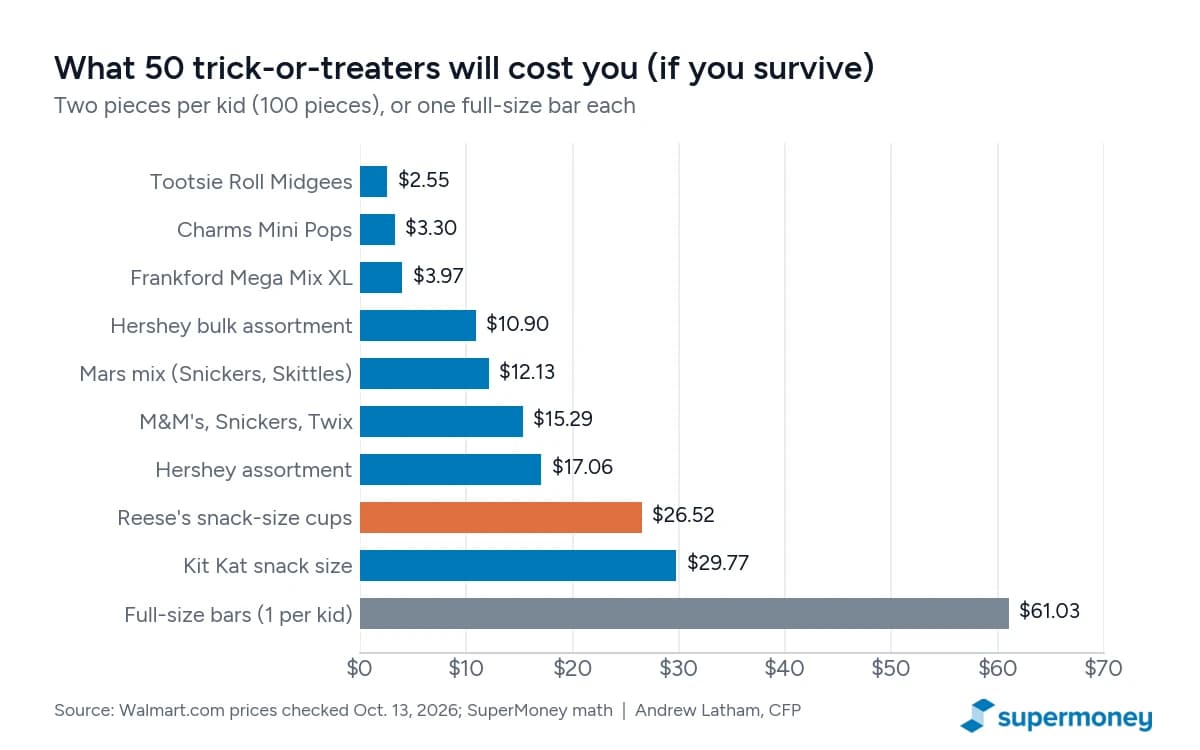
I call it the Reese’s Index, because America’s favorite peanut butter cup makes a handy yardstick. At 26.5 cents each in the 90-piece bag, one snack-size Reese’s costs about the same as 10 Tootsie Rolls. Each doorbell costs you about 53 cents with Reese’s, 34 cents with an average mixed bag, and 5 cents with Tootsie Rolls. Every ring of the bell is a tiny invoice.
None of these numbers will break the bank on their own. But they add up when 100 or 200 kids show up, and the candy aisle is one of the easiest places to save without anyone noticing. No kid has ever checked your per-piece cost. (We hope.)
How much Halloween candy should I buy? (Before they come back for more)
Start with how many trick-or-treaters you got last year. There’s no reliable national average for kids per house, because it swings wildly by neighborhood. A 2025 survey of Canadian households by research firm Field Agent found averages of 42 to 56 trick-or-treaters per household by region, and plenty of quiet streets see far fewer. If you’re new to the neighborhood, ask a neighbor. Ideally one who has survived a few Halloweens there.
Then plan on two pieces per kid, plus a small buffer. Here’s what that costs at current prices.
| Trick-or-treaters | Pieces needed | Tootsie Rolls | Average mixed bag | Reese’s cups | Full-size bars |
|---|---|---|---|---|---|
| 25 | 50 | $1.28 | $8.48 | $13.26 | $30.51 |
| 50 | 100 | $2.55 | $16.96 | $26.52 | $61.03 |
| 100 | 200 | $5.11 | $33.92 | $53.04 | $122.06 |
| 200 | 400 | $10.22 | $67.84 | $106.09 | $244.11 |
JUMP SCARE: 200 kids x full-size bars = $244.11.
Costs assume per-piece prices from the table above (average mixed bag from FinanceBuzz) and one full-size bar per child. You’ll buy whole bags, so round up. And beware the real villain of this section: the “just in case” second bag. It hides in the back of the pantry, perfectly innocent, until it turns a $17 night into a $35 night. Leftovers aren’t a total loss, but they’re not free either.
The full-size candy bar house: a cautionary tale
Every neighborhood has one. Kids talk about it in whispers. At $1.22 per bar, 100 trick-or-treaters cost $122.06. Giving those same kids two pieces from an average mixed bag costs $33.92. The difference, $88.14, is about three-quarters of what the average American spends on all of Halloween.
And here’s the curse. Word spreads. They will come back next year. They will bring cousins.
If you love it and it fits your budget, go for it. That’s what spending on things you value looks like. If you want the legend without the bill, try the bait and switch: one box of full-size bars for the first few dozen kids, then a mixed bag once the bars run out. The approach fits nicely into a conscious spending plan, where you spend freely on what you love and cut back on what you don’t.
How to save on Halloween candy (and survive the rest of Halloween)
- Compare price per piece, not per bag. Check the piece count on the front of the bag and divide. The math is less scary than the receipt.
- Mix cheap and chocolate. One bag of non-chocolate candy can cut your average cost per piece in half.
- Set a candy number before you shop. Two pieces times your expected crowd, rounded up to the nearest bag.
- Skip the second “safety” bag. When the bowl is empty, turn off the light. It’s not rude. It’s tradition.
- Reuse decorations and costumes. NRF found 34% of shoppers plan to reuse or repurpose items if prices run high. The skeleton in your garage works for free.
Don’t put Halloween on a card you can’t pay off
Okay, jokes aside for a minute, because this is the part that can actually haunt you. Halloween spending is small next to the holidays, but it lands right before them. If $115 of costumes, candy and decorations goes on a credit card and stays there, it gets more expensive. The average interest rate on credit card accounts that paid interest was 22.36% in August 2026, according to the Federal Reserve. Carry $115.14 for a year at that rate and you’d pay about $28 in interest, so your candy and costumes end up costing about 25% more than the price tag.
If you already have a balance, paying only the minimum credit card payment keeps that interest running for years. A simple debt repayment plan is a better use of November than a fresh round of holiday charges. The same goes for splitting purchases into installments; read up on how buy now, pay later can affect your credit score before you lean on it this season.
It also helps to see where the money actually goes. The SuperMoney app links your accounts and tracks spending against your budget, so a $40 candy run shows up next to everything else instead of lurking on a statement.
Frequently asked questions
Why is Halloween candy so expensive this year?
Mostly chocolate. Cocoa hit record prices in late 2024, and candy makers raised prices to cover it. Cocoa has fallen since, but companies buy months or years ahead, so lower costs haven’t reached shelves yet. Candy and gum prices were up 8.1% year over year in August 2026, per BLS.
How much do Americans spend on Halloween?
The NRF projects $13.5 billion in total Halloween spending for 2026, or $115.14 per person. That includes $4.4 billion on costumes, $4.3 billion on decorations and $4.1 billion on candy.
How much Halloween candy should I buy?
Plan on two pieces per trick-or-treater, based on how many kids came last year. For 50 kids, that’s 100 pieces, which costs about $17 at the average mixed-bag price or about $27 for Reese’s cups.
What is the cheapest Halloween candy?
Non-chocolate candy. At Walmart on Oct. 13, 2026, Tootsie Roll Midgees cost about 2.6 cents a piece and Charms Mini Pops about 3.3 cents. Chocolate assortments ran about 11 to 17 cents a piece.
Will I get egged for handing out Tootsie Rolls?
Probably not, but we can’t promise. The safer move is a mixed bowl: a cheap non-chocolate bag plus one chocolate assortment. Kids still find something they like, and your average cost per piece stays far below an all-chocolate bowl.
Can I eat the leftovers and call it a budget win?
You can eat them. You just can’t call it a win. Leftover candy was still paid for, so every extra bag is money spent, not saved. Buy for the crowd you expect and let the empty bowl decide when the night ends.
Will Halloween candy go on sale?
Seasonal candy is often discounted after Oct. 31, but that doesn’t help much if you need it for trick-or-treaters. Before Halloween, your best tools are comparing price per piece and choosing mixed or non-chocolate bags.
Survival guide
- Halloween candy prices are up 8.1% in a year and 48.8% since August 2020. Everything else is up 28.9%. Candy escaped.
- A 100-piece mixed bag averages $16.96 in 2026, up from $9.91 in 2021.
- The Tootsie Roll survives at about 2.6 cents a piece. Mixed chocolate runs 11 to 17 cents, and Reese’s cups 26.5 to 29.9 cents.
- Two pieces each for 50 trick-or-treaters costs $2.55 to $29.77, or $61.03 if you’re the full-size bar house.
- Americans plan to spend $13.5 billion on Halloween, or $115.14 per person. Pay it off before credit card interest comes back from the grave.
Share this post:
Add as a preferred source on Google
Table of Contents