
Where You Grow Up Influences Your Credit, but Your Parents Money Habits Matter More (Regardless of Income)

Last updated 07/18/2025 by
Andrew Latham
Summary:
Children raised in the same income bracket can still end up with wildly different credit outcomes, often depending on where they grew up and, more importantly, on whether their parents modeled on‑time bill payments. A new study shows that parental repayment behavior strongly predicts a child’s credit performance, even more so than economic connectedness or upward mobility. This highlights the critical role of early financial education by example.
Credit scores don’t just depend on your income or access to credit. They also reflect the financial lessons you absorbed growing up. Among low‑income families, kids from areas with stronger repayment cultures tend to do better with credit as adults.
Get Competing Personal Loan Offers In Minutes
Compare rates from multiple vetted lenders. Discover your lowest eligible rate.
It's quick, free and won’t hurt your credit score
Parental repayment: the strongest signal
Children imitate the ideas and habits of their family and community, and this includes financial habits. That is the conclusion of a new study that was released this week by researchers at Opportunity Insights, a Harvard-based institute that studies upward mobility.
The most powerful takeaway I took from the Opportunity Insights study is this: A parent’s repayment behavior is one of the best predictors of a child’s future credit success. Children from families that consistently pay bills on time are far less likely to fall behind on debt, even when they grow up in similar financial circumstances.
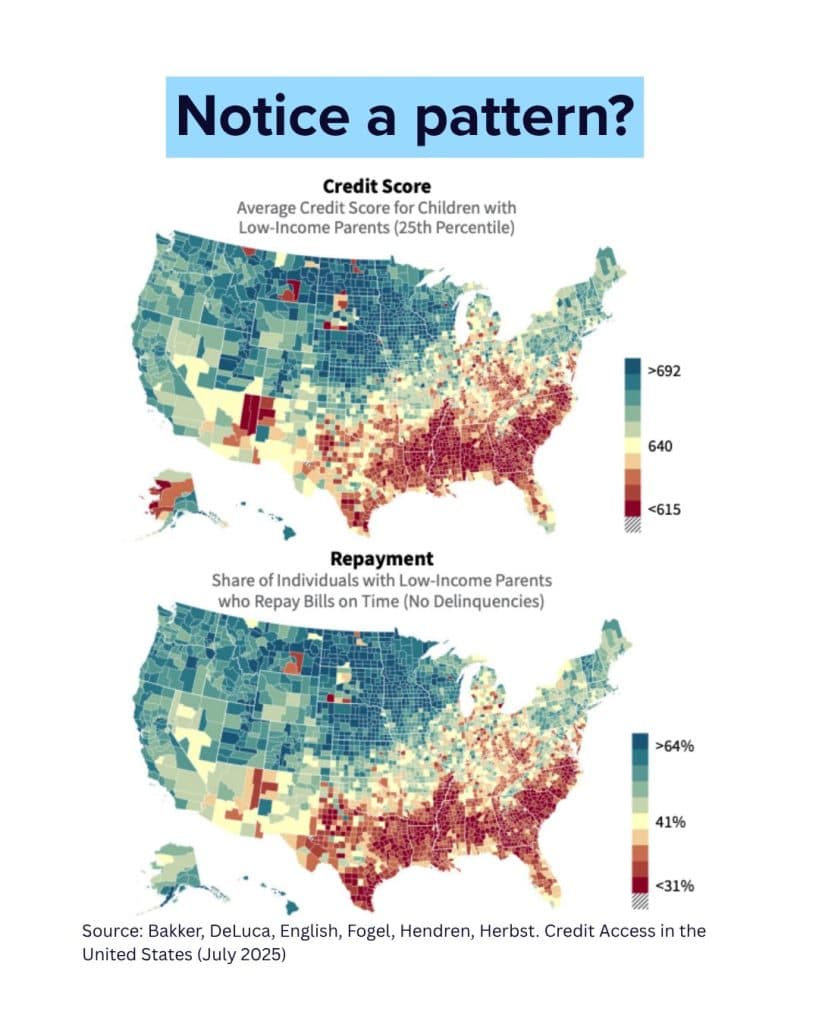
Why does this matter? Because paying bills on time reflects more than punctuality. It’s a signal that parents are living within their means and teaching their kids to do the same. These kids are more likely to borrow carefully, manage their spending, and understand how debt works. They learn through example how to navigate financial risk with responsibility.
Why parents are such powerful role models
Kids don’t just listen to what parents say. They watch what parents do. A parent who regularly pays bills on time is demonstrating financial self-control, discipline, and foresight. These lessons stick, especially when reinforced by a home environment where budgeting, saving, and prioritizing payments are the norm.
Unfortunately, in communities with limited access to fair credit or banking services, these behaviors can be harder to model. In those cases, families may rely on payday lenders or high-interest alternatives, passing along habits that can be harder to unlearn later. But when strong examples are present, regardless of income, those lessons can carry forward for a lifetime.
If you weren’t raised in a household or community where on-time bill payment was the norm, your financial story isn’t set in stone. The habits you build today can become the foundation your children learn from tomorrow. By modeling simple, consistent practices like budgeting, tracking expenses, and paying bills on time, you can change the cycle. Tools like SuperMoney’s budgeting app can help you take that first step and make financial confidence part of your family’s legacy.
Key Takeaways
- Where you grow up influences your credit, but parental financial behavior matters even more.
- Kids raised by parents who pay bills on time tend to have higher credit scores as adults.
- This effect is stronger than economic connectedness or upward mobility.
- Financial discipline, like living within your means, is often passed down by example.
- Helping parents build healthy credit habits can benefit generations to come.
Andrew is the Content Director for SuperMoney, a Certified Financial Planner®, and a Certified Personal Finance Counselor. He loves to geek out on financial data and translate it into actionable insights everyone can understand. His work is often cited by major publications and institutions, such as Forbes, U.S. News, Fox Business, SFGate, Realtor, Deloitte, and Business Insider.
Share this post:
Add as a preferred source on Google
Table of Contents