
Stocks vs. Gold: The 25-Year Chart Wall Street Investors Would Prefer You Didn’t See

Last updated 10/16/2025 by
Andrew Latham
Summary:
When you price U.S. stocks in gold instead of dollars, the market’s glittering performance over the past 25 years dims. Gold has quietly outshined equities during one of the most turbulent stretches in modern investing. But zoom out, and the power of compounding, dividends, and long-term productivity puts stocks back on top.
If you really want to humble Wall Street, grab a gold doubloon.
In dollar terms, U.S. stocks look spectacular. The S&P 500 has climbed more than six-fold since the dot-com bust. But if you measure the market like a pirate — in ounces of gold — that swagger fades fast. A Bloomberg chart that recently made the rounds shows that when equities are denominated in gold, they’ve been sliding for 25 years.
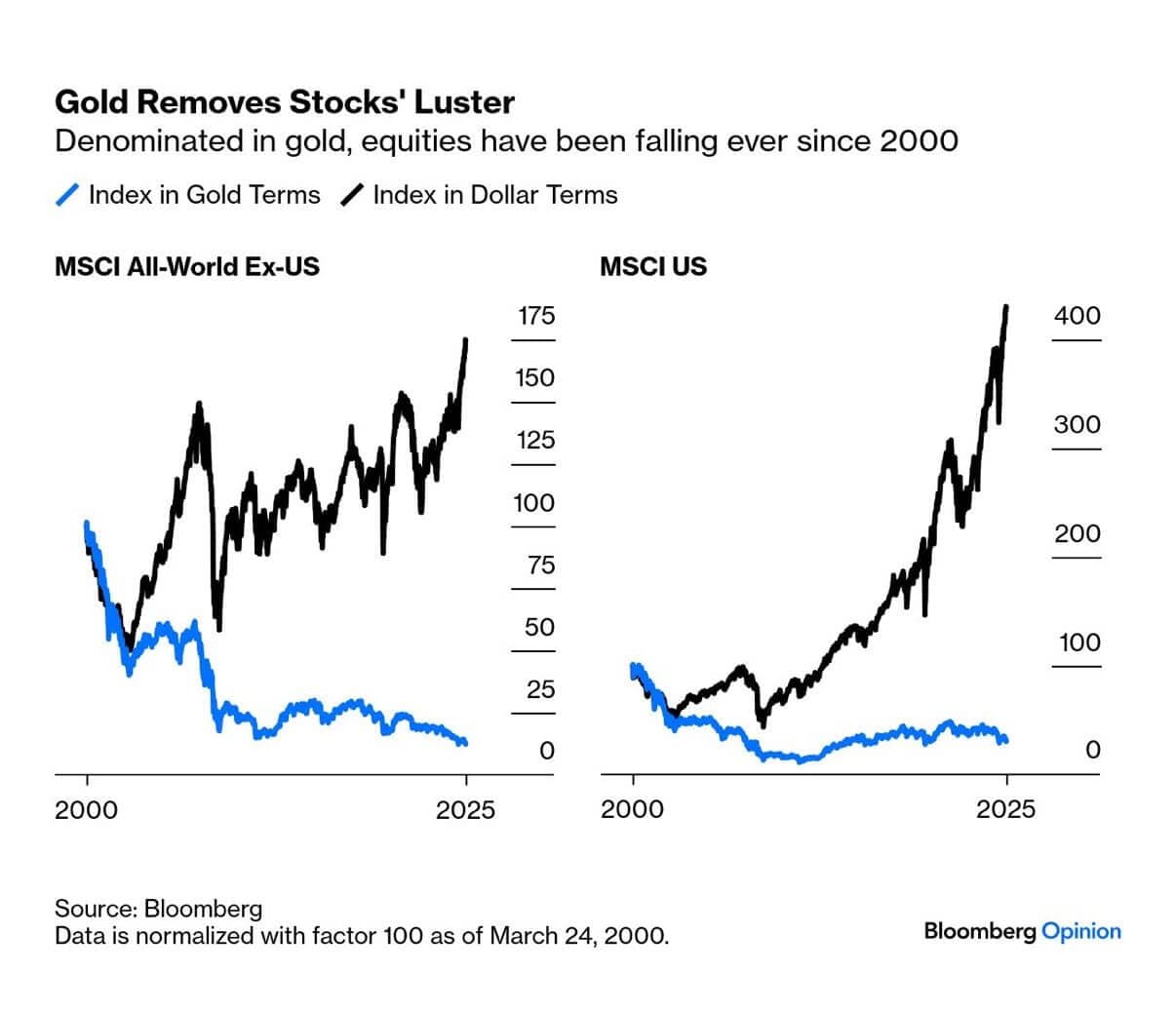
The same companies, the same profits — just a different yardstick — and suddenly the world’s most admired market looks like it’s treading water.
Get Competing Personal Loan Offers In Minutes
Compare rates from multiple vetted lenders. Discover your lowest eligible rate.
It's quick, free and won’t hurt your credit score
Gold’s sneaky 25-year comeback
The “stocks in gold terms” story starts at a perfect inflection point: the year 2000. Back then, gold was unloved and cheap at around $280 an ounce. The Nasdaq, meanwhile, was partying on borrowed excitement.
Then the hangovers came — dot-com, 2008, and a pandemic crash — while gold quietly multiplied eightfold. If you compare those two lines from 2000 to 2025, gold looks like the rock star and stocks like the backup singer. It’s one of the few 25-year stretches in modern history when the metal has kept pace with—or even outperformed—equities.
That’s why the Bloomberg chart feels so surprising: it captures gold’s best quarter-century and stocks’ most volatile one.
The bigger picture: what 30 and 100 years show
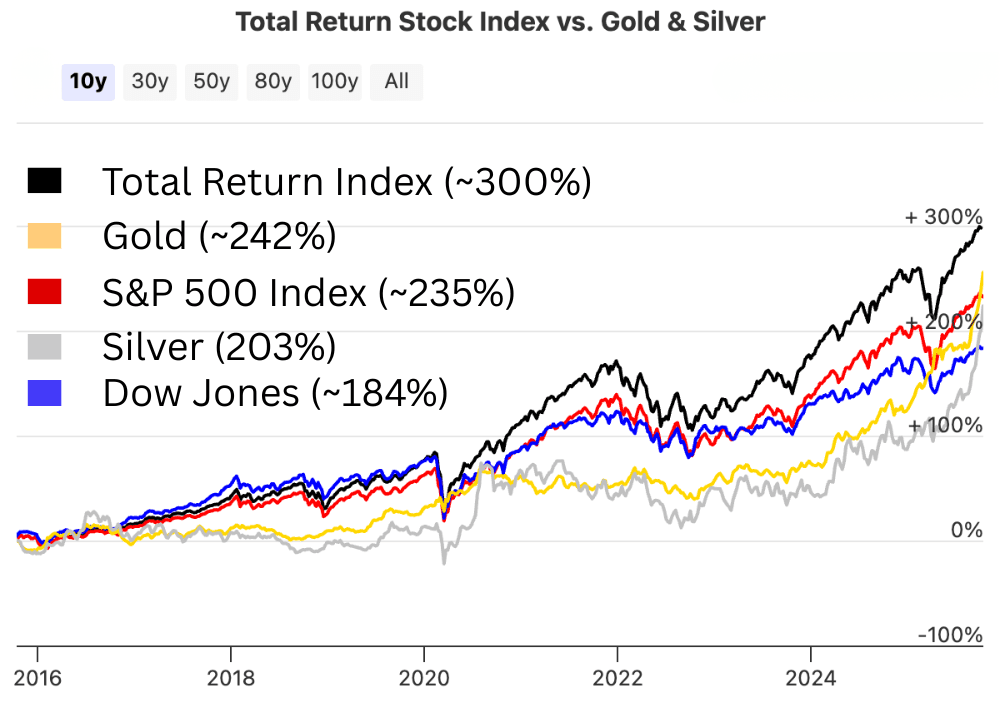
Choose a different timeframe and things change fast. This chart shows the last 10 years.
What’s the “Total Return Stock Index”?
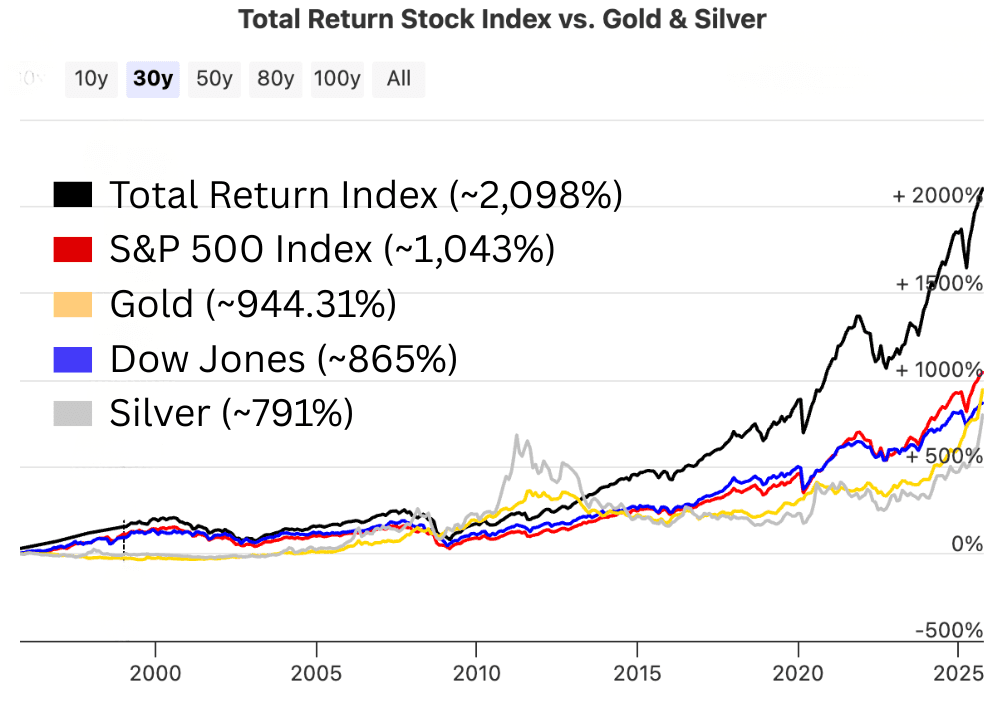
The Total Return Stock Index, similar in concept to the MSCI US Index, goes a step beyond the S&P 500 or Dow Jones by including dividends that are reinvested over time. That’s a crucial distinction — while the S&P 500 and Dow Jones measure only price gains, total return indexes capture the full reward of owning stocks, including the steady boost from reinvested dividends. Over long periods, that difference compounds dramatically, which is why the black line in the chart rises faster than the price-only benchmarks.
Zoom out, and the glitter fades. Over the past 30 years, with dividends included, U.S. equities have returned about 1,000 percent versus roughly 900 percent for gold.
Over 100 years, the gap turns epic: the S&P 500’s total return exceeds 56,000 percent, while gold’s sits near 19,000 percent.
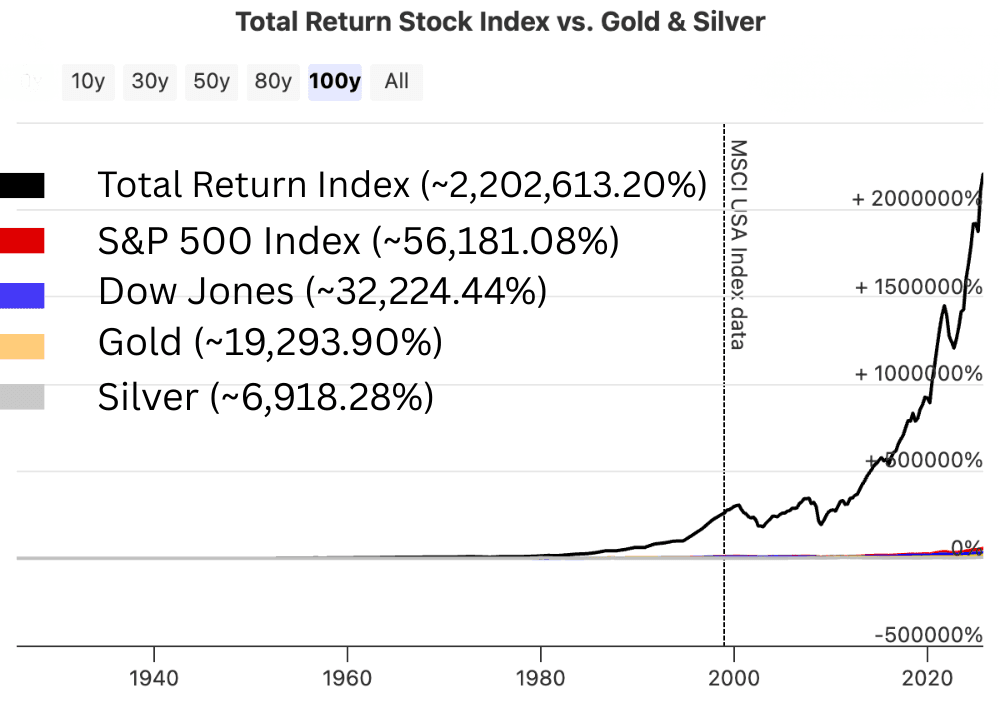
That’s the magic of compounding. Stocks are productive assets — they innovate, pay dividends, and reinvest profits. Gold is preservative — it just sits there, gleaming stoically, neither creating nor destroying value. Over generations, productivity wins.
So while gold had a heroic run from 2000 to 2025, it’s the exception, not the new rule.
Why timeframes (and dividends) change everything
The contrast between the 25-year and 100-year pictures teaches two deceptively simple lessons:
- Your start date matters. Begin at a stock-market peak and a gold trough, and the metal wins. Shift the start five years earlier, and stocks pull ahead.
- Dividends are the quiet powerhouse. Price charts ignore them; wealth does not. Reinvested dividends are the reason long-term equity investors end up miles ahead of those who simply hold metal.
Even the 25-year “gold victory” narrows dramatically once dividends are included. Gold’s outperformance depends on measuring price only — not total return.
Myths that underrate gold
Every time markets wobble or inflation bites, investors rediscover gold like it’s a long-lost friend. The metal tends to drift out of fashion during bull markets, only to come roaring back when faith in paper money or policymakers weakens. Yet much of gold’s appeal — and its misunderstood resilience — gets buried under a few stubborn myths.
Myth 1: Gold doesn’t earn anything, so it can’t compete
True, it pays no dividend. But during inflationary or crisis periods, the real return on cash and bonds is often negative. In those environments, earning nothing beats losing purchasing power.
Myth 2: Gold only shines in doomsday scenarios
Not quite. Gold thrives when real interest rates are low, when investors doubt policymakers’ discipline, or when diversification matters most. You don’t need chaos for gold to do well — just a little distrust in fiat money.
Myth 3: Gold is dead money long-term
Over a century, it’s not a get-rich asset, but it has preserved value remarkably well. A dollar in 1925 buys almost nothing today; an ounce of gold still buys a fine suit. That’s why gold is more monetary insurance than investment rocket fuel.
The thing to remember
Gold and stocks aren’t rivals; they’re complements.
Gold protects wealth across monetary regimes.
Stocks create wealth through growth and compounding.
The trick isn’t picking one — it’s understanding when and why each shines.
Over the short to medium term, gold can look brilliant when inflation, deficits, or fear dominate. Over the long haul, stocks harness human ingenuity — and that engine compounds far faster than any metal can appreciate.
So yes, if you measure the market like a pirate, stocks look underwhelming (especially in the last 25 yars). But if you measure like a patient investor — counting every dividend and every reinvested dollar — the treasure chest is still full of stocks, not doubloons.
Key takeaways
- Measuring stocks in gold shows their real returns have stagnated since 2000
- Gold outperformed equities from 2000 to 2025 due to market volatility and inflation
- Gold’s long-term role is monetary insurance — not wealth creation
- Over 100 years, stocks outperform gold by a wide margin, thanks to dividends and compounding
- The smart strategy isn’t choosing between gold or stocks — but using both wisely
Andrew is the Content Director for SuperMoney, a Certified Financial Planner®, and a Certified Personal Finance Counselor. He loves to geek out on financial data and translate it into actionable insights everyone can understand. His work is often cited by major publications and institutions, such as Forbes, U.S. News, Fox Business, SFGate, Realtor, Deloitte, and Business Insider.
Share this post:
Add as a preferred source on Google
Table of Contents