
The Rich Live Up to 15 Years Longer — Here’s How You Can Close The Gap

Last updated 01/19/2025 by
Andrew Latham
Summary:
Summary:
It’s no secret that money can open doors to a better quality of life. But can it also buy more years? Yes—wealth and income are closely linked to life expectancy. Wealthy Americans live significantly longer than those with fewer financial resources, with gaps as wide as 15 years between the richest and poorest, according to two major studies.
But here’s the silver lining: while money helps, the research also shows that the biggest factors behind a longer life—like healthy habits and access to resources—aren’t exclusive to the rich. In fact, many of the changes that add years to your life don’t require a fortune.
Let’s break down the key takeaways from these studies and explore what they reveal about how money, health, and location shape longevity.
Compare Savings Accounts
Compare savings accounts. Discover your best option.
The link between financial resources and lifespan
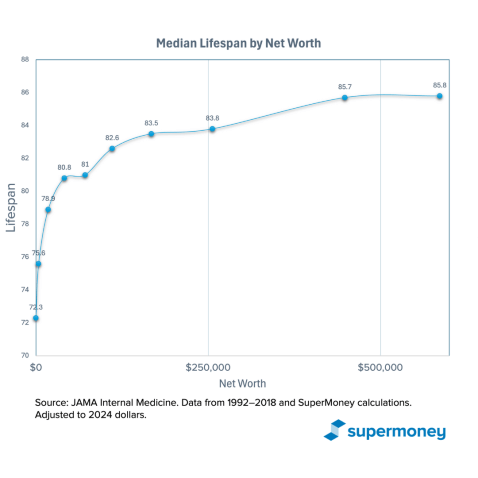
The more money you have, the longer you’re likely to live. A 2016 study (The Association Between Income and Life Expectancy in the United States, 2001-2014 by Chetty et al.), found that at age 40, men in the top 1% of income lived 15 years longer than men in the bottom 1%. Women in the top 1% lived 10 years longer than women in the bottom 1%.
The graphs above provide averages to simplify things, but if you want some more detail, here is the table used for the 2024 study that matches net worth brackets (ranging from the bottom 10% to the top 10%) and life expectancy.
| Wealth Brackets | Median Longevity |
|---|---|
| <$1 | 72.3 (69.3–75.5) |
| $1–$7,697 | 75.6 (74.2–77.1) |
| $7,698–$27,938 | 78.9 (78.0–79.9) |
| $27,940–$54,783 | 80.8 (80.3–81.5) |
| $54,784–$88,301 | 81.0 (80.1–81.7) |
| $88,303–$133,258 | 82.6 (81.5–83.3) |
| $133,259–$201,950 | 83.5 (82.9–84.2) |
| $201,952–$310,853 | 83.8 (83.0–84.6) |
| $310,854–$586,355 | 85.7 (85.1–86.4) |
| ≥$586,356 | 85.8 (85.2–86.3) |
This gap isn’t just about dollars and cents—it’s about what money allows you to access. Wealthier people tend to have:
- Better healthcare: They can afford regular checkups, specialists, and cutting-edge treatments.
- Healthier food: Fresh, nutritious meals are often more expensive than processed or fast food.
- Safer environments: They live in neighborhoods with less pollution, less crime, and more green spaces.
Money also reduces financial stress, which is linked to better mental and physical health. Simply put, having financial security gives you the freedom to prioritize your health.
Healthy lifestyle changes: The equalizer for longevity
While having more money can lead to a longer life, the good news is that the health habits driving this advantage are within reach for most people. Studies consistently show that staying active, eating well, and avoiding harmful habits like smoking can have a profound impact on how long—and how well—you live. What’s truly fascinating is that the benefits of healthy lifestyle changes closely mirror the life expectancy gap between the richest and poorest Americans.
For example, research by Chetty et al. found that health behaviors explained much of the variation in life expectancy across income groups and geographic areas. Low-income individuals living in areas with healthier habits—like California or Vermont—tended to live significantly longer than those in regions with higher rates of smoking and obesity, such as Indiana or Nevada. These findings suggest that adopting better health habits can partially bridge the longevity gap, regardless of income.
How much can lifestyle changes add to your life?
A 2018 study on the impact of healthy lifestyle factors on U.S. life expectancies estimates that you can increase your lifespan by up to 12 years. Here is the breakdown:
- Never smoking:+10 years of life expectancy.
Smoking is the leading cause of preventable death, contributing to lung cancer, heart disease, and other chronic illnesses. Avoiding tobacco entirely—or quitting—offers the most significant boost to lifespan. - Maintaining a healthy weight:+1.4 years for women, +1.8 years for men.
Keeping a body mass index (BMI) between 18.5 and 24.9 helps reduce the risk of obesity-related diseases such as diabetes, cardiovascular disease, and certain cancers. - Engaging in regular physical activity:+3.4 years for men, +3.8 years for women.
Regular exercise, such as 30 minutes of moderate to vigorous activity daily (e.g., brisk walking or cycling), improves cardiovascular health, lowers inflammation, and reduces early death risk. - Eating a healthy diet:+2.3 years for men, +2.9 years for women.
A diet rich in vegetables, fruits, whole grains, nuts, and unsaturated fats—and low in processed meats and sugary drinks—reduces the risk of chronic illnesses like heart disease. - Consuming alcohol in moderation:+1.4 years for women, +1.6 years for men.
Moderate drinking, defined as up to one drink per day for women and two drinks per day for men, helps avoid risks associated with excessive alcohol consumption, such as liver disease and certain cancers.
The big picture: Lifestyle vs. wealth
The study found that adhering to all five low-risk factors could increase life expectancy at age 50 by 14 years for women and 12.2 years for men, compared to individuals who don’t follow any of these habits. These numbers are strikingly similar to the life expectancy gap between the wealthiest and poorest Americans, as shown in studies by Chetty et al. and Himmelstein et al. This suggests that healthy lifestyle changes can act as an equalizer for longevity, offering nearly the same benefits as being in a higher income bracket.
Why this matters
Each of these habits targets major causes of premature death—like smoking-related illnesses, obesity, and inactivity-driven diseases. While wealth offers advantages like better healthcare and access to healthier food, these lifestyle habits demonstrate that living longer doesn’t require significant financial resources. The power to add years to your life lies in consistent, healthy choices, showing that a longer, healthier life is achievable for most people—regardless of income level.
Baby bonds and longevity
Baby bonds could increase lifespan: A proposed program would give newborns a $1,000 deposit and annual contributions of up to $2,000 based on family income. Researchers simulated the program using the American Opportunity Accounts Act as a framework. They added the estimated value of baby bonds at maturity—ranging from $2,067 to $56,820 (2024 dollars)—to participants’ observed per-capita wealth, based on household income-to-poverty ratios.
- Big impact for low-income groups: Life expectancy could increase by 6.4 years for the lowest-income individuals and 4.1 years for the second-lowest group.
- Populationwide gains: On average, longevity across the U.S. could increase by 1 year.
- Early investments matter: Baby bonds show how small investments early in life can lead to healthier, longer lives for future generations.
Your zip code could influence your lifespan
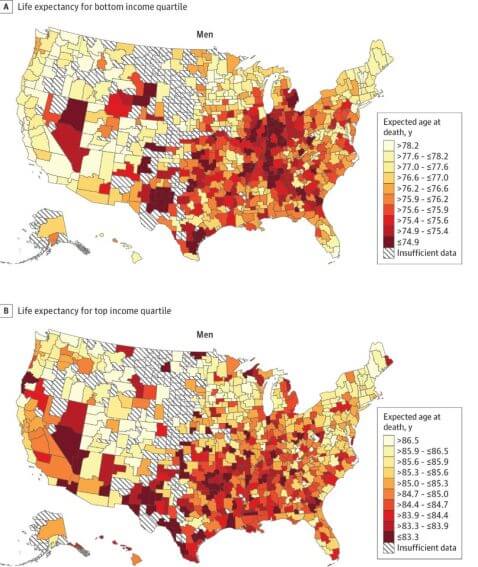
Where you live can have a major impact on how long you live, especially if you’re in a lower income bracket. Chetty et al. found that life expectancy at age 40 for low-income Americans varied by up to 4.5 years depending on where they lived.
For example:
- States with longer life expectancies: California, Vermont, and New York topped the list, thanks to healthier lifestyles and access to resources.
- States with shorter life expectancies: Nevada, Indiana, and Oklahoma ranked lower, with higher rates of smoking, obesity, and limited access to healthcare.
The Himmelstein study also found that areas with more immigrants, higher home prices, and more college graduates tended to have healthier behaviors and longer life expectancies.
Why this matters: Even if income levels are the same, the environment you live in can either support or hinder healthy living. Access to parks, fresh food, and strong community health programs can add years to your life.
Key findings
- Wealth and income are strongly tied to life expectancy: The wealthiest Americans live up to 15 years longer than the poorest.
- Health behaviors drive much of the difference: Quitting smoking, staying active, and maintaining a healthy weight explain many of the gaps in lifespan.
- Where you live matters: States with healthier lifestyles, like California and Vermont, have longer life expectancies for low-income residents.
- Redistribution could improve health outcomes: Policies like baby bonds or minimum inheritances could add 1-2 years to median life expectancy in the U.S.
- You don’t need to be rich to benefit: Lifestyle changes are accessible to most people and can have a significant impact on longevity.
Andrew is the Content Director for SuperMoney, a Certified Financial Planner®, and a Certified Personal Finance Counselor. He loves to geek out on financial data and translate it into actionable insights everyone can understand. His work is often cited by major publications and institutions, such as Forbes, U.S. News, Fox Business, SFGate, Realtor, Deloitte, and Business Insider.
Share this post:
Add as a preferred source on Google
Table of Contents