Annuity Formula: How to Calculate Your Future Payments

Last updated 10/14/2024 by
Benjamin Locke
Edited by
Andrew Latham
Summary:
Annuities are financial products that allow individuals to receive regular payments over time, either for a fixed period or for life. Understanding the annuity formula is essential for calculating your future payments, whether you’re looking at immediate or deferred annuities. This article provides an in-depth guide on how annuity formulas work, helping you plan your personal finances and budget effectively.
An annuity is like a long-term financial agreement where you invest money with a company, usually an insurance provider, and in return, you receive steady payments over time. It’s almost like giving a company a big chunk of your savings, and they promise to give it back to you bit by bit—either for a certain number of years or for the rest of your life. It’s often used as a way to create a predictable income stream for retirement, helping you ensure you don’t run out of money as you age.
Get Competing Personal Loan Offers In Minutes
Compare rates from multiple vetted lenders. Discover your lowest eligible rate.
It's quick, free and won’t hurt your credit score
What is an annuity?
An annuity is a financial contract often used for retirement planning, where you invest a lump sum or make regular contributions to receive payments over a set period. These payments can either be made for a specified number of years or continue for the remainder of your life, depending on the annuity type.
Types of annuities and their impact on future payments
When considering an annuity, it’s important to understand the different types available and how they impact your future payments. Each type of annuity is structured differently, influencing the timing and amount of the payments you receive. The right choice depends on your financial goals, risk tolerance, and whether you prefer fixed, variable, or flexible payments.
The major types of annuities are explained below, with details on how they can affect your long-term financial planning:
| Type of Annuity | Description |
|---|---|
| Immediate annuities | You make a lump sum payment and begin receiving payments almost immediately. These are commonly used by retirees who want to convert their savings into steady income. |
| Deferred annuities | Payments start at a future date, allowing your investment to grow during the accumulation phase. This option is suitable for those who want to build their investment before retirement. |
| Fixed annuities | Provide regular payments of a fixed amount over time, offering stability and predictability in income. Ideal for those who want consistent payments. |
| Variable annuities | Payments fluctuate based on the performance of investments in a portfolio. This option offers the potential for higher returns but also involves more risk. |
| Indexed annuities | Linked to a stock market index, such as the S&P 500. Payments can increase based on market performance but usually come with a guaranteed minimum payment to protect against market downturns. |
Basic annuity formula: How to calculate payments
The annuity formula helps you figure out how much you’ll receive in regular payments from your investment. Here’s an easy-to-understand version for a fixed annuity:
Annuity Payment Formula:
 Where:
- P = Payment amount you’ll receive per period (monthly, yearly, etc.)
- PV = The lump sum or initial investment amount
- r = Interest rate for each period (e.g., monthly or yearly interest rate)
- n = The total number of payments you will receive
This formula allows you to determine how much your regular payments will be based on the size of your investment and the interest rate. For example, if you invest $100,000 in an annuity with a 5% interest rate over 20 years, you can calculate the payment amount per period.
Present value and future value of an annuity
To understand annuity calculations, it’s crucial to differentiate between the present value (PV) and future value (FV) of an annuity.
Present Value of Annuity:
The Present Value (PV) of an Annuity represents the current worth of a stream of future payments that you will receive over a certain period. Since money has time value (meaning a dollar today is worth more than a dollar tomorrow due to the potential for earning interest), the future payments are discounted to reflect their value in today’s terms. This is essential because it allows you to understand how much those future payments are worth in today’s dollars, considering the interest rate and payment timeline.
Pro Tip
For example, if you are to receive $1,000 annually for 10 years, those future payments are less valuable in today’s terms because you could invest money now and earn interest on it. The present value calculation takes into account the interest rate (or discount rate) and adjusts the future cash flows accordingly, giving you a clearer picture of the real value of those future payments at this moment in time.
The Present Value (PV) of an Annuity formula is:

Where:
- PV = Present value, or the value of future payments in today’s dollars
- P = Payment amount per period (e.g., monthly or yearly)
- r = Interest rate or discount rate per period
- n = Total number of periods or payments
This formula is crucial for evaluating the true value of an annuity or any series of future payments, allowing investors to make better financial decisions.
Future Value of Annuity:
The Future Value (FV) of an Annuity represents how much your annuity will be worth at a specific point in the future, after all payments have been made. This value is calculated by compounding the periodic payments at a given interest rate. Understanding the future value is essential for long-term financial planning because it helps you estimate how much your investment will grow over time.
Pro Tip
The future value is particularly important when planning for goals such as retirement, as it shows the total amount of money you will have accumulated by the end of the annuity period. Essentially, it answers the question: “How much will my annuity be worth when all payments have been made, considering the interest earned over time?”
The Future Value (FV) of an Annuity formula is:
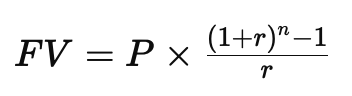
Where:
- FV = Future value, or the total value of the annuity at the end of the period
- P = Payment amount per period (e.g., monthly or yearly)
- r = Interest rate per period
- n = Total number of periods or payments
This formula allows you to calculate how your regular contributions will grow over time, considering the interest they earn. It’s useful for understanding the potential future financial outcome of your annuity and helps in making informed decisions about long-term investments.
Present value and future value comparison
Understanding both the present value and future value of an annuity is essential for evaluating its worth at different points in time. The present value shows what future payments are worth in today’s dollars, while the future value represents how much the annuity will grow by the end of the payment period. The chart below compares these two key metrics, helping you see the difference between the current value of future payments and the total amount you’ll accumulate over time.
Factors that affect annuity payments
Several factors influence the amount of your annuity payments:
- Interest rate: The higher the interest rate, the larger your payments will be.
- Length of payout period: Longer payout periods reduce the payment size per period, as the total amount is spread over more payments.
- Investment size: A larger initial investment will result in larger future payments.
- Annuity type: Fixed annuities provide predictable payments, while variable and indexed annuities fluctuate based on market performance.
Annuity growth comparison
This chart illustrates how annuities grow over time based on different interest rates. By comparing the projected growth at 3%, 5%, and 7%, you can see how higher interest rates significantly increase the future value of an annuity. This comparison helps investors better understand the long-term impact of interest rates on their annuity payments and overall investment strategy.
How to calculate annuity payments manually
While most people rely on online calculators for convenience, understanding how to calculate annuity payments manually can give you deeper insight into the process.
How to calculate annuity payments
Calculating annuity payments is an important step in understanding your future income. Follow these steps to estimate your annuity payments.
- Determine the present value (PV) of your annuity.
- Use the annuity formula to calculate the regular payment amount.
- Factor in the interest rate and total number of payments.
- Adjust for any changes in payment structure, such as increasing or decreasing annuities.
FAQ
How are annuities taxed?
Annuities are typically tax-deferred, meaning you don’t pay taxes on earnings until you withdraw funds. However, when you start receiving payments, they are generally taxed as ordinary income. The portion that comes from your original investment may be tax-free if funded with post-tax dollars.
What fees are associated with annuities?
Annuities often come with several fees, including administrative fees, surrender charges, and investment management fees (for variable annuities). It’s important to review these costs, as they can reduce the overall returns on your investment. Be aware of these fees before purchasing to avoid unexpected costs.
What are the risks involved with annuities?
Fixed annuities offer stable payments, but variable and indexed annuities carry risks related to market performance. Poor market conditions can lead to reduced payments or losses in value. Understanding the risk level of your specific annuity type is key to ensuring it aligns with your financial goals.
How do annuities compare with other retirement options?
Annuities offer guaranteed income, unlike 401(k)s or IRAs, which are subject to market fluctuations. However, they tend to have higher fees and less flexibility compared to other retirement accounts. The best choice depends on your financial goals, risk tolerance, and desire for guaranteed income.
When is the best time to buy an annuity?
The best time to buy an annuity is typically closer to retirement, as it provides a reliable income stream in later years. Timing can also depend on interest rates—higher interest rates mean larger payments, so it’s ideal to purchase when rates are favorable.
Key takeaways
- Annuities are used for retirement planning and can provide fixed or variable payments over a set period or lifetime.
- The present value formula helps you calculate the worth of future annuity payments in today’s dollars, considering interest rates.
- The future value of an annuity is the total accumulated amount after all payments, including the effects of compounding interest.
- Understanding annuity taxation and fees is essential for managing retirement income efficiently.
Share this post:
Add as a preferred source on Google
Table of Contents