
Assessing the History and Impacts of U.S. Tariffs

Last updated 02/10/2025 by
Miron Lulic
Edited by
Andrew Latham
The February 1st 2025 announcement by President Donald Trump of new tariffs on Canada, Mexico, and China, marked a significant shift in U.S. trade policy and the fulfillment of a key campaign promise. The move is reigniting a long-standing debate on tariffs’ economic impact, with proponents arguing tariffs will bolster domestic manufacturing and create jobs, while critics warn of potential cost increases and trade disruptions.
However, contrary to common narratives, economists are not unanimous in their positions for or against tariffs. Even John Maynard Keynes, one of the most influential economists of the 20th century, flip-flopped on his ideas.
Keynes initially championed free trade but, by the 1930s, had adopted a more pragmatic stance. Amid persistently high unemployment in Britain during the 1920s, Keynes argued that import tariffs could boost aggregate output and employment, particularly in industries struggling against foreign competition. His evolving perspective highlights the complexity of trade policy and the potential benefits of protectionist measures under certain conditions.
Get Competing Personal Loan Offers In Minutes
Compare rates from multiple vetted lenders. Discover your lowest eligible rate.
It's quick, free and won’t hurt your credit score
The Role of Tariffs in U.S. Economic History
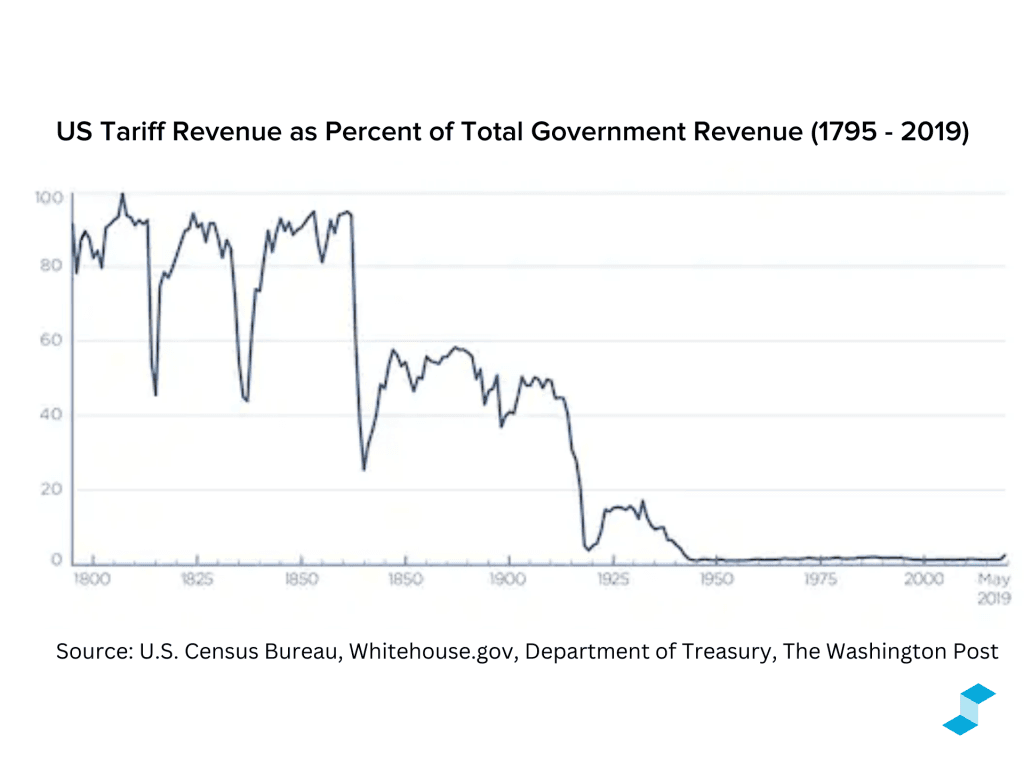
Tariffs have historically played a central role in American economic policy, shaping industrial growth and government revenue. Protectionist policies were widely endorsed by early American leaders, including George Washington, Thomas Jefferson, Andrew Jackson, and Abraham Lincoln.
Teddy Roosevelt, in his 1902 State of the Union address, declared:
Our past experience shows that great prosperity in this country has always come under a protective tariff.”
– Teddy Roosevelt
Similarly, Abraham Lincoln once stated:
Give us a protective tariff and we will have the greatest nation on earth.”
– Abraham Lincoln
For much of U.S. history, tariffs were the government’s primary revenue source, protecting domestic industries and reducing reliance on foreign goods (source).
The Shift Towards Free Trade
However, following World War II, the General Agreement on Tariffs and Trade (GATT), the precursor to the World Trade Organization (WTO), ushered in a new era of reduced trade barriers. At the time, this shift made strategic sense—the U.S. stood to benefit immensely from rebuilding war-torn economies and leveraging its unmatched manufacturing capacity – and it did, for a time.
Decades later, advocates of global trade liberalization promoted an optimistic vision: prosperity would be driven by intellectual skills and managerial know-how, rather than routine labor. Free trade, they argued, would lower consumer prices and boost economic efficiency. However, opposition to this model came primarily from labor unions, who warned that opening markets would lead to lower wages and job losses as American workers struggled to compete with foreign labor earning a fraction of U.S. wages.
Over the past 70 years, this vision has largely materialized—but with mixed results. While the global economy has shifted toward a knowledge-based model, manufacturing jobs have disappeared from the U.S. in favor of lower-cost labor markets. Instead of shifting into higher-value sectors, many displaced workers have found themselves in retail and service jobs, leading to stagnating wages for much of the working class.
Trump has argued that free trade has become a zero-sum game where countries like China have won, and the American worker has lost. Others argue that trade liberalization has been a net positive, improving global prosperity and benefitting U.S. consumers.
However, the question remains: Would the net benefit for Americans have been greater if protectionist policies had remained in place, keeping a larger share of wealth creation within U.S. borders rather than fueling economic growth abroad?
The Persistent U.S. Trade Deficit
For the past five decades, the U.S. has run persistent and worsening trade deficits, importing more than it exports. While conventional economic models suggest that trade imbalances are natural and self-correcting, critics argue that mercantilist policies from countries like China and Japan have distorted global trade. These nations have engaged in aggressive currency manipulation and state-backed industrial subsidies, giving their industries a competitive edge while the U.S. has remained committed to free-market principles.
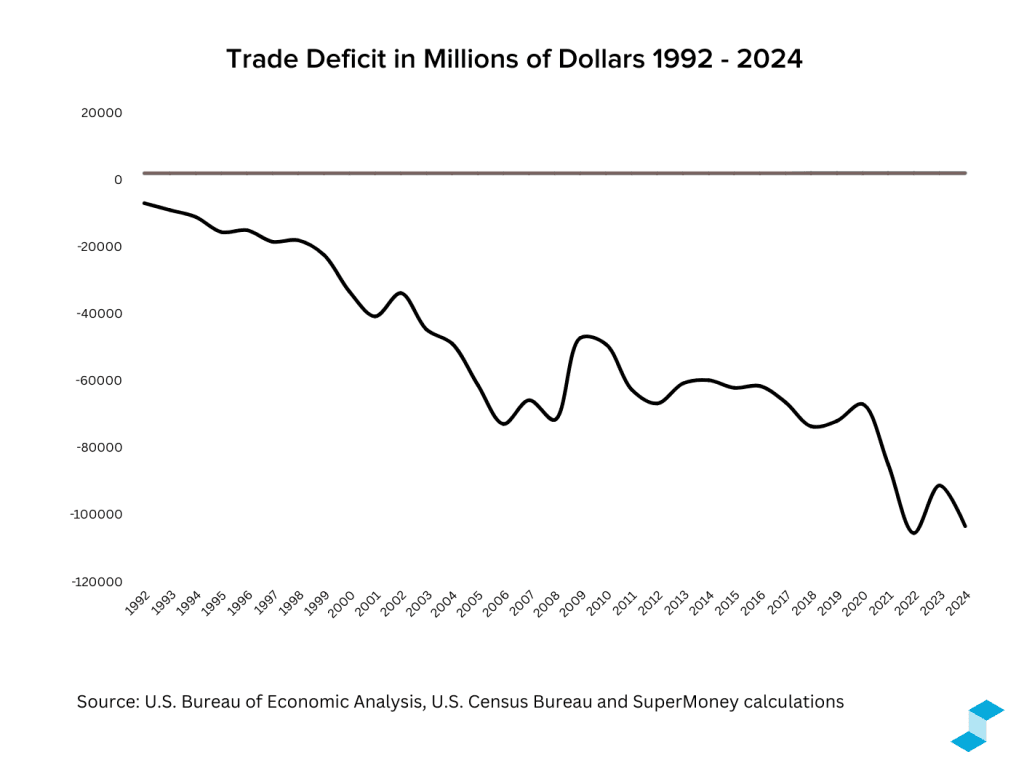
The consequences of this imbalance are becoming increasingly evident. Since 2008, the U.S. has relied heavily on borrowing from abroad, contributing to rising national debt and financial instability. Keynes himself predicted these outcomes over 60 years ago, warning that sustained trade deficits would lead to economic crises. His proposed solution? Balanced trade policies that ensure imports and exports remain in equilibrium, preventing excessive dependence on foreign capital.
The Actual Outcomes of Trump’s “Tariff Experiment” (2017-2020)
The new tariffs are a continuation of Trump’s earlier efforts to reshape trade policy. During his first term, tariffs were imposed on:
- Solar panels and washing machines (January 2018)
- Steel and aluminum (March 2018)
- Chinese goods (March–September 2018, across four rounds of tariffs)
At the same time, the administration lowered the federal income tax rate from 39.6% to 37%, aiming to counterbalance potential price increases. Critics argued that tariffs would raise consumer costs and stoke inflation, but key case studies tell a more nuanced story:
- Solar Panels (2018 Tariff: 30%)
- Despite tariffs, domestic solar panel prices continued to decline.
- U.S. production increased, suggesting that tariffs successfully stimulated domestic manufacturing.
- The Biden administration later doubled solar tariffs to 50% in 2024, signaling bipartisan support.
- Washing Machines (2018 Tariff: 20-50%)
- Prices initially rose but fell below pre-tariff levels by 2020.
- Two Korean manufacturers opened U.S. factories, creating over 2,000 jobs.
- The industry’s response supports the argument that tariffs can incentivize foreign companies to invest in American manufacturing.
- Steel (2018 Tariff: 25%)
- U.S. steel production increased nearly 10% after the tariffs were implemented.
- After an initial price spike, steel prices fell below pre-tariff levels.
- Inflation decreased from 2.1% (January 2018) to 1.6% (January 2019), challenging claims that tariffs necessarily drive inflation.
These examples suggest that tariffs can support domestic industry without necessarily increasing long-term costs.
Challenges and Risks
Despite the potential benefits, tariffs come with risks:
- Short-term price spikes (3-6 months) as supply chains adjust.
- Increased costs for industries lacking domestic production capacity.
- Retaliatory tariffs from trading partners, which could impact exports.
Canada and Mexico were quick to respond with counter-tarriffs, raising concerns about trade disruptions. However, the U.S. economy is significantly less dependent on Canadian and Mexican markets than those countries are on U.S. consumers, giving the U.S. negotiating leverage.
Conclusion
The reintroduction of tariffs marks a significant turning point in U.S. economic policy. While critics warn of cost increases and trade disputes, proponents argue that tariffs can strengthen domestic industry, increase government revenue, and provide leverage in global trade negotiations.
Whether Trump’s “Tariff Era” proves successful will depend on how industries respond, how international partners react, and whether domestic production can scale quickly enough to offset potential price increases. The long-term effects of this strategy—on wages, economic growth, and America’s global economic position—will be closely watched in the months and years ahead.
Miron Lulic is founder and CEO at SuperMoney, a service that helps millions of people transparently compare financial services such as loans, investments, and more.
Share this post:
Add as a preferred source on Google
Table of Contents