
Auto Loan Delinquencies Just Hit a Record. Here’s How to Make Sure You’re Not Next

Last updated 09/04/2026 by
SuperMoney Team
Edited by
Andrew Latham
Summary:
Auto loan serious delinquency hit 5.5% of outstanding balances in the second quarter of 2026, a series record that tops the Great Recession peak of 5.3%. Average new car payments are $770 a month and nearly 30% of trade-ins are underwater by an average of $6,884. Here’s the good news: most of that stress is concentrated among borrowers who financed at high rates and never revisited the loan, and that’s fixable. If your credit score has climbed since you signed, refinancing a $30,000 balance from subprime to prime pricing cuts about $103 off your payment and saves close to $4,900 over four years. That is the single highest-value hour you can spend on your car this month.
The Federal Reserve Bank of New York’s latest household debt report has a number in it worth paying attention to. In the second quarter of 2026, 5.5% of outstanding auto loan balances were seriously delinquent, meaning 90 or more days past due. That is higher than the worst point of the Great Recession, when the figure topped out at 5.3% in late 2010.
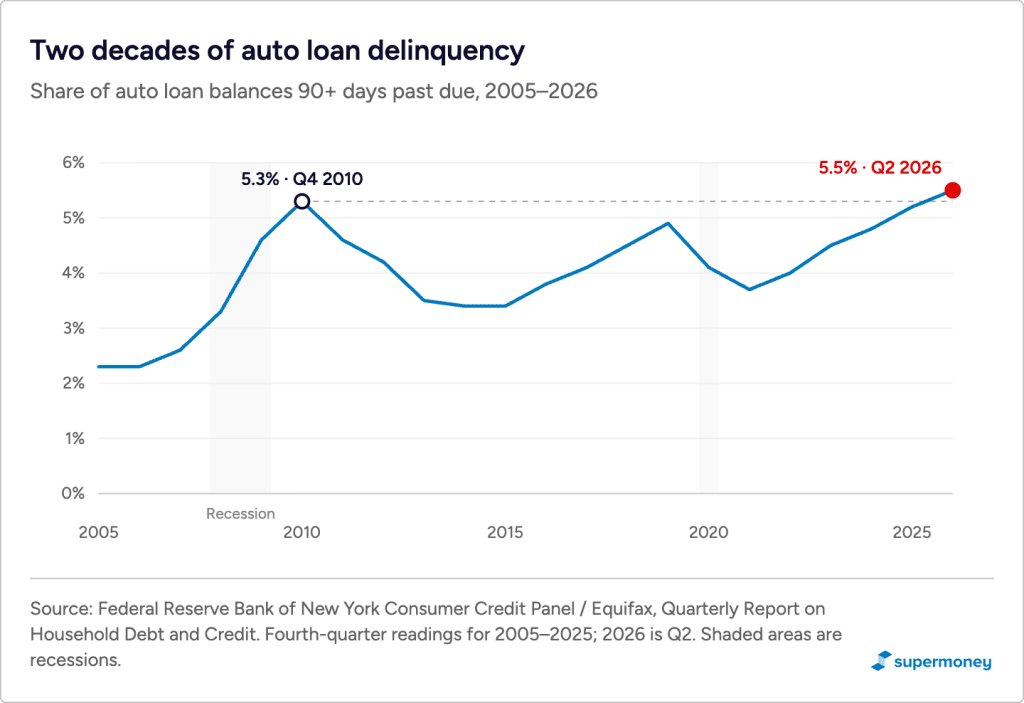
Car loans are performing worse right now than they did when unemployment was near 10%. But unemployment isn’t near 10% today, and household debt actually ticked down slightly to $18.8 trillion. So this isn’t an economy problem. It’s a loan-structure problem, and loan-structure problems have solutions. Let’s walk through what’s going on and, more importantly, what you can do about it.
Get Competing Auto Loan Refinance Offers In Minutes
Compare rates from multiple vetted lenders. Discover your lowest eligible rate.
It's quick, free and won’t hurt your credit score
The problem isn’t the economy. It’s the size of the payment.
Cars got expensive and loans got long. Experian’s data puts the average new vehicle loan at $43,925 with an average payment of $770 a month. Used vehicles average $531 a month. Nearly a third of auto loans now stretch past six years, which is how a $770 payment gets manufactured in the first place.
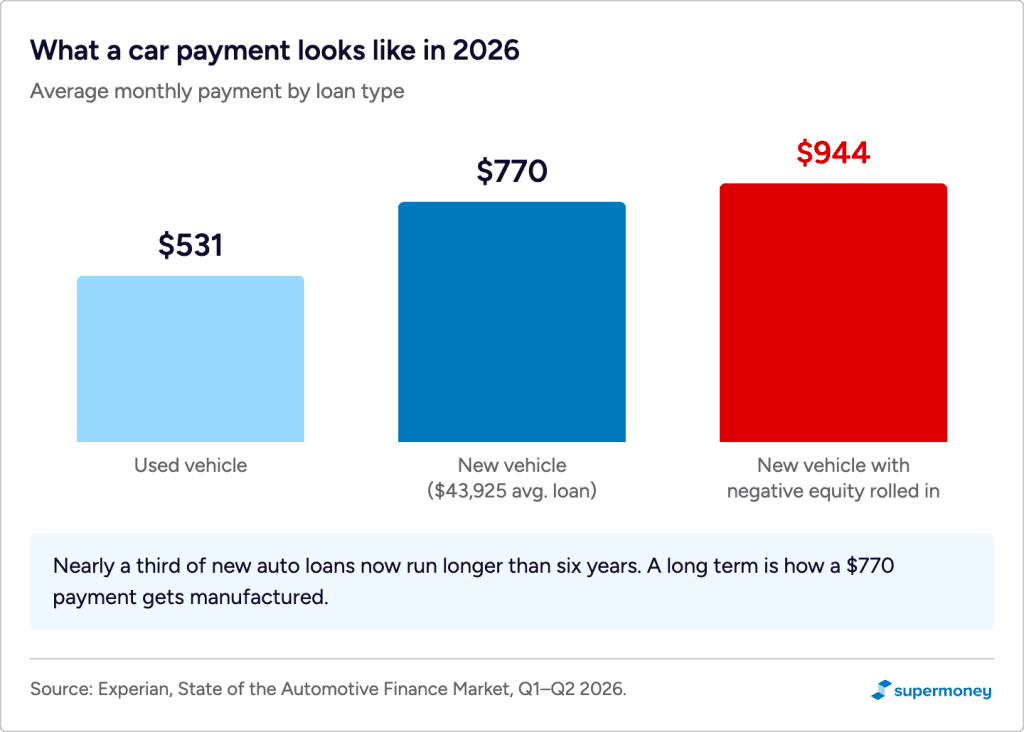
A 72-month or 84-month loan doesn’t make a car cheaper. It just moves the pain around. You pay less each month, more in total interest, and you spend years owing more than the car is worth. If you want a sanity check on what a payment should look like relative to your income, the 20/4/10 rule is a good place to start: 20% down, a term no longer than four years, and total car costs under 10% of gross income.
Almost nobody hits all three. That’s fine. The point is knowing which direction you’re off, because that tells you which fix to reach for.
Nearly 30% of trade-ins are underwater
In the second quarter of 2026, 29.6% of trade-ins toward a new vehicle carried negative equity, the highest second-quarter reading since 2020. The average shortfall was $6,884, a record for a second quarter. More than a quarter of those underwater trade-ins were short by $10,000 or more.
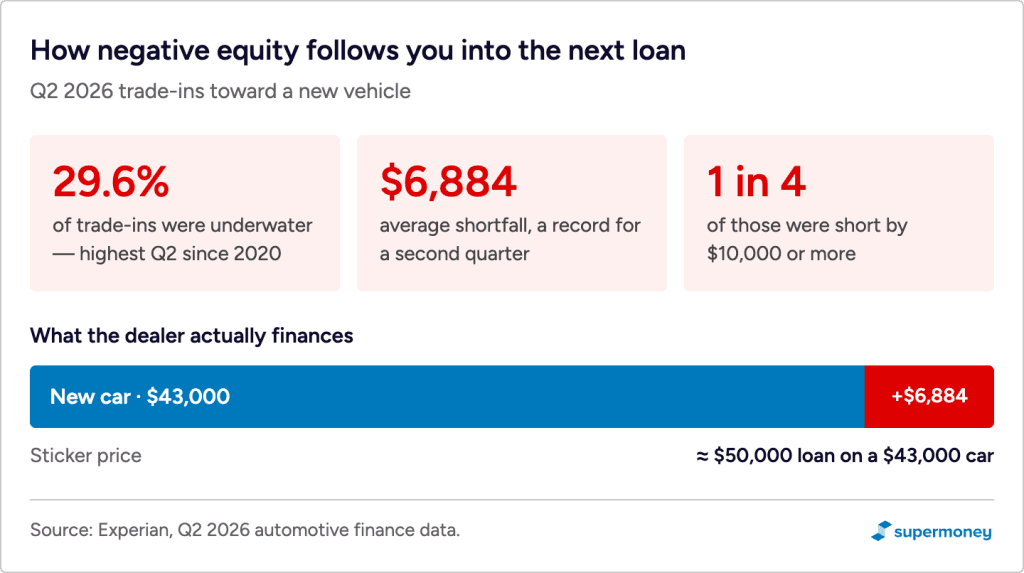
Here’s what happens next. The dealer rolls that $6,884 into the new loan. Now you’re financing $50,000 on a $43,000 car. Borrowers who roll negative equity forward are averaging a record $944 a month.
Do that twice and you have a payment that’s very hard to escape, attached to an asset that loses value every year. This is the mechanism behind the delinquency numbers. Not a recession. A slow-motion math problem. The encouraging part is that math problems respond to math, and the first move is simple: don’t trade in a car you’re upside down on unless you’ve priced out every alternative first. Keeping the car and paying it down is usually the cheaper path, even when it doesn’t feel like it.
The split nobody talks about
Averages hide the real story. Prime and super-prime borrowers are mostly fine. Their delinquency rates are stable and their payments are manageable. Almost all of the trouble sits with borrowers who financed at subprime and near-prime credit scores, where 60-plus-day delinquencies are at their worst level in more than three decades.
Look at what a credit score buys you on a new car loan, based on Experian’s first-quarter 2026 averages:
- Super-prime (781 to 850): 4.55%
- Prime (661 to 780): 6.23%
- Near-prime (601 to 660): 9.67%
- Subprime (501 to 600): 13.44%
- Deep subprime (below 501): 16.01%
The spread between a 640 score and a 700 score is roughly three and a half percentage points. On a $43,925 loan over 72 months, that gap is worth more than $5,000. Same car. Same driver. Different three-digit number. You can see how this plays out across every tier in our breakdown of average auto loan rates by credit score.
Why is this good news? Because the three-digit number moves. Your rate was set on the day you signed. Your score didn’t stop there.
Do this first: check whether you can refinance
If you bought a car in 2023 or 2024 with a bruised credit file, and you’ve made two years of on-time payments since, your score has almost certainly moved. Payment history is the single biggest factor in most scoring models, and 24 months of clean history is meaningful. If you haven’t looked at your score in a while, pull it now. If it needs work, these are the steps that actually move it, and none of them cost money.
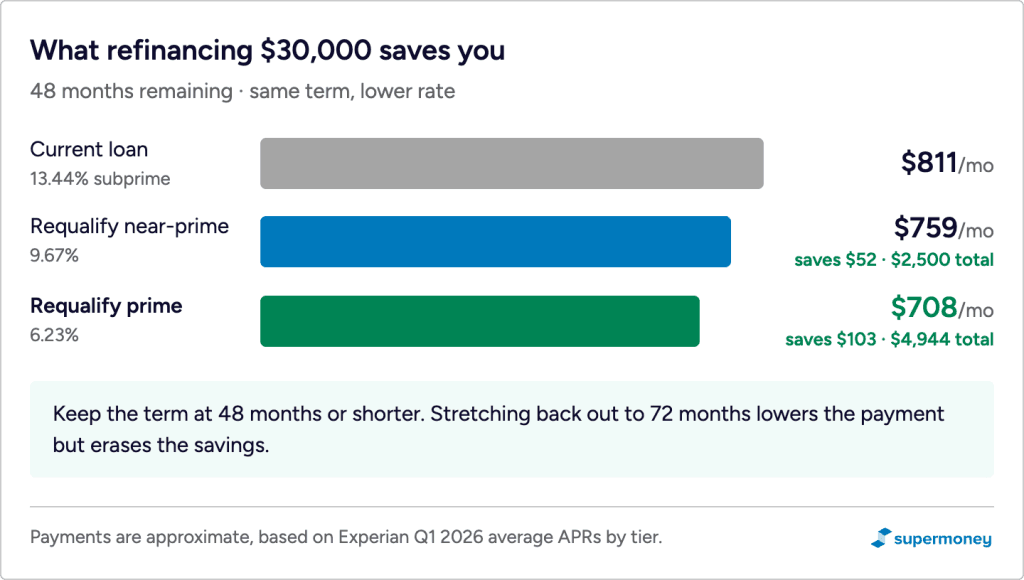
Run the math. Say you have $30,000 left on a loan at 13.44% with 48 months to go. Your payment is about $811. Requalify at 6.23% and that payment drops to roughly $708. You save $103 a month and about $4,944 over the remaining term.
Even a smaller improvement pays. Going from 13.44% to 9.67% on the same balance saves about $52 a month, or $2,500 over four years. That’s a car insurance premium, a set of tires, and a decent chunk of an emergency fund.
The process is easier than people expect. There’s no down payment, no dealer, and most lenders close in under two weeks. Our guide on when auto loan refinancing makes sense and how to do it walks through the paperwork step by step, and you can compare auto refinance lenders side by side before you apply anywhere.
Two rules when you shop:
Keep the term the same or shorter. Lenders love showing you a lower payment by stretching you back out to 72 months. That is not savings. If you have 48 months left, refinance into 48 months or fewer, and take the win as a smaller payment on the same timeline.
Do all your applications inside 14 days. Credit scoring models treat multiple auto loan inquiries in a short window as one shopping event. Spread them across two months and you take multiple hits for no reason. Here’s how long inquiries stay on your report and how the shopping window works.
If you’re underwater, you still have moves
Refinancing gets harder when you owe more than the car is worth, but it isn’t automatically off the table. Most lenders cap loan-to-value somewhere around 110% to 125%. If you owe $22,000 on a car worth $15,000, that’s 147%, and no lender is writing that today. If you owe $17,000 on the same car, you’re at 113%, and several will.
So the play is to close the gap first. A few hundred dollars in extra principal payments over a couple of months can move you from “declined” to “approved,” and every dollar of it stays in your pocket as equity. We cover the specifics in how to refinance a car that’s upside down, including which lenders are more flexible on LTV.
And if you can’t refinance yet, you can still lower your car payment without refinancing. Calling your current lender to ask about a rate reduction or a payment restructure costs nothing and works more often than you’d think, especially with two years of on-time payments behind you.
When the honest answer is that the car is too expensive
Refinancing does not fix a payment you could never afford, and it’s worth being straight with yourself about that.
If your car payment plus insurance is eating more than 20% of your take-home pay, the loan isn’t the real problem. The car is. Refinancing might buy you $100 a month of breathing room, but you’d still be one job change away from missing payments. Our car affordability guide has the full framework for figuring out where your ceiling actually sits.
If the car is too much, the goal becomes getting out of it on the best possible terms. If you have equity, selling it privately almost always nets more than a trade-in. Dealers build their margin into the trade-in number, and the difference can run into the thousands. A private sale takes more effort. It’s usually worth it.
What to do if you’re already behind
First, take a breath. Falling behind on a car payment is recoverable, and lenders deal with it every day. What matters is acting early.
Call the lender before you miss the second payment, not after. Auto lenders can repossess much faster than mortgage servicers can foreclose, and in most states they don’t need a court order. But they also lose money on repossession, so they have real incentive to work something out with you. Here’s what actually happens when you miss a car payment, and the timeline is more forgiving than most people assume, as long as you’re communicating.
Ask specifically about a payment extension or deferment, which moves one or two payments to the end of the loan. Get whatever they offer in writing before you rely on it.
One thing to avoid if you can: voluntary surrender. It feels like the responsible option, but a voluntary repossession still shows up on your credit report as a repossession, and you still owe the deficiency balance. If you’re weighing it, read what you still owe after a voluntary surrender first. Selling the car yourself, even at a small loss you cover with a personal loan, is nearly always the cleaner exit.
Where the SuperMoney app fits
Most people don’t know their current auto loan APR off the top of their head, let alone whether they’d qualify for something better.
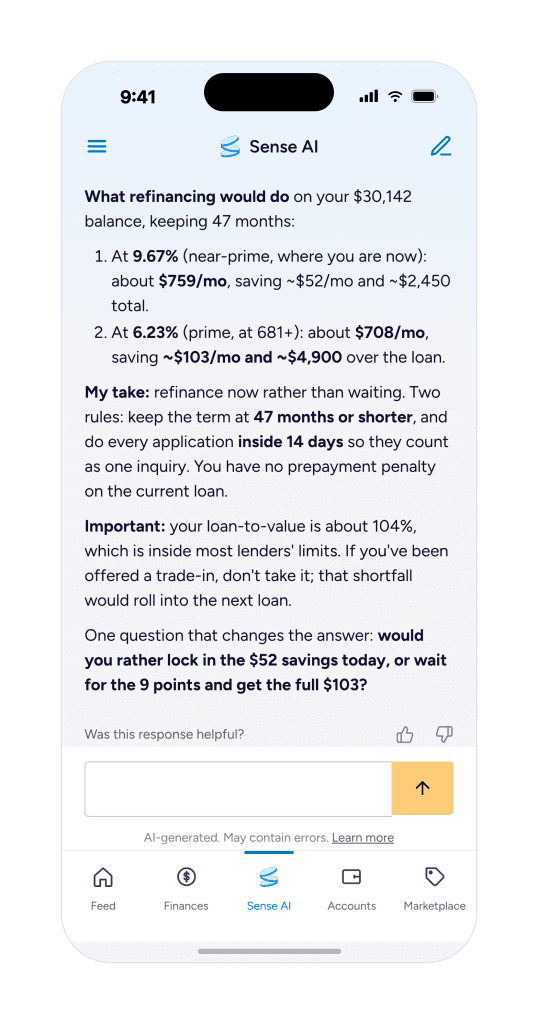
The SuperMoney app connects your accounts so you can see your actual car payment against your take-home pay, track your credit score as it moves, and compare real refinance offers side by side when your score crosses into a better tier. Set a goal for the payoff date and you’ll see whether an extra $50 a month actually gets you there. That is a lot more useful than guessing.
Key takeaways
- 5.5% of auto loan balances were seriously delinquent in Q2 2026, above the 5.3% Great Recession peak
- The average new vehicle payment is $770 a month on a $43,925 loan
- 29.6% of trade-ins carried negative equity averaging $6,884
- Borrowers rolling negative equity into a new loan average a record $944 monthly payment
- Subprime borrowers pay 13.44% on new car loans versus 6.23% for prime, a gap worth over $5,000 on a typical loan
- Refinancing $30,000 from 13.44% to 6.23% over 48 months saves about $103 a month and $4,944 total
The bottom line
Auto loan stress is at a record, but it isn’t spread evenly, and it isn’t permanent. It’s concentrated among people who financed at high rates on long terms and never revisited the loan. If your credit has improved since you signed, you are very likely sitting on a hundred dollars a month you’re handing to a lender for no reason. Pull your score, get your payoff quote, and shop three lenders this week. Worst case, you find out you already have a good rate and you stop wondering. Best case, you just gave yourself a raise.
Share this post:
Add as a preferred source on Google
Table of Contents