
Average Homeowners Insurance Cost by State (2026)

Last updated 10/30/2026 by
SuperMoney Team
Edited by
Andrew Latham
Summary:
The average homeowners insurance premium was $2,948 a year (about $246 a month) at the end of 2025, up 12% in a single year, and it’s projected to reach $3,057 by the end of 2026. Where you live matters more than anything else: Florida averages $8,292 a year, while Vermont averages $1,087. Shopping at least three insurers can save you $1,000 or more a year.
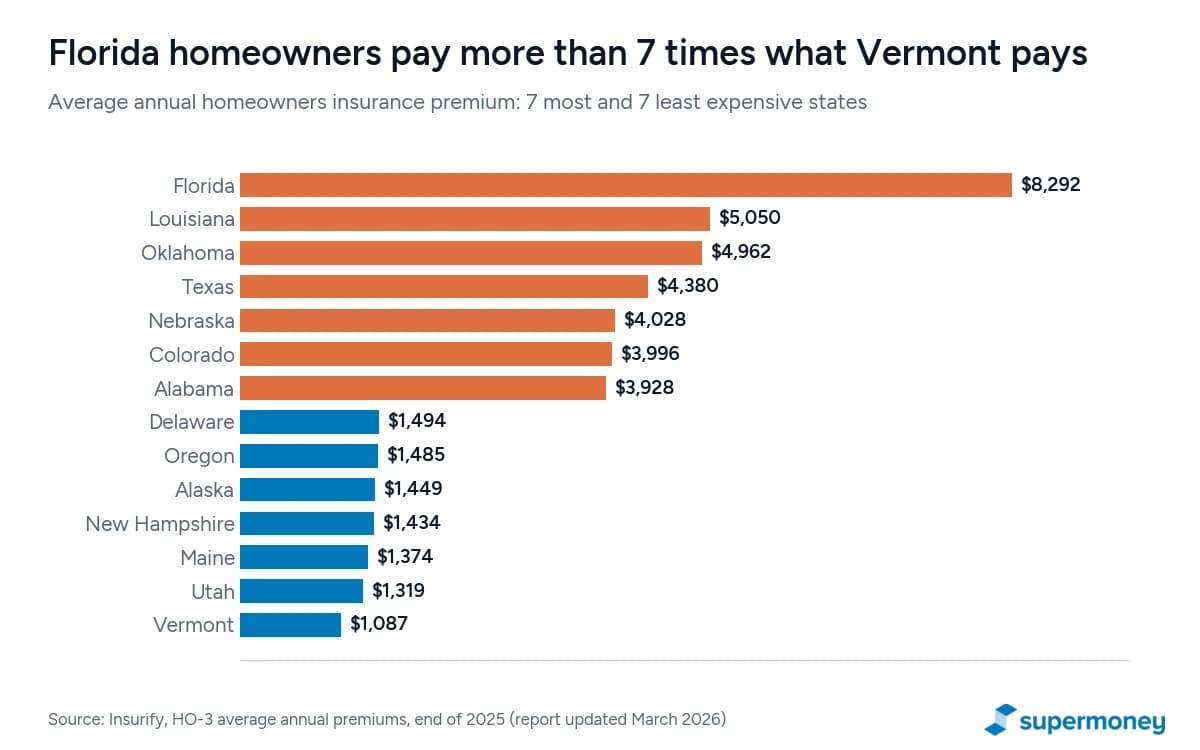
The average Florida homeowner pays $8,292 a year to insure their house. That’s $691 a month, close to a typical car payment. In Vermont, the average is $1,087 a year, or about $91 a month.
Same type of policy, more than seven times the price. Hurricanes, hail and the rising cost of rebuilding explain most of the gap, and they’re why premiums have climbed 46% since 2021, about three times the rate of inflation.1 Here’s what homeowners pay in every state, what drives your price and how to bring it down.
Data as of: State averages are Insurify’s end-of-2025 figures and end-of-2026 projections, from its report last updated March 2026.1 They price a standard HO-3 policy at each state’s typical dwelling coverage for a homeowner with good credit and no recent claims, with a $1,000 deductible (higher for wind and hail). Insurify is an insurance comparison site that analyzes quotes from more than 180 insurers.
Compare Home Insurance Providers
Compare multiple vetted providers. Discover your best option.
Average homeowners insurance cost in 2026
| Measure | Yearly | Monthly |
|---|---|---|
| National average, end of 2025 | $2,948 | $246 |
| National average, mid-2026 | $3,012 | $251 |
| Projected, end of 2026 | $3,057 | $255 |
| Median state (New Mexico) | $2,278 | $190 |
| Most expensive state (Florida) | $8,292 | $691 |
| Least expensive state (Vermont) | $1,087 | $91 |
Source: Insurify.1,2 Mid-2026 figure is Insurify’s first-half 2026 average; see where home insurance rates jumped the most by county.
The national average sits well above the typical state because a handful of big, high-risk states (Florida, Texas, Louisiana) pull it up. Half of states average $2,278 a year or less.
Average homeowners insurance by state
Find your state below. The monthly column is the yearly average divided by 12, which is roughly what you’d see added to a mortgage escrow payment.
| State | Average yearly premium (end of 2025) | Monthly | Projected yearly (end of 2026) | Projected change |
|---|---|---|---|---|
| Alabama | $3,928 | $327 | $3,979 | +1% |
| Alaska | $1,449 | $121 | $1,482 | +2% |
| Arizona | $2,104 | $175 | $2,142 | +2% |
| Arkansas | $3,129 | $261 | $3,345 | +7% |
| California | $2,455 | $205 | $2,843 | +16% |
| Colorado | $3,996 | $333 | $4,164 | +4% |
| Connecticut | $2,204 | $184 | $2,252 | +2% |
| Delaware | $1,494 | $124 | $1,519 | +2% |
| District of Columbia | $1,688 | $141 | $1,702 | +1% |
| Florida | $8,292 | $691 | $8,458 | +2% |
| Georgia | $2,879 | $240 | $3,167 | +10% |
| Hawaii | $2,566 | $214 | $2,520 | −2% |
| Idaho | $1,675 | $140 | $1,702 | +2% |
| Illinois | $3,380 | $282 | $3,559 | +5% |
| Indiana | $2,023 | $169 | $2,082 | +3% |
| Iowa | $2,802 | $234 | $2,906 | +4% |
| Kansas | $3,311 | $276 | $3,440 | +4% |
| Kentucky | $2,772 | $231 | $2,852 | +3% |
| Louisiana | $5,050 | $421 | $5,035 | 0% |
| Maine | $1,374 | $114 | $1,359 | −1% |
| Maryland | $2,186 | $182 | $2,223 | +2% |
| Massachusetts | $2,170 | $181 | $2,135 | −2% |
| Michigan | $2,214 | $184 | $2,289 | +3% |
| Minnesota | $3,530 | $294 | $3,654 | +4% |
| Mississippi | $3,743 | $312 | $3,833 | +2% |
| Missouri | $2,826 | $236 | $3,035 | +7% |
| Montana | $2,399 | $200 | $2,437 | +2% |
| Nebraska | $4,028 | $336 | $4,560 | +13% |
| Nevada | $1,672 | $139 | $1,720 | +3% |
| New Hampshire | $1,434 | $120 | $1,435 | 0% |
| New Jersey | $1,767 | $147 | $1,797 | +2% |
| New Mexico | $2,278 | $190 | $2,524 | +11% |
| New York | $2,140 | $178 | $2,149 | 0% |
| North Carolina | $2,937 | $245 | $3,075 | +5% |
| North Dakota | $2,422 | $202 | $2,456 | +1% |
| Ohio | $1,604 | $134 | $1,657 | +3% |
| Oklahoma | $4,962 | $414 | $5,205 | +5% |
| Oregon | $1,485 | $124 | $1,571 | +6% |
| Pennsylvania | $1,681 | $140 | $1,710 | +2% |
| Rhode Island | $2,981 | $248 | $2,978 | 0% |
| South Carolina | $3,092 | $258 | $3,370 | +9% |
| South Dakota | $2,761 | $230 | $2,775 | +1% |
| Tennessee | $3,019 | $252 | $3,094 | +3% |
| Texas | $4,380 | $365 | $4,529 | +3% |
| Utah | $1,319 | $110 | $1,370 | +4% |
| Vermont | $1,087 | $91 | $1,094 | +1% |
| Virginia | $1,717 | $143 | $1,736 | +1% |
| Washington | $1,533 | $128 | $1,600 | +4% |
| West Virginia | $1,588 | $132 | $1,623 | +2% |
| Wisconsin | $1,600 | $133 | $1,658 | +4% |
| Wyoming | $1,929 | $161 | $1,937 | 0% |
Source: Insurify, Home Insurance Price Projections, updated March 2026. HO-3 policy at each state’s typical dwelling coverage, which ranges from about $292,000 in Oklahoma to $500,000 in Hawaii.1
Where premiums are rising fastest in 2026
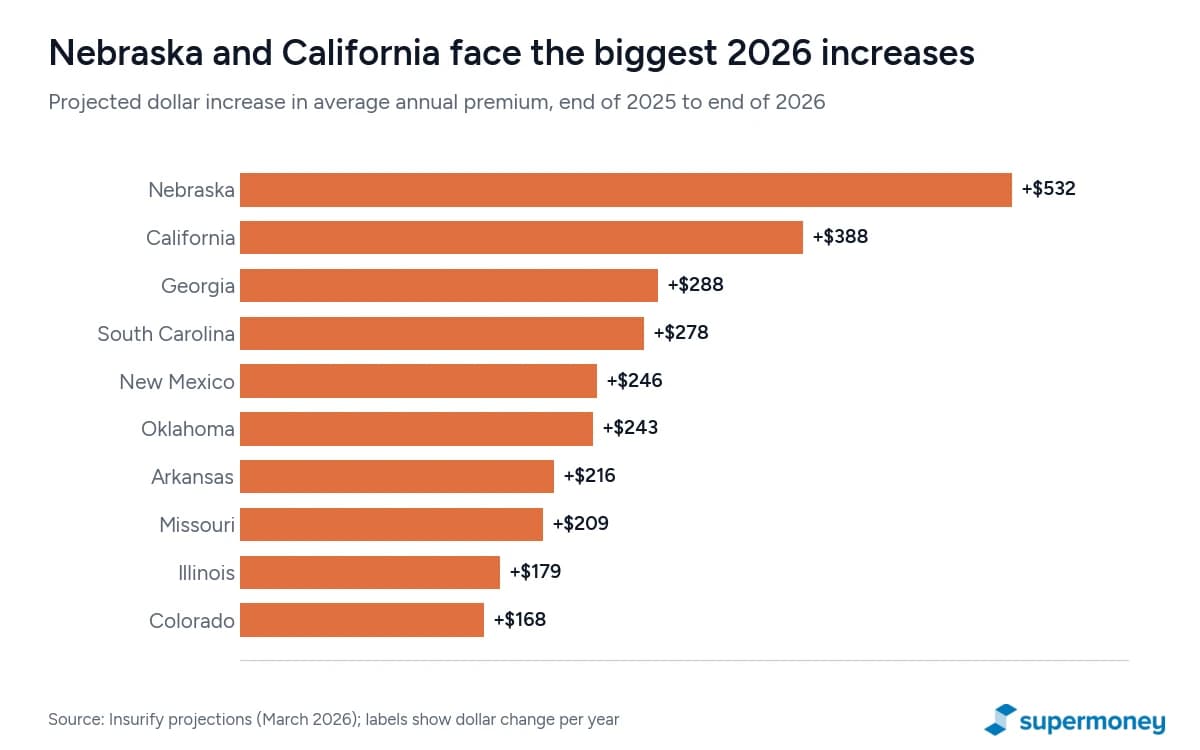
Insurify projects increases in 45 states and D.C. this year. California’s 16% jump is the biggest by percentage, as insurers try to recover losses from the January 2025 Palisades and Eaton wildfires. Nebraska’s is the biggest in dollars: $532 more a year, driven by a run of costly wind and hail storms. Five states (Hawaii, Louisiana, Maine, Massachusetts and Rhode Island) are projected to hold steady or dip slightly.
Average cost by dwelling coverage
Dwelling coverage is the amount it would cost to rebuild your house, not what you paid for it or what it would sell for. Land isn’t included, so a $500,000 home might need only $350,000 of dwelling coverage. Here’s the national average by coverage amount.
| Dwelling coverage | Average yearly premium | Monthly |
|---|---|---|
| $200,000 | $2,040 | $170 |
| $300,000 | $2,808 | $234 |
| $400,000 | $3,552 | $296 |
| $500,000 | $4,320 | $360 |
| $750,000 | $6,180 | $515 |
Source: Insurify quote data, updated October 21, 2026.2
A useful shortcut: nationally, you’ll pay roughly $8 to $10 a year for every $1,000 of dwelling coverage. If your rebuild cost is $350,000, expect somewhere around $2,900 to $3,500 a year before your state’s risk is factored in.
Average cost by insurance company
Two houses on the same street can get quotes thousands of dollars apart, depending on the insurer. These are national averages for $300,000 of dwelling coverage.
| Insurer | Average yearly premium | Monthly |
|---|---|---|
| Amica | $1,548 | $129 |
| USAA (military families only) | $1,980 | $165 |
| American Family | $2,148 | $179 |
| Allstate | $2,448 | $204 |
| Travelers | $2,460 | $205 |
| Farmers | $2,712 | $226 |
| State Farm | $2,760 | $230 |
| Nationwide | $3,276 | $273 |
| Erie | $3,312 | $276 |
| Chubb | $3,612 | $301 |
Source: Insurify quote data, updated October 21, 2026.2 Company averages are national; the cheapest insurer in your ZIP code may be different.
The gap between the cheapest and priciest insurer on this list is $2,064 a year. That’s the strongest argument for comparing quotes every year or two. You can compare homeowners insurance companies on SuperMoney, including Farmers and app-based insurers like Lemonade that quote online in minutes.
What drives your premium
- Location and weather risk. Hurricanes on the Gulf and Atlantic coasts, hail and tornadoes across the Plains, and wildfire in the West. About half of all home insurance claims in recent years have come from wind or hail.1
- Rebuilding cost. Premiums track what it costs to rebuild, and building material prices rose about 15% in the past year, according to Insurify.1
- Your deductible. A higher deductible means a lower premium, as long as you can cover it in cash.
- Your credit. In most states, insurers use a credit-based insurance score, so better credit can mean a lower premium. A few states restrict the practice.
- Claims history. Even one recent claim can raise your rate at renewal.
- The home itself. Roof age and material, distance to a fire hydrant, and features like a pool or trampoline.
Standard policies also leave out two big risks: flood and earthquake. If you’re in a flood zone, price a separate policy. Our flood insurance comparison is a good place to start.
What a rate increase does to your mortgage payment
If you have a mortgage, your premium is probably paid from an escrow account, so an increase shows up as a higher monthly payment even though your loan didn’t change. Take Nebraska’s projected $532 increase. Spread over 12 months, that’s about $44 more on every mortgage payment this year.
If you’re house hunting, get an insurance quote before you make an offer. On a $2,000 monthly payment, the difference between a $1,500 and a $5,000 premium is about $290 a month, which can change how much house you can afford. You can also compare mortgage lenders to see how insurance fits into your full monthly cost.
Catch bill increases before they catch you. The SuperMoney app links your bank and loan accounts, tracks your spending by category and shows your net worth in one place, so a jump in your escrow or insurance bill doesn’t slip past you. For most homeowners, home equity is the biggest piece of their wealth. See how yours compares with the median net worth by age.
Get the app: App Store | Google Play
How to lower your homeowners insurance
- Get at least three quotes. In the company table above, switching from the most expensive insurer to the cheapest would save $2,064 a year. Even a $600 difference is $50 a month back in your budget.
- Raise your deductible, carefully. Moving from $1,000 to $2,500 can trim the premium by 10% or more, depending on the insurer. On a $3,000 policy, that’s around $300 a year. Only do it if you have the full $2,500 in savings.
- Bundle with auto insurance. Most large insurers discount both policies when you buy them together.
- Ask about mitigation discounts. A newer or impact-resistant roof, storm shutters, monitored alarms and water-leak sensors can all earn credits, especially in hurricane and hail states.
- Don’t cut dwelling coverage below your rebuild cost. Underinsuring might save $20 a month and cost you six figures after a total loss. Here’s how to find home insurance that actually covers everything.
Types of homeowners insurance policies
The state and company averages on this page are for HO-3 policies, the most common type of homeowners insurance. Here’s how the main policy forms compare.
| Policy | Who it’s for | What it covers |
|---|---|---|
| HO-3 (special form) | Most single-family homeowners | The house against every cause of loss not specifically excluded; belongings against listed perils |
| HO-5 (comprehensive) | Newer or higher-value homes | The house and belongings against every cause not excluded; usually costs more than HO-3 |
| HO-2 (broad form) | Budget buyers | The house and belongings against a list of named perils only |
| HO-6 (condo) | Condo owners | Interior walls, belongings and liability; the building’s master policy covers the rest |
| HO-4 (renters) | Renters | Belongings and liability, not the building |
| HO-7 (mobile home) | Manufactured and mobile homes | Similar to HO-3, built for manufactured homes |
| HO-8 (modified) | Older homes worth less than their rebuild cost | Named perils, often paid at actual cash value |
FAQ
How much is homeowners insurance on a $300,000 house?
The national average for $300,000 of dwelling coverage is $2,808 a year, or $234 a month. Remember that dwelling coverage is the rebuild cost, not the sale price, so a $300,000 house may need less coverage than that. Your state can move the price by thousands of dollars either way.
How much is homeowners insurance on a $500,000 house?
For $500,000 of dwelling coverage, the national average is $4,320 a year, or $360 a month. If $500,000 is your purchase price and the land is worth $125,000, you might need closer to $375,000 of dwelling coverage, which would cost less.
Is $200 a month a lot for home insurance?
Not by national standards. $200 a month is $2,400 a year, below the $2,948 national average. It’s high for low-cost states like Vermont, Utah, Maine or New Hampshire, where averages run about $90 to $120 a month, and low for Florida, Louisiana, Oklahoma or Texas.
Why did my homeowners insurance go up so much?
The average premium rose 12% in 2025 alone. The main reasons are more frequent severe storms, higher costs for building materials and labor, and higher reinsurance costs (the insurance that insurers buy for themselves). If your premium jumped, shop it. Your current insurer may have raised rates more than its competitors did.
Is homeowners insurance required?
No state law requires it, but nearly every mortgage lender does. If you own your home outright, it’s optional, though going without means paying for a fire, storm or lawsuit yourself.
Key takeaways
- The average homeowners insurance premium was $2,948 a year ($246 a month) at the end of 2025 and is projected to hit $3,057 by the end of 2026.
- Florida is the most expensive state at $8,292 a year; Vermont is the cheapest at $1,087.
- Half of states average $2,278 a year or less. The national average is pulled up by a few large, high-risk states.
- Expect roughly $2,800 a year for $300,000 of dwelling coverage and $4,300 for $500,000.
- Insurers’ national averages differ by more than $2,000 a year, so compare at least three quotes.
Share this post:
Add as a preferred source on Google
Table of Contents