
Do You Pay Taxes on a High-Yield Savings Account?

Last updated 05/04/2026 by
Andrew Latham
Edited by
Andrew Latham
Summary:
Interest earned in a high-yield savings account is taxable income, reported on your federal tax return in the year it is credited to your account — regardless of whether you withdraw it. How that tax works depends on a few key factors.
- Tax type: HYSA interest is taxed as ordinary income, at the same rate as your wages — not at the lower capital gains rate.
- Reporting: Your bank sends a 1099-INT form if you earn at least $10 in interest; you must still report smaller amounts without one.
- Timing: Taxes are owed for the year the interest is credited to your account, even if you leave the money untouched.
- State taxes: Most states also tax savings account interest as ordinary income, though a handful do not.
Most people open a high-yield savings account focused on earning more — and only later wonder what that means at tax time.
The answer is straightforward, but knowing the details helps you estimate what you’ll owe and avoid surprises when your 1099-INT arrives in January.
End Your IRS Tax Problems
Get a free consultation from a leading tax expert.
It's quick, easy and will not cost you anything.
Yes, you pay taxes on high-yield savings account interest
Interest earned in a high-yield savings account is considered ordinary income by the IRS. It is taxed at the same federal income tax rate that applies to your wages, salary, or freelance earnings.
There is no tax exemption or special treatment for savings account interest — unlike, say, municipal bond interest, which can be federally tax-exempt. Every dollar your HYSA earns is a dollar added to your gross income for that tax year.
Pro tip: Taxes on HYSA interest are owed in the year the interest is credited to your account — not the year you withdraw the funds. If your bank credits interest monthly, each monthly deposit counts as income for that calendar year.
How HYSA interest is taxed: ordinary income, not capital gains
The most common misconception is that HYSA interest is taxed like investment gains. It is not. Capital gains apply to profits from selling assets — stocks, real estate, collectibles — and qualify for preferential tax rates of 0%, 15%, or 20%.
HYSA interest is never a capital gain. It is classified as interest income and taxed at your ordinary income rate, which ranges from 10% to 37% depending on your total taxable income and filing status.
| Federal tax bracket (2024) | Single filer income | Married filing jointly |
|---|---|---|
| 10% | Up to $11,600 | Up to $23,200 |
| 12% | $11,601 – $47,150 | $23,201 – $94,300 |
| 22% | $47,151 – $100,525 | $94,301 – $201,050 |
| 24% | $100,526 – $191,950 | $201,051 – $383,900 |
| 32% | $191,951 – $243,725 | $383,901 – $487,450 |
| 35% | $243,726 – $609,350 | $487,451 – $731,200 |
| 37% | Over $609,350 | Over $731,200 |
Only the interest income itself is taxed at your marginal rate — not your entire income. If you earn $400 in HYSA interest and you’re in the 22% bracket, your federal tax on that interest is roughly $88.
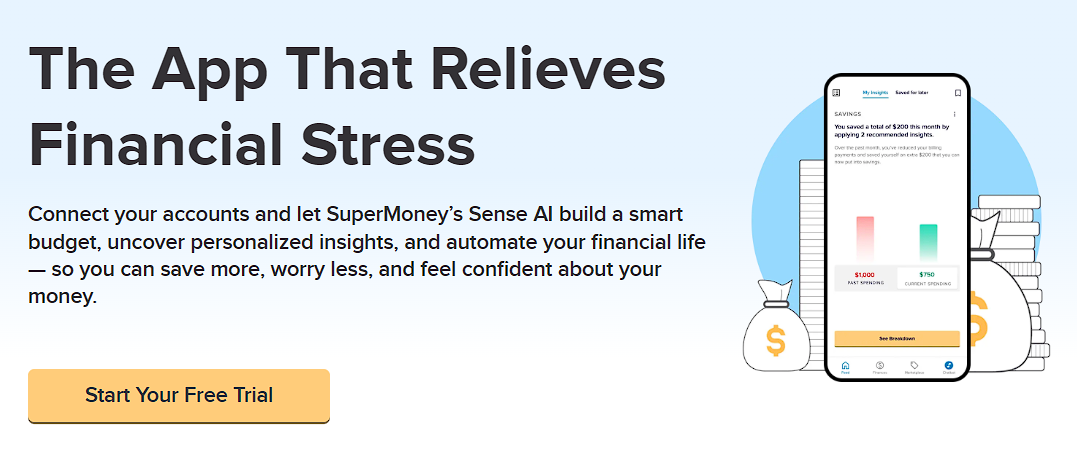 The SuperMoney app tracks your savings account balances and interest earnings automatically — so you always know what to expect at tax time before January arrives.
The 1099-INT form: what it is and when you get one
Your bank is required by the IRS to send a Form 1099-INT if you earned $10 or more in interest during the calendar year. You’ll typically receive it by late January or early February, either by mail or through your online account portal.
If you earned less than $10 in interest, your bank is not required to send a 1099-INT — but the IRS still expects you to report that income. The reporting obligation exists regardless of whether you receive the form.
Pro tip: Keep your 1099-INT alongside your other tax documents. If you have HYSA accounts at multiple banks, you’ll receive a separate 1099-INT from each institution — all of them need to be reported on your return.
How to report HYSA interest on your tax return
Reporting savings account interest is a straightforward addition to your federal return. Here’s the process:
- Collect your 1099-INT forms. Gather one from each bank where you earned interest. Log into each bank’s online portal in January if you haven’t received them by mail.
- Enter the interest on your federal return. Interest income goes on Schedule B (Form 1040) if your total interest income exceeds $1,500. Below that threshold, you can enter it directly on Line 2b of Form 1040.
- List each bank separately. Schedule B requires you to name each payer and the amount received. Use the exact institution name as it appears on the 1099-INT.
- Include any interest without a 1099-INT. If you earned less than $10 at a bank, estimate the amount from your account statements and add it to your total — it still counts as taxable income.
- File and pay any tax owed. The interest is added to your gross income and taxed at your marginal rate. Most tax software handles this automatically once you enter the 1099-INT figures.
How to estimate your tax bill on HYSA interest
Multiply your total HYSA interest earned by your marginal federal income tax rate. That gives you a rough estimate of the federal tax owed on that interest income alone.
For example: if your HYSA earns $500 in interest over the year and you’re in the 22% federal bracket, you’d owe approximately $110 in federal tax on that interest. State taxes, if applicable, would add to that amount.
| Interest earned | 12% bracket | 22% bracket | 24% bracket |
|---|---|---|---|
| $100 | $12 | $22 | $24 |
| $250 | $30 | $55 | $60 |
| $500 | $60 | $110 | $120 |
| $1,000 | $120 | $220 | $240 |
| $2,500 | $300 | $550 | $600 |
These are federal estimates only. Your actual tax bill depends on your complete income picture, deductions, and credits for the year.
Pro tip: If your HYSA balance is large enough that the interest meaningfully increases your taxable income, consider making an extra estimated tax payment in Q4 to avoid an underpayment penalty. The IRS charges a penalty if you owe more than $1,000 at filing and didn’t pay enough throughout the year.
Do states tax HYSA interest?
Most states treat savings account interest as ordinary income and tax it at the same rate as wages. If you live in a state with an income tax, expect to report your HYSA interest on your state return as well as your federal return.
A small number of states do not tax interest income or have no state income tax at all, including Alaska, Florida, Nevada, New Hampshire, South Dakota, Tennessee, Texas, Washington, and Wyoming. New Hampshire previously taxed interest and dividends but phased out that tax entirely as of 2025.
HYSA interest vs. capital gains: a key distinction
Understanding the difference matters for anyone who also invests. Capital gain distributions from mutual funds or the profit from selling a stock held over a year are taxed at preferential long-term capital gains rates — 0%, 15%, or 20% depending on income.
HYSA interest receives none of that preferential treatment. It goes straight onto your ordinary income stack, taxed at the same rate as your paycheck. This is true whether your HYSA pays 0.5% or 5% — the rate at which you earn interest does not change how the IRS classifies it.
Key takeaways
- HYSA interest is taxable ordinary income — it is taxed at your federal marginal rate, not the lower capital gains rate.
- You owe taxes in the year the interest is credited to your account, even if you never withdraw the funds.
- Your bank sends a 1099-INT if you earned $10 or more; you must still report smaller amounts without a form.
- Interest above $1,500 requires Schedule B on your federal return; smaller amounts go directly on Line 2b of Form 1040.
- Most states tax HYSA interest as ordinary income — check your state’s rules if you’re near a bracket threshold.
- To estimate your tax bill, multiply your total interest earned by your marginal federal tax rate.
Frequently asked questions
Do I have to pay taxes on HYSA interest if I don’t withdraw the money?
Yes. The IRS taxes interest in the year it is credited to your account, not the year you withdraw it. Even if you leave every dollar untouched, the interest credited during the calendar year counts as taxable income for that year.
What if my bank doesn’t send me a 1099-INT?
Banks are only required to send a 1099-INT if you earned $10 or more. If you earned less, you still owe tax on that interest and must report it — check your year-end account statement for the exact amount and include it on your return.
Is HYSA interest taxed as capital gains?
No. HYSA interest is ordinary income, not a capital gain. Capital gains rates (0%, 15%, or 20%) apply only to profits from selling assets like stocks or real estate. Savings account interest does not qualify and is always taxed at your ordinary income rate.
Does having a HYSA affect my tax bracket?
It can, at the margin. The interest is added to your total taxable income for the year. If that pushes you over a bracket threshold, only the income above that threshold is taxed at the higher rate — the U.S. uses a progressive system where each bracket applies only to income within its range, which is why your effective tax rate is always lower than your marginal rate.
Can I reduce taxes on HYSA interest?
There is no way to shelter HYSA interest from tax within the account itself — it is not a tax-advantaged account like an IRA or HSA. You can reduce the overall tax impact by ensuring you are taking all eligible deductions and credits on your return, which lower your total taxable income and may reduce the effective rate applied to your interest earnings.
Is a HYSA interest taxed differently than a regular savings account?
No. The IRS applies the same rules to all savings account interest regardless of the account’s yield. Whether your savings account earns 0.01% or 4.5%, the interest is classified as ordinary income and taxed at your marginal rate. If you’re comparing high-yield savings accounts, the tax treatment is identical across all of them — only the rate you earn differs.
Compare high-yield savings accounts with the SuperMoney app — see current rates, account features, and estimated annual interest before you open an account.Andrew is the Content Director for SuperMoney, a Certified Financial Planner®, and a Certified Personal Finance Counselor. He loves to geek out on financial data and translate it into actionable insights everyone can understand. His work is often cited by major publications and institutions, such as Forbes, U.S. News, Fox Business, SFGate, Realtor, Deloitte, and Business Insider.
Share this post:
Add as a preferred source on Google
Table of Contents