How Interest and APY Work in Savings Accounts

Last updated 03/18/2026 by
Andrew Latham
Edited by
Andrew Latham
Summary:
APY (annual percentage yield) is the total interest you earn on a savings account over one year, expressed as a percentage and adjusted to reflect how often interest compounds. It differs from the stated interest rate in one critical way — how it’s calculated depends on compounding frequency, which affects your actual earnings.
- Simple interest vs. compound interest: Savings accounts use compound interest, meaning you earn interest on your interest — not just your original deposit.
- Compounding frequency: Accounts that compound daily pay slightly more than those that compound monthly at the same stated rate.
- Variable rates: Savings account APYs are not fixed — they move with market conditions and Federal Reserve policy.
The basics of how savings accounts work — earning interest on parked funds while keeping them accessible — lay the groundwork for understanding why APY matters more than the stated rate. Understanding how interest actually accrues — and what separates a 4% APY from a 4% interest rate — can meaningfully change which account you choose and how much you end up with.
Compare Savings Accounts
Compare savings accounts. Discover your best option.
What Is Interest on a Savings Account?
Interest on a savings account is the money a bank pays you in exchange for holding your funds on deposit.
Banks take the money you deposit and lend it to other customers at a higher rate. The spread between what they charge borrowers and what they pay depositors is how they profit — and a portion of that spread comes back to you as interest.
Interest is almost always expressed as an annual rate. But the timing of how it’s calculated and credited to your account determines your actual earnings.
What Is APY — and How Is It Different From the Interest Rate?
APY (annual percentage yield) is the total amount of interest you earn on a deposit account over one year, expressed as a percentage — and it accounts for the effect of compounding.
The stated interest rate (sometimes called the nominal rate) does not factor in compounding.
APY does. That’s why two accounts with the same interest rate but different compounding frequencies will have different APYs — and different actual returns.
Here’s a simple illustration:
| Nominal Interest Rate | Compounding Frequency | APY |
|---|---|---|
| 4.00% | Annually | 4.00% |
| 4.00% | Monthly | 4.07% |
| 4.00% | Daily | 4.08% |
The difference looks small, but it compounds over time — literally. On a $50,000 balance, the gap between annual and daily compounding at 4% is roughly $40 per year. Over a decade, that adds up.
Federal law (under the Truth in Savings Act) requires banks to disclose APY on deposit accounts — so you can always compare accounts on an apples-to-apples basis using that number.
How Does Compound Interest Work in a Savings Account?
Compound interest means you earn interest not just on your original deposit, but on the interest that has already been added to your balance.
The more frequently interest compounds, the faster your balance grows — because each compounding period adds interest to a slightly larger base.
A simple example with $5,000 at 4.50% APY:
| Year | Starting Balance | Interest Earned | Ending Balance |
|---|---|---|---|
| 1 | $5,000.00 | $225.00 | $5,225.00 |
| 2 | $5,225.00 | $235.13 | $5,460.13 |
| 3 | $5,460.13 | $245.71 | $5,705.84 |
| 5 | $5,938.28 | $267.23 | $6,205.51 |
| 10 | $7,694.10 | $346.23 | $8,040.33 |
No additional deposits. No action required. The growth in Year 10 is nearly $120 more than Year 1 — purely from compounding.
How Often Does Savings Account Interest Compound?
Most savings accounts compound interest daily, though some compound monthly — and the difference affects how much you earn, even at the same stated rate.
Here’s how the most common compounding frequencies compare:
- Daily compounding — interest is calculated on your balance every day and added to your account. This is the most common structure at online banks and high-yield savings accounts.
- Monthly compounding — interest is calculated and credited once per month. Common at traditional banks and credit unions.
- Quarterly compounding — less common, but still used at some institutions. Every three months, interest is calculated and added.
The frequency of crediting (when interest actually shows up in your account) is separate from the frequency of calculation. A bank may calculate interest daily but only credit it monthly. Both matter — check your account terms.
Pro tip: When comparing savings accounts, always look at the APY — not the interest rate. APY bakes in compounding, so it’s the only truly apples-to-apples comparison across accounts with different compounding schedules.
How to Calculate Savings Account Interest
The formula for savings account interest depends on whether you’re calculating simple interest or compound interest — and compound interest is what your account actually uses.
Simple interest formula (for illustration only):
Interest = Principal × Rate × Time
Example: $10,000 × 4.50% × 1 year = $450
Compound interest formula (what banks actually apply):
A = P(1 + r/n)^(nt)
Where:
- A = final amount
- P = principal (starting balance)
- r = annual interest rate (decimal)
- n = number of compounding periods per year
- t = time in years
Example: $10,000 at 4.50% APY, compounded daily, after 1 year:
A = $10,000 × (1 + 0.045/365)^(365×1) = $10,460.25
The difference from simple interest: $10.25. That gap widens significantly with larger balances and longer time horizons.
How to Estimate Your Savings Account Earnings
You don’t need to run the compound interest formula by hand. Use this four-step approach instead.
- Find the APY. Look at the account’s current APY — not the interest rate. The APY is disclosed in the account terms and on the bank’s rate page. It already accounts for compounding.
- Multiply your balance by the APY. For a rough annual estimate: $10,000 × 4.50% = $450. This gives you a close approximation for most people’s purposes.
- Adjust for time. If you’re estimating earnings over 6 months, divide by 2. Over 3 months, divide by 4. These are approximations — actual earnings will be slightly higher due to compounding within the period.
- Account for balance changes. If you’re adding money regularly, your interest earned will be higher than the simple estimate. Most bank apps and online calculators will show your actual projected earnings based on your current balance and contribution rate.
When Is Interest Paid on a Savings Account?
Interest is typically credited to your savings account monthly, though the exact timing varies by institution and account type.
At most banks, interest accrues daily and is credited to your account at the end of each calendar month. A few banks credit quarterly, and some — particularly certificates of deposit — credit at maturity.
Practical implications:
- If you close your account mid-month, you may forfeit accrued but uncredited interest. Check your account terms before closing.
- Interest credited to your account is available immediately — it’s part of your balance and begins compounding the next day.
- Interest earned in a savings account is taxable income. The IRS treats it as ordinary income, and your bank will issue a 1099-INT if you earn $10 or more in interest during the year.
What APY Should You Be Earning?
As of early 2026, the national average savings account APY is approximately 0.41%, according to FDIC data — but the best high-yield savings accounts are paying 4.00–5.00% APY.
That’s a gap of roughly 10× between the average and the best available rate. On a $20,000 balance:
| Account Type | APY | Annual Earnings on $20,000 |
|---|---|---|
| Traditional savings (national avg) | 0.41% | $82 |
| High-yield savings account | 4.50% | $900 |
| Difference | — | $818 more per year |
The rate differential is especially pronounced right now because of the Federal Reserve’s rate cycle. When the Fed raises its benchmark rate, banks — particularly online banks — tend to pass higher yields to depositors faster than traditional brick-and-mortar institutions.
If your savings account APY is below 1%, it’s worth comparing online savings accounts — most have no minimum balance and no monthly fees.
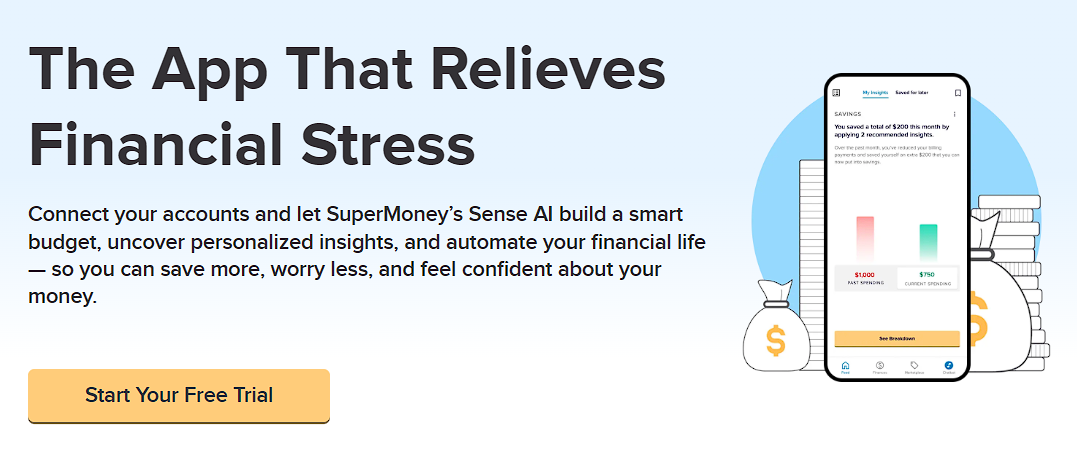
Put your money on autopilot
The SuperMoney app connects to your savings accounts, tracks interest earned in real time, and shows you exactly how much your money is growing — so you always know if your rate is still competitive.
Does Savings Account Interest Change Over Time?
Yes — savings account interest rates are variable, meaning the bank can raise or lower your APY at any time without notice.
Unlike a certificate of deposit (CD), which locks in your rate for the full term, a savings account rate floats with market conditions.
When the Federal Reserve raises its federal funds rate, savings account APYs at competitive banks tend to follow within weeks. When the Fed cuts rates, APYs fall.
This is both a risk and an advantage:
- In a rising rate environment, your savings account becomes more valuable without any action on your part.
- In a falling rate environment, the APY you signed up for may drop significantly within months.
The practical takeaway: don’t assume the rate you open an account with is the rate you’ll earn indefinitely. Check your APY every few months, especially after Fed rate announcements.
Key takeaways
- Banks pay interest on savings accounts as compensation for using your deposited funds — you earn money simply by keeping a balance.
- APY (annual percentage yield) is the most accurate measure of what you’ll earn. It includes the effect of compounding and is what you should use when comparing accounts.
- Compound interest means you earn interest on your interest — not just your original deposit. The more frequently interest compounds, the faster your balance grows.
- Most savings accounts compound daily and credit monthly. Daily compounding produces slightly higher returns than monthly at the same stated rate.
- The national average savings account APY is around 0.41% (FDIC, early 2026). The best high-yield savings accounts pay 4.00–5.00% APY — a difference of $818 per year on a $20,000 balance.
- Savings account rates are variable. Your APY can change at any time, rising or falling with market conditions and Federal Reserve policy.
- Interest earned is taxable income. Your bank will send a 1099-INT if you earn $10 or more in a calendar year.
Frequently asked questions
What is the difference between APY and interest rate on a savings account?
The interest rate is the base rate a bank pays on your deposit, without accounting for compounding. APY (annual percentage yield) reflects the total earnings you’ll receive over a year once compounding is factored in.
APY is always equal to or higher than the stated interest rate. Always compare accounts using APY — it’s the only truly apples-to-apples number.
How much interest does a savings account earn per month?
Divide your APY by 12 for a rough monthly estimate. At 4.50% APY, a $10,000 balance earns approximately $37.50 per month. Actual earnings will be slightly different because interest compounds daily at most banks, but this formula gives a close approximation.
Is savings account interest taxed?
Yes. Savings account interest is taxed as ordinary income — the IRS applies your marginal income tax rate to whatever you earn. Your bank will send a 1099-INT form if you earn $10 or more in interest during the tax year. Even if you earn less than $10, the income is technically still reportable.
Does keeping more money in a savings account earn more interest?
Yes — directly. Interest is calculated as a percentage of your balance, so a higher balance earns more interest at the same APY.
Some savings accounts also offer tiered rates, where larger balances qualify for a higher APY. Check your account’s rate structure to see if a balance tier applies to you.
How long does it take for interest to appear in my savings account?
Most banks credit interest monthly, even if they calculate it daily. You’ll typically see a monthly interest deposit at the end of each calendar month. Some accounts credit quarterly. Your bank’s account agreement will specify the crediting schedule.
What happens to my savings account APY when the Federal Reserve cuts rates?
When the Fed cuts its benchmark federal funds rate, banks typically lower savings account APYs within weeks — sometimes days.
Online banks and high-yield savings accounts tend to adjust faster than traditional banks, in both directions. This is why it’s worth reassessing your savings rate periodically, not just when you first open an account.
Put your money on autopilot
The SuperMoney app tracks your savings account balance and interest earned in one place — so you’ll know immediately if your rate drops and it’s time to shop for a better option.
Andrew is the Content Director for SuperMoney, a Certified Financial Planner®, and a Certified Personal Finance Counselor. He loves to geek out on financial data and translate it into actionable insights everyone can understand. His work is often cited by major publications and institutions, such as Forbes, U.S. News, Fox Business, SFGate, Realtor, Deloitte, and Business Insider.
Share this post:
Add as a preferred source on Google
Table of Contents