
How to Slash Your Summer Energy Bill: 8 Ways to Save Big on Electricity

Last updated 07/04/2025 by
Andrew Latham
With summer electricity bills projected to hit a record-high $784 this year—and the average annual electric bill forecast to reach $1,902—these low-cost tips could help you save up to $600 this summer and over $400 annually. From smart thermostat settings to smart fan use and insulation upgrades, learn how to lower your cooling costs with realistic savings estimates and actionable advice.
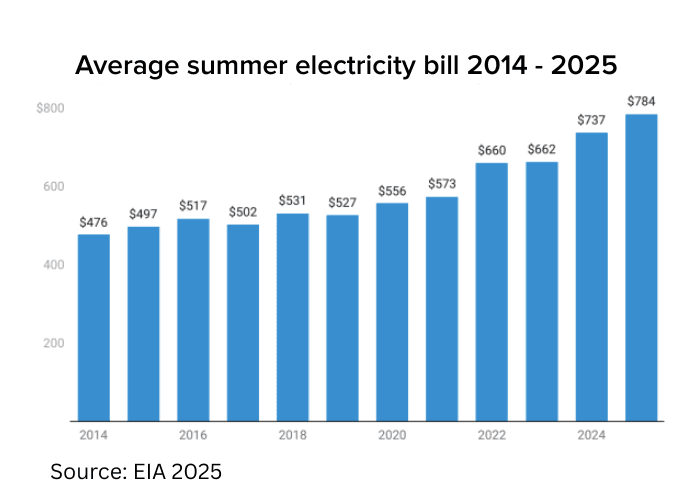
According to the National Energy Assistance Directors Association (NEADA), the average U.S. household will spend $784 on electricity during summer 2025—defined as June through August. That’s up 6.2% from last year, marking the highest level in over a decade. Meanwhile, the average annual electricity bill in 2025 is projected to hit $1,902, according to the U.S. Energy Information Administration. These rising costs make practical energy-saving strategies more valuable than ever.
Take control of your financial future
SuperMoney's AI-powered budgeting and personalized financial insights help you reduce financial stress and achieve your goals faster.
How summer electricity costs compare across the U.S.
Regional differences in climate, utility rates, and housing efficiency all affect summer energy bills. The chart below shows the average summer bill by U.S. Census region: 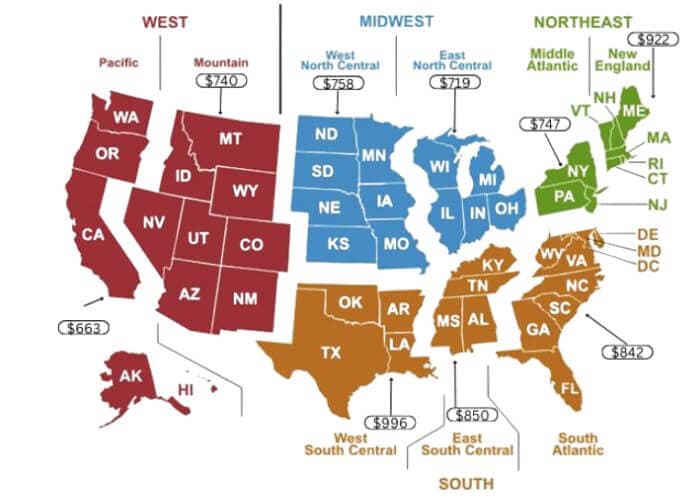
Energy bills have steadily risen over the last decade. Here’s how the average U.S. summer electric bill has changed since 2014:
Energy bills have steadily risen over the last decade. Here’s how the average U.S. summer electric bill has changed since 2014:
Best summer energy-saving tips that actually save money
With summer power bills soaring, cutting costs doesn’t have to mean sacrificing comfort. These proven, low-cost strategies are simple enough to start today and effective enough to make a real dent in your electricity bill. While the savings shown here are estimates, they offer a realistic picture of what the average household can save, often between $250 and $600 over the course of the summer.
1. Adjust your thermostat wisely
Thermostat settings have one of the biggest impacts on summer electricity bills. According to the U.S. Department of Energy, setting your thermostat to 78°F when you’re home and raising it to 85°F when you’re away can reduce cooling costs by up to 10%. With smart automation and consistent use, total savings can reach 15–20%—especially in hotter climates or homes with older HVAC systems.
- Estimated savings: Up to $235
- Math: A 15–20% reduction in cooling costs on a $784 summer bill = $117.60–$156.80. Homes with smart thermostats and optimized settings may exceed this range in high-usage zones.
- Note: Program your thermostat to run warmer during the day when you’re away and cooler at night. A smart thermostat can automate this schedule and adapt to your habits, maximizing savings without sacrificing comfort.
2. Use fans instead of lowering the A/C
Fans don’t lower the temperature, but they create a wind-chill effect that makes rooms feel cooler. This allows you to raise your thermostat without sacrificing comfort—significantly reducing A/C usage.
- Estimated savings: $75–$80
- Math: Raising your thermostat by 4°F with fan use can cut cooling costs by up to 12%. $784 × 12% = $94.08. Adjusting for partial use across rooms, savings typically range between $75–$80.
- Note: Set ceiling fans to rotate counterclockwise in summer to create a downward breeze. Turn them off when leaving the room—they cool people, not air.
3. Block out the sun
Solar heat gain from uncovered windows can dramatically increase indoor temperatures, especially during peak sun hours. Blocking direct sunlight with curtains, blinds, or reflective film can reduce indoor heat buildup and lower A/C usage. According to the U.S. Department of Energy, this simple step can cut cooling energy consumption by up to 5% in many homes.
- Estimated savings: $30–$40
- Math: $784 × 5% = $39.20. Blocking solar heat with effective window coverings lowers cooling demand without added cost.
- Note: Cover east-facing windows in the morning and west-facing windows in the afternoon. Reflective window film and thermal curtains offer even greater energy savings during peak heat.
4. Shift appliance use to the evening
Running major appliances during peak heat hours adds to your home’s cooling load and often costs more if your utility uses time-of-use (TOU) pricing. Shifting use to the evening helps reduce both cooling strain and energy charges.
- Estimated savings: $20–$30
- Math: Running a dryer (3.0 kWh) and dishwasher (1.5 kWh) five times a week during peak hours at $0.36/kWh (TOU peak rate) costs ~$81 over summer. Running them off-peak at $0.26/kWh lowers that to ~$58.50. Savings = ~$22.50 over 90 days.
- Note: Use delay-start features to run laundry and dishwashers after 8 p.m., especially if your utility charges higher rates during the day. This also helps keep your home cooler during peak heat.
5. Seal leaks and improve insulation
Air leaks around windows, doors, attics, and ducts let conditioned air escape and hot air enter, making your A/C work overtime. According to the U.S. Department of Energy, sealing air leaks and improving insulation can reduce heating and cooling energy use by 10–20%—with 15% being a realistic average for many U.S. homes, especially older ones.
- Estimated savings: $65–$115
- Math: $784 × 15% = $117.60. Sealing gaps and improving insulation reduces cooling loss and boosts A/C efficiency.
- Note: Apply weatherstripping or caulk to leaky windows and doors, seal attic openings, and have ductwork inspected for leaks. These improvements can yield long-term savings and increase home comfort.
6. Avoid the oven
Oven use can raise your home’s indoor temperature significantly, increasing cooling needs and energy bills.
- Estimated savings: $15–$45
- Math: Using your oven just once can raise kitchen temps by up to 10°F. That may cause your A/C to run for an extra 30–60 minutes, using 1–2 kWh more per day. At $0.26/kWh, that’s about $0.26–$0.52 per use, or up to $45 over 90 days.
- Note: Use a microwave, toaster oven, slow cooker, or outdoor grill instead. These options keep your home cooler and use far less electricity.
7. Switch to LED bulbs
Lighting makes up about 15% of the average household’s electricity use, and traditional incandescent bulbs convert most of that energy into heat. LED bulbs are up to 80% more efficient and last 10 to 25 times longer. They also emit very little heat, which means your A/C doesn’t have to work as hard to cool your space—especially in summer months.
- Estimated savings: $15–$20
- Math: Replacing 4 to 6 incandescent bulbs with LEDs saves approximately 1.2–1.5 kWh per day. At an average cost of $0.26/kWh, that equals $0.31–$0.39/day → $27.90–$35.10 over 90 days. Factoring in partial use and fewer bulbs replaced, savings typically range from $15–$20.
- Note: Prioritize replacing bulbs in rooms you use most—kitchens, living rooms, and bathrooms. Also, choose ENERGY STAR®-rated LEDs for best performance and longevity.
8. Maintain your A/C
A properly maintained air conditioner runs more efficiently, uses less electricity, and extends system life. Even small steps like changing air filters regularly can reduce energy use and prevent costly breakdowns during summer heatwaves.
- Estimated savings: $35–$60
- Math: A/C typically makes up 50–70% of a $784 summer electric bill ($392–$548). Improving efficiency by 5–10% through maintenance saves about $20–$55 per summer. Full professional tune-ups may save even more in high-use households.
- Note: Change air filters monthly during summer and clean vents regularly. Schedule a professional inspection each spring to check refrigerant levels, coils, and thermostat calibration.
Frequently asked questions
How much can I really save?
Most households can cut $250 to $600 from their summer bill by applying a mix of the strategies listed above.
Are smart thermostats worth the investment?
Yes. Smart thermostats can save up to 20% on cooling costs and often pay for themselves within one season.
Do fans cool a room?
No. Fans cool people by circulating air. Turn them off when the room is empty.
Should I turn the A/C off when I leave home?
It’s better to raise the temperature to 85°F rather than turning it off completely for short absences.
Do curtains and blinds really help?
Absolutely. Blocking solar heat can reduce indoor temperatures by up to 10°F and cut cooling costs by 5%.
Key takeaways
- Summer 2025 electricity bills are projected to hit $784, up 6.2% year over year
- Regional bills vary from $663 in California to $996 in Texas
- Smart thermostat use alone could save up to $235
- Sealing leaks, blocking the sun, and running fans also yield strong savings
- Total estimated savings: $250–$600 per household when used together and consistently
Feeling overwhelmed by money worries?
SuperMoney's AI-powered budgeting tools help you track your money goes, set realistic goals, and reduce financial stress.
Andrew is the Content Director for SuperMoney, a Certified Financial Planner®, and a Certified Personal Finance Counselor. He loves to geek out on financial data and translate it into actionable insights everyone can understand. His work is often cited by major publications and institutions, such as Forbes, U.S. News, Fox Business, SFGate, Realtor, Deloitte, and Business Insider.
Share this post:
Add as a preferred source on Google
Table of Contents