
How to Stop Living Paycheck to Paycheck (By Automating Your Way Out)

Last updated 03/06/2026 by
Andrew Latham
Edited by
Andrew Latham
Summary:
Living paycheck to paycheck means your entire income goes toward bills and expenses each month, leaving no money for savings, emergencies, or financial progress. Automating even $25 per paycheck into a separate savings account on payday — before any spending happens — is the fastest way to break the cycle without relying on willpower or a higher income.
The number on your paycheck isn’t always the problem. Plenty of people earning six figures still run out of money before the month ends, while others earning far less manage to save consistently.
The difference usually comes down to systems — specifically, whether money moves to the right places automatically or whether every financial decision depends on a choice you have to make in the moment.
Get Competing Personal Loan Offers In Minutes
Compare rates from multiple vetted lenders. Discover your lowest eligible rate.
It's quick, free and won’t hurt your credit score
What Does It Mean to Live Paycheck to Paycheck?
Living paycheck to paycheck means you depend on your next paycheck to cover your current month’s expenses, with little or no money left over for savings or unexpected costs. If your income stopped for even two weeks, you’d struggle to pay rent, utilities, or groceries without borrowing.
The term doesn’t necessarily mean you’re in poverty. It means your income and spending are so closely matched that there’s no buffer between earning and spending. Someone making $120,000 a year with $119,000 in annual expenses is living paycheck to paycheck just as much as someone making $35,000 with $34,500 in expenses.
The defining feature is financial fragility — one car repair, one medical bill, or one missed paycheck away from debt or default.
Common signs you’re living paycheck to paycheck:
- You check your bank balance before buying groceries or gas
- You time bill payments around when your paycheck deposits
- An unexpected $400 expense would require borrowing or selling something
- You carry credit card balances not by choice but because you can’t pay them off each month
- You’ve skipped or delayed a bill payment in the past 6 months
- You have less than two weeks’ worth of expenses in savings
If three or more of those describe your situation, you’re functionally paycheck to paycheck — even if your income looks healthy on paper.
How Many Americans Live Paycheck to Paycheck?
Roughly 62% of U.S. adults live paycheck to paycheck, according to a 2025 LendingClub and PYMNTS Intelligence report surveying over 3,200 consumers. That number climbed to 68% by August 2025, according to a separate PYMNTS Intelligence analysis, with 25% of that group actively struggling to pay monthly bills.
The problem isn’t limited to low earners. Here’s how the data breaks down:
| Data Point | Figure | Source |
|---|---|---|
| U.S. adults living paycheck to paycheck | 62% | LendingClub / PYMNTS, 2025 |
| Earners over $100K living paycheck to paycheck | 44% | LendingClub / PYMNTS, 2025 |
| Americans living paycheck to paycheck (August 2025) | 68% | PYMNTS Intelligence, January 2026 |
| U.S. households (stricter definition: 90%+ income on necessities) | ~25% | Bank of America Institute, 2025 |
| Americans unable to cover a $1,000 emergency | 59% | Bankrate Emergency Savings Report, 2025 |
| Gen Z workers living paycheck to paycheck | 73% | Deloitte, 2025 |
These numbers vary based on how surveys define “paycheck to paycheck.” LendingClub uses a self-reported measure — do you need your next paycheck to cover this month’s spending?
Bank of America Institute applies a stricter definition, looking at whether households spend 90%+ of income on necessities. Both approaches confirm the same underlying reality: most Americans have no meaningful financial cushion.
💡 Why the numbers matter: The gap between 25% and 68% isn’t contradictory — it reveals that many Americans who feel financially stretched aren’t technically destitute. They have income. The problem is that their money has no system directing it toward savings before it gets spent on everything else.
Why You’re Stuck in the Paycheck-to-Paycheck Cycle
The paycheck-to-paycheck cycle persists because most people save whatever is left after spending — and there’s rarely anything left.
The root causes fall into four categories, and most people experience more than one simultaneously.
- Expenses match or exceed income. Housing costs alone consume more than 30% of income for nearly half of U.S. renters, according to the Census Bureau. When fixed costs eat most of your paycheck before discretionary spending begins, there’s mathematically nothing left to save.
- Lifestyle inflation absorbs every raise. A $5,000 raise turns into a nicer apartment, a new subscription, and slightly more expensive groceries. Within months, the higher paycheck feels exactly as tight as the old one. This is why 44% of six-figure earners still live paycheck to paycheck.
- No savings buffer exists. Without even $500 set aside, every unexpected expense — a flat tire, a dental bill, a broken phone — becomes a crisis that forces borrowing. That borrowing creates debt payments, which tighten the budget further, which makes saving harder. The cycle reinforces itself.
- Debt payments consume cash flow. The average American household carries $7,951 in credit card debt, according to TransUnion. At 22% APR, that’s $1,750 a year in interest alone — money that could otherwise build an emergency fund. Deciding whether to prioritize debt or savings becomes the first real decision in breaking the cycle.
The common thread: every dollar entering the account has already been mentally or contractually committed. There’s no gap between income and outflow where savings can form.
How to Stop Living Paycheck to Paycheck: 5 Steps
The fastest way to break the cycle is to redirect money before you have a chance to spend it.
These five steps build an automated system that moves savings, bill payments, and debt payoff off your plate entirely.
- Find your baseline number. Add up your non-negotiable monthly expenses: rent/mortgage, utilities, insurance, minimum debt payments, groceries, and transportation. This is your survival floor — the minimum you need to function. Everything above this number is available for savings and debt acceleration.
- Automate savings on payday. Set up a recurring transfer from your checking account to a high-yield savings account that fires the same day your paycheck hits. This is the pay yourself first strategy — it ensures savings happen before you have a chance to spend. Even $25 per paycheck builds a $650 annual buffer — a small rainy day fund of $500–$1,000 is the natural first milestone, and building an emergency fund to cover 3–6 months of expenses is the goal once that habit is in place. If your income is irregular, automate savings based on your lowest-earning month and add a surplus rule for better months.
- Automate every bill payment. Late fees and missed payments are the silent budget killers — Americans paid $14.5 billion in credit card late fees in 2022 alone, according to the CFPB. Set up automatic bill pay for every recurring expense, starting with fixed-amount bills (rent, insurance, subscriptions) and then variable ones (utilities, credit cards).
- Attack high-interest debt with automated extra payments. Once savings and bills are automated, direct any remaining surplus toward your highest-interest debt. Schedule an automatic extra payment — even $50/month above the minimum — on the same day as your savings transfer. The avalanche method (targeting highest APR first) saves the most in interest over time.
- Build to a 30-day buffer. The ultimate escape from the paycheck-to-paycheck cycle is having one full month of expenses sitting in your checking account at all times. This means you’re spending last month’s income on this month’s bills, giving you a full 30-day cushion against any disruption. Calculate your target buffer amount and automate toward it.
The entire system can be built in a single afternoon. Once it’s running, every paycheck automatically splits into savings, bills, and debt payoff — without you making a single decision each month.
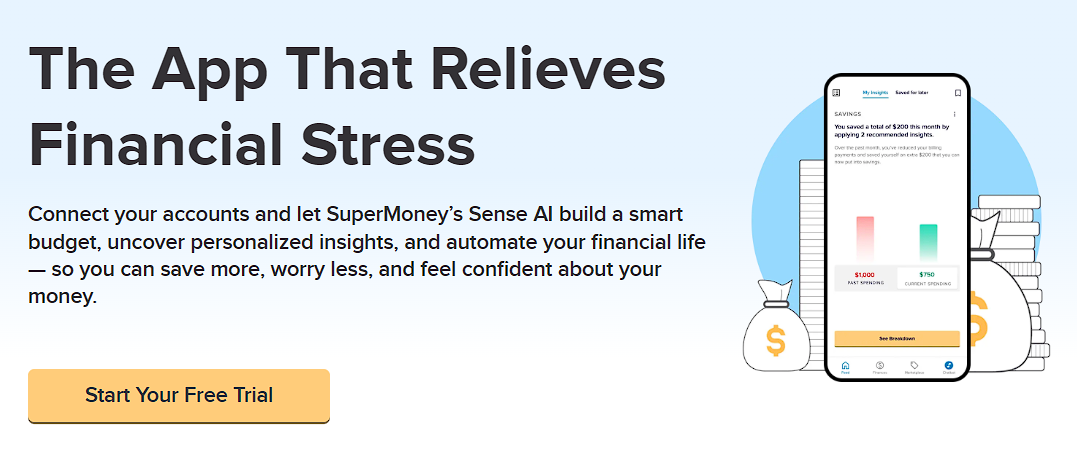
Put your money on autopilot
The SuperMoney app connects your accounts, tracks spending automatically, and helps you build a money system that runs itself — no spreadsheets required.
How to Save Money When You Live Paycheck to Paycheck
Saving while living paycheck to paycheck requires starting with amounts so small they don’t trigger financial anxiety — then scaling up as the buffer grows. The goal is consistency, not size.
- Start at 1% of your paycheck. On a $3,000/month income, that’s $30. It’s small enough to be painless but large enough to build a $360 annual baseline. Increase by 1% every month until you feel resistance.
- Use round-up savings. Apps and bank features that round every purchase to the nearest dollar and sweep the difference into savings can add $30–$50/month without any conscious effort. A $4.25 coffee becomes $5.00, and the $0.75 difference moves to savings automatically.
- Redirect windfalls immediately. Tax refunds, birthday money, side hustle income, and cash-back rewards should hit your savings account before they hit your checking account. The average U.S. tax refund was $3,138 in 2024 — deposited directly into savings, that’s an instant three-month emergency fund for many households.
- Cancel and reallocate. Audit your subscriptions and recurring charges. The average American spends $91/month on subscriptions they don’t fully use, according to a 2024 C+R Research survey. Canceling even half of those and auto-routing the savings creates a $545/year fund without changing your lifestyle.
- Try a savings challenge like the 100 envelope method. Each of 100 numbered envelopes holds a dollar amount matching its number — completing the set saves $5,050 and builds the habit of setting money aside before it gets spent. A structured savings challenge like the 52-week method works on the same principle but starts at just $1, scaling up by $1 each week so the habit grows gradually alongside the amounts.
The key insight: people who automate their savings consistently save more than people who try to manually transfer money each month, because automation removes the decision point where most people falter.
If your income fluctuates, set your automatic savings at the amount your lowest-earning month can sustain. On months where you earn more, a simple rule — “save 50% of everything above my baseline” — captures the surplus without requiring recalculation.
Here’s what consistent micro-saving looks like over 12 months:
| Weekly Amount | Monthly Total | 12-Month Total | What It Covers |
|---|---|---|---|
| $10 | $43 | $520 | One emergency car repair |
| $25 | $108 | $1,300 | Insurance deductible + small emergency |
| $50 | $217 | $2,600 | One month of basic expenses for many households |
| $100 | $433 | $5,200 | Solid emergency fund foundation |
The amounts look modest individually. Compounded over a year with consistency, they transform from “not enough to matter” into a real financial cushion — the difference between paycheck-to-paycheck and financial stability. Those already saving $100/week and ready to push further can follow a detailed roadmap for saving $10,000 in a year — the breakout milestone that marks a real exit from the cycle.
5 Mistakes That Keep You Living Paycheck to Paycheck
Certain financial habits feel productive but actually reinforce the cycle.
Recognizing these patterns is the first step toward replacing them with systems that work. Many of these are forms of overspending habits that feel reasonable in isolation but compound over months into a structural shortfall.
- Waiting until month-end to save. Saving “whatever’s left” after all spending is done almost always means saving nothing. Expenses expand to fill available income. The fix: move savings out of your checking account on payday, before any spending decisions happen.
- Treating every raise as a lifestyle upgrade. A $300/month raise that becomes a car payment, a streaming bundle, and slightly nicer groceries doesn’t improve your financial position — it just raises the floor. Automate at least 50% of every raise into savings or debt payoff before adjusting your lifestyle.
- Ignoring small recurring charges. A $12.99 subscription feels insignificant, but five of them add up to $780/year. Audit every recurring charge quarterly and cancel anything you haven’t used in the past 30 days.
- Using credit cards to bridge cash flow gaps. Charging groceries or gas because your checking account is low until next payday creates a debt cycle that compounds monthly. If you carry a balance, the average credit card APR of 22%+ means you’re paying for last month’s groceries at a 22% markup. Balance transfer cards with 0% intro APR can break this cycle if paired with automated payoff.
- Not having a one-paycheck buffer. Most overdraft crises and late payment spirals happen because bills hit before paychecks do. Building even a single paycheck’s worth of buffer in your checking account — separate from your emergency fund — eliminates timing-based financial stress entirely.
More From This Series: Automate Your Money
- How to Automate Savings Even if Your Income Is Irregular — Practical strategies for building savings on a freelance or variable income.
- How to Set Up Automatic Bill Pay Without Overdrafting — Schedule every bill on autopilot while keeping your checking account safe.
- Set It and Forget It Money System — A step-by-step framework for routing your income automatically so budgeting runs itself.
- How AI Budgeting Apps Work — What machine-learning tools actually do with your transaction data to optimize spending.
- Overdraft Fees and Protection — How overdraft charges work, what protection options exist, and how to avoid them entirely.
- Sinking Fund — A dedicated savings strategy that lets you pre-fund large or irregular expenses without touching your budget.
Why Automation Beats Willpower
Automated financial systems outperform manual budgeting because they eliminate the daily decision fatigue that causes most people to abandon their plans.
A 2025 Vanguard study found that employees enrolled in automatic 401(k) contributions saved at nearly twice the rate of those who had to opt in manually — the behavior was identical, but the default changed.
Willpower is a depletable resource. After a long day at work, a stressful commute, and dinner to figure out, the mental energy to open a banking app and manually transfer $50 to savings simply isn’t there.
Automation makes the right financial decision the default one, every paycheck, regardless of how your day went.
This is especially true when you’re already under financial stress. Research consistently shows that financial anxiety reduces cognitive bandwidth — the same brain resources you’d need to make good money decisions.
Automating removes the decision entirely.
A complete set-it-and-forget-it money system takes about an hour to build. Once it’s running, your finances improve on autopilot while you focus on earning, resting, or doing anything other than worrying about money.
💡 Pro Tip:Budgeting with anxiety is one of the most common reasons people avoid managing their finances altogether. Automation sidesteps this entirely — you make the hard decisions once, then the system executes them for you every month. No checking, no willpower, no guilt.
Key takeaways
- Living paycheck to paycheck means your income and expenses are so closely matched that there’s no buffer — one unexpected bill can trigger debt or default.
- 62% of U.S. adults live paycheck to paycheck according to LendingClub/PYMNTS data, including 44% of those earning over $100,000.
- The root cause isn’t always income — lifestyle inflation, no savings buffer, and debt payments consuming cash flow keep people trapped regardless of salary.
- Automation breaks the cycle by moving savings, bill payments, and debt payoff off your plate before spending decisions happen.
- Start with 1% of your paycheck automated into savings, then increase by 1% each month until you reach a 30-day buffer — the point where you’re spending last month’s income on this month’s bills.
FAQ
What does paycheck to paycheck mean?
Paycheck to paycheck means your monthly income is entirely consumed by bills and expenses, leaving no surplus for savings or emergencies. It doesn’t always mean low income — it means the gap between what you earn and what you spend is effectively zero.
What percentage of Americans live paycheck to paycheck?
Approximately 62% of U.S. adults live paycheck to paycheck, based on LendingClub and PYMNTS Intelligence surveys from 2025. A stricter Bank of America Institute definition — spending 90%+ of income on necessities — puts the number closer to 25%, suggesting many Americans are stretched thin by lifestyle costs rather than bare survival.
How do I stop being broke?
Automate one small action: set up a $25 recurring transfer from checking to savings on every payday. This single change creates a savings habit without requiring willpower. Once that’s running, add automatic bill payments to eliminate late fees, and direct any extra money toward your highest-interest debt.
How much should I save from each paycheck?
Start with whatever you can sustain — even 1% of your paycheck — and increase by 1% each month. The widely recommended target is 20% of gross income (the savings portion of the 50/30/20 framework), but any consistent amount that gets automated beats an ambitious target that doesn’t stick.
Can you live paycheck to paycheck on a high income?
Yes. LendingClub data shows 44% of Americans earning $100,000+ live paycheck to paycheck. High income doesn’t create financial security — the gap between income and expenses does. Lifestyle inflation, mortgage payments, and high fixed costs can consume a six-figure salary just as thoroughly as a modest one.
How long does it take to stop living paycheck to paycheck?
Building a one-month expense buffer — the minimum threshold for breaking the cycle — typically takes 6–12 months when you automate 10% of your income into savings. The timeline shortens significantly with windfall deposits (tax refunds, bonuses) and accelerates further as spending adjustments free up additional cash flow.
Put your money on autopilot
The SuperMoney app connects your accounts, tracks spending automatically, and helps you build a money system that runs itself — no spreadsheets required.
Andrew is the Content Director for SuperMoney, a Certified Financial Planner®, and a Certified Personal Finance Counselor. He loves to geek out on financial data and translate it into actionable insights everyone can understand. His work is often cited by major publications and institutions, such as Forbes, U.S. News, Fox Business, SFGate, Realtor, Deloitte, and Business Insider.
Share this post:
Add as a preferred source on Google
Table of Contents