
The ‘Set It and Forget It’ Money System: Build Yours in a Weekend

Last updated 03/16/2026 by
Andrew Latham
Edited by
Andrew Latham
Summary:
The “set it and forget it” money system is a personal finance approach that automates savings, bills, and debt payments on payday — so your financial priorities are funded before you have a chance to spend them. The foundation is the pay yourself first method — and when automation is the default, it works: switching 401(k) enrollment from opt-in to opt-out raises participation rates from roughly 40% to over 90%, according to research published by the National Bureau of Economic Research.
Most people intend to save more. They just never get around to setting it up — and the month ends before they do.
The system below takes one weekend to build. After that, your money moves itself.
Get Competing Personal Loan Offers In Minutes
Compare rates from multiple vetted lenders. Discover your lowest eligible rate.
It's quick, free and won’t hurt your credit score
Why saving “whatever’s left” never works
Saving at the end of the month fails because discretionary spending reliably consumes every available dollar before a savings decision gets made. By the time you check your balance, the opportunity is gone.
The average American makes over 50 financial decisions per day, according to behavioral economist Barry Schwartz. Decision fatigue is real — and your savings goal is usually the first thing to lose when willpower runs low.
The data backs this up. The Federal Reserve’s Report on the Economic Well-Being of U.S. Households found that while about three-quarters of Americans have some retirement savings, only 40% believe those savings are on track. The gap isn’t income — it’s system.
When researchers switched 401(k) enrollment from opt-in to opt-out — making automation the default — contribution rates jumped from less than 40% to nearly 100%. Same people, same paychecks, different system.
The fix isn’t discipline. It’s removing the decision entirely.
What is the “set it and forget it” money system?
The set it and forget it money system routes your income to its highest-priority destinations automatically, the moment your paycheck lands. Savings go first. Bills go second. Whatever remains is yours to spend freely.
It has three moving parts:
- An allocation framework — a percentage-based rule that decides how much goes where
- Automated transfers — scheduled on payday so money moves without you
- A monthly check-in — 15 minutes to confirm everything is running correctly
That’s it. The goal is a system that runs in the background while you live your life.
Step 1: Choose your allocation framework
An allocation framework is the rule you use to divide your take-home pay into buckets. You need one before you can automate anything, because automation without a plan just moves money faster — it doesn’t prioritize it.
The 50/30/20 rule: the default starting point
The 50/30/20 rule splits your after-tax income into three categories: 50% for needs, 30% for wants, and 20% for savings or debt repayment. It was popularized by Senator Elizabeth Warren and is built into the SuperMoney app as the default budgeting framework.
| Category | Allocation | What It Covers | Example ($4,000/mo) |
|---|---|---|---|
| Needs | 50% | Rent/mortgage, utilities, groceries, insurance, minimum debt payments | $2,000 |
| Wants | 30% | Dining out, subscriptions, entertainment, hobbies | $1,200 |
| Savings & debt payoff | 20% | Emergency fund, retirement, extra debt payments, goals | $800 |
The 20% savings slice is what you automate on Day 1. Everything else fills in around it.
Alternatives if 50/30/20 doesn’t fit your situation
No framework is universal. If housing costs are eating more than 50% of your income, or you’re aggressively paying down debt, one of these variations may fit better:
| Framework | Split | Best for |
|---|---|---|
| 80/20 rule | 20% savings, 80% everything else | Beginners who want one decision, not three |
| 60/20/20 rule | 60% needs, 20% savings, 20% wants | Higher cost-of-living households |
| 70/10/20 rule | 70% expenses, 10% savings, 20% debt | Anyone with significant debt to eliminate first |
Pick one. You can always adjust in month two. What matters now is having a target percentage before you open a single bank app.
How much should you pay yourself first?
The pay yourself first system works by directing your savings percentage to a separate account before spending anything else. Financial advisors typically recommend saving 15–20% of your gross income across all goals combined.
A practical breakdown of that 20%:
- 10–15% — retirement (401k, Roth IRA). At minimum, contribute enough to capture your full employer match — it’s the only guaranteed 50–100% return available.
- 3–5% — emergency fund, until you have 3–6 months of expenses saved
- 2–5% — specific goals (down payment, car, vacation)
For predictable irregular expenses — car registration, annual subscriptions, holiday gifts — a sinking fund for predictable expenses keeps these costs from disrupting your main savings plan. Each of these buckets has a different job — knowing how an emergency fund vs. savings vs. sinking fund account differs helps you set the right dollar amount for each automated transfer.
If 20% is out of reach right now, start with whatever you can automate today — even $25 per paycheck. The habit matters more than the amount in the early months. You can scale up each time you get a raise.
If 20% is out of reach right now, start with whatever you can automate today — even $25 per paycheck. The habit matters more than the amount in the early months. You can scale up each time you get a raise.
Pro tip: Don’t fund a brokerage account before your employer 401(k) match is maxed out and your emergency fund hits one month of expenses. The sequence matters. Free money from your employer and a cash buffer against surprises come first — everything else builds on top of that base.
Step 2: Set up your automation infrastructure
How to build your set it and forget it money system in a weekend
Spend Day 1 linking your accounts and deciding your amounts. Spend Day 2 scheduling all transfers and aligning your billing dates. The total active time is about 2–3 hours.
- Enroll in (or increase) your 401(k) contribution. Log into your employer’s benefits portal and confirm your contribution percentage. At minimum, set it to whatever captures your full employer match. This deduction happens before your paycheck hits your bank — the easiest automation you’ll ever set up.
- Open a dedicated high-yield savings account if you don’t already have one. Keep it at a different bank than your checking account — the slight inconvenience of transferring out acts as a natural barrier against impulse spending. Online savings accounts typically offer the highest APYs with no fees. If you’ve never opened one before, the process takes about 10 minutes — here’s exactly what to expect.
- Link your checking account to your savings account. Log into your savings account and add your checking account as a linked external account. This usually takes 1–2 business days to verify with micro-deposits.
- Schedule your automatic savings transfer. Set it to trigger 1–2 days after your regular payday — not on payday itself. The buffer gives your direct deposit time to clear before the transfer pulls. Use the exact dollar amount your allocation framework calls for. If you’re unsure, start with $50 and adjust next month.
- Set up automatic bill payments for fixed expenses. Log into each biller (utilities, insurance, subscriptions) and enable autopay from your checking account. For variable bills like credit cards, set autopay to the statement balance — not just the minimum — to avoid interest charges. See the full guide to setting up automatic bill pay without overdrafting for a safe sequencing strategy.
- Automate your Roth IRA contribution if applicable. Log into your brokerage (Fidelity, Vanguard, Schwab, etc.) and set up a recurring monthly contribution from your checking account. Even $50–100/month compounds meaningfully over decades. If you’re unsure whether a 401(k) or Roth IRA should come first, the comparison between the two depends primarily on your current vs. expected future tax bracket.
- Set a $500 cash buffer in your checking account. Leave a small cushion so a timing mismatch between income and transfers never triggers an overdraft. This buffer is not savings — it’s the grease that keeps the system running smoothly. The right buffer amount varies by your monthly expenses, but $400–$500 covers most households.
Align your billing dates
The fastest way to break an automated system is a timing mismatch — a bill that drafts two days before your paycheck clears. Call each biller and request a date change to cluster all payments within 3–5 days after your payday.
It takes about 10 minutes per biller. Say: “I’d like to change my billing date to the [Xth] of the month. Is that something I can do over the phone?”
Most will accommodate the request immediately. There may be one prorated billing cycle while dates shift, but after that the system runs cleanly.
If your income is irregular, the deeper guide on how to automate savings even if your income is irregular covers exactly how to set the right transfer amount when your paycheck varies month to month.
The 52-week savings challenge, automated
The 52-week savings challenge is a structured savings plan where you increase your weekly deposit by $1 each week — starting at $1 in week 1 and ending at $52 in week 52 — for a total of $1,378 saved by year’s end.
It’s popular because the starting amount is painless. The problem is that most people track it manually and quit around week 30 when the amounts start feeling significant. The 100 envelope challenge takes a different angle — you fill 100 numbered envelopes with $1 to $100 over time, saving $5,050 total with no strict weekly schedule.
The solution is to automate it at a fixed weekly amount. Instead of escalating deposits, transfer $26.50 every week (the average of all 52 amounts) into your dedicated savings account. You’ll end the year with the same $1,378 — without having to think about it once.
If $26.50/week feels like too much, run a scaled version:
| Weekly transfer | Annual total | Best for |
|---|---|---|
| $10/week | $520 | Starting from zero, tight budget |
| $26.50/week | $1,378 | Standard 52-week challenge amount |
| $50/week | $2,600 | Building a 1-month emergency fund in a year |
| $100/week | $5,200 | Reaching a 3-month emergency fund in roughly 18 months |
The right amount is whichever one you’ll leave running. A $10/week transfer you never cancel beats a $100/week transfer you pause after two months. Scaling up to $192/week — fully automated — is all it takes to hit a $10,000 savings goal by year’s end.
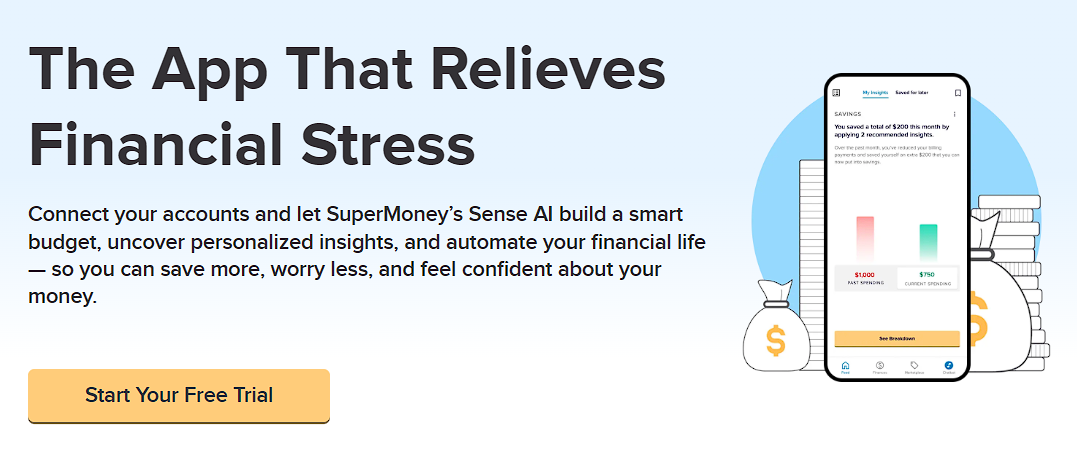
The SuperMoney app uses the 50/30/20 rule as its default framework — so when you connect your accounts, your budget is already structured around automating savings first. See how it works →
How to stop lifestyle inflation from canceling your progress
Lifestyle inflation is the automatic expansion of spending when income rises. You get a raise, upgrade your apartment, add a car payment, and arrive at next year with the same amount saved — just at a higher income level.
The antidote is a raise protocol — three steps to run every time your income increases:
- Calculate 50% of your net raise. If your take-home pay increases by $400/month, your savings increase is $200. Do this math before you spend a single dollar of the new income.
- Increase your automatic savings transfer first. Log into your bank and raise the scheduled transfer before adjusting any spending. Once the new transfer is confirmed, spend the remaining 50% however you want — guilt-free.
- Set an annual escalation reminder. Some 401(k) platforms offer automatic contribution escalation — an annual 1% increase that triggers on a date you set. If yours does, turn it on now. If not, put a recurring calendar reminder every January to log in and increase your contribution by 1%.
This single habit is what separates people who earn more every year from people who save more every year. The income is the same. The system is different. The raise protocol also functions as a system to stop overspending — when a fixed percentage of every increase routes to savings automatically, discretionary spending never gets the chance to absorb it.
More From This Series: Automate Your Money
- How to Automate Savings Even if Your Income Is Irregular — Practical strategies for building savings on a freelance or variable income.
- How to Set Up Automatic Bill Pay Without Overdrafting — Schedule every bill on autopilot while keeping your checking account safe.
- How AI Budgeting Apps Work — What machine-learning tools actually do with your transaction data to optimize spending.
- How to Stop Living Paycheck to Paycheck — Concrete steps to break the cycle and start building a financial cushion.
- Overdraft Fees and Protection — How overdraft charges work, what protection options exist, and how to avoid them entirely.
The 15-minute monthly check-in
“Set it and forget it” doesn’t mean never look. It means you look briefly and on your schedule — not every time you feel anxious about money.
Once a month, spend 15 minutes reviewing three things:
- Did all transfers execute? Scan your savings account and confirm the scheduled transfer arrived. If it didn’t, check for an overdraft or a timing issue.
- Did any bills change amounts? Autopay is reliable for fixed bills, but insurance premiums, subscriptions, and utility bills can change. A quick scan catches unexpected increases before they quietly drain your buffer.
- Is your buffer still intact? Your $500 checking cushion should be roughly the same size each month. If it’s eroding, a transfer amount or bill may need adjusting.
That’s the whole review. If everything ran correctly, close the app and move on. The goal is a system that earns your trust so you stop checking it out of anxiety — and only check it for maintenance.
Pro tip: Schedule your check-in for the same day each month — the day after your largest paycheck is a natural anchor. Put it in your calendar as a recurring 15-minute block. Treating it like any other appointment is what keeps it from becoming optional.
Mistakes that break the system
Most automated money systems don’t fail because of market conditions or income problems. They fail for predictable, preventable reasons.
- Setting transfers too high too fast. An aggressive first month that triggers an overdraft destroys the trust you’re trying to build. Start conservative. You can always increase next month.
- Skipping the cash buffer. Without a $400–$500 cushion in checking, one delayed paycheck or unexpected charge cascades into overdraft fees and cancelled transfers.
- Mixing your emergency fund with spending money. Emergency savings kept in your regular checking account will be spent. It needs its own account — ideally at a separate bank — to stay protected. A high-yield savings account at an online bank adds both the separation and interest you’re missing.
- Automating without a debt payoff plan. High-interest credit card debt at 20%+ APR is a guaranteed negative return. Before investing beyond your employer 401(k) match, compare the math: paying off a 22% APR card is equivalent to earning 22% risk-free. The snowball vs. avalanche comparison can help you decide which debt to attack first.
- Never reviewing. A subscription that doubled in price, a savings transfer that stopped working, a 401(k) contribution stuck at 3% when you can now afford 8% — the system needs a human to check in once a month. Automation handles execution. You handle strategy.
How to stop living paycheck to paycheck with this system
The fastest way to stop living paycheck to paycheck is to automate savings on payday, before spending begins — which shifts the problem from willpower to system design. Living paycheck to paycheck is largely a cash flow timing problem, not just an income problem. Money arrives, bills hit, and nothing is left — because everything is reactive.
The system above solves this structurally. When savings leave your account on payday before spending begins, and bills are clustered on a predictable schedule, your financial life stops feeling chaotic. You always know what’s coming and when.
The first month is the hardest. Your buffer may be thin. Your transfers may need adjusting. That’s normal.
By month three, the system runs quietly. By month six, you’ll have an emergency fund large enough to absorb most surprises without touching a credit card. That’s the moment the paycheck-to-paycheck cycle actually breaks — not because you earned more, but because you stopped giving every dollar an opportunity to be spent before it was saved.
If you’re earlier in the process and still working to cover basics, the guide to budgeting on a low income covers how to find the first $25–50/month to start with. For a broader foundation, the personal finance beginner’s guide walks through every building block in order.
Key takeaways
- The set it and forget it money system automates savings, bills, and investments on payday — so your priorities are funded before discretionary spending begins.
- The 50/30/20 rule (50% needs, 30% wants, 20% savings) is the most practical starting allocation framework for most households.
- Pay yourself first by scheduling a savings transfer 1–2 days after payday, before any discretionary spending can occur.
- The 52-week savings challenge can be fully automated at $26.50/week — saving $1,378 per year without manual tracking.
- A raise protocol — directing 50% of every income increase to savings before adjusting spending — is the primary defense against lifestyle inflation.
- A $400–$500 buffer in checking and a 15-minute monthly review are the two maintenance habits that keep the system running reliably.
- High-interest debt (especially credit cards above 18% APR) should be addressed before contributing beyond your employer’s 401(k) match.
Frequently asked questions
What does “pay yourself first” mean?
Paying yourself first means directing a set percentage of your income to savings or investments before paying bills or spending anything else. The term comes from the idea that your financial future is the first creditor you should pay — not the last. Most people save what’s left after spending; paying yourself first reverses that sequence by making savings automatic on payday.
How much should I pay myself first?
Financial advisors typically recommend saving 15–20% of gross income across all goals. A practical starting split is 10–15% toward retirement accounts, 3–5% toward an emergency fund until it reaches 3–6 months of expenses, and the remainder toward specific savings goals. If 15% isn’t achievable today, start with whatever amount you can automate consistently — even $25 per paycheck builds the habit that larger contributions later depend on.
What is the 50/30/20 rule and how does it work with automation?
The 50/30/20 rule divides your after-tax income into three buckets: 50% for needs (rent, utilities, groceries, insurance), 30% for wants (dining, entertainment, subscriptions), and 20% for savings or debt repayment. In an automated money system, the 20% savings slice is the first transfer scheduled after payday. Needs are covered by autopay for fixed bills. The remaining 30% is whatever’s left to spend freely — no tracking required.
What is the 52-week savings challenge?
The 52-week savings challenge is a year-long savings plan where you deposit $1 in week 1, $2 in week 2, and so on up to $52 in week 52 — saving $1,378 by the end of the year. The escalating structure makes it easy to start but difficult to sustain manually. The most effective way to complete it is to automate a fixed $26.50 weekly transfer (the average of all 52 amounts) and let it run without tracking.
How do I stop living paycheck to paycheck?
The most reliable way to stop living paycheck to paycheck is to automate a savings transfer on the day you get paid, before any discretionary spending occurs. This breaks the reactive cycle where bills consume every available dollar — because your savings are already gone before the spending starts. Start with any amount you can sustain, even $25 per paycheck, and build a $400–$500 checking buffer to absorb timing mismatches between income and bills.
How do I automate the 52-week savings challenge?
Instead of manually depositing escalating amounts each week, set up a fixed recurring transfer of $26.50/week to a dedicated savings account. This is the mathematical average of all 52 weekly amounts, and it produces the same $1,378 at year’s end. Scheduling it through your bank’s transfer tool takes about five minutes, and you can run it as a standing weekly transfer indefinitely — not just for one year.
What’s the difference between a money system and a budget?
A budget is a plan for how to allocate money — it requires active decisions and regular updates. A money system is a set of automatic transfers and rules that execute the plan without ongoing decisions. Budgets fail when life gets busy and tracking lapses. Systems fail only if they’re not set up correctly in the first place. The goal of a set it and forget it system is to build a budget once, automate it completely, and maintain it with a brief monthly review rather than daily attention.
Should I save or pay off debt first?
The answer depends on the interest rate. Debt above 7–8% APR (most credit cards) typically costs more than any risk-free savings account earns, so eliminating it first is usually the better math. The exception: always contribute enough to your 401(k) to capture the full employer match before paying extra on any debt — that match is an immediate 50–100% return that no debt payoff can beat. For a detailed comparison, the savings vs. debt payoff guide walks through both scenarios with numbers.
Ready to build your system? The SuperMoney app connects your accounts, tracks your 50/30/20 split automatically, and shows you exactly where your money goes — so you can automate confidently. Get started free →
Andrew is the Content Director for SuperMoney, a Certified Financial Planner®, and a Certified Personal Finance Counselor. He loves to geek out on financial data and translate it into actionable insights everyone can understand. His work is often cited by major publications and institutions, such as Forbes, U.S. News, Fox Business, SFGate, Realtor, Deloitte, and Business Insider.
Share this post:
Add as a preferred source on Google
Table of Contents