
“No Tax on Tips”? Not Quite — Here’s How Much Workers Will Actually Save

Last updated 07/10/2025 by
SuperMoney Team
Edited by
Andrew Latham
Summary:
The new “no tax on tips” law delivers a welcome tax break for service workers by exempting up to $25,000 in tip income from federal income taxes. It’s a meaningful win for many in hospitality and leisure, but the law doesn’t go as far as some headlines suggest. Workers still owe payroll taxes, and a closer look reveals that higher earners see the biggest benefits. Here’s what the law really does—and what it means for your paycheck.
The “No Tax on Tips Act” is now law, and for millions of tipped workers, it marks a new kind of relief. The federal income tax deduction on up to $25,000 in tip income offers a clearer path to higher take-home pay, especially for workers in restaurants, hotels, and bars. But before you stash that extra cash, it’s worth knowing the fine print. This isn’t a full tax exemption—Social Security and Medicare payroll taxes still apply, meaning most workers will continue to pay about 15.3% on their tips. So, how much are workers really saving, and who gains the most? The answers may surprise you.
Get Competing Personal Loan Offers In Minutes
Compare rates from multiple vetted lenders. Discover your lowest eligible rate.
It's quick, free and won’t hurt your credit score
What the new law actually does
At its core, the law provides a federal income tax deduction for up to $25,000 in tip income annually. For most tipped workers—servers, bartenders, bellhops, and more—it means a smaller income tax bill come April. But payroll taxes still apply, and the total savings vary significantly depending on income level and how much of your income comes from tips. A broader version that would have also exempted payroll taxes was dropped due to cost concerns. Analysts estimated it could reduce federal revenue by as much as $150 billion over ten years. The more limited version that passed gained bipartisan support and focuses on easing burdens without completely eliminating taxes on tips.
Who benefits and by how much?
According to estimates from The Budget Lab at Yale, average tax savings for those who qualify under the income tax deduction are as follows:
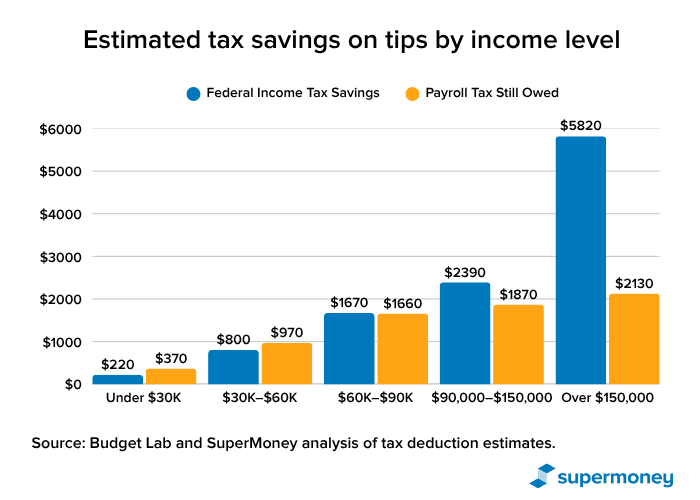
You may have noticed that higher earners receive the largest tax cuts in dollar terms. That’s because federal income tax is progressive: the more you earn, the more you save when income is exempt. By contrast, payroll taxes are flat and capped, making them regressive. While low- and middle-income earners pay a consistent share of their wages, high earners eventually hit a cap and pay a smaller share.
On average, workers who qualify for the deduction and make under $30K can expect around $220 more a year, but will still need to pay around $370 on their tips. The big winners are service workers who make more than $150K a year. They get the highest tax break, an average of $5,820 more a year, and the highest tax cut as a percentage of income also.
| Income Quintile | Average Tax Cut (2025) |
|---|---|
| 1st Quintile (<$30K) | $220 |
| 2nd Quintile ($30K – $60K) | $800 |
| 3rd Quintile ($60K – $90K) | $1,670 |
| 4th Quintile ($90K – $150K) | $2,390 |
| 5th Quintile (>$150K) | $5,820 |
These savings apply only to those who both receive tips and file federal income taxes. The majority of benefits go to middle and upper-middle income earners who report substantial tip income. Lower-income workers see smaller savings in dollars, though as a percentage of income, the relief may be more meaningful.
But workers still pay payroll taxes
The biggest misconception? Tipped workers aren’t fully exempt from taxes. They still owe payroll taxes on tips, which fund Social Security and Medicare. Here’s what that means in practice:
| Yearly Income Range | Estimated Average Federal income tax savings | Payroll tax still owed |
|---|---|---|
| Under $30,000 | $220 | $370 |
| $30,000–$60,000 | $800 | $970 |
| $60,000–$90,000 | $1,670 | $1,660 |
| $90,000–$150,000 | $2,390 | $1,870 |
| Over $150,000 | $5,820 | $2,130 |
This means the average worker still pays hundreds or thousands of dollars in taxes on their tips. While their income tax bill drops, their total tax burden remains significant.
Big picture: who gains and what’s lost?
On paper, the “no tax on tips” law offers a meaningful boost for service workers. And for many it does—especially those making between $30,000 and $90,000 a year. A yearly tax break of $800 or even $1,670 isn’t life-changing, but it’s certainly not nothing. That money might cover a few car payments, rent for a month, or help build a small emergency fund. For tipped workers who live paycheck to paycheck, it matters.
But as we zoom out, the data tells a more complicated story. The biggest winners by far are workers making more than $150,000 annually. This may come as a surprise, since those aren’t the first people who come to mind when we think of bartenders, waitstaff, or bellhops. But high-earning hospitality professionals—like sommeliers, fine-dining servers, or luxury hotel concierges—can pull in large amounts in tips. When those tips are exempt from income tax (up to the $25,000 cap), the tax break adds up quickly.
According to the Baker Institute, while the law may boost take-home pay and simplify recordkeeping, it also raises concerns:
- Distributional equity: The biggest benefits (in dollars) go to higher-income tipped workers, not those with the lowest wages.
- Budget impact: The deduction reduces federal revenue, especially if underreported tips increase.
- Incentives to game the system: There’s a risk that employers or workers might misclassify income as “tips” to claim deductions.
Will this reshape the service economy?
Probably not dramatically. The capped nature of the deduction means it won’t fully transform the lives of tipped workers. But it could signal a shift in how policymakers view precarious service labor, especially in hospitality, where tipping is often a wage subsidy rather than a bonus.
Frequently asked questions
Does the new law eliminate all taxes on tips?
No. It exempts federal income taxes on up to $25,000 in tips but does not eliminate Social Security and Medicare (payroll) taxes.
Who qualifies for the deduction?
Tipped employees, especially in hospitality and leisure industries, who report their income on federal tax returns.
How much will workers save?
According to Budget Lab estimates, average savings range from $220 to $5,820 depending on income level. But these figures exclude payroll taxes still owed.
Why was the payroll tax exemption removed?
Cost concerns. Fully exempting tips from all taxes would have significantly reduced Social Security and Medicare funding.
What’s the long-term impact?
Too early to tell. It could lead to more accurate tip reporting or it could open doors to abuse if enforcement lags behind policy shifts.
Key takeaways
- The law provides income tax relief, not a full tax exemption.
- Payroll taxes still apply, reducing net benefit.
- Lower earners get modest relief, but high-income service workers see the largest savings in dollars and percentage terms.
- Policy tradeoffs include revenue loss and potential reporting loopholes.
Share this post:
Add as a preferred source on Google
Table of Contents