
How to Start Saving in Your 20s Without Guilt, Willpower, or a Bigger Paycheck

Last updated 06/25/2026 by
SuperMoney Team
Edited by
Andrew Latham
Summary:
The best savings strategies don’t rely on discipline. Instead, they side-step willpower and create systems that run without you. Automate a transfer for the morning after payday, grab your full employer 401(k) match (it’s the only guaranteed 100% return you’ll ever see), and build a $1,000 to $1,500 starter cushion before you worry about anything bigger. Start at a number that feels almost silly, like $25 a paycheck, and turn the dial up every time you get a raise.
Let’s get one thing out of the way. This isn’t a lecture about your coffee. Nobody ever built wealth by feeling bad about a $6 latte, and the math says that’s not where your money goes anyway.
Here’s what actually matters when you’re young and earning an entry-level salary: starting. Not starting big. Just starting with a system that doesn’t depend on you being a disciplined superhuman every single payday. Because you won’t be. Nobody is.
The data backs this up, and it’s not pretty. The Federal Reserve’s 2025 household survey found that 63% of adults could cover a surprise $400 expense with cash or its equivalent. Flip that around. More than a third can’t. And among people earning under $50,000, 4 in 10 said they couldn’t cover even a $100 emergency out of savings. A $100 emergency. That’s a flat tire, not a hospital stay.
So if you feel behind, you’ve got plenty of company. The good news is that the fix is mechanical, not moral. Let me show you.
Compare Savings Accounts
Compare savings accounts. Discover your best option.
Why starting early is the cheat code
Compounding rewards time more than it rewards big contributions, and that’s the whole game when you’re in your 20s. You don’t have much money. You do have decades. Decades are worth more.
Meet Emma and Larry. Emma starts at 25 and tucks away $200 a month. Larry waits until 35, then hustles to catch up, saving $267 a month until he’s put in the exact same $96,000 Emma did. Same total out of pocket. Larry even saved more each month. Here’s where they land at 65, assuming a 7% average annual return.
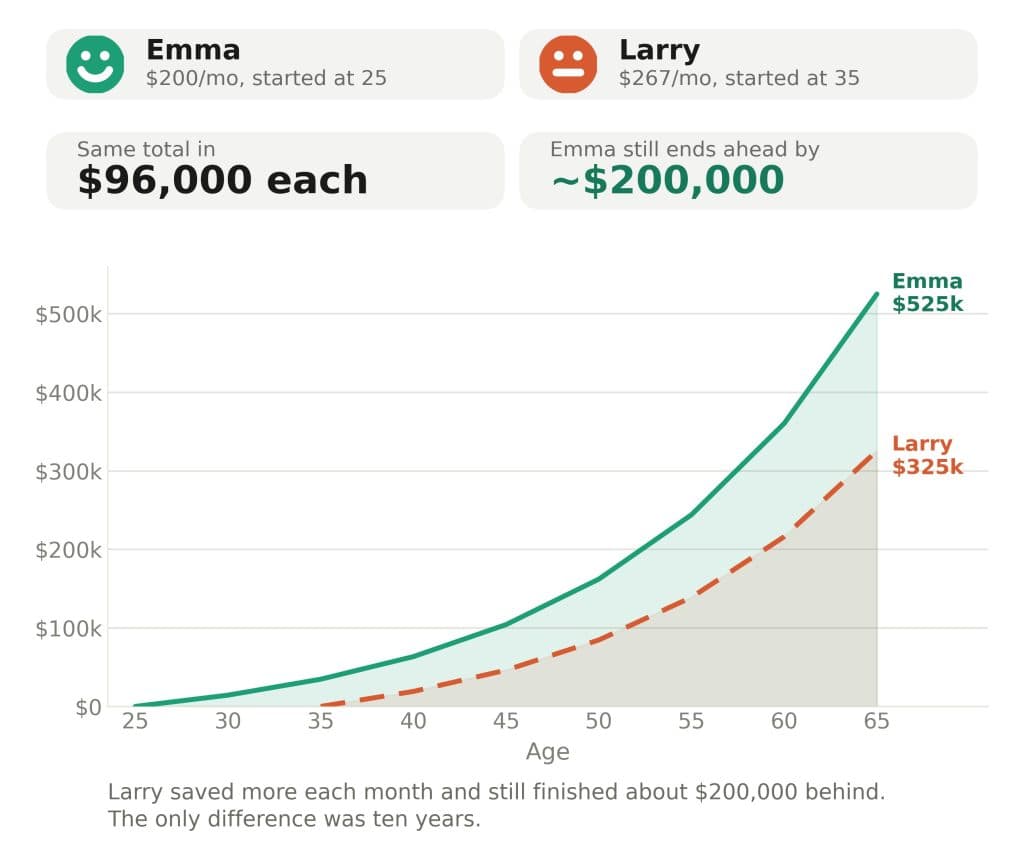
Emma finishes around $525,000. Larry, who put in every bit as much, lands near $325,000. That $200,000 gap has nothing to do with willpower or how much they saved, because they saved the same amount. It’s the ten-year head start, plain and simple. Emma’s early dollars had an extra decade to compound on themselves, and you can’t out-hustle that with a bigger deposit later. (These are illustrative figures at a steady 7% return. Real markets bounce around, but the shape holds.)
Emma finishes around $525,000. Larry, who put in every bit as much, lands near $325,000. That $200,000 gap has nothing to do with willpower or how much they saved, because they saved the same amount. It’s the ten-year head start, plain and simple. Emma’s early dollars had an extra decade to compound on themselves, and you can’t out-hustle that with a bigger deposit later. (These are illustrative figures at a steady 7% return. Real markets bounce around, but the shape holds.)
This is why “I’ll start saving when I make more money” is the most expensive sentence in personal finance. More never feels like enough. Every raise quietly gets absorbed by a nicer apartment or a car payment, and the decade you needed most slips by.
Grab the free money first (yes, it’s actually free)
If your employer offers a 401(k) match, that is the highest return you will find anywhere on earth. Not a good return. The best one. It beats the stock market, real estate, crypto, all of it, because it’s instant and guaranteed.
Say you earn $45,000 and your plan matches dollar for dollar up to 4%. You put in $1,800 over the year. Your employer hands you another $1,800. That’s $3,600 in the account for $1,800 out of your pocket. A 100% return before the market does a single thing.
Most plans aren’t quite that generous. According to Vanguard’s 2025 report, the most common formula is 50 cents per dollar on the first 6% of your pay, and the average match works out to about 4.6% of salary. Even at 50 cents on the dollar, you’re getting a 50% return for free. There is no investment on the planet that competes with that.
Now here’s the part that should bug you. Skipping the match is the quiet killer of young savers’ net worth. Walk past a 4% match on a $50,000 salary and you’ve left $2,000 a year on the table. Invest that foregone match over a decade at average market returns and you’ve handed away close to $28,000. For doing nothing. So before you optimize anything else, contribute enough to capture the entire match. That’s step one, full stop.
The strategies that actually work (because they don’t rely on you)
Willpower is a terrible savings plan. It works great for about three weeks, then real life shows up. The strategies that stick are the ones you can set up once and mostly forget.
Automate the transfer for the day after payday
This is the single highest-leverage move, and it beats every other tactic hands down. Set up an automatic transfer to savings for the morning after your paycheck lands. The trick is you save before the money ever feels like yours. You never see it, so you never plan to spend it, so you never miss it. Pulling money you already “have” feels like loss. Money that vanishes before you notice it feels like nothing.
Think in percentages, not leftover dollars
Here’s the thing about saving “whatever’s left at the end of the month.” With a real budget, there should never be anything left at the end of the month. So leftovers are a savings plan that’s designed to fail.
Take a percentage off the top instead. Even 5% works when it’s automatic. Say you bring home $3,200 a month: $1,200 goes to rent, $300 to your student loan, $400 to the car. Pull $160, that’s 5%, into savings the day you get paid, before lifestyle creep gets a vote. Then you build the rest of your month around the $3,040 that’s left. You adjust your spending to fit the gap instead of trying to save whatever survives.
Put your savings at a different bank
Out of sight is out of mind, and a little friction is your friend. Keep your savings at a separate bank from your checking. When raiding the account means logging into a different app and waiting a day or two for the transfer, you raid it a lot less. That tiny bit of annoyance is doing real work.
Use the windfall rule
Any money you didn’t plan on gets split in half. Tax refund, work bonus, birthday check from grandma, all of it. Half to spend, half to save. An $1,800 refund quietly becomes a $900 contribution, and you don’t feel deprived because that money was never in your monthly budget to begin with. You still get to enjoy the other $900. Nobody’s asking you to be a monk.
Your first goal: forget six months of expenses
The standard advice is to save six months of living expenses. For someone earning $40,000, that’s a five-figure mountain, and staring at it just makes people freeze. So skip it for now.
Aim for a $1,000 to $1,500 starter cushion first. That’s the number that keeps a $600 car repair or an ER copay from turning into credit card debt. And that matters more than ever right now, because the average card carrying a balance charges 21.5% interest, and if your credit’s still thin you’re probably looking at 24% or higher. A $600 repair you can’t cover becomes a $600 balance that grows every month you carry it.
Hit that first cushion and two things happen. You stop bleeding money on interest. And you prove to yourself you can actually do this, which is the part that keeps the habit alive. Once it’s sitting there, then you can start building toward the bigger emergency fund.
How much to save, and how to turn the dial
Start at 5%. On a $40,000 salary that’s about $167 a month, which is doable even with rent eating you alive. Treat 10% as the next mountain to climb, and 15% (counting your employer match) as the real long-term target. For context, Vanguard’s data shows the average worker now defers about 7.7% of pay on their own, so 10% puts you ahead of the pack.
The trick as your income grows is to bank half of every raise. Get a $4,000 bump? Send $2,000 of it straight to savings and enjoy the other $2,000. You lift your savings rate and your lifestyle at the same time, and because you never got used to spending the full raise, it doesn’t sting. Do this a few times across your 20s and your savings rate climbs without you ever feeling squeezed.
What if you genuinely can’t afford to save?
Then start at an amount so small it feels almost silly. Twenty-five dollars a paycheck. Automate it and walk away.
The point this early isn’t the balance. It’s proving the habit survives contact with real life. That $25 every two weeks is $650 a year, which is real, but the bigger win is that you’ve built the muscle. The system is already running. So when your income grows, you don’t have to start from scratch and find the motivation. You just turn the dial up.
This is also where a solid personal finance app earns its keep. The good ones, SuperMoney’s included, link to your accounts and hand you personalized, do-this-now insights instead of generic tips. Stuff like: your emergency cash is parked somewhere earning next to nothing when a high-yield account would pay around 4%, or you’re walking past an employer match. Here’s the kicker. Most of these apps run less than $100 a year, so acting on a single insight tends to cover the subscription for years. Move $5,000 of idle savings into a high-yield account and that’s about $200 a year you weren’t earning before, from one nudge. SuperMoney’s app is paid, but the free trial gives you enough runway to set up your automatic transfer and see which gaps it flags.
Key takeaways
- More than a third of U.S. adults can’t cover a surprise $400 expense with cash, per the Federal Reserve’s 2025 survey.
- The most common 401(k) match is 50 cents per dollar on your first 6% of pay, with the average match worth about 4.6% of salary (Vanguard).
- Skip a 4% match on a $50,000 salary and you give away $2,000 a year, roughly $28,000 over a decade once invested.
- Put in the same $96,000 either way, and starting at 25 instead of 35 can mean about $525,000 versus $325,000 by 65. That $200,000 gap is the head start alone.
- The average credit card balance now costs 21.5% APR, so a $1,000 to $1,500 starter cushion is your cheapest insurance against high-interest debt.
- Even $25 a paycheck adds up to $650 a year, and the habit matters more than the amount.
None of this requires you to be good with money. It requires you to set up two or three things once and then mostly ignore them. Automate the transfer. Grab the match. Build the little cushion. The rest is just turning the dial as you earn more. Future you is going to be very glad you didn’t wait.
Share this post:
Add as a preferred source on Google
Table of Contents