

Industry Study
2026 Inflation Study

Last updated 06/10/2026 by
Andrew Latham
Edited by
Miron Lulic
Get Competing Personal Loan Offers In Minutes
Compare rates from multiple vetted lenders. Discover your lowest eligible rate.
It's quick, free and won’t hurt your credit score
What happened
On April 10, 2026, the Bureau of Labor Statistics reported that the Consumer Price Index rose 0.9% in March on a seasonally adjusted basis — triple the 0.3% pace in February and the largest one-month jump since the pandemic inflation peak of June 2022.
Year-over-year, headline inflation hit 3.3%, up sharply from 2.4% in February. The annual rate is the highest since April 2024 and marks a dramatic reversal after inflation had appeared to be cooling steadily in early 2026.
The culprit is clear: the U.S.–Israeli military conflict with Iran, which began in late February, sent global oil prices soaring and domestic gasoline prices up a record 21.2% in a single month — the largest monthly gasoline increase since the BLS began tracking the category in 1967. Gasoline alone accounted for nearly three-quarters of the overall monthly CPI increase.
But here’s the counterintuitive finding: strip away the volatile food and energy categories, and core inflation actually remained tame. Core CPI rose just 0.2% for the month and 2.6% from a year ago — both 0.1 percentage point below economists’ forecasts. Used cars fell 3.2%, medical care declined, and personal care costs dropped. The underlying inflation picture, excluding the war-driven energy shock, is the best it’s been since early 2022.
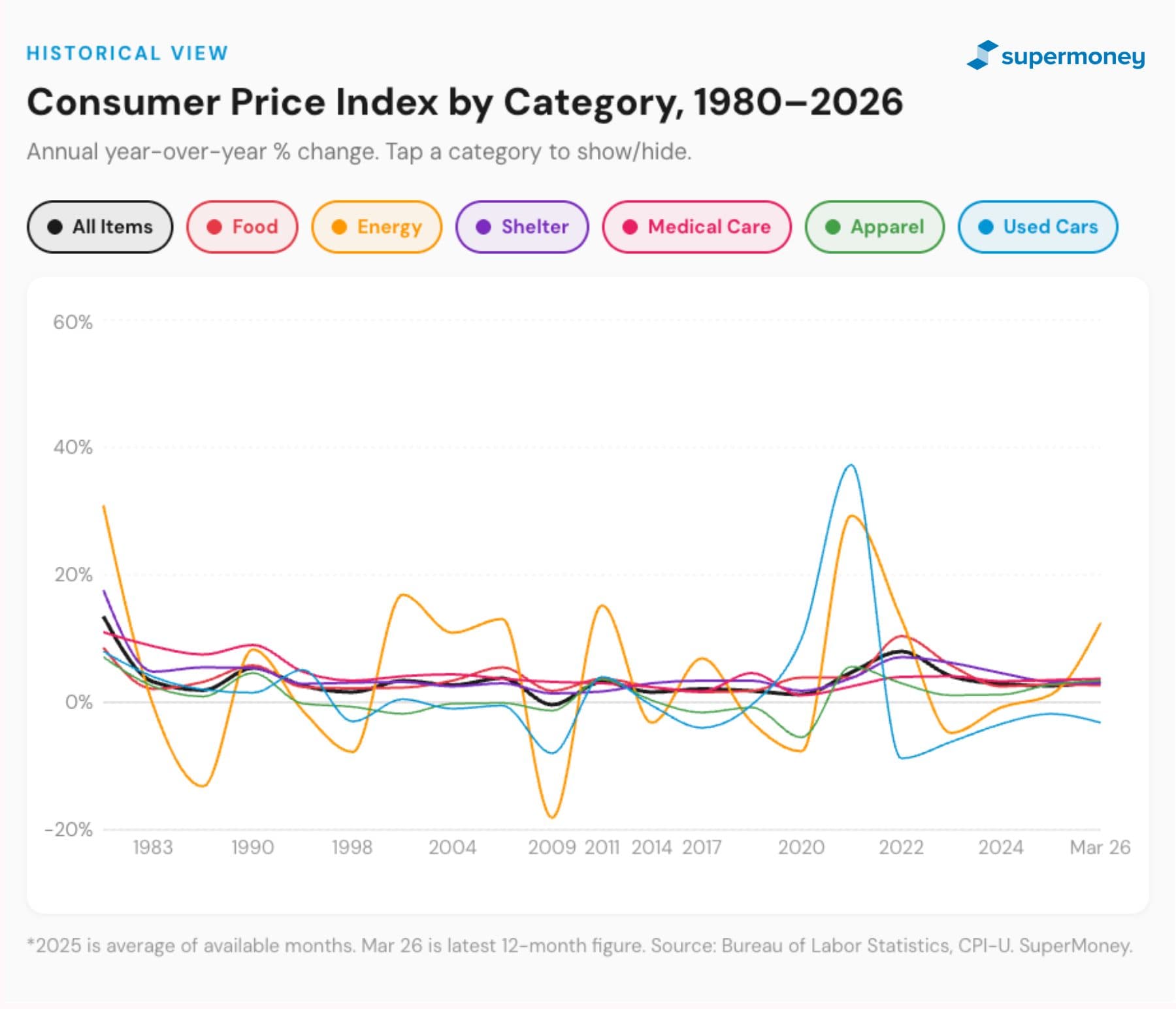
The two-front inflation problem
March 2026 revealed that America is now dealing with two distinct inflation pressures at once — and they require opposite policy responses.
Front 1: The Iran war energy shock. The U.S.–Israeli conflict with Iran, which began February 28, disrupted global oil supplies and sent energy prices surging. Gasoline rose 21.2% in a single month (the largest increase since the series began in 1967). Fuel oil jumped 30.7% (the largest since February 2000). The energy index as a whole climbed 10.9% in March alone. These are supply-side shocks that the Federal Reserve can do little about — raising interest rates won’t produce more oil.
Front 2: Tariff-driven goods inflation. Even before the war, underlying inflation was running above normal. Tariffs enacted during 2025 continue to push up prices on imported goods. The effective tariff rate has fallen from its April 2025 peak of 21% to roughly 8%, but the cumulative price impact is still flowing through to consumers. Apparel rose 3.4% year-over-year, toys increased 2.3% in March (the largest monthly gain in nearly five years), and tools and hardware were up 1.4% (the largest since October 2022).
The result is an inflation picture that looks far worse than it actually is — and a Federal Reserve trapped between two forces pulling in opposite directions.
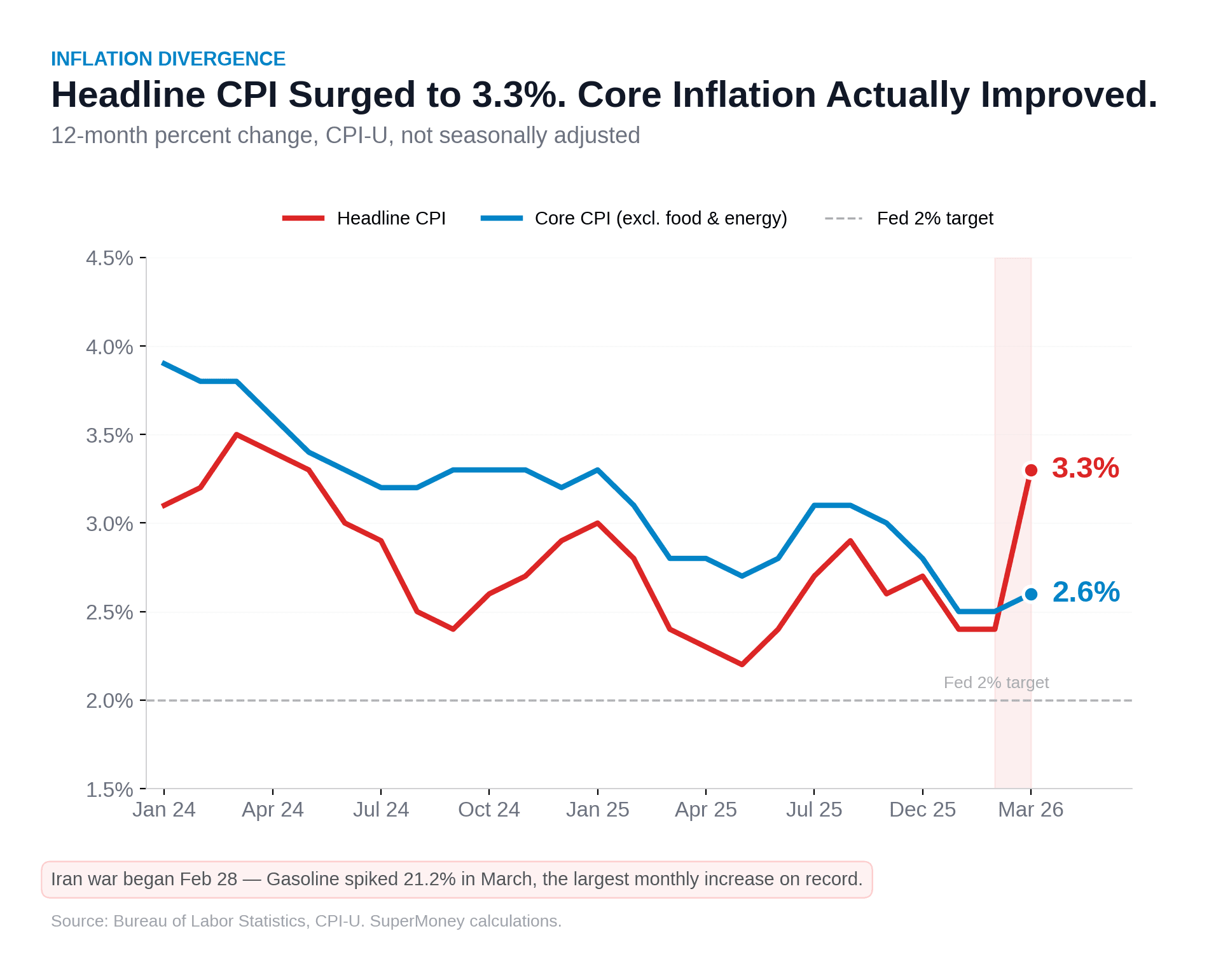
Why it matters
The surge in headline inflation to 3.3% complicates every aspect of economic policy. Markets had been pricing in the possibility of rate cuts as recently as January, when inflation appeared on track toward the Fed’s 2% target. That window has now slammed shut.
For consumers, the impact is immediate. Gas prices above $4 per gallon are the most visible burden. But the ripple effects extend further: airlines have already raised baggage fees, transportation costs are climbing, and economists expect grocery prices to follow as fuel surcharges work through supply chains.
For the Federal Reserve, the dilemma is acute. The economy shows signs of softening — unemployment ticked up to 4.3% in March, and job growth has been modest. In a normal slowdown, the Fed would cut rates. But with inflation accelerating, rate cuts risk fueling more price increases. The specter of stagflation — slow growth combined with rising prices — hasn’t been this real since the 1970s oil crisis.
As Navy Federal Credit Union chief economist Heather Long put it: the Fed is now “on a prolonged pause until the fog of war clears.”
Fed rate policy and impact
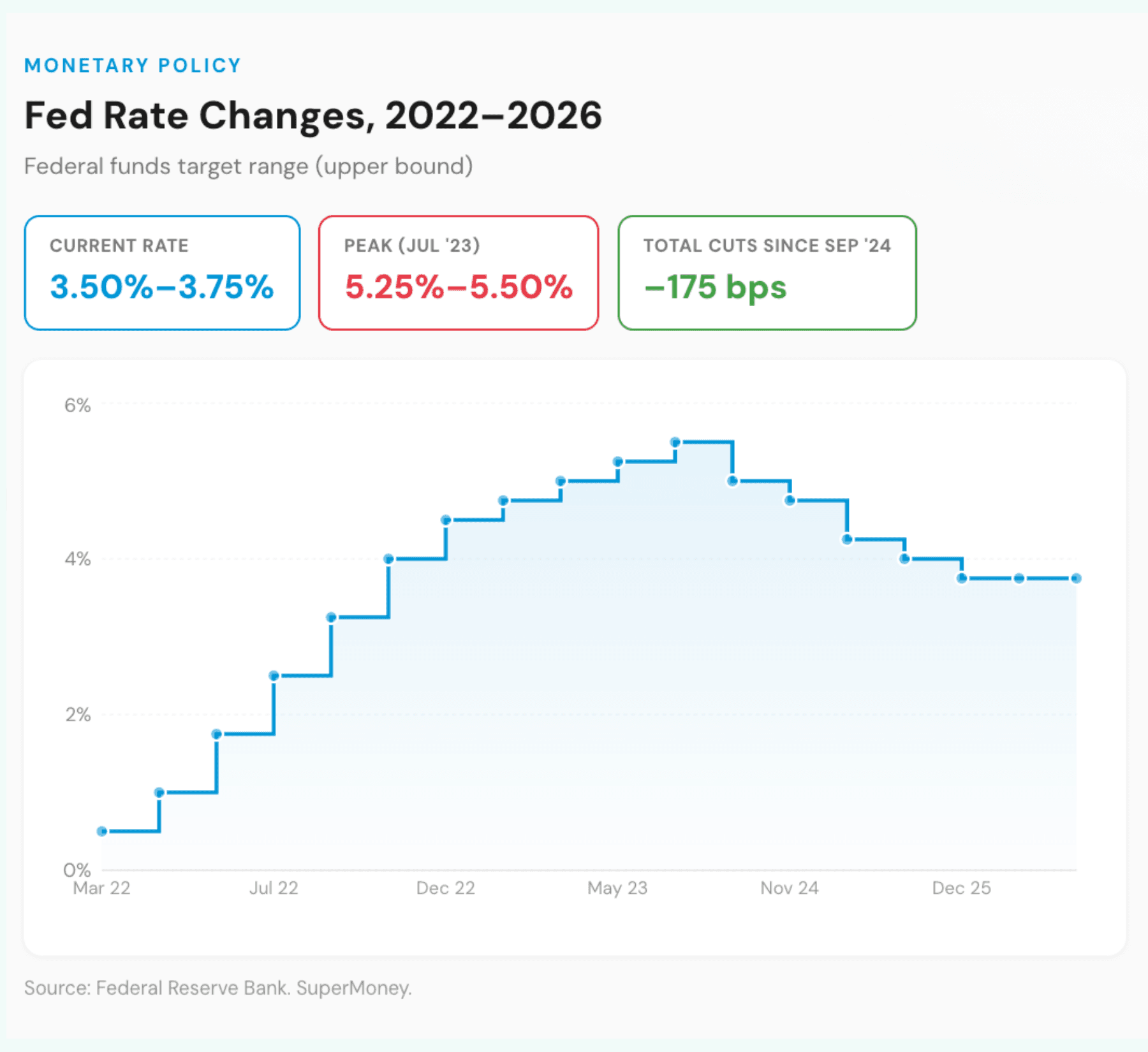
The Federal Reserve held the federal funds rate steady at the 3.50%–3.75% target range at its March 17–18 meeting, the second consecutive pause after cutting rates by a cumulative 175 basis points between September 2024 and December 2025 — across five meetings over 15 months.
Those cuts — from 4.75% down to 3.75% — were made when inflation appeared to be fading. But the economic landscape has shifted dramatically since then. The Fed’s March Summary of Economic Projections still pencils in one rate cut for 2026, but the timing is now highly uncertain. Some Fed officials have even raised the possibility that rate hikes could become necessary if the energy shock feeds into broader price increases.
Markets are pricing in virtually no chance of a rate cut through the rest of 2026. Many economists have removed their rate cut forecasts entirely. The next FOMC meeting is April 28–29, and a unanimous hold is expected.
| FOMC Meeting Date | Rate Change (bps) | Federal Funds Rate | Context |
| Mar 17–18, 2026 | 0 | 3.50% to 3.75% | Iran war uncertainty; inflation reaccelerating |
| Jan 27–28, 2026 | 0 | 3.50% to 3.75% | Inflation cooling; pause to assess |
| Dec 10, 2025 | –25 | 3.50% to 3.75% | 4th consecutive cut |
| Nov 5, 2025 | –25 | 3.75% to 4.00% | Continued easing |
| Sep 16–17, 2025 | –50 | 4.00% to 4.25% | Jumbo cut; labor market softening |
| Nov 7, 2024 | –25 | 4.50% to 4.75% | Second cut of easing cycle |
| Sep 18, 2024 | –50 | 4.75% to 5.00% | Start of easing cycle |
| Jul 26, 2023 | +25 | 5.25% to 5.50% | Peak rate |
Source: Federal Reserve Bank. Note: Oct–Nov 2025 CPI data affected by the 43-day government shutdown; see section below.
Energy: The record-breaking shock
The March 2026 energy price spike is historic by any measure. Gasoline prices rose 21.2% in a single month on a seasonally adjusted basis — the largest monthly increase since the BLS first published the series in 1967. Before seasonal adjustment, the jump was even larger: 24.9%.
Fuel oil surged 30.7%, the largest monthly increase since February 2000. The electricity index rose 0.8%, and natural gas fell 0.9%. Over the past 12 months, total energy costs are up 12.5%, with gasoline up 18.9% year-over-year.
The Iran war, which began February 28, disrupted key oil shipping routes in the Strait of Hormuz and caused global crude prices to spike above $100 per barrel. Although a two-week ceasefire was announced on April 8, economists caution that energy prices tend to rise quickly during disruptions but fall much more slowly afterward — a phenomenon known as the “rockets and feathers” principle.
Even if peace holds, the damage to inflation data will persist. Higher fuel costs are already flowing into transportation, shipping, and food production costs, meaning the downstream effects of the energy shock will continue to appear in coming CPI reports.
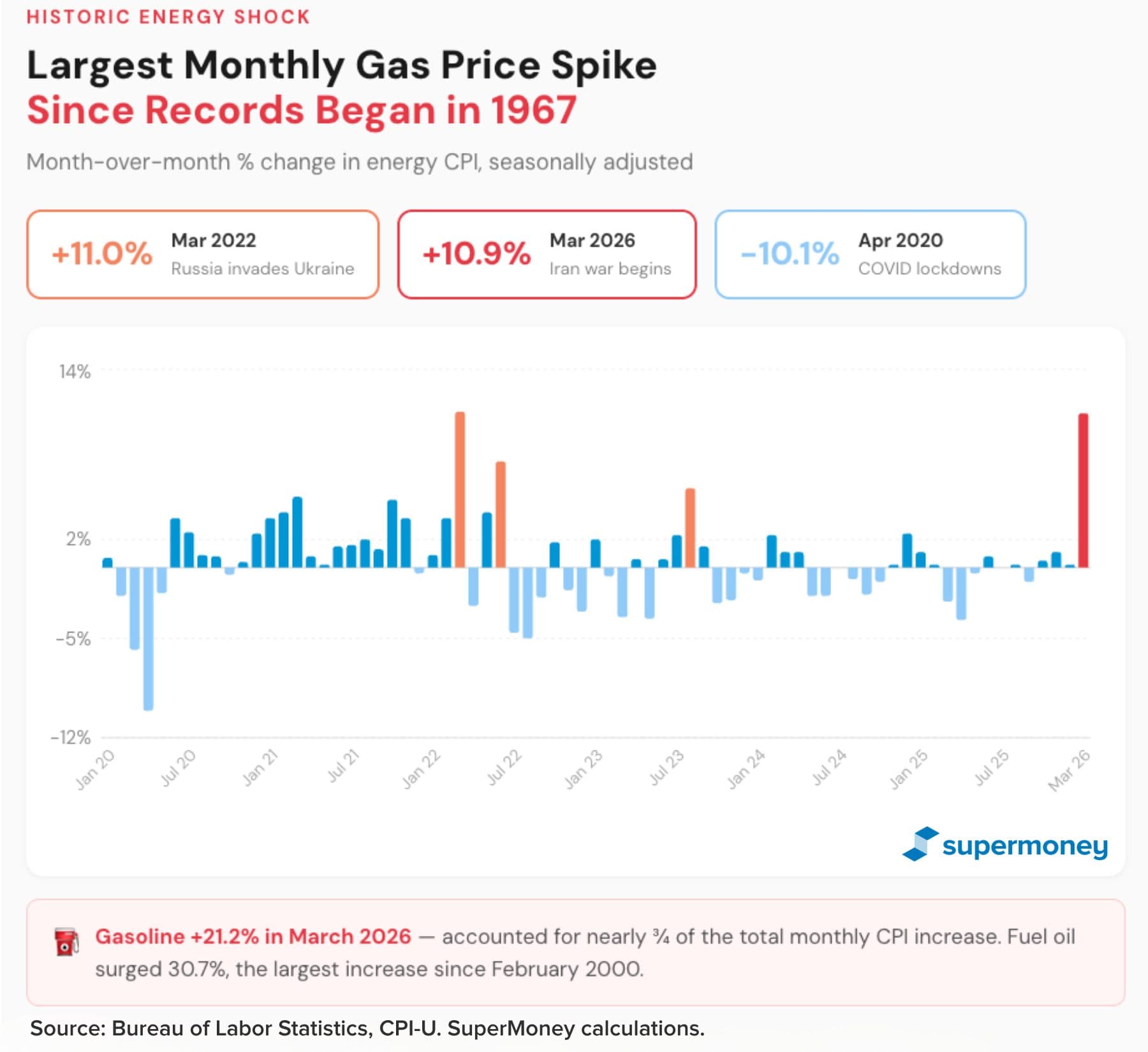
Note: Oct–Nov 2025 data omitted due to BLS collection interruption during the government shutdown.
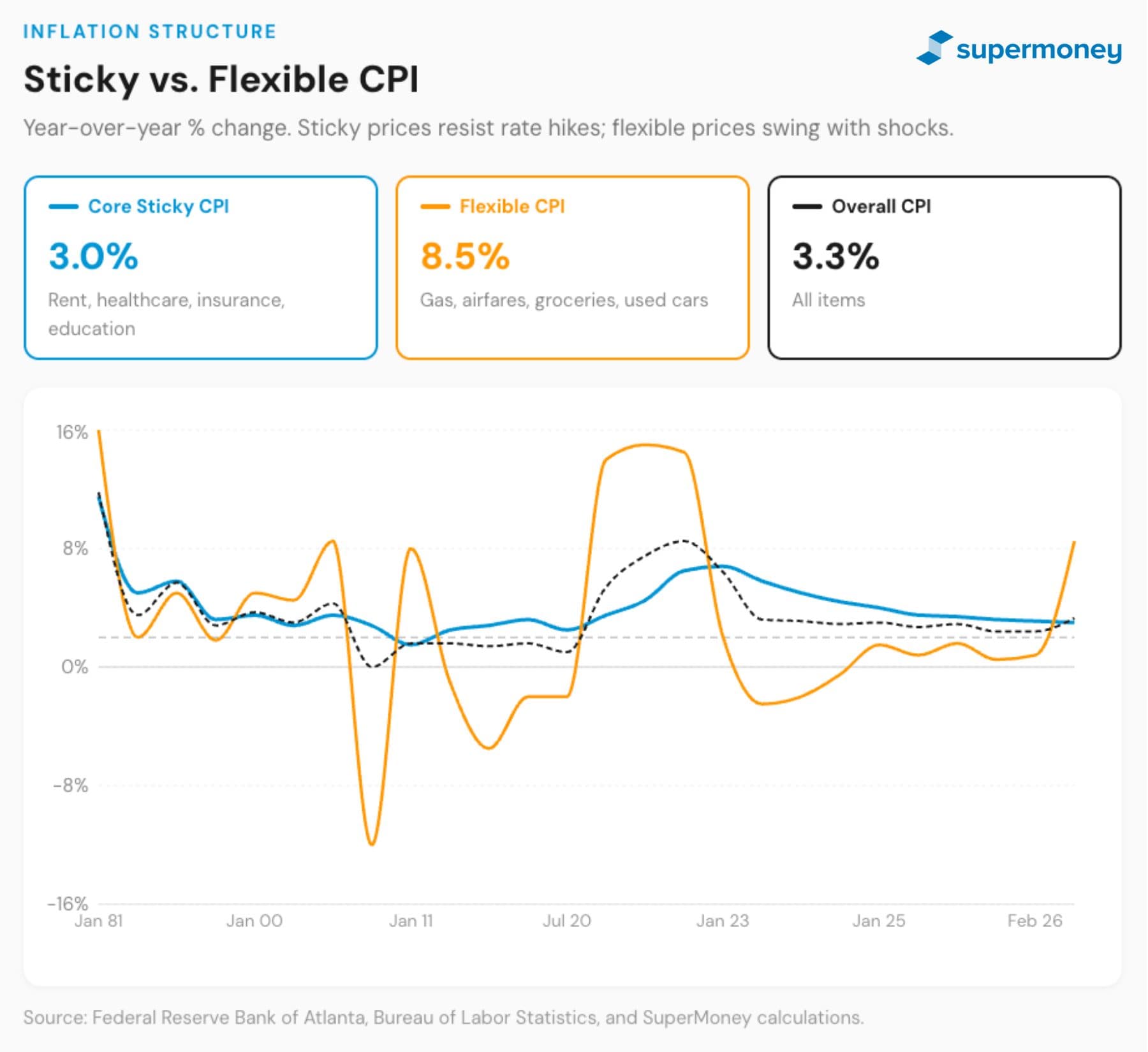
Sticky vs. flexible CPI
The March 2026 data shows the starkest divergence in years between sticky and flexible price categories — and understanding this split is critical to interpreting what inflation actually means for the economy right now.
Flexible CPI — covering volatile categories like gasoline, airfares, and groceries — has surged due to the energy shock. These categories can spike rapidly in response to supply disruptions but can also reverse quickly once conditions normalize.
Sticky CPI — which tracks slow-moving categories like rent, healthcare, insurance, and education — tells a different story. These prices move gradually because they’re shaped by long-term contracts, regulatory pricing, and labor-intensive business models. Core sticky CPI has continued its slow decline from the 2023 peaks, moving closer to the levels the Fed needs to see.
This divergence matters because the Fed has historically “looked through” temporary energy-driven spikes to focus on underlying trends. The risk this time is that the energy shock persists long enough for flexible-price increases to bleed into sticky categories — as higher fuel costs drive up transportation, shipping, and service-sector prices.
What’s actually getting cheaper — and more expensive
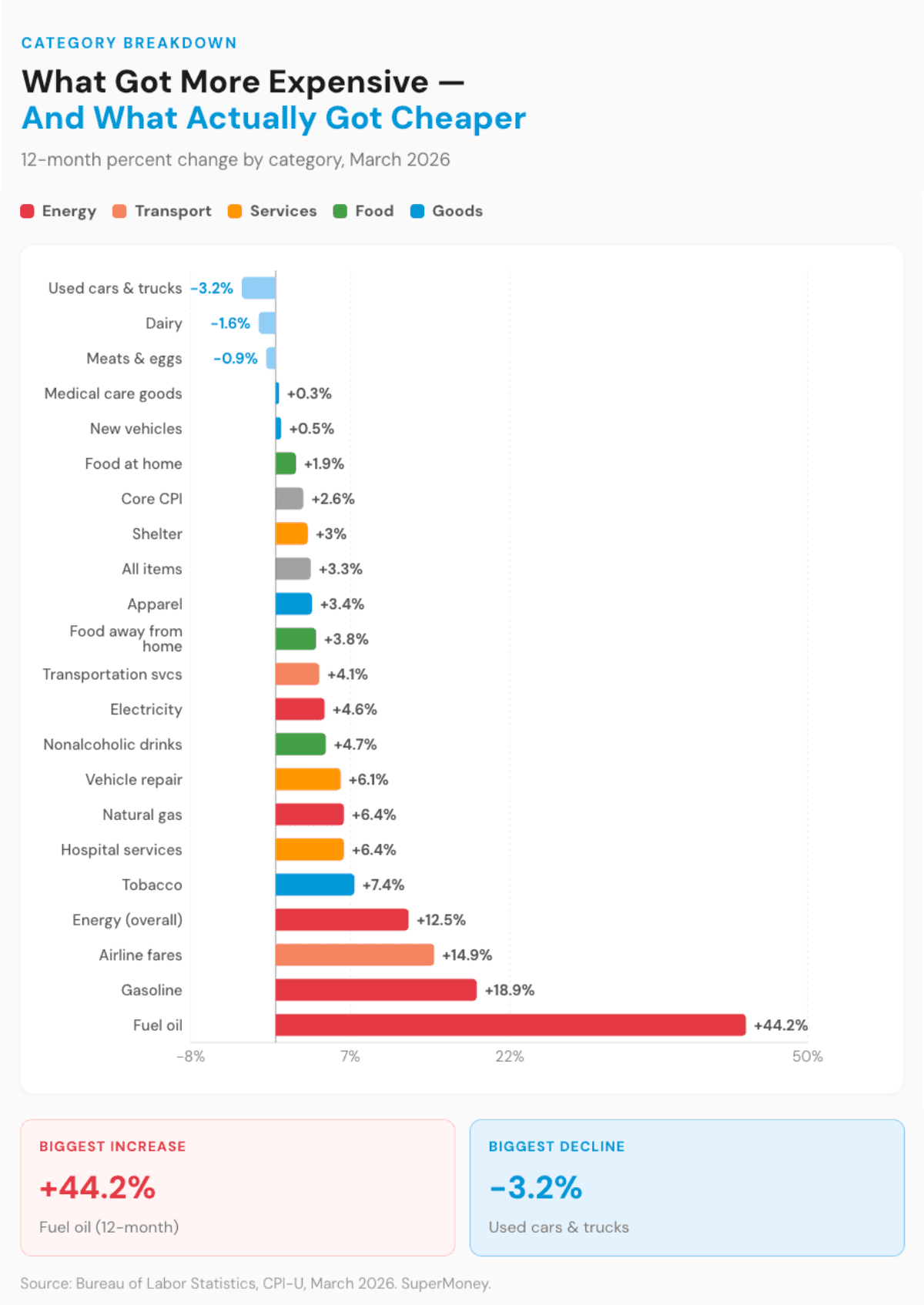
The March 2026 data reveals a surprisingly mixed picture beneath the alarming headline. While the energy shock dominates the narrative, several categories actually saw price declines — offering relief in areas that had been stubborn sources of inflation for years.
Categories with price declines in March 2026
| Category | Monthly Change | 12-Month Change |
| Used cars and trucks | –0.4% | –3.2% |
| Medical care commodities | –1.0% | +0.3% |
| Dairy and related products | –0.6% | –1.6% |
| Meats, poultry, fish, and eggs | –0.6% | –0.9% |
| Cereals and bakery products | –0.6% | +2.1% |
| Natural gas (piped) | –0.9% | +6.4% |
| Food at home (overall) | –0.2% | +1.9% |
Categories with the largest price increases
| Category | Monthly Change | 12-Month Change |
| Fuel oil | +30.7% | +44.2% |
| Gasoline (all types) | +21.2% | +18.9% |
| Airline fares | N/A | +14.9% |
| Energy (overall) | +10.9% | +12.5% |
| Tobacco and smoking products | N/A | +7.4% |
| Hospital services | N/A | +6.4% |
| Motor vehicle maintenance/repair | N/A | +6.1% |
| Electricity | +0.8% | +4.6% |
| Transportation services | +0.6% | +4.1% |
| Food away from home | +0.2% | +3.8% |
Source: Bureau of Labor Statistics, CPI March 2026, seasonally adjusted where applicable.
Real wages & household impact
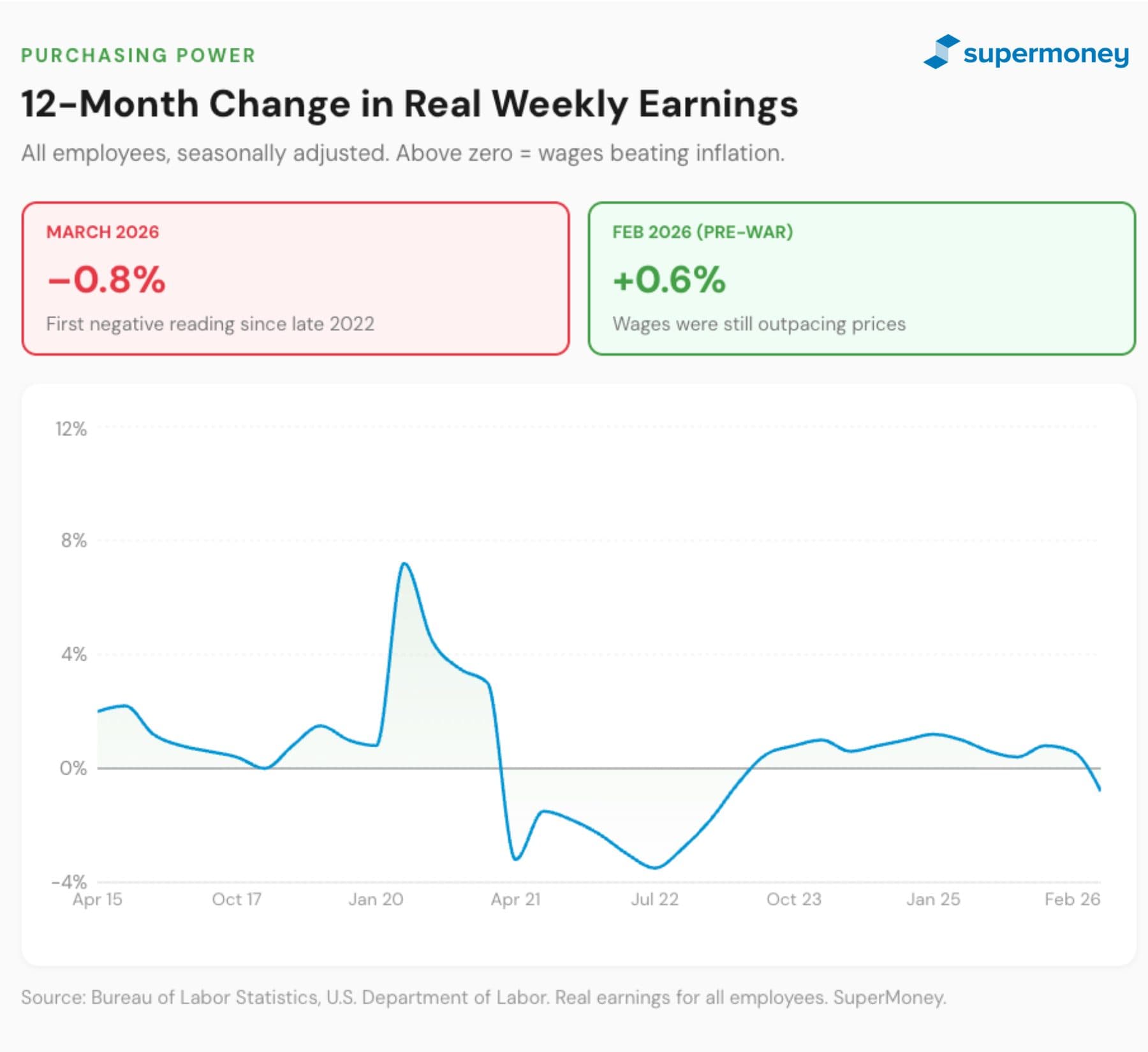
The March 2026 inflation spike dealt a direct blow to workers’ purchasing power. Real wages, which had been outpacing inflation by roughly one percentage point for nearly three years, were rapidly eaten away by the energy shock.
Average hourly earnings rose $0.09 in March 2026, but with prices climbing 0.9% in a single month, nominal wage gains were far outstripped by inflation for the first time since the 2022 inflation peak.
The picture is especially difficult for lower-income households, who spend a disproportionate share of their income on gasoline, food, and energy. With gas above $4 per gallon and grocery transportation costs rising, the households that were already stretching to manage higher credit card balances and depleted savings are now being squeezed further.
Before the Iran war, the trend had been encouraging. Real average weekly earnings for all employees had been rising modestly — gaining about 0.4% year-over-year as of late 2025. But March’s energy shock likely erased months of real wage progress in a matter of weeks.
Real disposable income
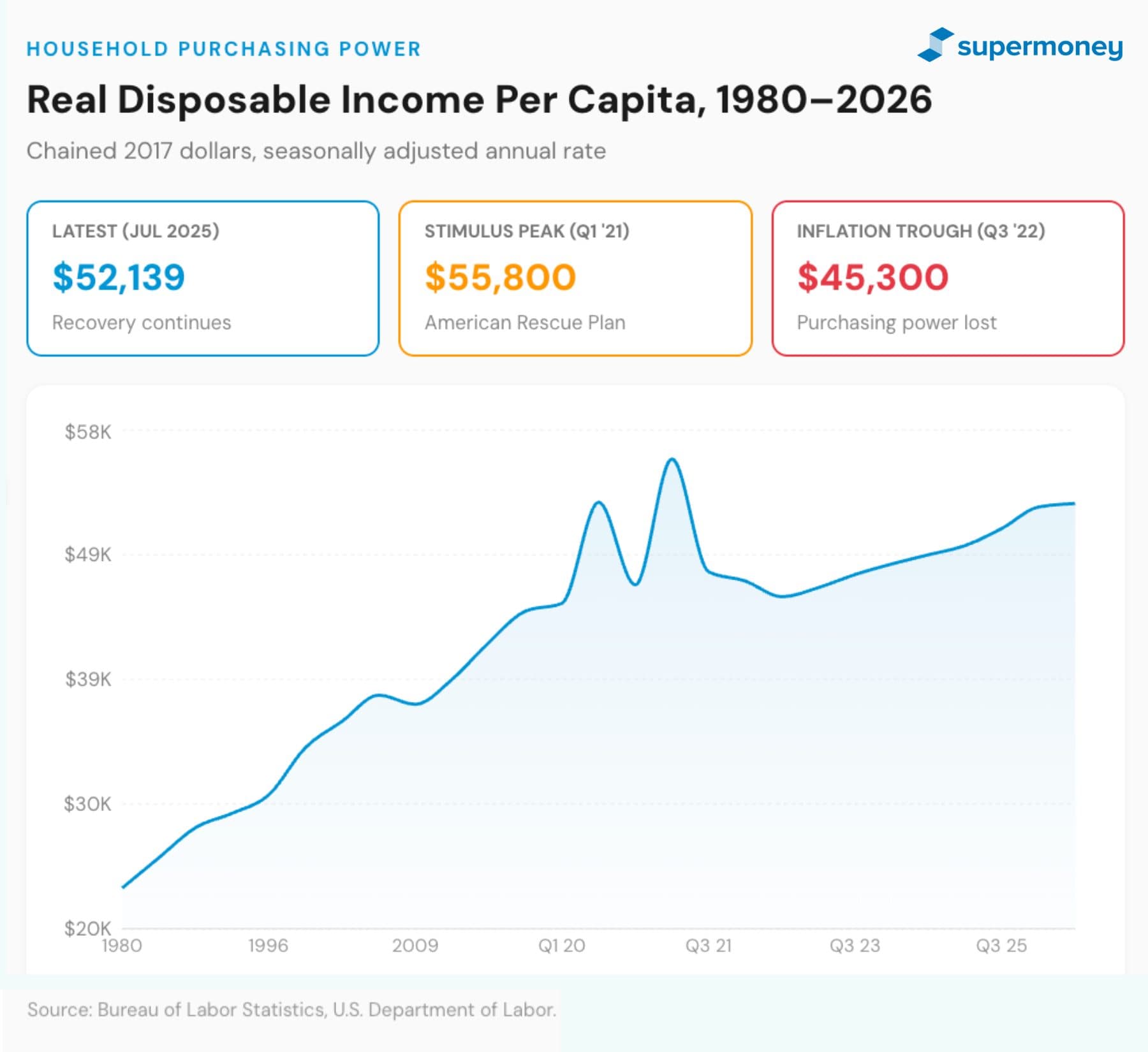
Real disposable personal income per capita had been climbing steadily, reaching $52,139 in July 2025. The gradual recovery reflected stable wage growth and moderating inflation through late 2025 and early 2026.
However, the March 2026 inflation rebound will almost certainly weigh on the next several months of disposable income data. With headline inflation jumping to 3.3% and energy costs surging, the purchasing power gains that households had been accumulating are now at risk of reversal.
The broader trajectory remains better than the 2022 inflation trough, but still falls short of the peaks reached during the 2020–2021 stimulus period. The energy shock adds a new layer of pressure on a recovery that was already fragile — particularly for households without significant savings buffers.
The stagflation question
The combination of accelerating inflation and softening economic indicators has revived talk of stagflation — the toxic combination of stagnant growth and rising prices that defined the 1970s economy.
The parallels are uncomfortable. Like the 1973 Arab oil embargo, the Iran conflict represents an external supply shock that pushes up energy costs in ways that monetary policy can’t directly address. Unemployment reached 4.3% in March 2026. Job growth, while still positive at 178,000, has been trending lower. Consumer confidence has weakened.
Fed Chair Jerome Powell pushed back on the comparison at the March press conference, saying he would “reserve the term stagflation for a much more serious set of circumstances.” But economists note that the building blocks are in place: an energy shock, tariff-driven goods inflation, and a labor market that’s cooling rather than overheating.
The key variable is duration. If the ceasefire holds and oil stabilizes, the stagflation scenario may not materialize. But if conflict resumes and oil returns above $110 per barrel, the April CPI could push inflation above 4% and force the Fed into territory where holding rates steady starts to look insufficient.
The government shutdown data gap
One important caveat for reading inflation trends through this period: the 43-day government shutdown in fall 2025 disrupted BLS data collection. October 2025 CPI data was never collected, and November’s report relied on incomplete sampling.
The BLS used a “carry-forward” methodology to fill the gaps, but economists note this likely imparted a downward bias to inflation readings from December 2025 through early 2026. As fresh data fully replaces the imputed figures this spring, some apparent acceleration in prices may simply reflect the normalization of data collection rather than genuine new price pressures.
What to watch next
The April 2026 CPI report — covering the first full month after the Iran war began with prices already elevated — could show headline inflation climbing above 4%. Some forecasters project headline CPI reaching 3.6% or higher, with core potentially drifting toward 2.9% by mid-year due to tariff effects and healthcare cost increases.
Key dates and events to monitor:
- Ceasefire status: The current two-week pause was announced April 8. If it breaks down, oil prices could return above $110/barrel.
- FOMC meeting, April 28–29: A unanimous hold is expected, but the statement language will signal how concerned officials are about inflation re-acceleration.
- Fed Chair transition: Jerome Powell’s four-year term as Chair expires May 15, 2026. The naming of a potential successor could shift market expectations on monetary policy direction.
- April CPI release, May 12: The first full-month reading after the war began. This will show whether the energy shock is bleeding into broader prices.
Frequently asked questions
Why did headline inflation jump so dramatically in one month?
The Iran war, which began in late February 2026, disrupted global oil supplies and sent gasoline prices up a record 21.2% in March — the largest single-month increase since BLS began tracking the category in 1967. Energy costs drove roughly three-quarters of the overall CPI increase.
Is core inflation still improving?
Broadly, yes. Core CPI (excluding food and energy) rose just 0.2% in March and 2.6% year-over-year — both below economists’ forecasts. While core ticked up slightly from February’s 2.5%, it remains well below the 3.1% level seen in mid-2025. The risk is that the energy shock eventually bleeds into core categories through higher transportation and production costs.
Will the Fed cut rates in 2026?
The Fed held rates steady at 3.50%–3.75% in March and is expected to hold again in April. The March dot plot still shows one cut penciled in for 2026, but many economists have removed rate cuts from their forecasts entirely. Some Fed officials have even raised the possibility of rate hikes if inflation doesn’t stabilize.
How do tariffs factor in?
The effective tariff rate has fallen from its April 2025 peak of 21% to roughly 8%, but cumulative tariff effects continue to push up prices on imported goods like apparel, toys, tools, and vehicles. Tariff-driven inflation was a pre-existing condition that the energy shock has now compounded.
What does the Fed’s projection say about future inflation?
The March 2026 Summary of Economic Projections forecasts PCE inflation of 2.7% for 2026 (up from 2.4% projected in December), declining to 2.2% in 2027. Core PCE is also projected at 2.7% for 2026. These projections were made before the full impact of the Iran war was reflected in data.
Could inflation go even higher?
Yes. Several forecasters project headline CPI reaching 3.6%–4.0% by April or May if energy prices remain elevated. Even if the ceasefire holds, lagged effects from higher fuel costs will continue pushing up transportation, shipping, and food prices for months.
Key takeaways
- Headline CPI surged to 3.3% in March 2026 — the highest since April 2024 — driven by a record one-month gasoline spike of 21.2%.
- Core CPI (excluding food and energy) remains relatively tame at 2.6%, actually better than expected and the closest to the Fed’s 2% target in years.
- The Iran war energy shock is layered on top of lingering tariff-driven inflation, creating a two-front inflation problem.
- The Fed is frozen at 3.50%–3.75% — unable to cut rates to support a softening economy or raise them to fight a supply shock it can’t control.
- Gas above $4/gallon and rising transportation costs are erasing months of real wage gains, especially for lower-income households.
- Economists warn April’s CPI could be even worse — potentially pushing above 4% if the ceasefire doesn’t hold.
Methodology note
This study uses seasonally adjusted data from the Bureau of Labor Statistics Consumer Price Index for All Urban Consumers (CPI-U). Year-over-year figures are not seasonally adjusted. Federal funds rate data is from the Federal Reserve Board of Governors. Real wages data is from BLS series on Real Earnings. Real disposable income data is from the Bureau of Economic Analysis. Sticky and flexible CPI categories are based on the Atlanta Fed’s methodology. All data is current as of April 10, 2026.
Article sources
- Consumer Price Index — March 2026 – U.S. Bureau of Labor Statistics
- CPI Home / Latest Numbers – BLS CPI
- FOMC Minutes, March 17–18, 2026 – Federal Reserve
- FOMC Statement and Summary of Economic Projections – Federal Reserve
- Real Earnings Summary – U.S. Bureau of Labor Statistics
- Personal Income and Outlays – Bureau of Economic Analysis
- Federal Funds Rate Data – FRED, Federal Reserve Bank of St. Louis
- Sticky-Price CPI – Federal Reserve Bank of Atlanta
- Fed Chair Term Information – Federal Reserve Board of Governors
Andrew is the Content Director for SuperMoney, a Certified Financial Planner®, and a Certified Personal Finance Counselor. He loves to geek out on financial data and translate it into actionable insights everyone can understand. His work is often cited by major publications and institutions, such as Forbes, U.S. News, Fox Business, SFGate, Realtor, Deloitte, and Business Insider.
Share this post:
Add as a preferred source on Google
Table of Contents