
Trump Announces New External Revenue Service Agency: What You Need to Know

Last updated 01/15/2025 by
SuperMoney Team
Edited by
Andrew Latham
Summary:
President Donald Trump has unveiled his proposal for a new federal agency, the External Revenue Service, aimed at collecting tariffs and taxes from foreign entities doing business in the United States. The announcement has sparked mixed reactions, with supporters lauding it as a step toward economic nationalism and critics arguing it could harm global trade relations and burden American families. This article explores the potential benefits and drawbacks of the agency, as well as its implications for businesses, taxpayers, and foreign trade partners.
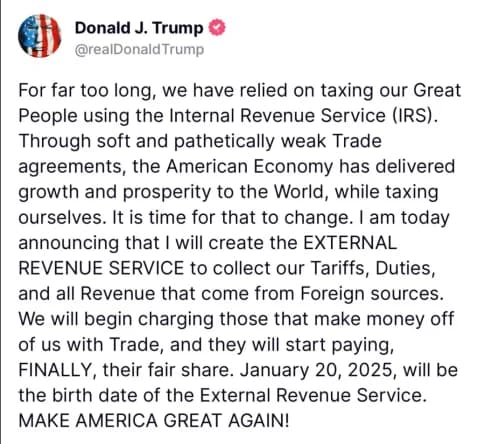
In a bold move to reshape the U.S. tax and trade landscape, President Donald Trump has proposed the creation of the External Revenue Service (ERS). The agency, according to Trump, would focus on collecting taxes, tariffs, and fees from foreign corporations and countries conducting business in the United States. Trump unveiled the plan during a campaign rally, framing it as a strategy to promote “economic independence” while reducing the tax burden on American citizens.
The announcement has drawn sharp reactions, with supporters applauding the plan as a long-overdue reform and critics warning of its potential downsides for global trade and American consumers.
Compare Business Credit Cards
Compare rates of multiple card issuers. Discover your lowest eligible rate.
What is the External Revenue Service?
The External Revenue Service, as outlined by Trump, would serve as a new federal agency separate from the Internal Revenue Service (IRS). While the IRS primarily collects taxes from American citizens and businesses, the ERS would focus exclusively on revenue generated from foreign entities. This could include tariffs on imported goods, fees from foreign corporations operating in the U.S., and other taxes aimed at non-domestic entities.
The proposal aligns with Trump’s longstanding “America First” agenda, which prioritizes reducing reliance on foreign nations and boosting domestic production. During his speech, Trump claimed the ERS could generate billions of dollars in additional revenue, allowing for further tax cuts for middle-class Americans and small businesses.
Supporters’ perspective: Boosting economic independence
Supporters of Trump’s proposal have praised the ERS as a step toward economic sovereignty and fair trade practices. They argue that the agency would level the playing field for American businesses that face competition from foreign companies operating under different regulatory and tax structures.
I really, really love this idea. Anything that gets us away from income taxes and towards tariffs is a great idea.” Economist EJ Antoni
Economist EJ Antoni of the Heritage Foundation expressed strong support for the idea. “I really, really love this idea,” Antoni told the New York Post. “Anything that gets us away from income taxes and towards tariffs is a great idea,” he added, noting that the ERS will likely be created by transforming an existing agency to “better serve” the American people.
Proponents also highlight how the plan aligns with traditional economic goals, such as reducing dependency on foreign imports and encouraging domestic manufacturing. Some may see the ERS as a way to address longstanding trade imbalances while potentially reducing the federal deficit by generating significant revenue without raising taxes on American citizens.
Critics’ perspective: Trade tensions and higher costs
Critics of the ERS proposal have raised concerns about its potential downsides, particularly its impact on international trade and diplomatic relations. Some warn that an aggressive approach to taxing foreign entities might provoke retaliatory measures, such as higher tariffs on U.S. goods exported abroad, which could harm American exporters and lead to trade wars.
No amount of silly rebranding will hide the fact that Trump is planning a multi-trillion-dollar tax hike on American families and small businesses to pay for another round of tax handouts to the rich,” Oregon Sen. Ron Wyden
Sen. Ron Wyden of Oregon, the top Democrat on the Senate Finance Committee, called the proposal “silly rebranding” and “a multi-trillion-dollar tax hike on American families and small businesses to pay for another round of tax handouts to the rich.” Wyden’s comments reflect broader concerns that the ERS could burden consumers and small businesses with higher costs while primarily benefiting wealthy individuals.
Other critics have pointed out that the ERS might create redundancies with existing agencies, such as Customs and Border Protection, which already oversees tariffs. They also worry about the potential for disruptions to global trade relations, as foreign governments may view the ERS as a protectionist move and respond with retaliatory actions.
How would the ERS impact American businesses?
The potential impact of the ERS on American businesses remains a topic of debate. Supporters argue that it could provide much-needed relief to domestic companies by reducing unfair competition from foreign corporations. By collecting more revenue from foreign entities, the ERS could ease the tax burden on U.S. businesses and consumers.
However, critics warn that the policy could lead to higher costs for industries reliant on imported goods. For example, manufacturing sectors that depend on foreign raw materials might face increased expenses if tariffs rise. On the other hand, industries producing goods domestically could see a boost in demand as foreign competitors face higher operating costs in the U.S.
The long-term success of the ERS would likely depend on how the agency structures its taxes and tariffs, as well as how foreign governments and corporations respond.
Frequently asked questions
How is the ERS different from the IRS?
The ERS would focus exclusively on collecting taxes and tariffs from foreign entities, whereas the IRS collects taxes from U.S. citizens and businesses.
What types of revenue would the ERS collect?
The ERS would collect tariffs on imported goods, fees from foreign corporations operating in the U.S., and potentially other taxes targeting non-domestic entities.
Would this lower taxes for Americans?
According to Trump, the ERS would generate enough revenue to allow for tax cuts for middle-class Americans. However, critics argue that the plan’s success depends on its implementation and the global response.
Could this lead to higher prices for consumers?
Yes, if foreign entities pass the cost of increased taxes and tariffs onto American importers, consumers could see higher prices for certain goods.
Key takeaways
- Former President Trump proposed the creation of the External Revenue Service, which would focus on taxing foreign entities.
- Supporters, like economist EJ Antoni, see the ERS as a way to reduce reliance on income taxes and promote tariffs.
- Critics, including Sen. Ron Wyden, argue the ERS would burden families and small businesses while benefiting the wealthy.
- The success of the ERS depends on its structure, foreign responses, and its impact on trade relations.
Share this post:
Add as a preferred source on Google
Table of Contents