
What Is The Fiji Currency? A Guide To Getting Fiji Currency For Travel Or Investment

Last updated 08/07/2024 by
Benjamin Locke
Edited by
Andrew Latham
Summary:
Fiji’s currency, the Fijian Dollar (FJD), was introduced in 1969, replacing the Fijian Pound. The FJD features unique designs that highlight Fiji’s natural beauty and cultural heritage. Travelers and investors can access Fijian currency through various methods, whether for daily expenses or investment purposes.
Fiji is an island nation located in the South Pacific Ocean, known for its stunning landscapes, vibrant culture, and warm hospitality. The official currency of Fiji is the Fijian Dollar (FJD), introduced in 1969 to replace the Fijian Pound and now features designs that highlight the country’s rich natural and cultural heritage.
What is the currency of Fiji?
The official currency of Fiji is the Fijian Dollar (FJD), abbreviated as FJ$. Introduced in its modern form in 1969, the Fijian Dollar replaced the Fijian Pound, which was used during the colonial era. Over the years, the currency has undergone several changes, including the removal of Queen Elizabeth II’s portrait from its banknotes and coins in 2012, replaced by images of local flora and fauna to better reflect Fiji’s cultural heritage.
What and where is Fiji?
Fiji is an island country located in the South Pacific Ocean, about 1,300 miles (2,100 kilometers) northeast of New Zealand. It comprises an archipelago of more than 330 islands, with around 110 of them permanently inhabited. The two major islands, Viti Levu and Vanua Levu, account for the majority of Fiji’s land area and population. Fiji is known for its stunning landscapes, including lush forests, mountains, and beautiful beaches, as well as its vibrant culture and welcoming people. The capital city, Suva, is situated on Viti Levu and serves as the country’s political and economic hub.
History of the Fijian Dollar
The first dollar
The initial iteration of the Fijian Dollar emerged between 1867 and 1873. During this period, Fiji issued notes in various denominations, including 12.5 cents, 25 cents, 50 cents, $1, $5, $10, $25, and $50. These early notes set the foundation for Fiji’s modern currency system.
The second dollar
The modern Fijian Dollar, or the second dollar, was introduced on January 15, 1969. This re-introduction included denominations of 50 cents, $1, $2, $10, and $20, with the $5 note added in 1970. Over the years, the Reserve Bank of Fiji, which took over from the Central Monetary Authority in 1986, introduced higher denominations, including the $50 note in 1996 and the $100 note in 2007.
In December 2012, Fiji decided to remove Queen Elizabeth II’s portrait from its banknotes and coins, replacing them with images of local flora and fauna. This change symbolized Fiji’s move towards a more locally representative currency.
Banknotes and coins in circulation
Banknotes
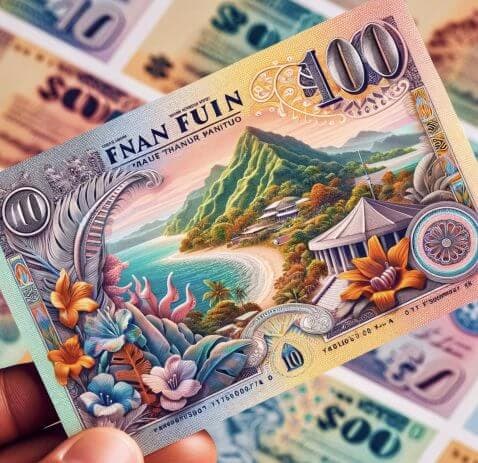
Currently, Fijian banknotes in circulation include the following denominations:
- $2
- $5
- $10
- $20
- $50
- $100
The banknotes feature various designs highlighting Fiji’s rich cultural heritage and natural beauty. For instance, the $2 note depicts a Mohar sovereign locket and the National Stadium in Suva, while the $100 note showcases a ceremonial presentation of Tabua (whale’s tooth) and Yaqona (kava bowl).
Coins
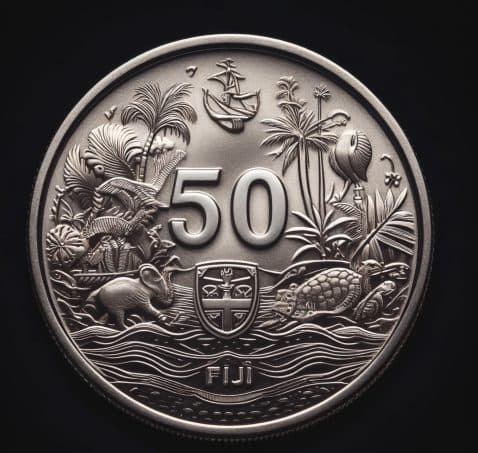
Fijian coins in circulation include:
- 5 cents
- 10 cents
- 20 cents
- 50 cents
- $1
- $2
Each coin features unique designs representing Fiji’s wildlife and traditional artifacts. For example, the 5-cent coin depicts the Nuqa-roro (Foxface Rabbitfish) and the Lali drum, while the $2 coin features the Peregrine Falcon and a traditional kava bowl Exchange Rates and Value.
As of May 2024, the exchange rate between the Fijian Dollar and the US Dollar (USD) is approximately 1 FJD to 0.44 USD. Conversely, 1 USD is equivalent to about 2.27 FJD. These rates fluctuate based on market conditions and are essential for currency conversion and international trade.
Table of current exchange rates
| Amount (FJD) | Equivalent (USD) |
| 1 FJD | 0.44 USD |
| 5 FJD | 2.20 USD |
| 10 FJD | 4.41 USD |
| 50 FJD | 22.05 USD |
| 100 FJD | 44.12 USD |
These exchange rates are influenced by various factors, including economic conditions, inflation rates, and global market trends. For real-time conversion, using tools like the XE Currency Converter can provide up-to-date exchange rates.
Several factors influence the value of the Fijian dollar in the global market, including economic indicators like inflation and GDP growth, political stability, trade balances, foreign investment, global economic conditions, and central bank policies. – Jonathan Brody, CEO Kratom Earth
International value comparison
Comparing the Fijian Dollar’s value against other major currencies can provide further insights:
- 1 FJD is approximately 0.66 Australian Dollars (AUD).
- 1 FJD is around 0.67 New Zealand Dollars (NZD).
- 1 FJD equals about 0.42 Euros (EUR).
- 1 FJD is roughly 55 Japanese Yen (JPY)
How do you get access to Fiji currency?
Accessing Fijian currency (FJD) is possible for both travelers and investors. While tourists need FJD for daily expenses during their stay, investors seek to gain exposure to this currency without traveling to Fiji. The following tables provide detailed methods for obtaining Fijian currency for both purposes.
Accessing Fiji currency for traveling
| Method | Description |
| Banks and ATMs | Withdraw Fijian Dollars from ATMs in urban areas, airports, and tourist spots. Banks also offer currency exchange services. |
| Currency Exchange Services | Convert foreign currency to Fijian Dollars at currency exchange offices, particularly in tourist areas and international airports. |
| Credit and Debit Cards | Use major credit and debit cards for transactions, and get cash advances at ATMs. |
| Travelers’ Cheques | Exchange travelers’ cheques at some banks and hotels, though this method is less common. |
Accessing Fiji currency for investment
| Method | Description |
| Foreign Exchange (Forex) Trading | Trade Fijian Dollars on the Forex market through online trading platforms. |
| International Banks and Financial Institutions | Set up an account with international banks that offer services to hold and trade Fijian Dollars. |
| Currency Exchange Services | Use specialized currency exchange services to purchase Fijian Dollars for investment. |
| Fiji Government Bonds and Securities | Invest in government-issued bonds and securities through international brokers. |
| Mutual Funds and ETFs | Invest in mutual funds and ETFs that include Fijian assets, available through brokerage accounts. |
| International Money Transfers | Transfer money to a Fijian bank account using services like Wise or PayPal for business interests. |
FAQ
How can I exchange foreign currency for Fijian Dollars before traveling?
You can exchange foreign currency for Fijian Dollars before traveling by ordering FJD online through currency exchange services, which often provide competitive rates. Additionally, you can exchange currency at a bureau de change in city centers or at your home airport, although airport rates may be less favorable.
What is the best way to handle money transactions in Fiji?
The best way to handle money transactions in Fiji is by using a combination of cash and credit/debit cards. While major cities and tourist areas have ATMs and card facilities, rural and remote areas may require cash. Ensure to carry sufficient FJD for areas without banking facilities.
Are there any fees associated with using ATMs in Fiji?
Yes, using ATMs in Fiji typically incurs fees. Fijian ATMs often charge around FJD$5 per withdrawal, in addition to any foreign ATM withdrawal or currency conversion fees your bank might impose. It is advisable to use ATMs associated with your bank, like Westpac or ANZ, to potentially avoid some fees.
What denominations are available for Fijian banknotes and coins?
Fijian banknotes come in denominations of $2, $5, $10, $20, $50, and $100. Coins are available in 5 cents, 10 cents, 20 cents, 50 cents, $1, and $2 denominations, each featuring designs of local flora, fauna, and cultural symbols.
Can I use traveler’s cheques in Fiji?
While some banks and hotels in Fiji still cash traveler’s cheques, they are not commonly used. Alternatives like ATM withdrawals or direct cash exchanges are generally more convenient and provide better value.
View Article Sources
View Article Sources
Key takeaways
- The Fijian Dollar (FJD) is the official currency of Fiji, introduced in its modern form in 1969, replacing the Fijian Pound.
- Fijian banknotes and coins feature designs representing local flora, fauna, and cultural symbols, with major updates in 2012 to better reflect Fiji’s heritage.
- Accessing Fijian currency for travel involves using banks, ATMs, currency exchange services, and credit/debit cards.
- Investors can access Fijian currency through Forex trading, international banks, currency exchange services, government bonds, mutual funds, ETFs, and international money transfers.
Share this post:
Add as a preferred source on Google
Table of Contents