
2027 ACA Open Enrollment Starts Nov. 1. Don’t Let Your Plan Auto-Renew

Last updated 10/30/2026 by
SuperMoney Team
Edited by
Andrew Latham
Summary:
Open enrollment for 2027 Marketplace health insurance starts Sunday, November 1, and this is not a year to let your plan auto-renew. Insurers filed a median 15% increase for 2027, the average monthly premium enrollees actually paid already jumped 58% this year after the enhanced tax credits expired, and 11 insurers are leaving Marketplaces next year. Shop by December 15, get your income estimate right, and compare total yearly cost, not just the monthly premium.
If you buy your own health insurance, Sunday is the day that decides what you pay all next year. Open enrollment for 2027 coverage on HealthCare.gov and the state Marketplaces opens November 1.
Most years, letting your plan roll over is a small risk. This year it’s a big one. Your premium, your subsidy and maybe even your insurer could all look different in January, and auto-renewal won’t ask you about any of it.
Get Competing Personal Loan Offers In Minutes
Compare rates from multiple vetted lenders. Discover your lowest eligible rate.
It's quick, free and won’t hurt your credit score
The rate hike is not the biggest hit
The headline number is real. Insurers selling Affordable Care Act (ACA) plans filed a median 15% premium increase for 2027, according to KFF, a nonprofit health policy research group that reviewed filings from 276 insurers in all 50 states and DC. That’s the second double-digit year in a row, after a 20% median increase for 2026.
But the bigger change already happened. The enhanced premium tax credits, the extra subsidies Congress added in 2021, expired at the end of 2025. The House passed an extension in January, but the Senate hasn’t acted, so the credits are not in place for 2027 either.
You can see the effect in what people actually pay. The sticker price of the average plan barely moved: $619 a month before tax credits in both 2025 and 2026, according to the Centers for Medicare & Medicaid Services (CMS), the agency that runs HealthCare.gov. What changed is how much of that bill landed on enrollees.
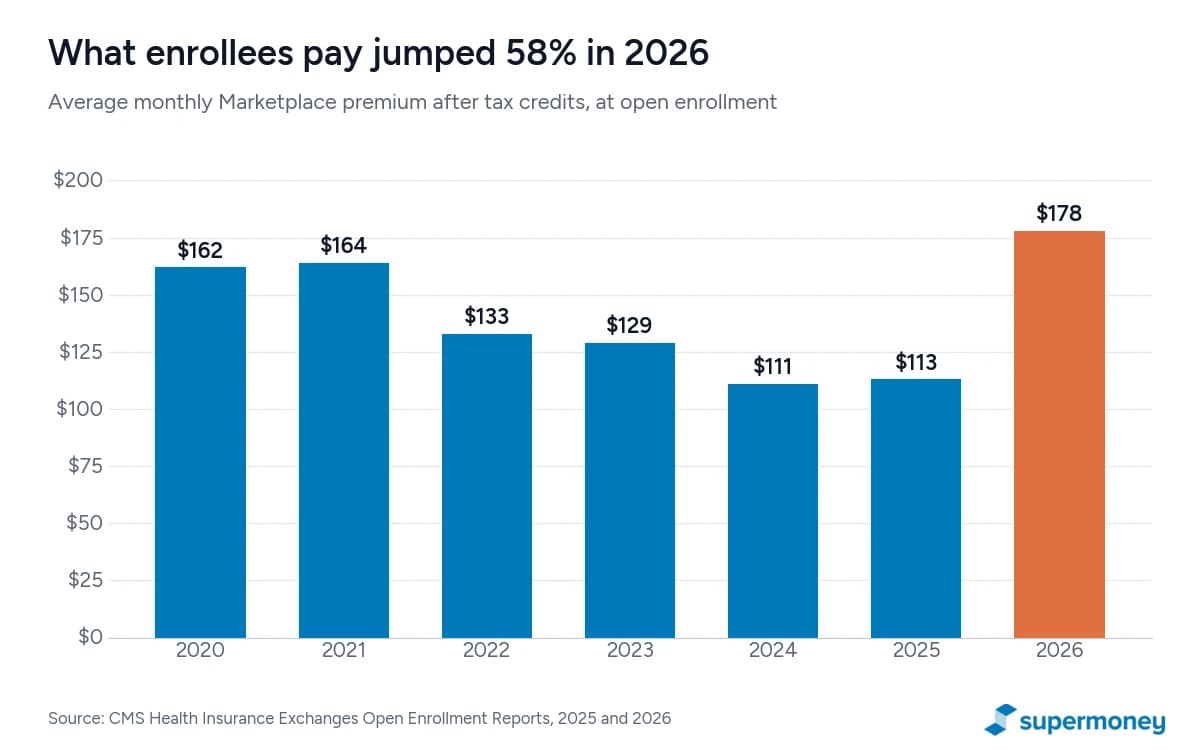
After tax credits, the average enrollee paid $113 a month in 2025 and $178 in 2026. That’s a 58% jump in one year, or $780 more over twelve months, before anyone filed a single new rate increase.
The subsidy cliff is back
The expired credits also removed a safety net for middle-income buyers. Under the original ACA rules, premium tax credits stop completely at 400% of the federal poverty level.
For 2027 coverage, that line is $63,840 for a single person, based on the 2026 federal poverty guidelines. Earn one dollar over it and your credit doesn’t shrink a little. It goes to zero, and you pay the full price of the plan.
For older buyers, whose full-price premiums are the highest, that can mean thousands of dollars a year riding on a few hundred dollars of income. KFF estimated before the credits expired that subsidized enrollees’ premium payments would more than double on average, and that older middle-income enrollees would take the biggest dollar hits.
Some plans won’t exist next year
Insurers are pulling back too. As of October 28, KFF counts 11 insurers that have announced they will leave the ACA Marketplaces for 2027, including Cigna, which is exiting all 11 states where it sells individual plans. Seven insurers are entering new states, but fewer insurers in a market usually means fewer choices and less pressure on price.
Here’s what happens if you do nothing. HealthCare.gov will likely re-enroll you, either in your current plan or a different plan from the same insurer. If your insurer is leaving, you’ll be moved to a plan from another company. Either way, the plan is picked for you, at a price you haven’t checked. Read about what’s driving 2027 health insurance costs for the bigger picture across employer plans too.
Three moves to make this month
1. Shop now, even if you like your plan
Log in and compare plans in the first week or two. The deadline for coverage that starts January 1 is December 15. Open enrollment runs through January 15 on HealthCare.gov, but plans picked after December 15 don’t start until February 1. State-run Marketplaces can set their own dates, so check yours.
Don’t stop at the premium. Confirm your doctors are in network, look up your prescriptions on each plan’s drug list, and check the deductible, the amount you pay for care before the plan starts sharing costs. If the difference trips you up, here’s how a deductible differs from an out-of-pocket maximum.
2. Get your income estimate right, and keep it right
Your tax credit is based on the income you expect for 2027. Guess low and you’ll get more credit up front than you’re owed. Starting with 2026 coverage, there’s no longer a cap on how much of that excess you repay at tax time, so the whole difference comes back to bite you. Guess high and you overpay all year.
If you’re anywhere near $63,840 as a single filer, treat that number like a wall. A bonus, a raise or one strong freelance month could push you over and erase your entire credit. Report income changes to the Marketplace during the year, not just at tax time.
The good news is that some of the best moves near the cliff aren’t health insurance decisions at all. The income that counts here is your modified adjusted gross income (MAGI), and pre-tax 401(k) contributions, deductible traditional IRA contributions and HSA contributions all lower it. A $2,000 pre-tax contribution that keeps you under the line can be worth far more than $2,000.
3. Compare total yearly cost, not the monthly premium
The cheapest premium with a deductible you can’t afford isn’t cheap. Add up twelve months of premiums, then add the care you’d realistically use. Here’s a hypothetical comparison of two plans:
| Plan | Monthly premium | Deductible | Light year ($1,000 of care) | Heavy year (hit the deductible) |
|---|---|---|---|---|
| Plan A (lower premium) | $350 | $7,500 | $5,200 | $11,700 |
| Plan B (higher premium) | $480 | $2,500 | $6,760 | $8,260 |
Totals are a year of premiums plus what you pay toward the deductible, before coinsurance and copays. Plan A wins by $1,560 in a quiet year. Plan B wins by $3,440 the year something goes wrong.
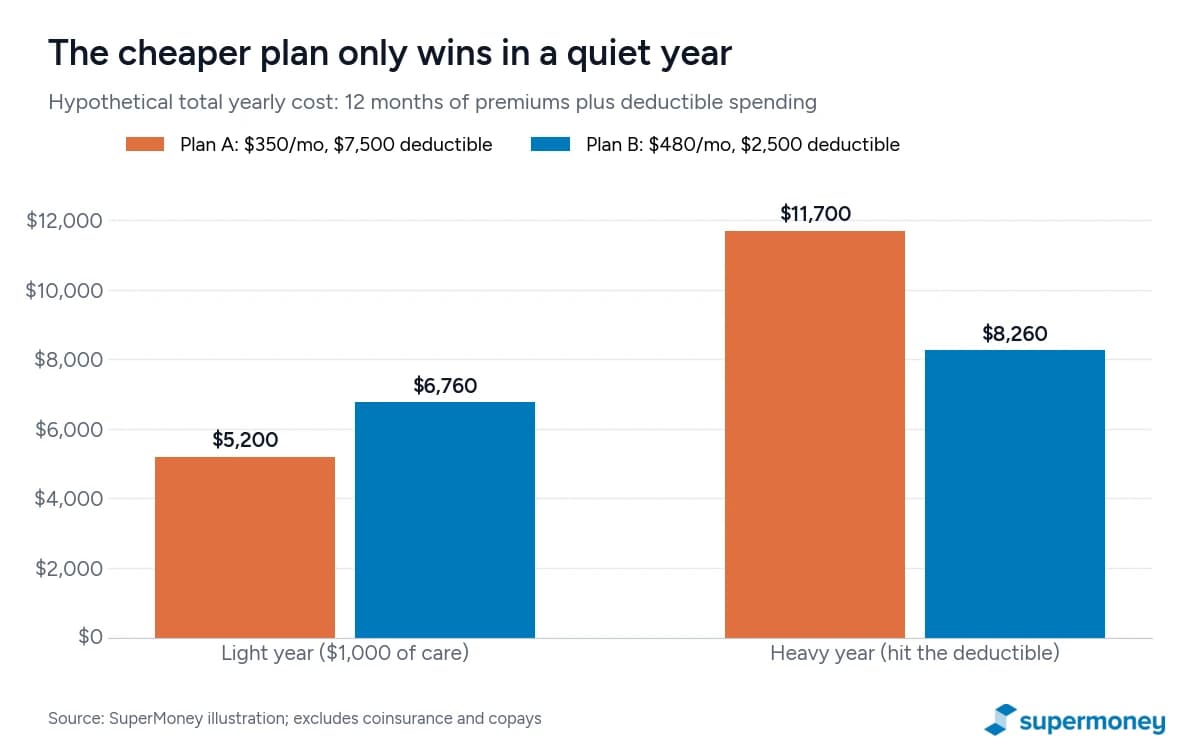
So ask yourself which year you can afford. If a $7,500 bill would land on a credit card, the low premium is a bet, not a bargain.
There’s no one-size-fits-all answer
The right plan depends on your income, your health, your doctors and how much cash you could cover in a bad year. Two neighbors with the same income can land on opposite plans, and both can be right.
Start with your real numbers. You can try SuperMoney free with a trial, link your accounts and ask Sense™, our AI money coach, to help you see what you can actually afford: what you spend each month, how much cash you could put toward a deductible, and how close your income runs to the subsidy cliff. It’s education, not a sales pitch.
If your situation is complicated, a licensed Marketplace navigator can help for free, and a tax professional can help you plan around the 400% line. Either way, give it an hour this month. It’s the hour that sets your health costs for all of 2027.
Key takeaways
- Open enrollment for 2027 Marketplace coverage runs November 1, 2026 to January 15, 2027 on HealthCare.gov. Pick a plan by December 15 for coverage starting January 1.
- Insurers filed a median 15% premium increase for 2027, after a 20% median increase for 2026.
- The average monthly premium enrollees paid after tax credits rose 58%, from $113 in 2025 to $178 in 2026, after the enhanced credits expired.
- Tax credits stop entirely above 400% of the poverty level, $63,840 for a single person for 2027 coverage.
- 11 insurers are leaving the Marketplaces for 2027, so some current plans won’t exist.
- Compare a year of premiums plus realistic out-of-pocket costs, and keep your income estimate current, since excess credits must now be repaid in full.
Share this post:
Add as a preferred source on Google
Table of Contents