
Americans Spend 4 hours a Day Thinking About Money—There Is a Silver Lining

Last updated 08/04/2025 by
SuperMoney Team
Edited by
Andrew Latham
Summary:
A new study by Empower reveals that Americans spend nearly four hours a day thinking about money. Gen Z leads the trend, with nearly five hours a day on average. While financial stress plays a role, many are turning their money mindset into action. This mental load, if managed well, can actually become a powerful tool for change.
Money is on Americans’ minds constantly. According to a recent study from Empower, people now spend an average of four hours a day thinking about their finances. For many, that’s nearly a part-time job in mental labor alone. But here’s the twist: that financial worry might actually be a good thing if it drives action.
Take control of your financial future
SuperMoney's AI-powered budgeting and personalized financial insights help you reduce financial stress and achieve your goals faster.
Younger generations think about money the most
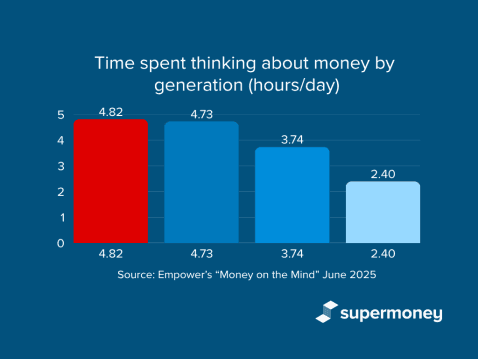
The Empower study found that Gen Z spends the most time thinking about money, averaging 4.82 hours each day. Millennials come in close behind at 4.73 hours. Gen X clocks 3.74 hours, while Boomers think about money for about 2.4 hours daily.
What are they thinking about? Tips, wages, rent, inflation, debt, and how to make it all work. Nearly half check their bank or investment accounts daily, especially Gen Z and Millennials.
The mental load is growing
More financial stress than last year
The study shows that 54% of Americans say they’re thinking about money more now than they were a year ago. That makes sense. With prices still high, student loan payments returning, and housing costs surging, people are in constant financial triage mode.
But here’s the encouraging part: 45% of those surveyed say this mental energy motivates them to take financial action, whether it’s budgeting, paying down debt, or setting savings goals.
From stress to strategy: turning anxiety into action
Planning can improve your money mindset
Financial worry doesn’t have to be paralyzing. In fact, the study suggests it can be productive. One in five respondents said creating a detailed financial plan would improve their mental state. Among Gen Z, that number rises to 25%. For Millennials, 23% agree.
Empower calls it “productive preoccupation.” The constant thinking may be unpleasant, but when it leads to planning, it can shift the narrative from stress to strength.
How to manage your financial mindset
Tips for using that mental energy wisely
Instead of letting money worries dominate your day, put that focus to work:
- Create or update a financial plan: Outline your income, expenses, goals, and debt payoff plan.
- Automate smart habits: Schedule transfers for savings or minimum debt payments to reduce daily decision fatigue.
- Set boundaries: Try checking your accounts only once a day or even just a few times a week to reduce stress and avoid impulsive decisions.
Your thoughts about money aren’t the problem. It’s what you do with them that counts. If you’re feeling overwhelmed, tools like SuperMoney’s AI-powered app can help ease the burden by organizing your financial life, offering personalized recommendations, and helping you stay on track with your goals.
Frequently asked questions
Is it bad to think about money too much?
Not necessarily. If thinking about money leads to stress with no action, it can be harmful. But if it prompts you to budget, save, or plan, then it can be a good thing.
Why do Gen Z and Millennials spend more time thinking about money?
Younger adults face rising student debt, job uncertainty, and high living costs, all while building financial foundations. It’s no surprise they’re laser-focused on money.
What can I do to reduce financial stress?
Create a financial plan, automate small wins (like savings), and limit how often you check accounts. Apps like SuperMoney’s financial assistant are designed to simplify this process and reduce mental load.
How do I know if I’m overthinking money?
If money worries disrupt sleep, focus, or mood, or you check your accounts obsessively, it’s time to reset. Set time-bound financial “check-ins” and stick to them.
Key takeaways
- Americans now spend nearly 4 hours a day thinking about money
- Gen Z and Millennials report the highest mental load
- Over 50% say they think about money more than last year
- 45% say it pushes them to take action
- 1 in 5 believe a detailed financial plan would ease the stress
- Turning worry into strategy is the real game-changer
- SuperMoney’s app offers AI-powered tools to turn stress into progress
Feeling overwhelmed by money worries?
SuperMoney's AI-powered budgeting tools help you track your money goes, set realistic goals, and reduce financial stress.
Share this post:
Add as a preferred source on Google
Table of Contents