
Nearly 1 in 4 Car Claims Is Now a Total Loss. Check Your Deductible and Coverage Before You Need Them

Last updated 10/21/2026 by
SuperMoney Team
Edited by
Andrew Latham
Summary:
About 23.5% of auto insurance claims in the first half of 2026 ended as total losses, the average repair runs $4,821, and more drivers carry deductibles of $1,000 or more. A higher deductible can trim your premium, but only if you could actually write that check tomorrow. Pick the deductible you can cover from savings, and make sure your coverage matches what your car is worth.
You get in a fender bender. The shop sends an estimate, the adjuster calls, and then you hear the word “total.” Your car is worth less than the repair, so the insurer is cutting you a check instead.
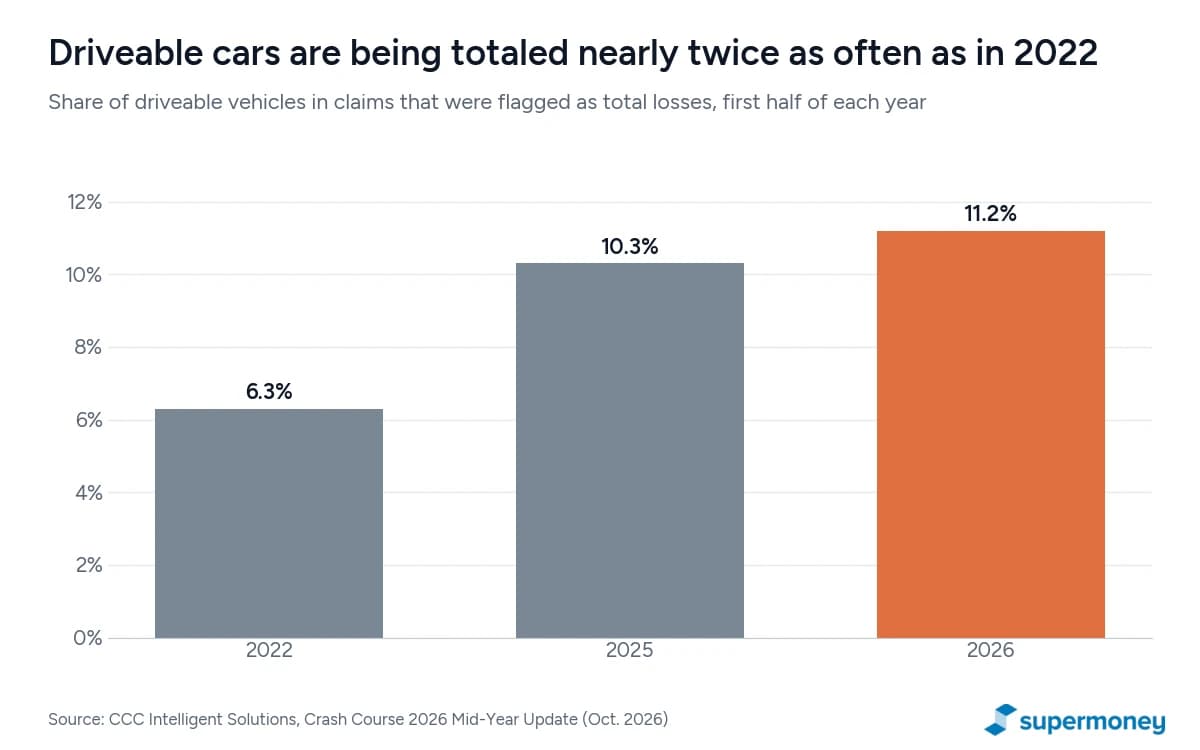
That conversation is getting more common. A mid-year report from CCC Intelligent Solutions found that 23.5% of auto claims were flagged as total losses in the first half of 2026. Even more telling, 11.2% of driveable vehicles that went through a claim were flagged as total losses, up from 10.3% a year earlier and 6.3% in 2022. Cars that look fine are being written off because repairs are costing so much.
So what does this mean for what you pay and what you’re covered for? Plenty, and most of it is in your control.
Compare Auto Insurance Providers
Compare multiple vetted providers. Discover your best option.
Why repairs keep getting pricier
The average cost of a repairable claim was $4,821 in the first half of 2026. In 2020 it was $3,331. Parts prices jumped 8% year over year, and about 30% of repairable estimates in the first quarter included a sensor calibration, up from 23.3% a year earlier. Bumpers and windshields aren’t just glass and plastic anymore. They’re packed with cameras and radar.
The result is that an average adjusted vehicle value of $13,594 (CCC’s figure across its total loss valuations through the second quarter) can be wiped out by a repair bill that once would have been routine. Older cars are hit the hardest. Vehicles seven years or older made up 74.3% of total loss valuations.
The deductible trend nobody talks about
Here’s the number I’d stare at: 28.4% of repairable collision claims now carry a deductible of $1,000 or more. That’s up from 25.7% a year earlier and 20.3% in 2022.
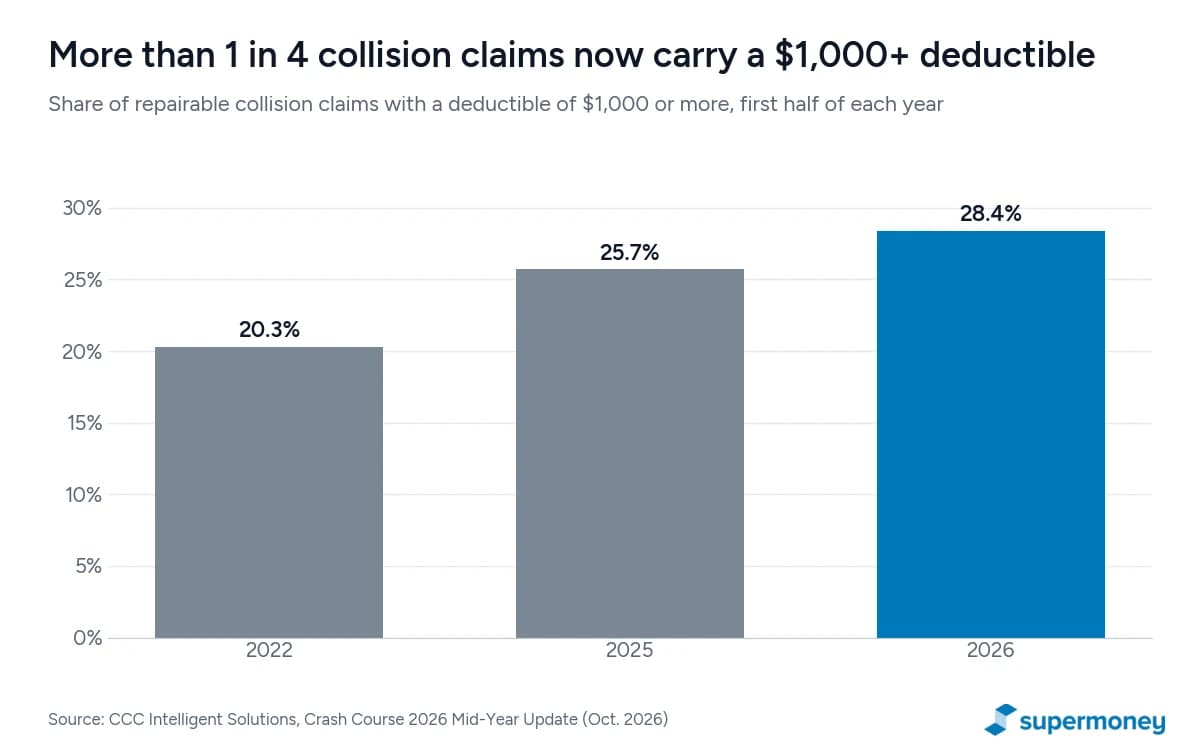
Drivers are raising deductibles to hold down premiums. That’s a legitimate move. But it only works if you’ve got the cash.
Let’s use a hypothetical. Say moving from a $500 to a $1,000 deductible cuts your premium by $150 a year (your quote will differ, so ask for both numbers). You’d need to go about three and a third years without a claim just to break even on the extra $500 you’d pay out of pocket. If you have a claim in year two, you’re behind.
If you’ve got an emergency fund and rarely claim, the higher deductible usually wins. If a surprise $1,000 would land on a credit card at 22% APR, it doesn’t. At that rate, carrying $1,000 for a year costs about $220 in interest. That wipes out the savings and then some.
Many drivers just pay for repairs themselves
CCC found 26% of repair orders in the first half were self-pay, meaning the driver skipped insurance. The average self-pay repair cost $1,941, versus $4,821 for repairs billed to insurers. More than 71% of self-pay jobs were under $2,000.
That makes sense. When your deductible is $1,000 and the repair is $1,500, you’re only getting $500 from the insurer, and you risk a rate bump. Some drivers decide it’s not worth it. That’s fine, but know the rules for your policy and state, and don’t count on small claims being free of consequences.
Is full coverage worth it on an older car?
This is where I see the most waste. Collision and comprehensive coverage pays out up to the car’s current market value, minus your deductible. On a car worth $4,000 with a $1,000 deductible, the most you’d ever collect is $3,000. If you pay $700 a year for that coverage, you’re paying 23% of your maximum payout every year.
A common rule of thumb says to rethink collision when the annual cost of the coverage approaches 10% of the car’s value. On a $4,000 car, that’s $400. Check your numbers. If you can afford to replace the car from savings, dropping collision can make sense. Keep liability coverage, though. That protects you from a lawsuit, and you never want to skimp there.
If your car is financed, your lender will require collision and comprehensive. Ask about gap coverage too if you owe more than the car’s worth. With a long loan, that gap can be thousands of dollars.
What to do this month
Pull up your declarations page and find your current deductibles for collision and comprehensive. Ask your insurer for quotes at $500, $1,000, and $1,500, so you can see exactly what each step saves.
Set the deductible equal to what you could cover from savings without borrowing. If that number is $500, don’t go higher just to shave a few dollars.
Then shop around. The premium for the exact same coverage can differ by hundreds of dollars between insurers, and comparing car insurance quotes takes about 20 minutes. Do it at least once every year or two.
Finally, if you drive an older car, run the value test above. Look up your car’s market value and compare it to what you pay for collision.
Use your money picture to choose
The right deductible depends on how much cash you have on hand, and that’s easy to lose track of. The SuperMoney app shows your savings, spending, and debts in one place, so you can see whether you could cover a $1,000 deductible without touching a credit card. It can also help you spot an insurance bill that’s crept up over the year.
Key takeaways
- 23.5% of auto claims were total losses in the first half of 2026, and 11.2% of driveable vehicles in claims were written off anyway.
- The average repair cost is $4,821, up from $3,331 in 2020. Parts prices rose 8% in a year.
- 28.4% of repairable collision claims carry a $1,000 or higher deductible, up from 20.3% in 2022.
- A $150 annual premium savings takes more than three years to cover an extra $500 deductible.
- Self-pay repairs are 26% of repair orders and average $1,941.
Share this post:
Add as a preferred source on Google
Table of Contents