
How to Consolidate Credit Card Debt the Right Way (Avoid These 4 Costly Mistakes)

Last updated 09/18/2026 by
Andrew Latham
Summary:
Debt consolidation moves high-interest debt to one lower-rate loan, and right now the gap is wide: credit cards that carry a balance average 22.15% APR while a two-year personal loan at a bank averages 11.86%. On $10,000, that gap is worth about $2,817 and nine months off your payoff date if you keep sending the same payment. It fails for three reasons, and none of them is the loan itself: stretching the term too long, ignoring the origination fee, and running the cards back up. Do those three things right and consolidation works. Skip them and you just rearranged the furniture.
Let me start with the number that made me want to write this. In 2025, Americans paid roughly $181 billion in credit card interest. That’s not principal. That’s the rental fee on money already spent, and it’s more than double what we were paying in 2021.
Meanwhile, credit card balances sit at $1.26 trillion, according to the New York Fed’s latest Household Debt and Credit report. The average cardholder carries $6,659. And 6.97% of card balances are now seriously delinquent, meaning 90 days or more past due.
So the question “should I consolidate my debt?” isn’t academic. For a lot of people, it’s the difference between being done in three years and being done in twenty-five.
Debt consolidation is a good tool that gets a bad rap because it is often misused. It’s oversold by lenders who want your application, and it’s dismissed out of hand by personal finance personalities who’ve decided that any borrowing is a moral failure. Both camps are wrong.
Get Competing Debt Consolidation Loan Offers
Consolidate your debt into one manageable loan with better rates and terms.
It's quick, easy and won’t hurt your credit score.
What debt consolidation actually is
Debt consolidation means taking out one new loan or credit line, using it to pay off several existing debts, and then making a single payment on the new one. The debts don’t disappear. They move.
The whole point is the rate. The Federal Reserve’s G.19 release puts the average APR on credit cards that carry a balance at 22.15%. The average rate on a 24-month personal loan at a commercial bank is 11.86%. That’s a gap of more than ten percentage points, and it’s the widest it’s been in years.
There’s a second benefit people underrate. A credit card is a revolving line with no end date, and minimum payments are engineered so the balance barely moves. A consolidation loan is amortizing, which means every payment is calculated to kill the balance on a fixed schedule. You get a payoff date. That structural change does more work than most people expect.
What the math actually looks like
Take $10,000 on a card at 22.15%.
Pay the minimum, which most issuers set at 1% of the balance plus that month’s interest, and you’ll be at it for 25 years and hand over $17,388 in interest. You’d pay back nearly three times what you borrowed.
Now move that $10,000 to a three-year consolidation loan at 11.86%. Your payment is $331 a month, and you’ll pay $1,933 in interest total. Done in 36 months. Obviously, the cost will change depending on the rate you qualify for.
The same payment on a 22.15% credit card takes 45 months to repay. Credit card minimum payments leave $5,472 still owed after five years.
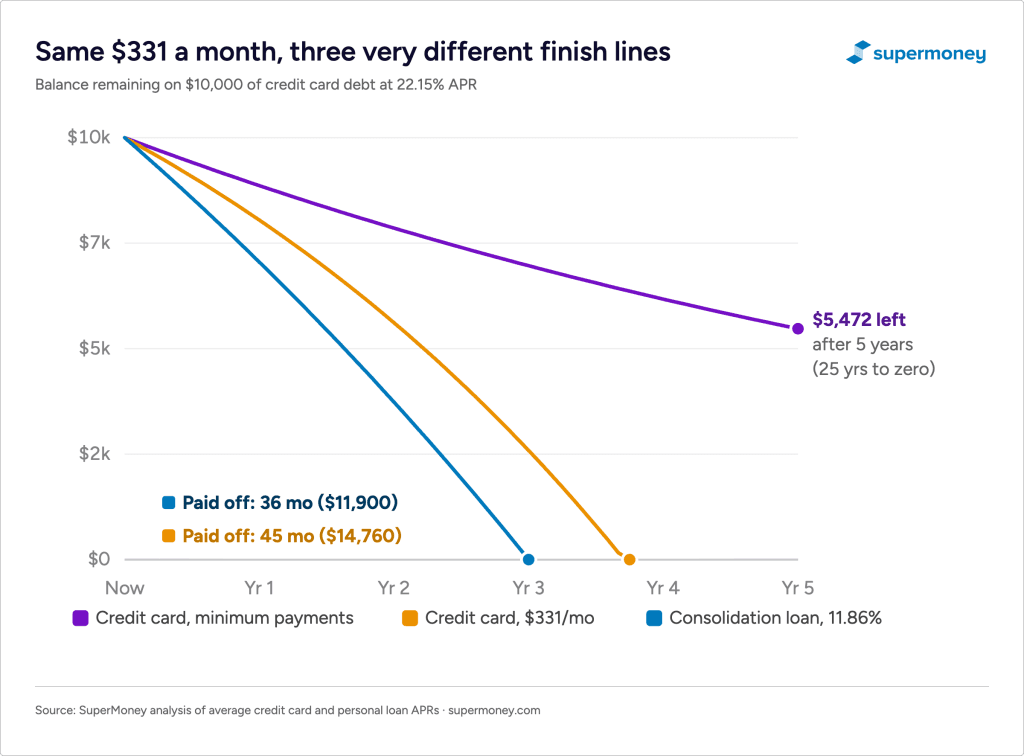
However, comparing a consolidation loan to minimum payments isn’t really comparing apples to apples. So here’s the transparent version. Take that same $331 a month and throw it at the card instead, at 22.15%, with no new loan at all. You’d be debt-free in 45 months and pay $4,750 in interest.
Against that, the consolidation loan saves you $2,817 and nine months. On a $10,000 balance, a single afternoon of paperwork buying you $2,817 is one of the better hourly rates you’ll ever earn.
Your five options, ranked by how often they’re the right answer
A personal loan. The default, and the right call for most people carrying four or five figures across several cards. Fixed rate, fixed term, no collateral, funds usually in a few days. Here’s a fuller breakdown of using a personal loan for debt consolidation.
A 0% balance transfer card. Better than a loan if, and only if, you can clear the balance inside the promotional window. Intro periods run up to about 21 months and transfer fees run 3% to 5%. Miss the deadline and the leftover balance snaps back to a rate north of 20%. Read how balance transfers work before you commit to one.
A home equity loan or HELOC. Cheapest rates on the list because your house secures the debt. That sentence is also the entire warning. You’re converting debt that can, in a disaster, be discharged in bankruptcy into debt that can take your home. I recommend this only to people with stable income who have genuinely fixed the spending problem, not people who hope to.
A debt management plan. If your score is in the 500s or low 600s, you won’t qualify for a loan at a rate worth having. A nonprofit credit counseling agency can negotiate your card rates down, often into the single digits, and roll everything into one payment. No loan, no credit score requirement. See how debt management compares to debt consolidation.
A 401(k) loan. Last on my list on purpose. You’re borrowing from your own retirement, the money stops compounding while it’s out, and if you leave your job the balance can come due fast. It’s not never. It’s rarely.
Mistake one: stretching the term until the savings vanish
This is the big one, and almost nobody writes about it honestly, because the longer term is what makes the monthly payment look attractive on a lender’s landing page.
A lower rate over a longer period can cost you more money than a higher rate over a shorter one. Rate and time both matter, and time is sneaky.
Take $20,000 at 11.86%. Over 36 months you pay $3,866 in interest. Over 84 months, at the same rate, you pay $9,531. Same balance, same APR, nearly two and a half times the interest, purely because the money was out longer.
At 11.86% APR, a $20,000 consolidation loan costs $2,564 in interest over 24 months and $9,531 over 84 months. The 84-month figure exceeds the $9,501 of interest you would pay attacking the same balance on a 22.15% credit card at $663 a month.
Stretch the term far enough and the savings disappear.
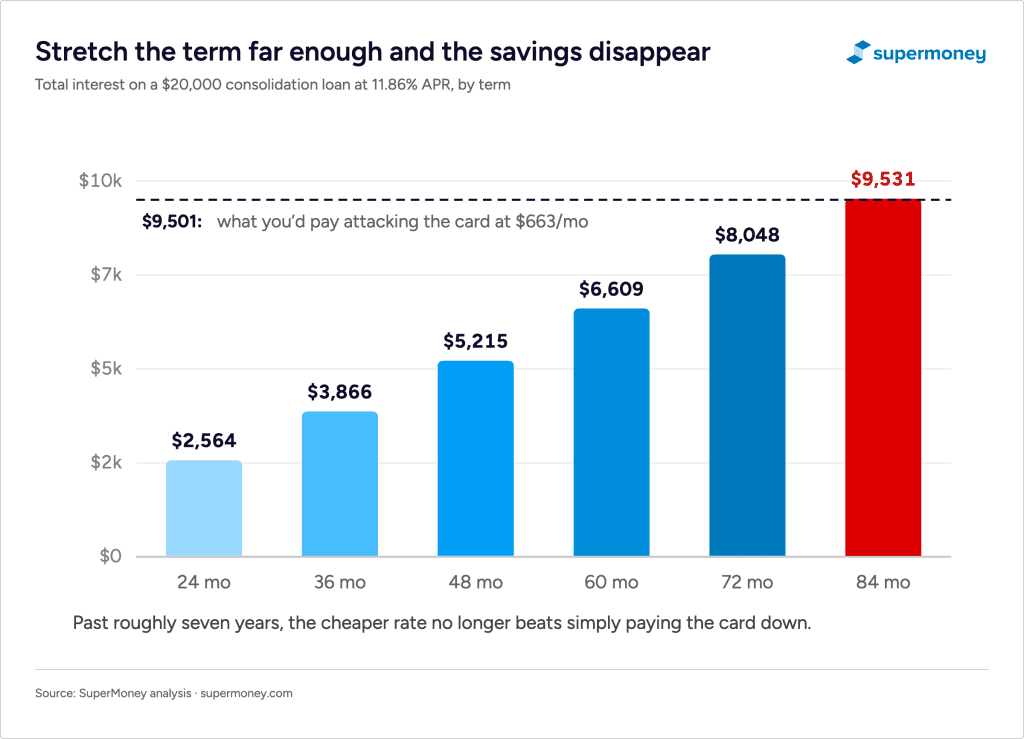
Past roughly seven years, the cheaper rate no longer beats simply paying the card down.
Now look at where that 84-month bar lands. If you’d skipped the loan entirely and attacked that $20,000 card balance at 22.15% with $663 a month, you’d have paid $9,501 in interest and been done in 45 months. The seven-year consolidation loan costs $9,531. You cut your interest rate nearly in half, you paid a fee for the privilege, and you ended up handing over slightly more money over twice as long.
That’s the trap. So here’s my rule: pick the shortest term you can actually afford, and treat anything past 60 months as a warning sign. If the only payment that fits your budget requires a seven-year term, the problem isn’t your interest rate. It’s that the debt is too big for your income, and a different tool (credit counseling, or a hard look at the income side) will serve you better than a long loan.
Mistake two: shopping the rate and ignoring the fee
Personal loan origination fees run from 0% to about 8%, and they’re usually deducted from your proceeds. Ask for $20,000 with a 5% fee and $19,000 lands in your account, but you owe interest on the full $20,000.
People compare headline APRs and skip this entirely. They shouldn’t. Run the fee through the math, and an 11.86% loan over 36 months becomes:
- No fee: 11.86% effective APR, $3,866 in total cost
- 3% fee: 13.99% effective, $4,604
- 5% fee: 15.46% effective, $5,122
- 8% fee: 17.76% effective, $5,942
An 8% origination fee turns a loan that looked like it cut your rate in half into one that barely beats your card. Always compare the all-in APR, which by law includes the origination fee, not the interest rate. If a lender quotes you an interest rate and an APR that are meaningfully different, the gap is the fee.
Which gives you a threshold worth memorizing. With a typical origination fee, a consolidation loan stops beating a disciplined card payoff somewhere around an 18% headline rate. Practically speaking: if your quoted rate isn’t at least four or five points below your current card APR, don’t bother. You’re paying a fee and filling out paperwork to move sideways.
Mistake three: the one Ramsey is actually right about
Dave Ramsey’s team says debt consolidation flatly doesn’t work. Their position is that “you can’t borrow your way out of debt” and that you’ll “end up paying about the same as you would on your own.”
It’s a good slogan, but the math doesn’t add up. A ten-point rate cut is not nothing. Telling someone with $20,000 at 22% that moving to 12% is meaningless is, respectfully, not very helpful.
But he’s pointing at something very real, and it’s the reason I don’t recommend consolidation to everyone who asks. TransUnion tracked what actually happens to people after they consolidate card debt with a personal loan. Median credit card utilization dropped from 59% to 14% the moment the loan funded. Eighteen months later, it was back to 42%.
TransUnion found median credit card utilization fell from 59% before consolidating to 14% immediately after, then climbed back to 42% within 18 months. It’s what I call the debt consolidation bounce.
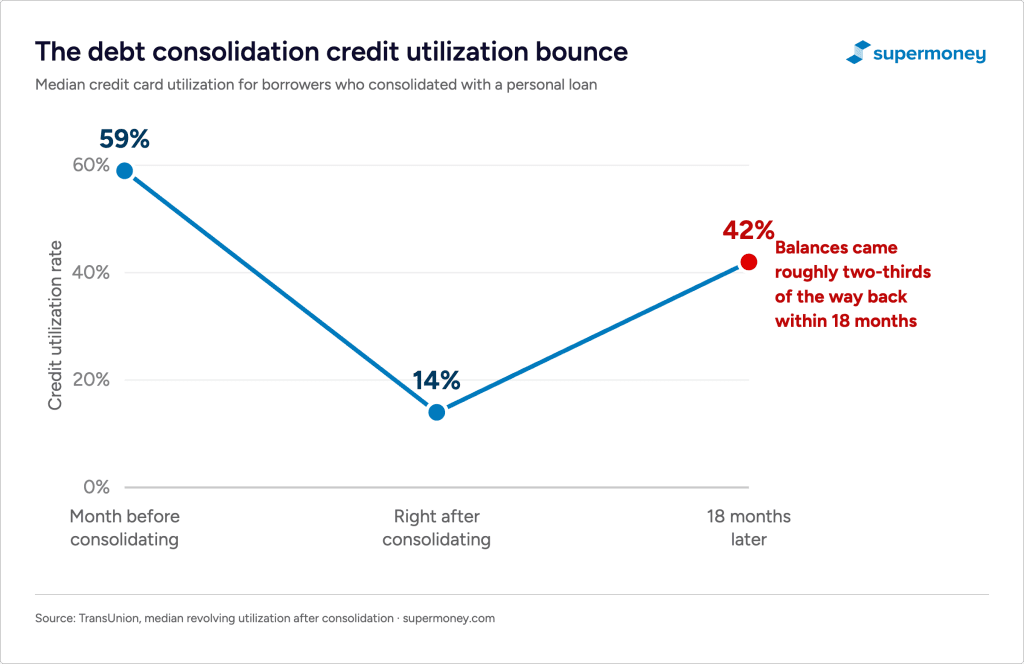
Read that chart carefully, because it’s the whole argument. The loan worked. It did exactly what it promised, instantly. And then a large share of borrowers filled the cards back up and ended up owing the loan and the cards.
The same study found consolidators gained about 18 points on their credit scores on average. Prime borrowers held onto that gain. Near-prime and subprime borrowers gave it back over the following year and a half.
So Ramsey is right about the failure mode and wrong about the cause. The loan isn’t what fails. The unchanged spending is what fails, and the loan is just what was standing nearby when it happened. Blaming consolidation for the rebound is like blaming a cast for a second broken arm.
U.S. News asked me about this exact pattern for a piece published this week on what usually goes wrong with debt consolidation, and my answer was short:
“It’s a tool, and success depends on how you use it.”
A consolidation loan refinances a balance. That’s all it does, and it does it well. It does not touch the reason the balance existed. If you don’t pair it with a plan for why the cards filled up in the first place, you’ve bought yourself a cheaper version of the same problem, and in 18 months you’ll have the cheaper version plus the original.
The fix is unglamorous and takes about ten minutes:
- Take the cards out of your wallet and out of your browser’s autofill. Don’t close them, since that shrinks your available credit and can ding your score. Just make them inconvenient.
- Autopay the new loan so the payoff date is a fact rather than an intention.
- Figure out what actually drove the balances. If it was a medical bill or a job gap, you have a cash-flow problem and consolidation is a fine answer. If it was ordinary month-to-month overspending, fix the budget first or you’ll be back here in 18 months.
- Build a small emergency cushion, even $1,000. Most rebound balances start with a car repair, not a shopping spree.
Mistake four: taking the first offer you’re given
This one costs more money than all the others and takes the least effort to avoid.
Lenders price the same borrower very differently. They weight income, employment history, existing debt, and their own appetite for risk in ways that have nothing to do with each other. We looked at roughly 160,000 prequalified offers made to more than 15,000 borrowers through SuperMoney’s platform, and the average borrower’s highest and lowest offer were 7.1 percentage points apart. Same person, same day, same loan.
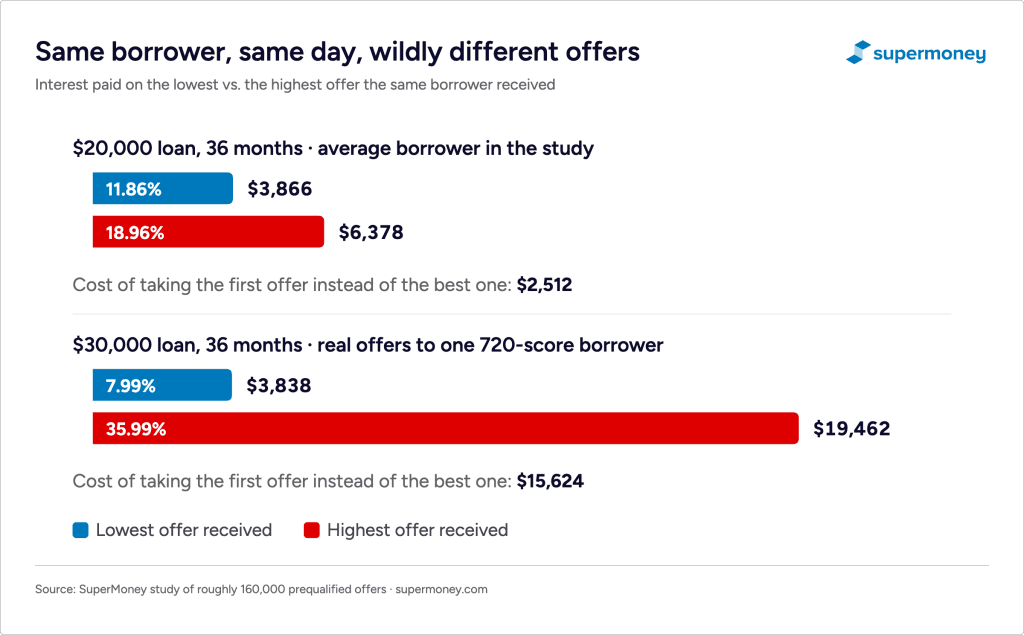
On a $20,000 three-year loan, 7.1 points is $2,512.
And the averages hide how wild the tails get. One borrower with a 720 score looking for $30,000 got offers ranging from 7.99% to 35.99%.
On a $20,000 three-year loan, the average borrower’s lowest offer costs $3,866 in interest and their highest costs $6,378. For one 720-score borrower seeking $30,000, offers ranged from 7.99% to 35.99% APR, a difference of $15,624 in interest.
People skip this step because they think shopping around wrecks their credit. However, that is not true when you shop with lenders and aggregators that allow you to prequalify for loans without a hard credit pull. Prequalifying uses a soft credit pull, which does not affect your score at all. You can prequalify with a dozen lenders and your score won’t move a point. Soft pulls are free, and they’re how you find the bottom of that 7.1-point range.
However, it is true that you usually get a hard credit pull when you accept the loan offer, even if prequalifying for it only triggered a soft credit pull. Something else to consider is that FICO’s rate-shopping window, the rule that bundles multiple applications into one inquiry, covers mortgages, auto loans, and student loans. It does not cover personal loans. Every formal personal loan application is its own hard inquiry.
So do it in this order. Prequalify with three to five lenders using soft pulls, compare the real offers, then submit exactly one full application to whichever one won. You get the benefit of shopping without collecting hard inquiries.
When you should not consolidate
Skip consolidation if:
- You can clear the balance in 12 to 18 months at your current payment. The fee and the paperwork aren’t worth it.
- Your best offer isn’t at least four or five points under your card APR, after fees.
- The only affordable payment requires a term past five years.
- Your total unsecured debt is more than about half your annual income. At that point you likely need credit counseling or a conversation about bankruptcy, not a refinance.
- You know, honestly, that the cards will be full again by spring. Fix that first. The loan will still be available.
One more warning. The debt relief space attracts predators. Anyone charging large upfront fees, promising to “erase” debts, or telling you to stop paying your creditors while they negotiate is a problem. Real consolidation is just a loan. Here’s what to watch for with debt consolidation scams.
How to do this right, in order
- List every debt with its balance, APR, and minimum payment. Add it up. Most people are off by a few thousand dollars, usually in the wrong direction.
- Calculate your blended rate. Weight each APR by its balance. This is the number your new loan has to beat, not the rate on your worst card.
- Check your credit score before you apply so you know which options are realistic.
- Prequalify with at least three lenders. Soft pulls only. This is the step worth thousands.
- Compare the all-in APR and the total interest over the life of the loan. Not the monthly payment. The monthly payment is how you get talked into 84 months.
- Take the shortest term you can afford, then set up autopay.
- Pay the cards off in full the day the money lands, then make them hard to reach.
- Redirect the freed-up minimums. You were paying those anyway. Send them at the loan or into savings, not into your lifestyle.
The part an article can’t do for you
Everything above uses averages, because that’s all I have to work with here. You don’t have average debt at an average rate with an average budget. You have your specific balances, your specific APRs, your specific income, and your specific spending patterns, and those four things decide whether consolidation is the best move you’ll make this year or a waste of a hard inquiry.
That’s the gap the SuperMoney app is built to close. Link your accounts and Sense AI, the financial assistant inside it, reads your actual balances and rates, builds a payoff plan from your real numbers, and shows you your debt-free date and what you’d save. It compares consolidation against a balance transfer against simply attacking the cards, using your budget rather than my $10,000 example. Then it checks your prequalified offers from multiple lenders in one place, which is the step that was worth $2,512 to the average borrower in our study.
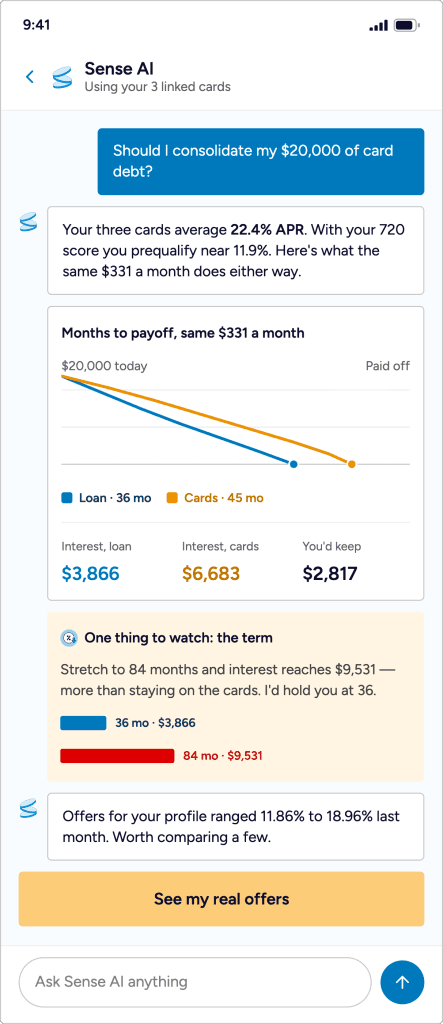
It also watches the part of this that actually determines whether consolidation sticks. It sees your spending, so it can tell you what’s rebuilding the balances and flag it early rather than 18 months later when the cards are full again.
If you want the full comparison in one shot, try this once you’ve linked your accounts:
Look at all my debts and rates. Compare consolidating them into a personal loan against a 0% balance transfer and against just paying the cards down at my current payment. Show total interest and payoff date for each, factor in origination fees, and tell me which one wins for my situation and why.
The app is free to try for a week, which is more than enough time to get a personalized plan and see the numbers on your own debt. If it tells you consolidation isn’t worth it for you, that’s a useful answer too, and you’ll have it before you apply for anything.
Key takeaways
- Credit cards carrying a balance average 22.15% APR while a 24-month bank personal loan averages 11.86%, a gap of more than ten percentage points (Federal Reserve, Q2 2026).
- On $10,000, consolidating at 11.86% saves $2,817 and nine months versus sending the same $331 payment to a 22.15% card.
- Term length can erase the benefit: $20,000 at 11.86% costs $3,866 in interest over 36 months and $9,531 over 84 months, roughly what you’d pay staying on the card.
- An 8% origination fee turns an 11.86% loan into a 17.76% effective APR. Compare all-in APR, not interest rate.
- Median credit card utilization fell from 59% to 14% after consolidating, then rebounded to 42% within 18 months (TransUnion), which is why habit change matters more than the loan.
- The average borrower’s highest and lowest loan offers were 7.1 percentage points apart, worth $2,512 on a $20,000 three-year loan (SuperMoney study of ~160,000 offers).
- Americans paid about $181 billion in credit card interest in 2025, more than double 2021 levels.
Rate and savings disclaimer: The interest rates, average balances, and savings examples in this article are based on published Federal Reserve, bank, and industry data as of Q2 2026 (or the most recent available figures) and are provided for illustration only. Actual rates and terms depend on your credit profile, income, debt-to-income ratio, the specific lender, loan amount, term length, and other factors. Origination fees, balance-transfer fees, and other costs can reduce or eliminate projected savings. This article is not personalized financial, credit, or investment advice. Always prequalify with multiple lenders, compare all-in APRs and total costs, and consider speaking with a qualified financial professional or nonprofit credit counselor before making decisions.
Andrew is the Content Director for SuperMoney, a Certified Financial Planner®, and a Certified Personal Finance Counselor. He loves to geek out on financial data and translate it into actionable insights everyone can understand. His work is often cited by major publications and institutions, such as Forbes, U.S. News, Fox Business, SFGate, Realtor, Deloitte, and Business Insider.
Share this post:
Add as a preferred source on Google
Table of Contents