
$2.1 Trillion Is Sitting in Forgotten 401(k)s. Some of It Could Be Yours.

Last updated 10/22/2026 by
SuperMoney Team
Edited by
Andrew Latham
Summary:
Americans have left behind an estimated 31.9 million 401(k) accounts holding $2.1 trillion, up almost 30% in two years, with an average balance of $66,691. The small ones are the problem: a former employer can move a balance under $7,000 into a “safe harbor” IRA you never chose, parked in cash and charged flat fees that can outrun the interest. A new PensionBee study found 68% of those accounts lose value in their first year. Two free government searches take about 15 minutes, and roughly 3 in 10 people who ran the federal one found an account.
Every time you change jobs, your 401(k) stays behind unless you move it. Most people don’t. They mean to, and then the new job, the move, and the next ten years happen. The money sits there, and for the smallest balances, it doesn’t just sit. It shrinks.
That’s the headline from a USA Today report this week on automatic rollover IRAs, the accounts that former employers use to push out small balances. A new analysis by PensionBee, a retirement account provider, used account-level data from the Employee Benefit Research Institute (EBRI), a nonpartisan research group, and found that 68% of these accounts are worth less after one year than the day the money arrived. The reason is simple arithmetic: flat fees on an account earning 1% or 2%.
Forgotten 401(k)s are a bigger story than that, though. Capitalize, a company that helps people consolidate retirement accounts, worked with the Center for Retirement Research at Boston College to estimate the total. As of July 2025, there were about 31.9 million left-behind 401(k) accounts holding roughly $2.1 trillion, up almost 30% from $1.65 trillion in mid-2023 and nearly double the count of a decade ago. That’s almost a quarter of all the money in 401(k) plans.
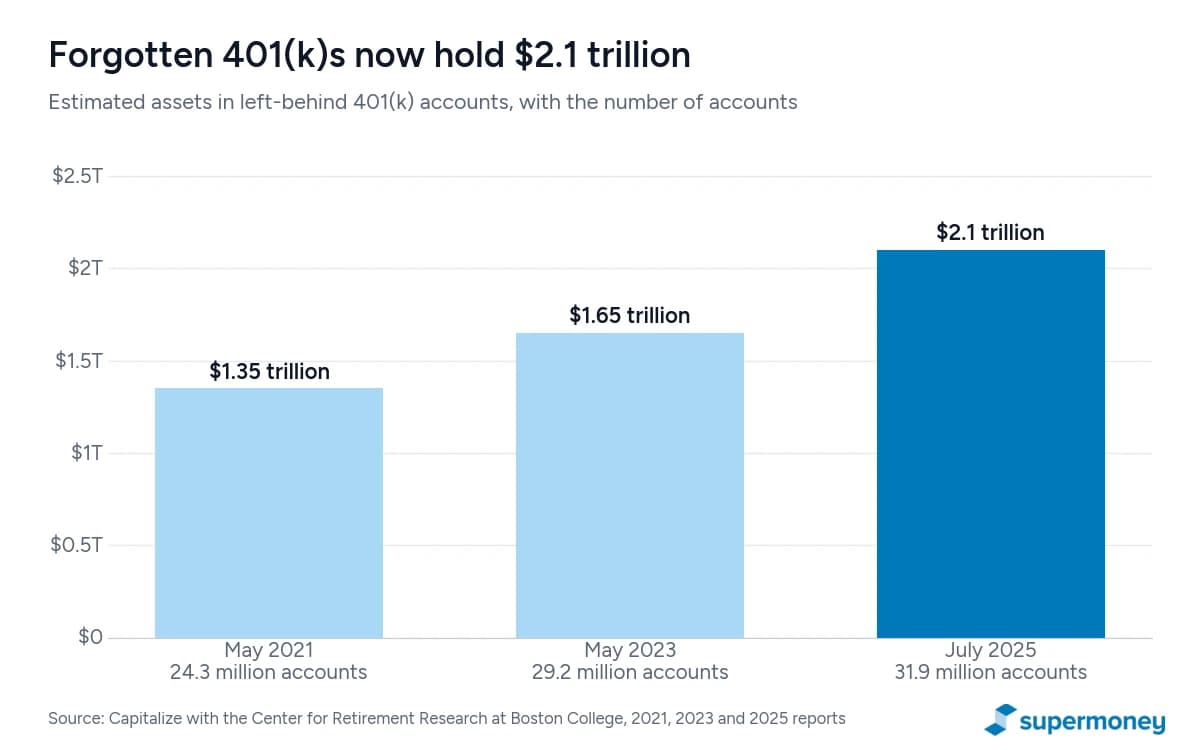
The average forgotten account holds $66,691, up from $56,616 two years earlier. That’s not couch change. It’s a down payment, or a year of college, or a meaningful piece of someone’s retirement. And the research estimates that one forgotten account, left in a high-fee plan with a stale investment mix, can cost more than $500,000 in lost retirement wealth over a career in the worst case. (Capitalize sells rollover services, so treat its totals as industry estimates. The direction is not in dispute.)
Compare Investment Advisors
Compare the services, fees, and features of the leading investment advisors. Find the best firm for your portfolio.
Why forgotten 401(k) accounts keep piling up
People change jobs a lot. The Bureau of Labor Statistics (BLS), which has followed the same group of late baby boomers since 1979, reports they held an average of 12.9 jobs between ages 18 and 58. Younger workers are on a similar or faster pace. Every one of those job changes is a chance to strand an account, and about 3.5 to 4 million accounts get left behind each year, according to Capitalize.
Most people don’t know what their options are when they leave. A 2024 study by the Government Accountability Office (GAO), the agency that audits federal programs, found that about 80% of 401(k) participants who’d been eligible for a rollover were not aware of all four of their choices, and about 40% didn’t understand the tax consequences. An earlier GAO survey found 41% of participants believed they paid no 401(k) fees at all.
A survey Empower released on October 19 puts a number on the result: 34% of Americans say they may have retirement savings from a previous employer that they’ve lost track of, rising to 50% of Gen Z and 45% of millennials. Two-thirds wish someone had explained their options when they changed jobs, and 47% have put off dealing with an old account because it felt overwhelming.
Auto-enrollment adds a twist. If you were signed up for a 401(k) automatically and never actively chose it, you may not know the account exists. As NerdWallet’s Kate Ashford put it in the USA Today piece, an old account isn’t on your priority list, and the longer you wait, the lower it goes.
The small-balance trap: what happens to a 401(k) under $7,000
Here’s the part most people don’t know. When you leave a job, your former employer doesn’t have to keep a small account on its books. Federal rules, written into the SECURE 2.0 Act of 2022 and Department of Labor regulations, let plans force out small balances, and the limit went up in 2024.
| Your balance when you leave | What the plan can do | What it means for you |
|---|---|---|
| Under $1,000 | Mail you a check, whether you asked for one or not | 20% is withheld for federal taxes, and if you don’t deposit the full amount in an IRA within 60 days, it’s taxable income plus a 10% penalty if you’re under 59½ |
| $1,000 to $7,000 | Roll it automatically into a “safe harbor” IRA at a custodian the employer picked | Your money moves to an account you didn’t choose, invested in cash-like products, with its own fee schedule |
| Over $7,000 | Leave it in the plan | Still invested, still paying plan fees, still easy to forget |
SECURE 2.0 raised the automatic rollover ceiling from $5,000 to $7,000 for distributions after 2023. Plans can choose to adopt the higher limit, and most large recordkeepers have. EBRI estimates that about one-third of workplace retirement balances are under $7,000 at any given time, so a lot of accounts qualify.
Add the normal churn of corporate life. Companies merge, rebrand, and close. Plans switch recordkeepers. Statements go to the apartment you left in 2019 and the email address you stopped checking. The plan sends the required notice before it moves your money, but if the notice goes to a dead address, you’ll never see it. PensionBee’s earlier research found only 35% of people with a left-behind 401(k) knew it could be moved without their consent.
How fees eat a safe harbor IRA
Safe harbor IRAs are designed to preserve principal, not grow it. The regulation that created them requires the default investment to seek a stable dollar value, so the money lands in money market funds, savings accounts, or similar products paying roughly 0.5% to 2% a year, according to PensionBee’s analysis.
Then come the fees. The USA Today report cited one provider’s schedule with a $100 one-time opening fee plus $5 a month in maintenance. That’s $160 in the first year. On a $1,200 balance, 13% of the account is gone before it earns a dime. Other providers charge $30 to $50 a year, and some waive fees above certain balances. The amounts vary, but the structure is the same: a flat dollar fee.
Flat fees are harmless on big balances and lethal on small ones. A $60 annual fee is 0.03% of a $200,000 account and 4% of a $1,500 account. As PensionBee’s CEO Romi Savova told USA Today, there’s no way for the return on a small account to outgrow the fee.
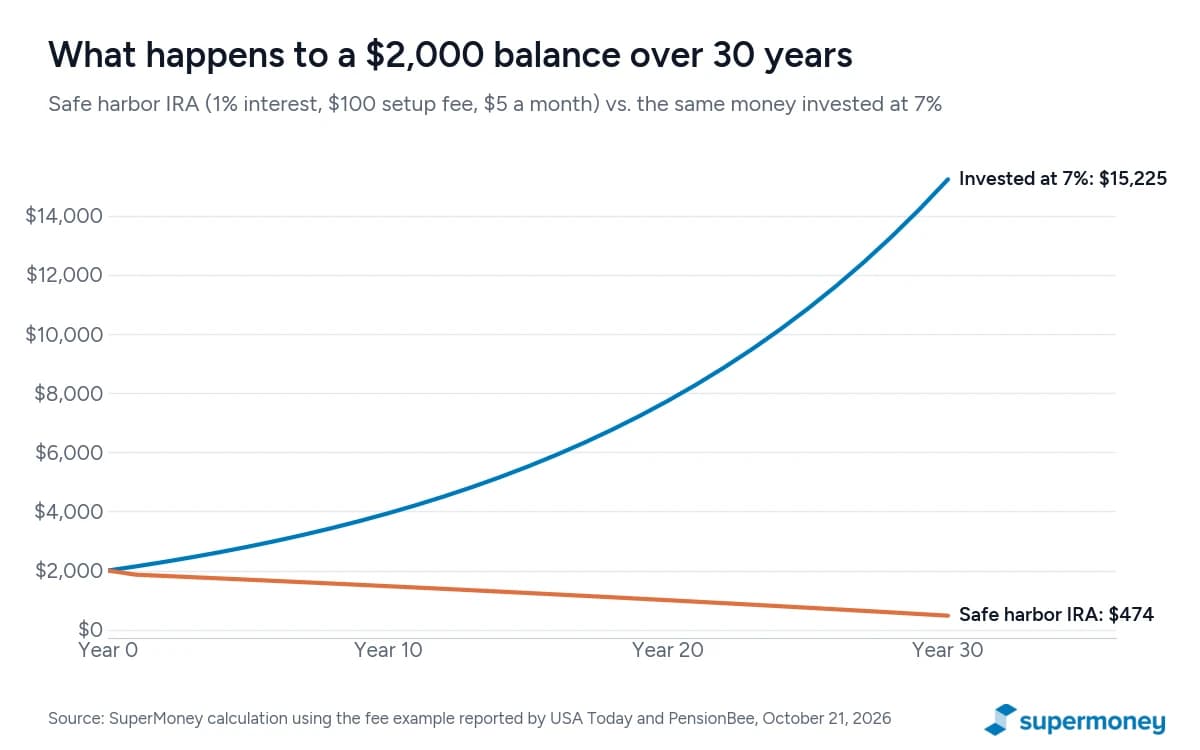
Run the numbers on a $2,000 balance. In a safe harbor IRA earning 1% with a $100 setup fee and $5 a month in charges, you have $1,859 after year one, $1,471 after year ten, and the account hits zero in year 39 without a single bad day in the market. The same $2,000 in a low-cost target-date fund earning a 7% average return grows to about $15,200 in 30 years. A $1,200 balance under the same fees is gone in about 21 years.
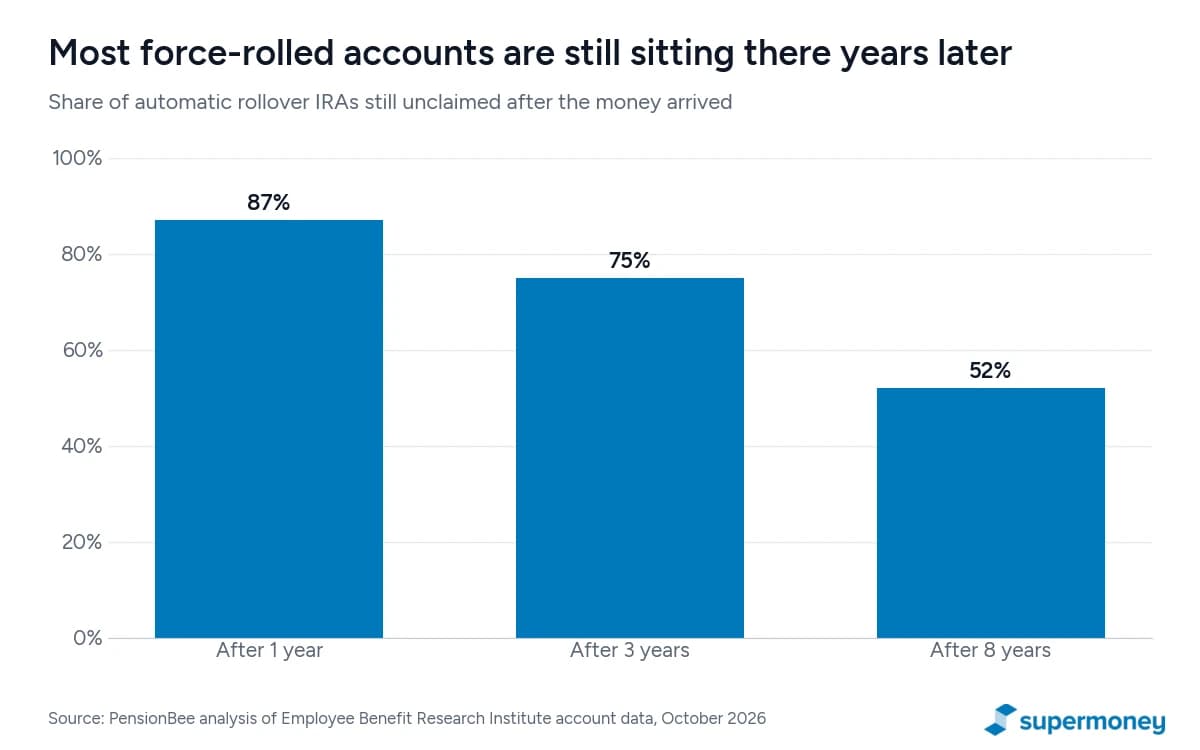
These accounts were meant to be temporary parking spots until the owner showed up. In practice, nobody shows up. PensionBee’s data shows 87% of automatic rollover IRAs are still sitting there after one year, 75% after three years, and 52% after eight. Of the accounts still open after eight years, 39% are worth less than when they arrived, and 6.1% have lost three-quarters or more of their value. Most of the owners are 44 or younger, the people with the most years of compounding to lose.
Bigger left-behind accounts bleed more slowly but for longer. A $66,691 balance in an old plan stays invested, but in whatever you picked at 28, charging whatever that plan charges. The median 401(k) plan costs 0.75% of assets a year and the most expensive tenth charge 1.45% or more, per Capitalize’s reading of Investment Company Institute data. Nobody is rebalancing it. That’s the slow version of the same problem, and it’s how you get to the $500,000 worst case.
How to find a forgotten 401(k): run these searches in order
Finding the money has never been easier. Each search below fills a different gap, so run the first two at minimum and keep going if you’ve had a lot of jobs.
1. The federal database: Retirement Savings Lost and Found
Start at lostandfound.dol.gov. SECURE 2.0 ordered the Department of Labor to build this database, and its Employee Benefits Security Administration (EBSA) launched it on December 27, 2024. It’s free. You verify your identity through Login.gov with a state driver’s license or ID and your Social Security number, and the search runs against your SSN.
Know what it is: a phone book, not a bank. It returns the names of plans tied to your SSN and the plan administrator’s contact information. It doesn’t show balances, and it doesn’t pay claims. You still have to call the administrator, and the contact details may be old because they come partly from historical filings.
The early results are encouraging. Through the end of 2025, 236,269 people had searched and 69,712 of them, about 29.5%, found at least one plan tied to their SSN, according to data the DOL shared with CNBC. The limits matter too: reporting by plan administrators is voluntary, so coverage is still being built, and as of early 2026 the database was returning results mainly for people 65 and older. It also excludes IRAs, government plans, and most church plans. An empty result is not proof that nothing exists.
2. The National Registry of Unclaimed Retirement Benefits
Go to unclaimedretirementbenefits.com, a free database run by PenChecks Trust, a retirement plan distribution company. Employers register former participants they can’t reach, and you search by Social Security number. It catches accounts the federal database misses, but it only includes employers that chose to participate, so you need both.
3. State unclaimed property
Accounts that sit dormant long enough get turned over to the state, a process called escheatment. Search missingmoney.com, which covers most states at once, and use unclaimed.org, run by the National Association of Unclaimed Property Administrators, to reach any state that isn’t included. Search every state you’ve lived or worked in, and search maiden and former names. A name mismatch is the most common reason a search comes up empty when money exists.
4. Your former employers
Call HR or the benefits department and ask two questions: do I have an account in my name, and who is the recordkeeper? If the company was acquired, the buyer inherited the plan, so call the successor. Old W-2s help here. Box 12 codes like D (401(k) deferrals) and the “Retirement plan” box tell you which jobs had plans. Pay stubs and old enrollment emails do the same.
5. Form 5500 filings
Every plan files an annual Form 5500 with the DOL, and the filings are public at efast.dol.gov. Search the employer’s name and you’ll find the plan sponsor and administrator, even after mergers and rebrands. This is the deep-cut method when the company no longer exists in the form you remember.
6. The PBGC missing participant search
If you had an old-style pension, check pbgc.gov. The Pension Benefit Guaranty Corporation, the federal agency that insures private pensions, holds benefits for people it couldn’t find when their plans terminated. Search by last name and the last four digits of your SSN. Different pot of money, same problem.
7. The DOL Abandoned Plan database
When an employer goes under and nobody is left to run the plan, the DOL appoints a qualified termination administrator to hold and distribute the assets. The Abandoned Plan Search at askebsa.dol.gov lists them. Search by the employer’s name.
8. The safe harbor IRA custodian
If a small balance disappeared from an old plan, the plan has to tell you where it went. Ask the administrator for the custodian’s name, then contact the custodian directly. The largest automatic rollover custodians, including Inspira Financial, can look you up by SSN.
9. Paid finders
Capitalize, Beagle, and similar services will do the detective work and handle the paperwork for a fee or a share of the rollover. Nothing wrong with that if you want it done for you. Just run the free searches first, because they take minutes and the paid services often start in the same places.
Watch for scams
Any topic with “lost money” in it attracts fraud, and this one is no exception. A few rules:
- The Department of Labor will never call, text, or email you asking for a password or one-time code, and it never charges a fee to release retirement money.
- Anyone who contacts you first about “found” retirement money and asks for a fee, gift cards, or account credentials is running a scam. Real money doesn’t come looking for you.
- The only federal search site is lostandfound.dol.gov. Type it into your browser. Don’t click lookalike links in ads or emails.
What to do once you find an old 401(k)
Finding the account is the hard part. The decision afterward is easier, because there are only four options and one of them is almost always wrong.
Leave it. If the balance is over $7,000 and the old plan is cheap and well run, staying put is a legitimate choice. It’s rarely the examined one, though. Pull up the plan’s fee disclosure and compare it with what an IRA would cost before you decide.
Roll it into an IRA. A rollover IRA you control gives you more investment choices, one login, and simpler beneficiary management. Ask for a direct rollover so the check goes custodian to custodian and no tax is withheld. Watch for surrender charges or restrictions on stable-value funds on the way out.
Roll it into your current employer’s plan. This keeps everything in one place and preserves 401(k)-only perks like the rule of 55, which lets you take penalty-free withdrawals if you leave your job in or after the year you turn 55, and access to plan loans. Check the new plan’s fees first. Consolidation only helps if you’re consolidating into something good.
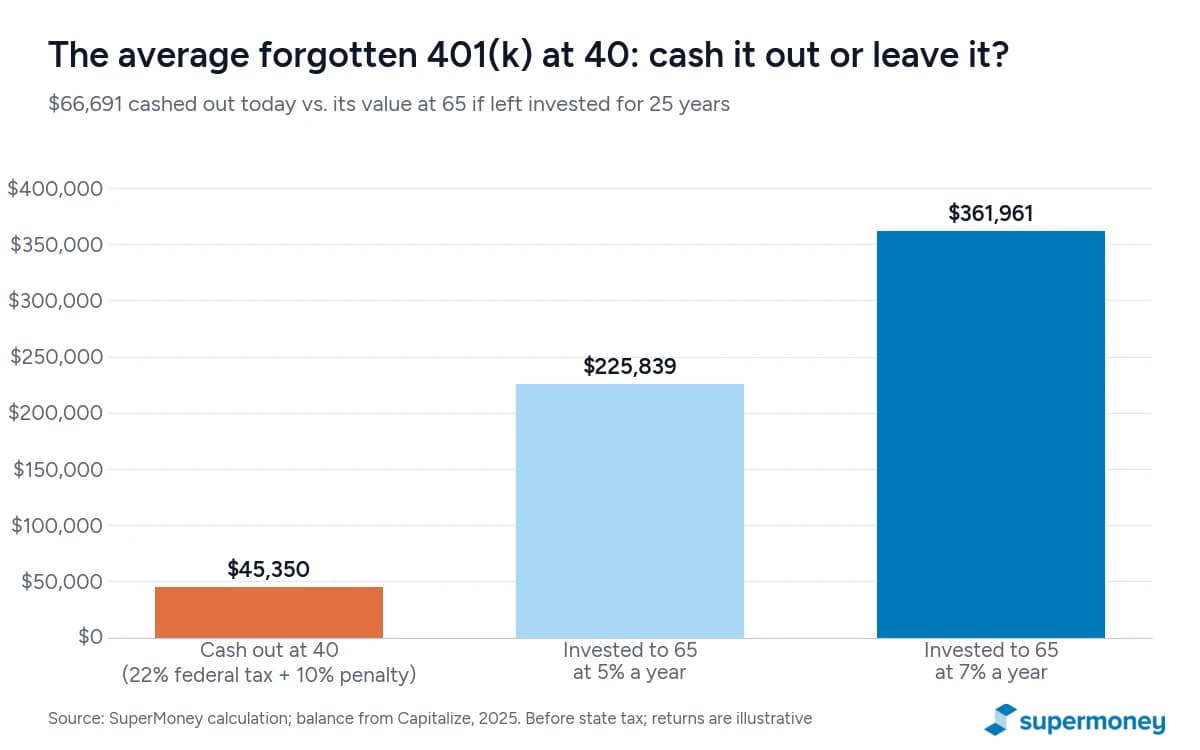
Don’t cash it out. Here’s the math on the average forgotten balance of $66,691, found at age 40. Cash it out and the IRS treats it as income. At a 22% federal rate plus the 10% early withdrawal penalty for anyone under 59½, you’d keep about $45,350 before state tax. Leave it invested and it grows to roughly $226,000 by 65 at a 5% average return, or about $362,000 at 7%. The check feels real. The compounding is what you’re giving up.
Once the money is consolidated, do three small things. Update the beneficiaries, because the person listed on an account from 2012 may not be who you’d pick today. Set the investment mix on purpose instead of accepting the default. And store the login somewhere your future self will find it. Then update your contact information with every plan you still have, so the next move doesn’t restart the problem.
If you’re not sure which option fits, that’s exactly the kind of question a fee-only financial planner answers in one meeting. You can compare investment advisors by fee structure and minimums before you commit to anyone. And once your accounts are consolidated, the next question is where the next dollar should go, which we covered in where to save after your 401(k) match.
The system is slowly starting to fix itself
The default is beginning to flip from “strand it” to “move it.” SECURE 2.0 also blessed auto-portability, which lets a small balance follow you to your new employer’s plan automatically instead of being pushed into a safe harbor IRA. The Portability Services Network, owned by Alight, Empower, Fidelity, Principal, TIAA, and Vanguard with Retirement Clearinghouse, now covers more than 185,000 employer plans and about 82 million workers. If both your old and new recordkeepers participate and your employer opted in, balances under $7,000 can transfer without you lifting a finger.
That’s progress, but it only helps with future job changes at participating plans. The accounts you’ve already left behind still need you to go get them.
The 15-minute version
Count your jobs. For each one, ask yourself whether you can name the company that held the retirement plan. If you can’t, that’s a candidate. Then run the two free searches, the federal Lost and Found and the National Registry. They take about 15 minutes combined, and roughly 3 in 10 people who ran the federal one found something. The SuperMoney app can help with what comes next: link the accounts you find alongside the ones you already have, and watch your net worth update as the forgotten money gets counted.
As a planner, I ask every new client the same two questions: how many jobs have you had, and can you name the recordkeeper for each one? A “found” $66,691 account changes a retirement projection more than a year of careful budgeting ever will. Ask yourself the same thing tonight.
Frequently asked questions
How do I find a forgotten 401(k) for free?
Search the Department of Labor’s Retirement Savings Lost and Found at lostandfound.dol.gov, then the National Registry of Unclaimed Retirement Benefits at unclaimedretirementbenefits.com, then your state’s unclaimed property site through missingmoney.com. All three are free. If those come up empty, call former employers’ HR departments and search Form 5500 filings at efast.dol.gov for the plan administrator’s contact information.
Can my old employer move my 401(k) without asking me?
Yes, if the balance is $7,000 or less. Under SECURE 2.0 and Department of Labor rules, a plan can cash out balances under $1,000 by check and automatically roll balances from $1,000 to $7,000 into a safe harbor IRA at a custodian the plan chose. The plan has to send you a notice first, but if it goes to an old address, you may never see it.
What is a safe harbor IRA?
A safe harbor IRA, also called an automatic rollover IRA, is an account a former employer opens for you to hold a small 401(k) balance you left behind. By rule, the money is invested to preserve principal, usually in a money market fund or savings account earning around 0.5% to 2%, and the custodian charges its own fees. You can move the money to an IRA or 401(k) of your choice at any time.
Should I cash out a small old 401(k)?
Almost never. A cash-out is taxed as income, plus a 10% penalty if you’re under 59½, and 20% is withheld on the spot. Even a $2,000 balance is worth about $15,000 in 30 years at a 7% average return. Roll it into an IRA or your current 401(k) instead.
Does the DOL Lost and Found database show my balance?
No. It lists plans connected to your Social Security number and gives you the plan administrator’s contact information. The administrator confirms whether a benefit is still owed and how much. Coverage is still growing because plan reporting is voluntary, so an empty result doesn’t mean there’s no account.
Key takeaways
- An estimated 31.9 million forgotten 401(k) accounts hold about $2.1 trillion, up almost 30% in two years. The average balance is $66,691.
- Former employers can mail a check for balances under $1,000 and force balances of $1,000 to $7,000 into a safe harbor IRA you didn’t choose.
- 68% of automatic rollover IRAs lose value in their first year. A $100 setup fee plus $5 a month takes 13% of a $1,200 balance before it earns anything.
- $2,000 in a safe harbor IRA earning 1% with those fees reaches zero in about 39 years. Invested at 7%, it grows to about $15,200 in 30 years.
- Two free searches, lostandfound.dol.gov and unclaimedretirementbenefits.com, take about 15 minutes. About 29.5% of federal searchers found a plan.
- Cashing out $66,691 at 40 leaves about $45,350 after tax and penalty. Left invested, it’s roughly $226,000 to $362,000 by 65.
- The DOL never calls, texts, or charges a fee to release retirement money. Type lostandfound.dol.gov yourself.
Share this post:
Add as a preferred source on Google
Table of Contents