
How Much Do You Need To Make To Afford $1,500 Rent

Last updated 10/27/2025 by
Benjamin Locke
Edited by
Andrew Latham
Summary:
Determining how much you need to earn to afford $1,500 rent involves exploring various budgeting methods. While the 30% rule is a common guideline, alternative approaches like the 50/30/20 rule, debt-to-income ratio, cost-of-living adjustments, and savings-first methods offer flexibility based on individual financial situations. This article delves into these methods to help you make informed choices.
Rent affordability is a cornerstone of financial stability. It ensures that housing costs don’t undermine your ability to save, pay down debt, or meet essential expenses. However, the approach to determining affordability varies based on income, location, and financial goals.
Get Competing Personal Loan Offers In Minutes
Compare rates from multiple vetted lenders. Discover your lowest eligible rate.
It's quick, free and won’t hurt your credit score
The 30% Rule: A Traditional Benchmark for Rent Affordability
The 30% rule has been a foundational guideline for many renters and homeowners alike. It suggests that no more than 30% of your gross income should be spent on rent or housing costs. This rule emerged as a straightforward way to keep housing expenses in check, ensuring that people could still afford other essential expenses, such as food, healthcare, transportation, and savings.
Why the 30% Rule is Popular
The 30% rule is widely recognized because of its simplicity and ease of use. It’s a quick way to assess whether someone is spending too much on rent. By applying this rule, individuals can avoid overcommitting their income to housing, thus ensuring they have enough money left for other financial needs. Additionally, many housing assistance programs and government-funded initiatives use this benchmark when evaluating affordability and eligibility for subsidies.
How the 30% Rule Works
To understand how the 30% rule works in practice, let’s break it down into a simple calculation:
- Step 1: Determine your gross monthly income, which is your income before taxes and deductions.
- Step 2: Multiply your gross monthly income by 30%. This will give you the maximum amount of money you should allocate toward rent.
- Step 3: Ensure that your rent doesn’t exceed this amount.
Example of the 30% Rule
If your monthly income is $4,000, applying the 30% rule would result in:
- $4,000 x 30% = $1,200
This means that your rent should not exceed $1,200 per month. If your rent is higher than this, it may be difficult to afford other expenses and save for the future.
The Limitations of the 30% Rule
While the 30% rule offers a helpful starting point for evaluating rent affordability, it has limitations:
- It doesn’t account for other essential expenses: The rule assumes that rent is the primary expense, but it doesn’t factor in other necessities like utilities, healthcare, or childcare, which may consume a significant portion of your income.
- It may not be realistic in high-cost cities: In cities with high living costs, such as New York City, San Francisco, or Los Angeles, the 30% rule often doesn’t apply. Rent can consume a much larger percentage of income in these areas, sometimes exceeding 50% or more of monthly earnings.
- It doesn’t consider individual financial goals: The rule focuses solely on housing, but it doesn’t account for personal financial goals like saving for retirement, paying off debt, or building an emergency fund. In some cases, it may be wise to allocate a larger portion of income to savings and less to rent.
When to Deviate from the 30% Rule
While the 30% rule is a good guideline for many renters, it’s important to assess your unique situation. There are times when spending more than 30% on rent may be justified:
- In high-cost areas: If you live in an expensive city, it may be unrealistic to stick to the 30% rule. However, try to keep other costs down and prioritize savings in other areas.
- If your income is high: Higher-income earners may comfortably afford to spend more than 30% on rent without sacrificing other financial goals, particularly if they can still maintain savings and investments.
- If you’re prioritizing location: If proximity to work, school, or family is more important to you than saving, you may choose to allocate a higher percentage of your income to rent. However, it’s important to ensure that this doesn’t compromise other financial priorities.
Alternative approaches to rent affordability
The 50/30/20 rule
This budgeting approach provides a balanced framework for managing income and ensures a balance between financial obligations and personal enjoyment. It divides income into three categories:
| Category | Percentage of Income | Examples |
|---|---|---|
| 50% for Needs | 50% | Rent, utilities, groceries, transportation, insurance (non-negotiable essentials) |
| 30% for Wants | 30% | Dining out, entertainment, travel, hobbies (discretionary spending) |
| 20% for Savings and Debt Repayment | 20% | Building emergency fund, retirement accounts, paying down loans |
Debt-to-income (DTI) ratio
The debt-to-income ratio is a key metric used by landlords and lenders to evaluate your financial health. It measures the percentage of your gross income that goes toward debt payments, including rent.
- Front-end DTI: The percentage of income allocated to housing expenses (rent, utilities, insurance).
- Back-end DTI: The percentage of income allocated to all debt obligations, including student loans, credit cards, and car payments.
Landlords often prefer a front-end DTI below 28% and a back-end DTI below 36%. For a $5,000 gross income, a back-end DTI exceeding these thresholds may signal financial stress.
Cost-of-living adjustments
Living costs vary dramatically by location. A $1,500 apartment might be affordable in Houston but considered inexpensive in New York. Adjusting your rent budget based on the cost of living ensures a realistic approach.
Savings-first approach
This method prioritizes financial security by allocating a fixed percentage of income to savings before determining rent affordability.
Steps:
- Set a savings goal (e.g., 20% of income).
- Deduct essential fixed expenses like insurance and transportation.
- Allocate the remaining income to rent and discretionary expenses.
For example, someone earning $4,000 monthly might allocate $800 to savings and $1,200 to fixed expenses, leaving $2,000 for rent and other costs. This ensures a focus on long-term financial stability while covering immediate needs.
Comparing Different Rent Affordability Methods
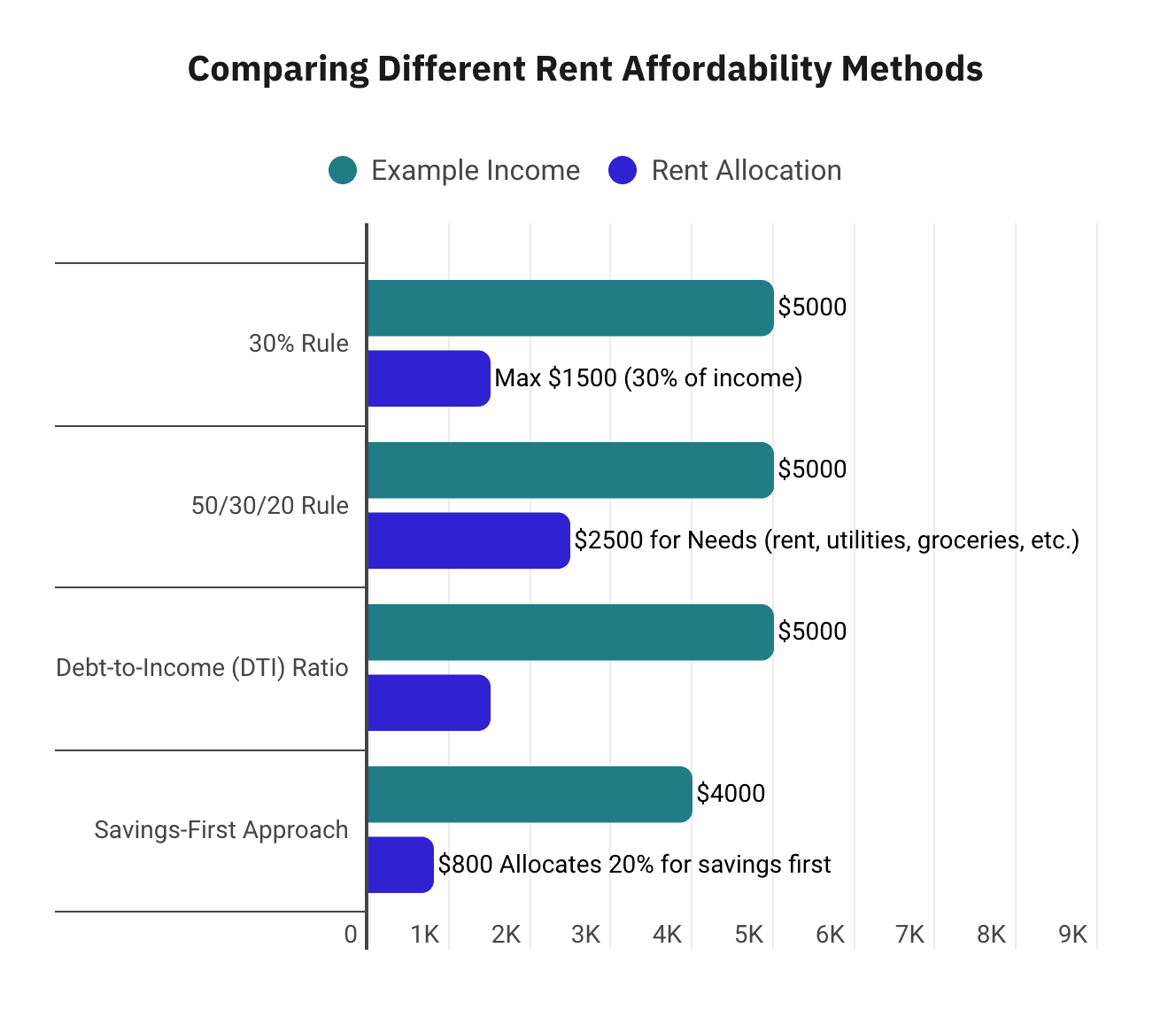
Below is a comparison of various rent affordability methods, including the 30% rule, 50/30/20 rule, debt-to-income (DTI) ratio, cost-of-living adjustments, and the savings-first approach. This table illustrates how each method works using examples and how they impact your monthly budget for rent and other expenses.
| Method | Example Income | Rent Allocation | Other Expenses/Details | Remaining Budget |
|---|---|---|---|---|
| 30% Rule | $5,000 | Max $1,500 (30% of income) | Basic living expenses like utilities and groceries | Remaining income after rent covers other essentials |
| 50/30/20 Rule | $5,000 | 50% ($2,500) for Needs (rent, utilities, groceries, etc.) | 30% ($1,500) for Wants (dining, entertainment, travel) 20% ($1,000) for Savings and Debt Repayment | Remaining budget for needs, wants and savings goals |
| Debt-to-Income (DTI) Ratio | $5,000 | Front-End DTI: $1,500 rent should be under 28% of income (preferable ratio) | Back-End DTI: Rent + all other debt obligations (e.g., $500 debt payments = $2,000 total) should ideally be under 36% | Front-End DTI example = 30%, Back-End DTI = 40% (Higher debt increases stress) |
| Cost-of-Living Adjustments | $5,000 | New York: $2,500 (50% of income) Houston: $1,500 (30% of income) Phoenix: $1,200 (24% of income) | Rent is adjusted based on local living costs; more affordable in lower-cost cities | The remaining budget varies based on local rent costs |
| Savings-First Approach | $4,000 | Allocates 20% ($800) for savings first | Deducts essential expenses like insurance and transportation (e.g., $1,200) | Remaining income: $2,000 for rent and other needs, ensuring financial security |
Factors to consider in rent affordability
Additional housing costs
Rent is just one part of housing expenses. Other costs include:
| Expense | Estimated Cost | Details |
|---|---|---|
| Utilities | $100-$200 | Electricity, water, and gas |
| Internet and cable | $50-$100 | Monthly cost for internet and cable services |
| Renter’s insurance | $20-$50 | To protect your belongings |
| Parking fees | $50-$200 | Cost varies depending on location |
Including these expenses in your calculations prevents underestimating the true cost of housing.
Emergency fund
Building an emergency fund is crucial before committing to higher rent. Aim for 3-6 months’ worth of expenses to cover unexpected events like job loss or medical emergencies.
For example, if your monthly expenses are $3,000, your emergency fund should range between $9,000 and $18,000. Prioritize building this fund alongside rent planning.
Shared living arrangements
Sharing housing costs can significantly improve affordability. Splitting a $1,500 apartment between two people reduces individual rent to $750, leaving more room for savings and other expenses.
Co-living options or renting out a spare room through platforms like Airbnb can further offset costs.
FAQ
What is the best way to determine how much I should spend on rent?
The best way to determine how much you should spend on rent is to evaluate your financial situation and personal priorities. While the 30% rule provides a general guideline, it’s important to consider other methods like the 50/30/20 rule, debt-to-income ratio, and cost-of-living adjustments based on your income, expenses, and location. Tailoring your rent budget to these factors will help ensure you maintain financial balance and meet long-term goals.
Is it better to rent or buy a home?
Whether it’s better to rent or buy a home depends on your financial goals, stability, and personal preferences. Renting may offer flexibility, lower upfront costs, and less responsibility for maintenance while buying can build equity over time and provide long-term stability. Consider factors such as your income, location, future plans, and ability to manage additional homeownership costs before making a decision.
How much should I save before renting an apartment?
Before renting an apartment, it’s recommended to save enough for the first month’s rent, security deposit, and other moving costs. Many landlords require a deposit equal to one or two months’ rent. Additionally, having an emergency fund of 3 to 6 months of living expenses can help ensure financial security in case of unexpected situations, such as job loss or urgent repairs.
Can I afford $1,500 rent if my salary is lower than the suggested percentage?
If your salary is lower than the suggested rent-to-income percentage, you may still be able to afford $1,500 rent by adjusting other parts of your budget. Consider reducing discretionary spending (wants), sharing rent with a roommate, or finding ways to increase income through side jobs or additional savings. It’s also important to factor in all additional living expenses to ensure you’re not overcommitting financially.
What should I do if I can’t afford rent in my current city?
If you can’t afford rent in your current city, consider moving to a more affordable location or exploring shared housing options. You can also look into rent subsidies or government assistance programs available for low-income renters. Additionally, evaluating your income sources and cutting unnecessary expenses can help free up funds for housing while working toward financial stability.
Key takeaways
- Relying solely on the 30% rule may not be suitable for everyone—alternative methods provide more tailored solutions.
- Explore the 50/30/20 rule, debt-to-income ratio, and cost-of-living adjustments for a comprehensive approach.
- Account for additional housing costs like utilities and insurance when budgeting for rent.
- Shared living arrangements, savings-first strategies, and relocating to lower-cost areas can help improve affordability.
Share this post:
Add as a preferred source on Google
Table of Contents