
The Viral Mortgage Math Is Right. The Rent-vs.-Buy Conclusion Is Wrong.

Last updated 10/09/2026 by
Andrew Latham
Edited by
Andrew Latham
Summary:
A viral post points out that three years of payments on a $500,000 mortgage at 7.5% costs $125,859, and only $14,929 of that goes to principal. The math is right. But that’s how every fixed-rate mortgage starts, and it doesn’t tell you whether renting or buying builds more wealth. That comes down to how long you stay, the full cost of owning, and whether a renter actually invests what renting saves.
A post has been making the rounds with a brutal-looking claim. Take out a $500,000 mortgage at 7.5%, make payments for three years, and you’ll still owe $485,071. You paid $125,859. Only $14,929 went toward principal. The other $110,930 went to interest.
The math checks out. The conclusion people are drawing from it doesn’t.
Here are the exact numbers. A 30-year fixed mortgage of $500,000 at 7.5% has a monthly principal-and-interest payment of $3,496.07. After 36 payments you’ve paid $125,858.61. Of that, $110,929.85, or 88.1%, was interest. Your balance is $485,071.24.
And 7.5% isn’t some worst case pulled from 2023. Freddie Mac’s average 30-year rate hit 7.40% on October 8, 2026, up from 6.30% a year earlier.[1] At 7.40%, the same loan costs $3,461.90 a month, and 88% of your first three years of payments still goes to interest.
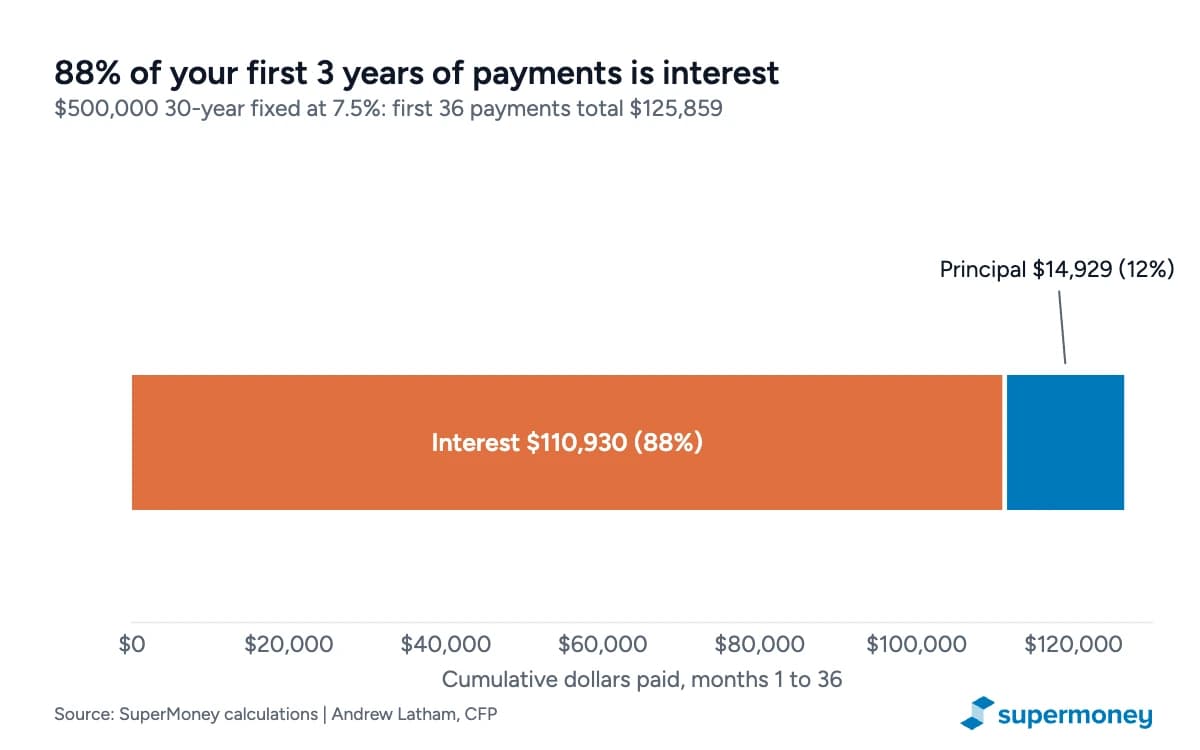
Figure 1. The early years are interest-heavy because interest is charged on the largest balance you’ll ever owe.
Get Competing Personal Loan Offers In Minutes
Compare rates from multiple vetted lenders. Discover your lowest eligible rate.
It's quick, free and won’t hurt your credit score
How mortgage interest works: it’s amortization, not a rip-off
A mortgage isn’t a savings account with a little interest skimmed off the top. It’s a loan. Each month the lender charges interest on whatever you still owe. Early on, that’s close to the full $500,000, so the interest charge is big. As the balance falls, so does the interest, and more of the same payment goes to principal.
Your payment never changes. What changes is how it’s split, every single month.
So the first act is ugly and the second is a lot better. In this example you pay down just under $15,000 of principal in three years. By year 15, the balance is $377,133.33, meaning $122,866.67 of principal is gone. From there it speeds up fast.
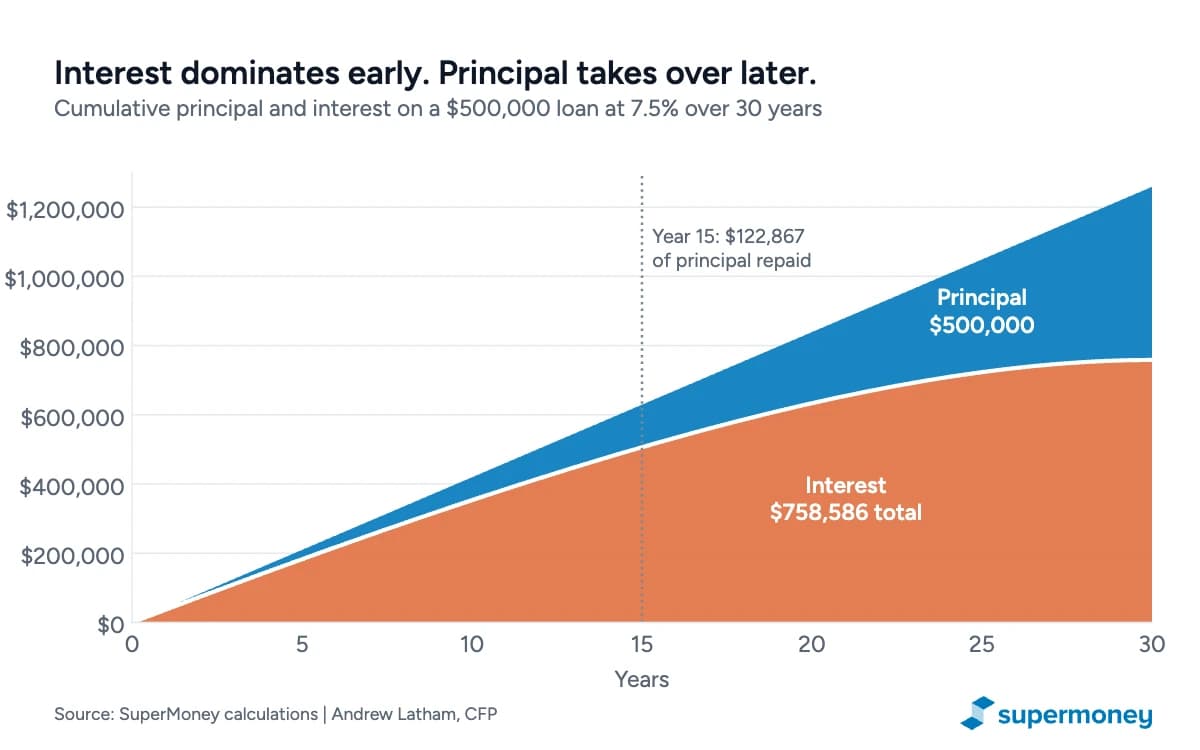
Figure 2. Over the full 30 years you’d pay $1,258,586.12, including $758,586.12 of interest. That lifetime number assumes you keep the loan all 30 years and never refinance or pay extra.
Very few people do keep it that long. Sellers in the National Association of Realtors’ latest profile had owned their homes for a median of 11 years.[2] Most mortgages end in a sale or a refinance well before year 30.
The viral post freezes the movie at year three, when amortization looks its worst, and treats that as the whole story. It’s like judging a retirement portfolio by its first bear market. The snapshot is accurate. The verdict isn’t.
Mortgage principal vs. interest: interest is the rent on the money
Here’s the part the post leaves out. In year one of that loan you’d pay about $37,300 in interest. A renter in a comparable home at $2,800 a month pays $33,600 in rent. Neither of you gets that money back. Mortgage interest is what you pay to rent $500,000 from a bank. Rent is what you pay to use someone else’s house.
So “most of my payment is interest” isn’t the question. The question is whether the total unrecoverable cost of owning (interest, property tax, insurance, maintenance, and eventually selling costs) comes out higher or lower than rent over the years you’ll actually live there.
The mortgage balance is only half the ledger
A fair comparison tracks every dollar on both sides.
Start with the monthly payment. Principal and interest on a fixed-rate loan stay flat for 30 years. Rent doesn’t. If rent starts at $2,800 a month and rises 3.5% a year, it passes the $3,496 mortgage payment around year 6.5 and keeps climbing.
But principal and interest aren’t what it costs to own a house. They’re just the entry fee. On a $625,000 home, a realistic budget for the rest looks like this:
- Property tax around 1.1% of the home’s value, about $6,900 a year
- Homeowners insurance, which reached an average of $2,948 a year nationally by the end of 2025, up 46% since 2021[3]
- Maintenance of about 1% of the home’s value, or $6,250 a year, arriving as a roof one year and nothing the next
That’s about 2.6% before any premium increases, so call it 2.7% of the home’s value, roughly $16,900 in year one and rising with the home’s value. Add that on and the real monthly cost of owning starts near $4,900, not $3,496. Rent doesn’t pass that line until around year 24.
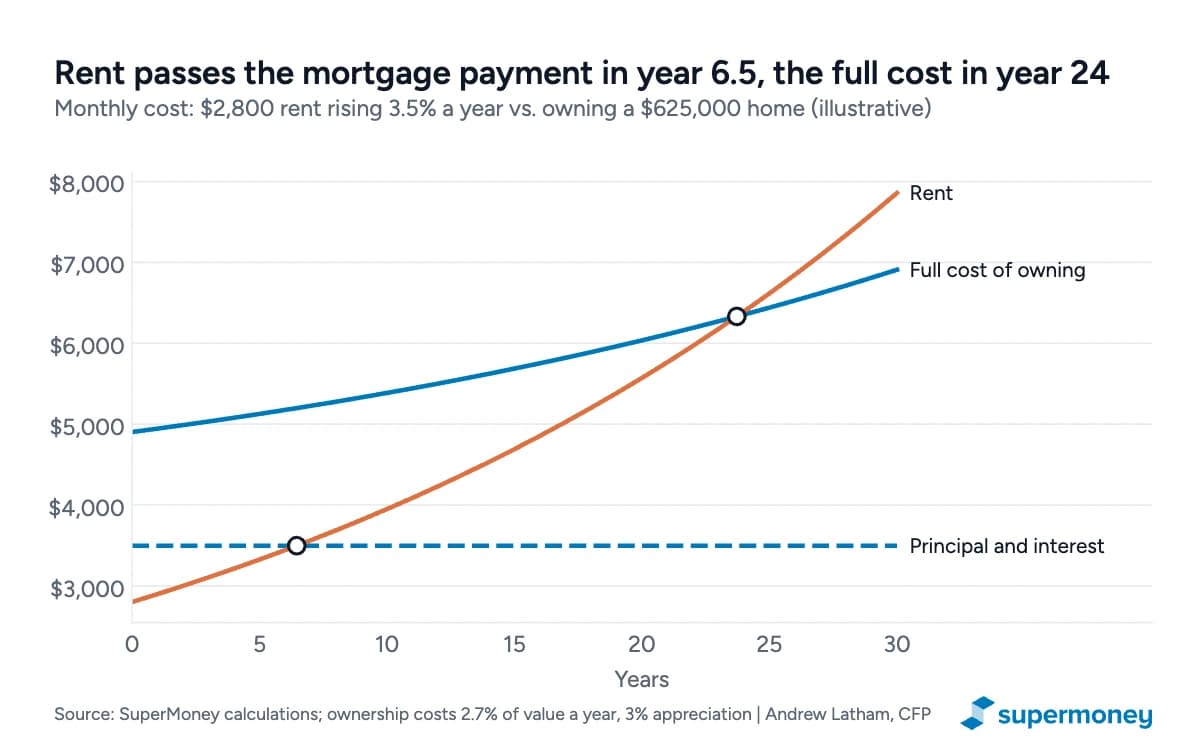
Figure 3. Illustrative: $625,000 home, 20% down, 7.5% rate, 3% annual appreciation, 2.7% a year for property tax, insurance and maintenance. Your tax rate and insurance cost will differ. HOA dues, if you have them, go on top.
Now the benefits the viral post skips. If the home appreciates at something like its long-run pace, that builds equity alongside your principal paydown. That’s a possibility, not a promise. Prices can stall or fall. And on a loan this size, the mortgage interest deduction does help: year-one interest of $37,300 plus $6,900 of property tax clears the 2026 standard deduction of $32,200 for a married couple by about $12,000.[4] In the 22% bracket, that’s worth about $2,600 in year one, and less every year after as the interest shrinks. On a smaller loan, you may get nothing.
Is renting better than buying? On paper, it can be.
The hard part is doing it for 15 years.
The best argument for renting isn’t that mortgage interest is a scam. It’s that renting frees up capital. The renter keeps the down payment and closing costs, pays less each month, and can invest the difference in a diversified portfolio.
Under the assumptions below, that strategy wins big. It also loses big, depending on one habit.
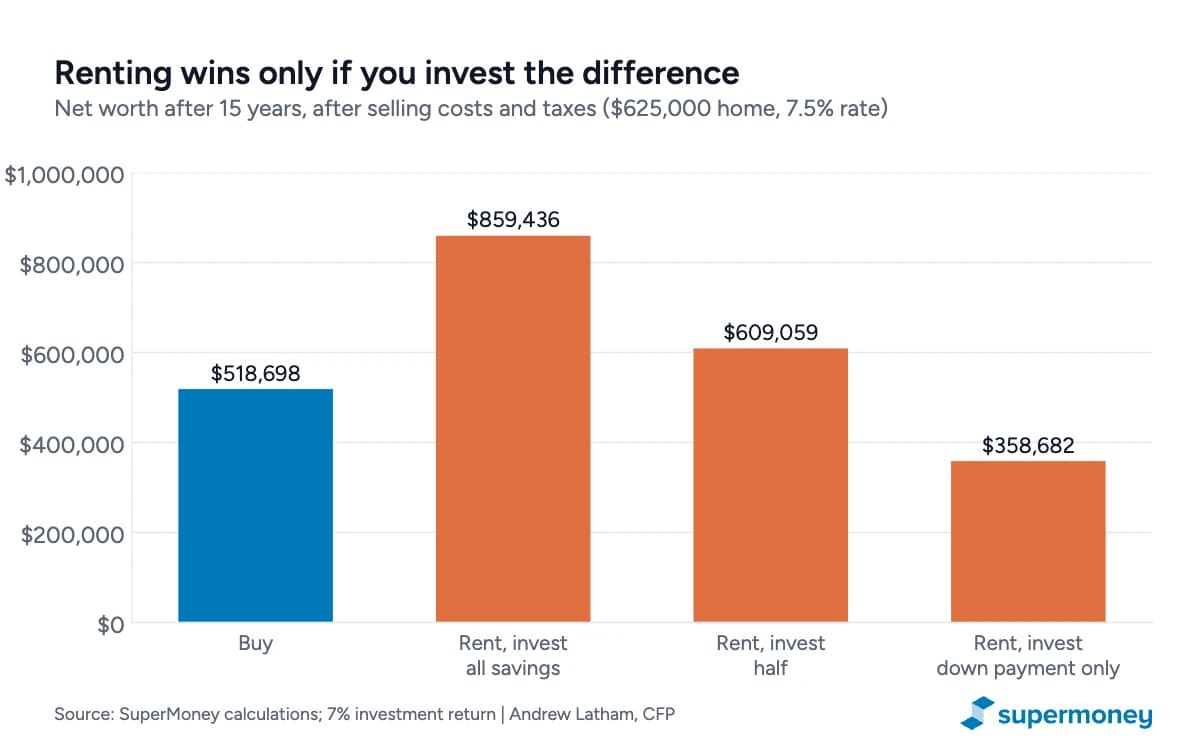
Figure 4. $625,000 home, 20% down plus 3% closing costs, $500,000 loan at 7.5%, 3% annual appreciation, 2.7% a year in ownership costs, $2,800 starting rent rising 3.5% a year, 7% investment return. The buyer pays 8% to sell; the renter pays 15% long-term capital gains tax on investment growth. The mortgage interest deduction isn’t included.
Here’s what’s happening. The buyer puts $143,750 into the house on day one. The renter invests that same $143,750. Then, because owning costs about $2,100 a month more than renting in year one, the renter has $2,100 a month to invest too. Owning stays more expensive than renting for all 15 years in this example, so the renter has something to invest every month.
If the renter invests every dollar of that difference, they end up about $340,000 ahead of the buyer after 15 years, even after taxes. That’s a real result and I’m not going to bury it. At a price-to-rent ratio of about 18.6 and a 7.5% mortgage rate, this is a setup that favors renting.
But look at the last bar. A renter who invests the down payment and then spends the monthly difference ends up $160,000 behind the buyer. The break-even point is about a third. Invest at least 32% or so of the monthly savings, every month for 15 years, and renting wins here. Invest less and buying wins.
That’s why the spreadsheet doesn’t build wealth. The habit does.
You’ll often see research cited that investors lose returns by trading at the wrong time. Morningstar’s 2025 “Mind the Gap” study found fund investors earned 7.0% a year over the decade through 2024, versus 8.2% for the funds they owned.[5] A 2026 study in the Financial Analysts Journal reworked the same data and put the real cost of bad timing closer to 0.1% a year.[6] The researchers disagree on how big that gap is. Either way, it isn’t the renter’s biggest risk. The biggest risk is that the money never gets invested in the first place. A mortgage solves that problem by force. Every payment moves some money into equity without asking you to make a fresh decision.
Run your own numbers
The example above is one house, one rent and one set of assumptions. Yours will be different, and the answer can flip. Plug in your home price, your rent, your rate and how long you’d realistically stay. The calculator marks both sides to market every year, after selling costs and taxes, and has a slider for how much of the difference you’d really invest. For the full walkthrough of how to read it, see our rent vs. buy calculator guide.
Open the SuperMoney rent vs. buy calculator and plug in your own numbers.
Four rules that beat a hundred comment-section arguments
There’s no universal winner. There’s the decision that fits your timeline, your cash flow and how you actually behave with money. Before you sign a lease or a closing disclosure, run these four checks.
1. Put your time horizon first
Use the rent vs. buy calculator with the number of years you’d bet on, not hope for. Stay only a few years and renting usually wins, because buying and selling costs never get a chance to wash out. Stay a decade or more and buying has time to pull ahead. That’s a rule of thumb, not a guarantee.
2. Price the whole house
Budget roughly 2.5% to 3.5% of the home’s value each year for property tax, insurance and maintenance, and adjust for your state and the age of the house. Add HOA dues if you have them. If your budget only works when the roof, the HVAC and the tax bill all behave, it doesn’t work.
3. If you rent, automate the difference
Set up an automatic transfer into low-cost index funds on the day rent is due. Treat it like a bill. If you wait to invest whatever’s left at the end of the month, your lifestyle will find it first. If you link your accounts in the SuperMoney app, the net worth tracker will tell you pretty fast whether that money is actually getting invested.
4. Stop resetting the clock
Buying gets expensive when you move often. Agent commissions averaged 5.46% in a 2026 survey,[7] and once you add transfer taxes, title and escrow, 8% of the sale price is a realistic total. Add 2% to 5% in closing costs when you buy. Repeat that every few years and it can wipe out most of your appreciation and principal paydown.
The real question: which plan can you stick with long enough for the math to work? A buyer needs cash reserves, a stable timeline and room in the budget for the costs beyond the mortgage. A renter needs an automatic investing habit strong enough to survive raises, vacations and bad markets.
The first three years of a mortgage can feel discouraging because the balance barely moves. That doesn’t make buying bad. It makes it slow. Renting isn’t throwing money away, either. It buys flexibility and sidesteps some risks, but it only builds wealth when the savings actually get invested.
So don’t ask whether rent or interest is the bigger waste. Ask which costs you’re willing to carry, how long you’ll stay, and what you’ll really do with the difference. The right housing decision isn’t the one that wins online. It’s the one your life and your habits can actually sustain.
Mortgage interest FAQs
Why is most of my mortgage payment interest at first?
Because interest is charged on what you still owe, and in the early years you owe almost the whole loan. On a $500,000 loan at 7.5%, the first month’s interest is $3,125 of a $3,496 payment. As the balance drops, the interest charge drops with it, and more of each payment goes to principal. By year 15 you’ve paid off $122,867, and the payoff speeds up from there.
Is renting throwing money away?
No more than mortgage interest is. Rent pays for a place to live and the freedom to leave. Mortgage interest, property tax, insurance and maintenance pay for a place to live plus a leveraged bet on one house. Both are costs you don’t get back. The real question is which set of costs is smaller over the years you’ll actually stay, and whether a renter invests what renting saves.
Is renting better than buying?
Sometimes. In the example above, a renter who invests every dollar renting saves ends up about $340,000 ahead after 15 years. One who spends the monthly difference ends up about $160,000 behind. How long you stay, your local price-to-rent ratio and your savings habits decide it. Run your own numbers in the rent vs. buy calculator.
Key takeaways
- On a $500,000 loan at 7.5%, $110,930 of the first $125,859 in payments is interest. At today’s 7.40% average, it’s still about 88%.
- By year 15 you’ve repaid $122,867 of principal, and the payoff speeds up from there.
- Principal and interest are only part of owning. Tax, insurance and maintenance can add about 2.7% of the home’s value a year.
- In our example, the renter who invests everything ends up $340,000 ahead after 15 years. The renter who spends the monthly difference ends up $160,000 behind.
- Sellers keep their homes a median of 11 years, so the 30-year lifetime interest figure rarely applies.
Calculation note: Mortgage figures use standard monthly amortization for a $500,000, 30-year fixed loan at 7.5%. Monthly principal and interest: $3,496.07. After 36 payments: $125,858.61 paid, $110,929.85 interest, $14,928.76 principal, $485,071.24 remaining. After 15 years: $377,133.33 remaining. Full-term interest: $758,586.12. The 15-year comparison is a SuperMoney illustration using the assumptions in Figure 4. It’s not a forecast.
Andrew is the Content Director for SuperMoney, a Certified Financial Planner®, and a Certified Personal Finance Counselor. He loves to geek out on financial data and translate it into actionable insights everyone can understand. His work is often cited by major publications and institutions, such as Forbes, U.S. News, Fox Business, SFGate, Realtor, Deloitte, and Business Insider.
Share this post:
Add as a preferred source on Google
Table of Contents