
How to Calculate Your Mortgage Refinance Break-Even Point

Last updated 10/08/2026 by
Andrew Latham
Summary:
Your refinance break-even point is your closing costs divided by your monthly payment savings. That quick version is a fine first filter, but it can be badly wrong when a new 30-year loan resets your clock. The better test compares what you’d pay plus what you’d still owe under each loan over the years you actually expect to stay. If the refi doesn’t win on that test within your time horizon, skip it.
The break-even point is the single most useful number in any refinance decision. It’s also the one most people calculate wrong.
Not because the math is hard. It isn’t. The problem is that the simple formula everyone uses (lenders included) only looks at your monthly payment. And your monthly payment can drop while the refinance still costs you money.
If you’re still deciding whether a refinance makes sense at all, start with our guide on should you refinance your mortgage. This article goes deeper on one question: how long until a refinance actually pays for itself?
Get Competing Personal Loan Offers In Minutes
Compare rates from multiple vetted lenders. Discover your lowest eligible rate.
It's quick, free and won’t hurt your credit score
The simple break-even formula
Here it is:
Break-even (months) = total closing costs / monthly payment savings
Closing costs are the fees to get the new loan: appraisal, title, origination, recording, underwriting. Freddie Mac says to plan on 3% to 6% of your loan principal.1 Monthly savings is your current principal and interest payment minus the new one. Leave taxes and insurance out, since those don’t change when you refinance.
Let’s use a real borrower. Say you took out a $400,000 30-year loan at 7.8% in November 2023. Your principal and interest payment is about $2,879. Three years later, you owe about $389,000.
Closing costs at 3% of $389,000 come to $11,670. That’s the low end of Freddie Mac’s range, so treat it as a best case.
Refinancing at 7.40% (the 30-year average in Freddie Mac’s October 8, 2026 survey2) into a new 30-year loan gets you a payment of about $2,693. You save $186 a month. $11,670 divided by $186 is about 63 months. Call it five and a quarter years.
Refinancing at 6.5% gets you a payment of about $2,459. You save $421 a month, and break-even drops to about 28 months.
Simple. And for the 7.40% refi, misleading.
Why the simple version can fool you
The simple formula assumes a dollar saved on your payment is a dollar in your pocket. It isn’t always. Two things get in the way.
1. Resetting the clock
Our borrower has 27 years left on their loan. A new 30-year loan stretches the remaining balance over three extra years. Part of that lower payment isn’t savings at all. It’s just slower repayment.
2. Payment savings aren’t interest savings
Your old loan is three years into its schedule, so a bit more of each payment goes to principal. A brand-new loan front-loads interest. So even when your payment drops, your balance shrinks more slowly than it would have. That gap is real money you’ll have to pay later (or hand over at closing when you sell).
The simple formula ignores both.
A better way: compare total cost over your time horizon
Here’s the method I actually use with clients. Pick the number of years you realistically expect to keep the loan. Then, for each option, add up:
- Every payment you’d make over that stretch
- The balance you’d still owe at the end of it
- Closing costs (refi side only)
Whichever total is smaller wins. The break-even point is the first month where the refi’s total drops below the old loan’s total. This captures the payment savings, the closing costs, and the slower paydown all at once.
Run our borrower through it and the picture changes.
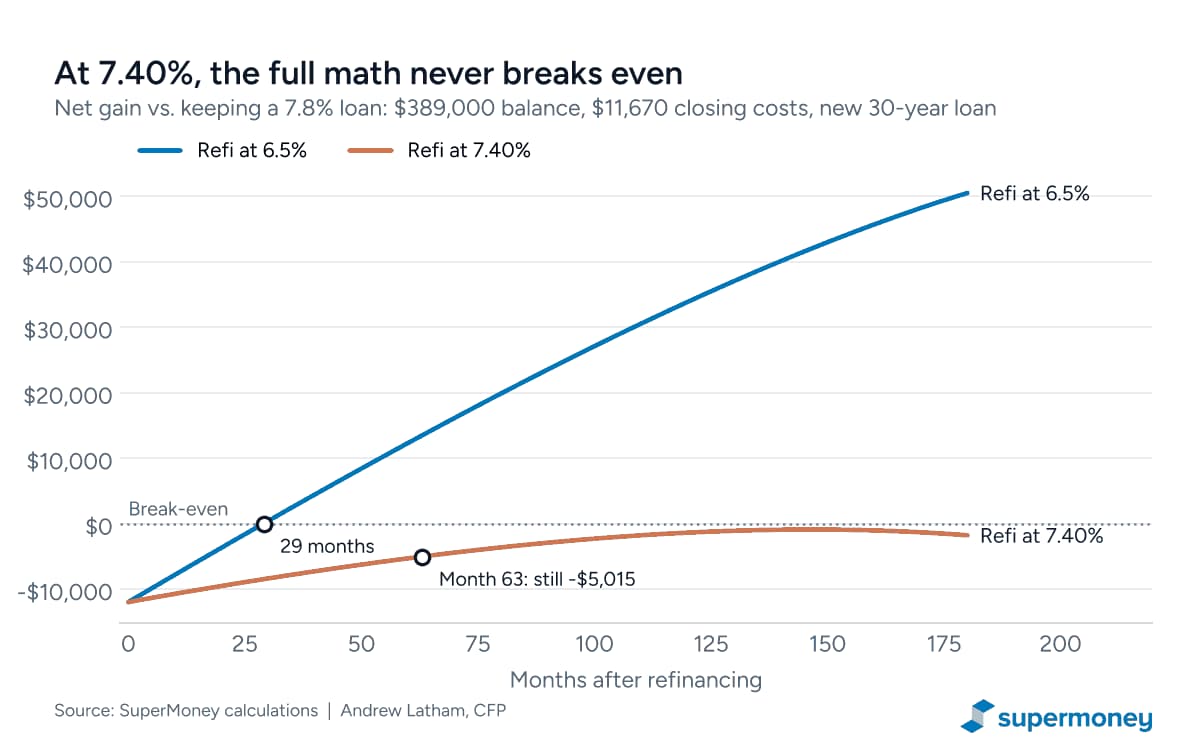
At 6.5%, the refi still holds up. True break-even lands at 29 months, basically the same as the simple answer. By year five, you’re about $12,300 ahead.
At 7.40%, the refi never breaks even. At month 63, where the simple formula says you’re even, you’re still about $5,015 behind. The gap narrows to roughly $885 around year 12, then widens again. Hold the loan the full 30 years and you’d pay about $48,000 more than if you’d left your 7.8% loan alone.
Same $186 a month in “savings.” Completely different answer.
The fix: match your remaining term
You don’t have to accept a new 30-year clock. Ask lenders to quote a loan with the same number of years you have left, or shorter. Here’s our borrower refinancing into a 27-year loan instead:
- At 7.40%, the payment is about $2,778. Monthly savings shrink to $102, so the simple formula says 115 months. The full math says 93 months, because the lower rate now pays down principal faster than the old loan did. Still too long for most people, but at least it eventually wins.
- At 6.5%, the payment is about $2,550 and the savings are $329. Simple break-even says 35 months. Full math says 29. And if you keep the loan to payoff, you come out about $95,000 ahead.
Notice what happened. With a matched term, the simple formula is too pessimistic. With a 30-year reset, it’s too optimistic. That’s exactly why I don’t trust it on its own.
How discount points change your break-even
A discount point is an upfront fee you pay to lower your rate. One point equals 1% of the loan amount.3 On $389,000, that’s $3,890.
How much rate a point buys depends on the lender and the day, so get it in writing. Say a lender quotes you 6.5% with no points, or 6.25% if you pay one point. At 6.25%, your payment is about $2,395, which is $64 a month less than at 6.5%.
Treat the point as its own mini break-even problem:
- Simple version: $3,890 / $64 is about 61 months.
- Full-math version: about 48 months, because the lower rate also knocks your balance down faster.
So the point pays for itself in roughly four to five years. If you’re confident you’ll keep the loan longer than that, it’s a reasonable buy. If there’s a decent chance rates fall and you refinance again in two years, that $3,890 is gone.
Points also push back your overall break-even. With the point, total upfront cost rises to $15,560 and monthly savings rise to $484. Overall break-even goes from about 28 months to about 32.
Watch out for one tax detail. Points you pay on a refinance generally aren’t deductible all at once. The IRS says you deduct them over the life of the loan, with an exception for the portion tied to proceeds used to substantially improve your main home.4 If you pay off or refinance that loan later with a different lender, you can deduct the remaining balance that year. Refinance with the same lender and you keep spreading it over the new loan instead.4 And all of this only helps if you itemize. Don’t count on a tax break to justify points.
Quick break-even table
Want a fast gut check? Find your closing costs on the left and your monthly payment savings across the top. These are simple break-even months, so use them as a first filter, then run the full math on anything that looks close.
| Closing costs | $100/mo | $200/mo | $300/mo | $400/mo | $500/mo |
|---|---|---|---|---|---|
| $6,000 | 60 | 30 | 20 | 15 | 12 |
| $9,000 | 90 | 45 | 30 | 23 | 18 |
| $12,000 | 120 | 60 | 40 | 30 | 24 |
| $15,000 | 150 | 75 | 50 | 38 | 30 |
Anything in the 90 to 150 month range is a pass for almost everyone. Too much happens in seven to twelve years.
My rule of thumb
Here’s how I’d use all this:
- Under 24 months on the simple formula, with a matched or shorter term? Strong candidate. Go get quotes.
- Somewhere between 24 and 60 months, run the full comparison over the number of years you expect to stay, and only move forward if you’ll be there at least a year past the true break-even.
- Past 60 months, I’d usually pass.
- If the new loan is 30 years and you have fewer left, always run the full math. That’s where the simple formula lies.
Short on cash for closing? A no-closing-cost refinance trades upfront fees for a higher rate, which changes the break-even math entirely. And if you’ve decided to move ahead, here’s how to refinance your mortgage step by step.
Then get at least three Loan Estimates on the same day, for the same loan amount and term, and run each one through the steps above. Closing costs and points vary a lot from lender to lender, so your break-even does too. You can compare lenders side by side on our mortgage refinance lender reviews.
Key takeaways
- Simple break-even is closing costs divided by monthly savings. On $11,670 in costs, that’s about 63 months at 7.40% and 28 months at 6.5% for our $389,000 borrower.
- Counting remaining balance, the 7.40% refi into a new 30-year loan never breaks even. It’s still about $5,015 behind at month 63.
- Matching the 27-year remaining term at 6.5% gets a true break-even of 29 months and saves about $95,000 over the loan.
- One discount point on $389,000 costs $3,890. Dropping from 6.5% to 6.25% saves $64 a month and takes about 48 to 61 months to pay back.
- Refinance points are generally deducted over the life of the loan, not all in the year you pay them, per the IRS.
Andrew is the Content Director for SuperMoney, a Certified Financial Planner®, and a Certified Personal Finance Counselor. He loves to geek out on financial data and translate it into actionable insights everyone can understand. His work is often cited by major publications and institutions, such as Forbes, U.S. News, Fox Business, SFGate, Realtor, Deloitte, and Business Insider.
Share this post:
Add as a preferred source on Google
Table of Contents