
How to Refinance Your Mortgage: A Step-by-Step Guide

Last updated 10/08/2026 by
Andrew Latham
Summary:
Refinancing is a 30- to 45-day process: decide what you’re fixing, check your credit, equity, and debt-to-income ratio, then get at least three Loan Estimates on the same day and compare rate, APR, and origination charges side by side. On a $389,000 loan, the gap between a 7.65% quote and a 7.15% quote is about $133 a month and nearly $9,800 in interest over five years. Lock once you’ve picked a lender, don’t touch your credit until closing, and read your Closing Disclosure the moment it arrives.
Most people treat a refinance like a chore. Call the bank that holds the loan, sign what they send, done.
That’s how people overpay. The process isn’t hard, but the order matters, and two or three steps are where real money is won or lost. If you haven’t decided yet whether refinancing makes sense at all, start with our guide on should you refinance your mortgage. This article assumes the math works and you’re ready to go.
I’ll use the same borrower from that guide: a $400,000 loan at 7.8% taken in November 2023, about $389,000 left to pay three years in. Today’s average 30-year fixed rate is 7.40%, per Freddie Mac’s October 8, 2026 survey.1
Get Competing Personal Loan Offers In Minutes
Compare rates from multiple vetted lenders. Discover your lowest eligible rate.
It's quick, free and won’t hurt your credit score
Step 1: Know exactly what you’re trying to fix
Write it down in one sentence before you talk to a single lender. “Lower my payment.” “Get rid of PMI.” “Pay the house off by 2045.” “Pull out $50,000 for a roof.”
Why bother? Because each goal points to a different loan, and loan officers will happily sell you whatever pays them best. If your goal is dropping mortgage insurance, read up on refinancing to get rid of PMI or FHA mortgage insurance first. If you want cash, the comparison you need is cash-out vs. rate-and-term refinance. And whatever the goal, know your break-even point. Here’s how to calculate your refinance break-even point.
Step 2: Check your credit, equity, and DTI
Lenders price your loan off three things. Look at them yourself before they do.
Equity (your loan-to-value ratio)
Loan-to-value, or LTV, is your loan balance divided by your home’s value. Say our borrower’s home is now worth $500,000. $389,000 divided by $500,000 is 77.8% LTV.
For a conventional loan sold to Fannie Mae, the current eligibility matrix caps a one-unit primary residence at 80% LTV for a cash-out refinance. A limited cash-out refinance (the standard rate-and-term kind) can go as high as 97%, though anything above 95% requires that Fannie Mae already own your existing loan.2 High LTV gets you approved. It doesn’t get you a good price. Below 80%, you also skip private mortgage insurance on a conventional loan, which is why our borrower at 77.8% is in a strong spot.
Debt-to-income ratio
Your DTI is your total monthly debt payments divided by your gross monthly income. Fannie Mae allows up to 50% when the loan runs through its automated underwriting system, Desktop Underwriter. For manually underwritten loans, the limit is 36%, or up to 45% if you meet extra credit score and cash reserve requirements.3
Run yours. Say you earn $11,000 a month before taxes. Your new mortgage payment is $2,693, plus $600 for property taxes and insurance, a $450 car payment, and a $300 student loan. That’s $4,043, or about 36.8% DTI. You’d qualify comfortably through automated underwriting. Paying off that car loan first would drop you to about 32.7%.
Credit
Pull your reports and fix errors before you apply, not during. A higher score usually means a better rate, and a surprise collection account found mid-application can stall everything.
Step 3: Gather your documents now
Do this before you apply. Freddie Mac lists what lenders typically ask for:4
- At least one month of pay stubs
- Two years of W-2s
- Your most recent tax returns
- Statements for every bank and investment account
- Proof of any side or supplemental income
- Your homeowners insurance policy and latest mortgage statement
Self-employed? Expect to send more, often two years of business returns. Put it all in one folder on your computer. You’ll be uploading the same files to three lenders, and then again to the one you pick.
Step 4: Get at least three Loan Estimates on the same day
This is the step that pays. A Loan Estimate is a standardized three-page form, and a lender must give you one within three business days of receiving your application.5 Because every lender uses the same form, you can lay them side by side.
Apply with three or more lenders within a day or two of each other, and ask them all to quote on the same day. Rates move daily. A quote from Monday and a quote from Thursday aren’t comparable, because the market itself may have moved a quarter point in between. Ask for the same loan from each: same term, same loan amount, same lock length.
Then compare these four things:
- Interest rate. Drives your monthly payment.
- APR. The rate plus most fees, expressed as a yearly cost. The CFPB calls it “one measure” of your loan’s cost, so use it as a cross-check, not the final word.6
- Section A, Origination Charges, on page 2. This is what the lender itself charges: application, underwriting, processing, and any points. It’s the most negotiable part of your closing costs.
- The page 3 Comparisons section, which shows what you’ll pay in the first five years.
Watch out for a low rate bought with points. If Lender A’s rate is 0.25% lower but Section A is $3,800 higher, you’re paying for that rate upfront. Do the break-even math on the difference.
So what’s shopping worth? Take our borrower’s $389,000 balance on a 30-year loan and three plausible quotes around the 7.40% average. At 7.65%, the payment is $2,760. At 7.15%, it’s $2,627. That’s $133 a month, and in the first five years alone, the higher quote costs about $9,800 more in interest.
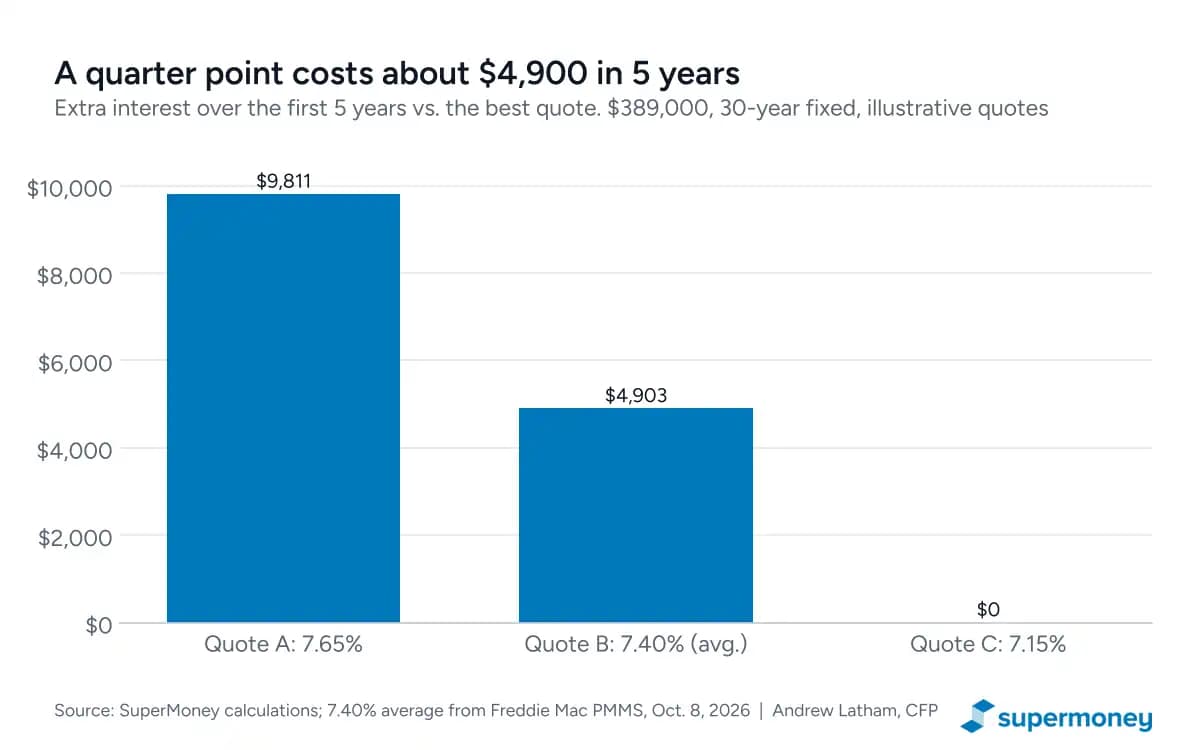
Over the full 30 years, the gap between those two quotes grows to about $47,800 in interest. Same borrower, same house, same week. The only difference is whether you made two extra phone calls.
Rate shopping won’t wreck your credit
People skip shopping because they’re afraid of the hard inquiries. Don’t be. According to myFICO, newer FICO score versions count all mortgage inquiries within any 45-day span as one inquiry, and older versions use a 14-day span. FICO scores also ignore mortgage inquiries made in the 30 days before scoring.7 Since you don’t know which version a lender uses, keep all your applications inside 14 days. Easy if you’re doing them the same week anyway.
Step 5: Lock your rate
A rate lock guarantees your rate as long as you close within the lock period and your application doesn’t change. The CFPB says locks typically run 30, 45, or 60 days.8 Some lenders lock when they issue the Loan Estimate and some don’t, so check the top of page 1.
Pick a lock long enough to actually close. Extensions can be expensive. And know that “locked” has conditions: if your appraisal comes in low, your credit score changes, or the lender can’t document your bonus income, your rate can still change.8
Step 6: The appraisal
Your lender orders an appraisal to confirm the home’s value. If our borrower’s home appraises at $470,000 instead of $500,000, LTV jumps from 77.8% to about 82.8%. That crosses the 80% line, which can mean PMI and a worse price.
You can help. Have a list of upgrades ready (new roof, remodeled kitchen, with dates and costs) and hand it to the appraiser. If the value comes in clearly wrong, ask your lender about disputing it with comparable sales.
Step 7: Underwriting
An underwriter verifies everything: income, assets, debts, and the appraisal. Expect follow-up requests. Answer them the same day.
And freeze your financial life until closing. No new credit cards, no car loans, no big unexplained deposits, no job changes if you can avoid it. Any of these can change your rate or kill the approval.
Step 8: Review your Closing Disclosure
Freddie Mac says to plan on closing costs of 3% to 6% of the loan amount.9 For our borrower, that’s $11,670 to $23,340. Your Closing Disclosure shows the final number. Your lender must give it to you at least three business days before closing.10
Use those three days. Put it next to your Loan Estimate and check the rate, the loan amount, the monthly payment, and Section A. If something went up and nobody told you why, ask before you sign, not after.
Step 9: Close, then wait out the right of rescission
On a refinance of your primary home, federal law gives you the right to cancel until midnight of the third business day after closing.11 For this rule, business days include Saturdays but not Sundays or federal holidays.12 The lender can’t disburse funds (other than into escrow) until that window passes, so your old loan gets paid off a few days after you sign.
One wrinkle. If you refinance with the same lender that holds your current loan, the right to cancel only covers any new money beyond your existing balance and costs. With a new lender, it covers the whole loan.11
How long the whole thing takes
Freddie Mac says the process typically takes 30 to 45 days.4 Here’s roughly how that breaks down:
- Days 1 to 3: Apply with three or more lenders and get Loan Estimates back.
- Around day 4: Choose a lender and lock.
- Weeks 1 to 4: Appraisal and underwriting, which is where most delays happen.
- At least 3 business days before closing, you get your Closing Disclosure.
- Closing day, then 3 business days of rescission before funds go out.
The fastest way to shorten it is boring. Have your documents ready and reply to the underwriter quickly.
Ready to start collecting quotes? Compare offers on our mortgage refinance lender reviews. If you’re leaning toward rolling costs into the loan, read no-closing-cost refinance explained before you choose.
Key takeaways
- On $389,000, a 7.65% quote costs about $133 more a month than a 7.15% quote, and roughly $9,800 more in interest over five years.
- Lenders must send a Loan Estimate within 3 business days of your application. Get at least three, priced the same day.
- Fannie Mae caps conventional cash-out refinances at 80% LTV, and DU-approved loans at 50% DTI.
- Newer FICO models treat mortgage inquiries within 45 days as one. Keep shopping inside 14 days to be safe.
- Budget 3% to 6% of the loan for closing costs: $11,670 to $23,340 on $389,000.
- Expect 30 to 45 days start to finish, plus a 3-business-day rescission window on a primary home.
Andrew is the Content Director for SuperMoney, a Certified Financial Planner®, and a Certified Personal Finance Counselor. He loves to geek out on financial data and translate it into actionable insights everyone can understand. His work is often cited by major publications and institutions, such as Forbes, U.S. News, Fox Business, SFGate, Realtor, Deloitte, and Business Insider.
Share this post:
Add as a preferred source on Google
Table of Contents