
No-Closing-Cost Refinance: How It Works and When It’s Worth It

Last updated 10/08/2026 by
Andrew Latham
Summary:
A no-closing-cost refinance doesn’t make your closing costs disappear. You pay them through a higher interest rate or by adding them to your loan balance. On a $389,000 refi, skipping $11,670 in upfront costs for a rate half a point higher comes out ahead for about six years, then starts costing you more every month. If you’ll likely move or refinance again before that point, no-cost is a smart move. If you’re staying put, pay the costs.
“No closing costs” might be the most effective phrase in mortgage marketing. Who wouldn’t want to skip a five-figure bill at the closing table?
Here’s the catch. The lender still gets paid. Freddie Mac says it plainly: “There is no such thing as a free loan.”1 The real question isn’t whether you pay. It’s how you pay and for how long, and the answer can swing your total cost by tens of thousands of dollars.
If you haven’t decided whether to refinance at all, start with should you refinance your mortgage. This article assumes you’ve decided a refi makes sense and you’re weighing how to handle the costs.
Get Competing Personal Loan Offers In Minutes
Compare rates from multiple vetted lenders. Discover your lowest eligible rate.
It's quick, free and won’t hurt your credit score
The two ways “no-cost” actually gets paid
Refinance closing costs typically run 3% to 6% of your loan principal, according to Freddie Mac. That covers things like the appraisal, title insurance, origination, underwriting, and recording fees.1 On a $389,000 loan, even the low end is $11,670.
A “no-cost” refinance handles that bill in one of two ways.
1. Lender credits (you take a higher rate)
The lender gives you a credit that covers your closing costs, and in exchange you accept a higher interest rate. The CFPB describes lender credits as the reverse of discount points. Points lower your rate in exchange for paying more at closing. Lender credits lower what you pay at closing in exchange for a higher rate. The more credit you take, the higher your rate goes.2
The lender isn’t being generous. A higher-rate loan is worth more to the lender (and to whoever buys it later), so the lender can afford to cover your fees upfront and earn it back from your interest over time.
2. Rolling costs into the balance (you borrow them)
Here you keep the lower rate, but your closing costs get added to the loan amount. Instead of owing $389,000, you owe $400,670. Nothing comes out of your pocket at closing, but you’re paying 30 years of interest on your fees.
Some lenders call this “no-cost” too. It’s really “no cash at closing.” Freddie Mac’s warning covers both versions: a lender advertising a no-cost refi is probably charging a higher rate or rolling the costs into the loan, and either one “may cost you more over the life of the loan.”1
What “no-cost” usually still doesn’t cover
Even with a full lender credit, you may need to bring money to closing. The usual culprits are prepaid items and your new escrow account.
- Initial escrow deposit. If your new loan has an escrow account for property taxes and insurance, you’ll fund a starting balance at closing. The CFPB notes this shows up in Section G on page 2 of your Loan Estimate.3
- Prepaids. Things like daily interest from your closing date to the end of the month, and sometimes homeowners insurance premiums. These sit in Section F of the Loan Estimate.
- Your old escrow balance can soften the blow. When your old loan is paid off, the servicer generally has to refund what’s left in your escrow account within 20 business days, or it can credit that money to your new loan’s escrow if you agree and the new loan stays with the same lender or servicer.4
So ask every lender a direct question: “What’s my cash to close?” Then check that the number on your Loan Estimate matches the answer. Some lenders’ “no-cost” covers only their own fees. Others cover third-party fees like title and appraisal too. You won’t know which you’re getting until you read the paperwork.
The real-number comparison on a $389,000 refi
Let’s run three versions of the same refinance. You owe $389,000 and you’re taking a new 30-year fixed loan. The average 30-year rate was 7.40% as of October 8, 2026, per Freddie Mac.5 Closing costs are $11,670, which is 3%.
For the no-cost version, I’m using an illustrative rate 0.375 to 0.5 percentage points higher. That’s an assumption to show the math, not a quote. Lenders price lender credits very differently, and some will want a bigger rate bump to cover 3% of your loan.
- Pay upfront at 7.40%: $11,670 out of pocket, payment of about $2,693 a month.
- No-cost at 7.90% (0.5 points higher): $0 at closing, payment of about $2,827. That’s $134 more a month.
- No-cost at 7.775% (0.375 points higher): $0 at closing, payment of about $2,794, or $100 more.
- Roll costs in at 7.40%: $0 at closing, balance of $400,670, payment of about $2,774, or $81 more.
Payments only tell part of the story. The fair way to compare is to add up what each option really costs you by any given year: closing costs paid plus interest paid. Principal isn’t a cost. It’s your money going back into the house.
Here’s how the 0.5-point version stacks up against paying upfront:
- Sell or refinance after 3 years and the no-cost loan saved you about $7,760.
- After 5 years, you’re still ahead by about $1,850.
- Somewhere around month 72, the lines cross. After that, every year costs you about $2,000 more.
- Over the full 30 years, the no-cost loan costs about $36,500 more.
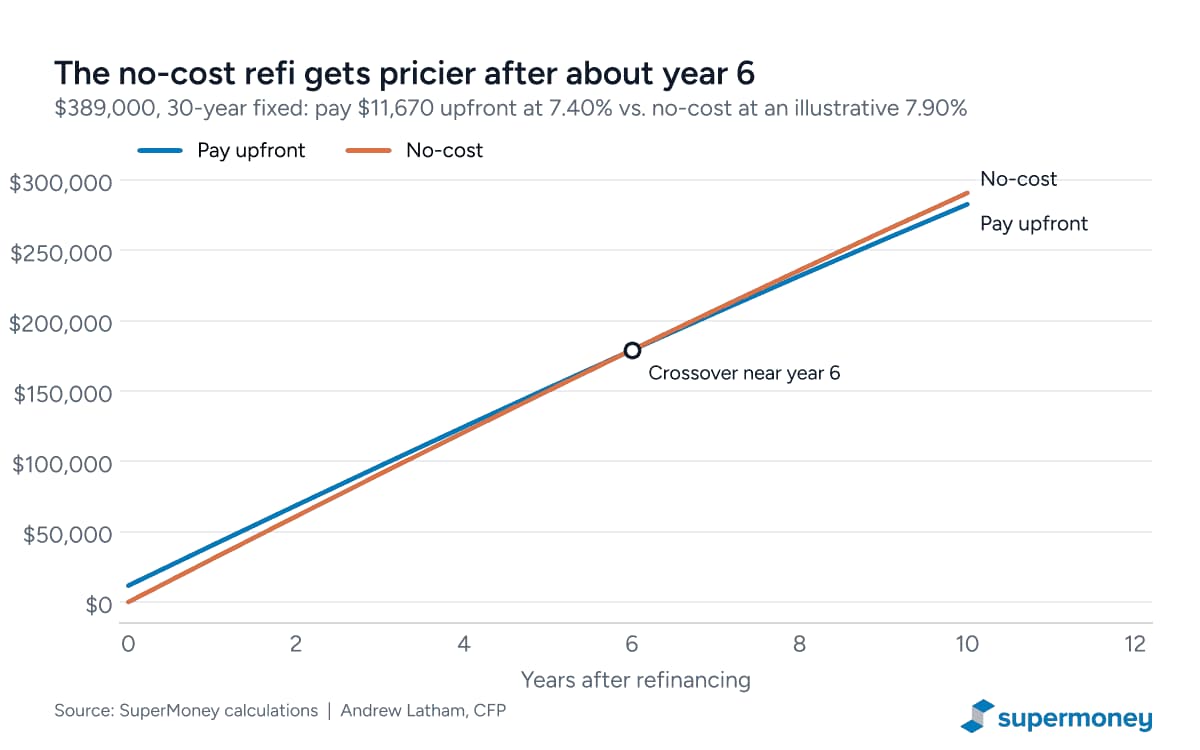
At a 0.375-point bump, the crossover moves out to about month 95, a little under eight years. The full-term extra cost drops to roughly $24,400.
One thing that surprises people: the crossover comes sooner than simple payment math suggests. If you just divide $11,670 by $134 a month, you get 87 months. But the higher rate also means less of each payment goes to principal, so you’re paying interest on a slightly bigger balance every month. That pulls the real crossover in by more than a year.
Rolling costs in is the worst of the three for most people
This one doesn’t have a good window. You keep the 7.40% rate, but you’re paying interest on $11,670 from day one, and you still owe that $11,670 when you sell. At every point in time, it costs more than paying upfront. Over 30 years the extra interest alone is about $17,400.
Compared to the 7.90% lender-credit loan, rolling costs in does win if you keep the loan past about year 10. But the whole reason to go no-cost is that you probably won’t keep the loan long. In those early years, the lender credit is the cheaper version because you never owe the $11,670 back. Rolling costs in also raises your loan-to-value ratio, which can affect your pricing or whether you can avoid mortgage insurance.
A reality check before you go further. If your current rate is 7.8%, like the 2023 buyer in our pillar article, a no-cost loan at 7.775% or 7.90% saves you almost nothing or nothing at all. No-cost only works when there’s a real gap between the rate you have and the rate you’re getting.
Who a no-cost refinance is right for
You’ll probably move within a few years. Job relocation, a growing family, a planned downsize. If there’s a good chance you’re out in three to five years, you’d never earn back $11,670 in upfront costs anyway. Take the credit.
You expect to refinance again. With rates at 7.40% and up more than a full point from a year ago, a lot of people refinancing today would happily refinance again if rates fall. Each time you pay upfront costs, you reset your break-even clock. A no-cost loan means a future refi is cheap to walk away from. If that’s your plan, run the refinance break-even math on both versions before you commit.
Your cash is tight. If paying $11,670 at closing would drain your emergency fund, don’t do it. Being house-rich and cash-poor is how a car repair turns into credit card debt. A slightly higher payment is the better trade here.
Who should skip it
If this is your forever home, or at least your next-ten-years home, pay the costs. Past the crossover, the no-cost loan just keeps costing you more. Over 30 years, the 0.5-point version in our example costs about $36,500 extra.
Also skip it if the rate bump is big. If a lender wants a full point or more to cover your costs, the crossover could land just a few years out. Have the lender show you the math before you agree.
And if you have the cash and you’re staying put, you might even consider the opposite move: paying points to buy the rate down. Same math, reversed.
How to compare offers on the Loan Estimate
Don’t compare a no-cost quote to a pay-upfront quote by looking at the rate alone. Ask each lender for two Loan Estimates for the same loan amount and term, one with lender credits and one without. The CFPB suggests exactly this: if you see a lender credit, ask whether a similar loan without it is available.6
Then check these lines on page 2:
- Section J, Lender Credits. Lender credits show up as a negative number on this line.2 Compare that credit to your total closing costs. A credit that covers 60% of your costs isn’t “no-cost.”
- Section A, Origination Charges. This is where points appear, and where lenders bury their own fees. A lender with a lower rate but higher origination charges isn’t necessarily cheaper.
- Sections F and G. Your prepaids and initial escrow deposit. These are the dollars you’ll likely still need even with a full credit.
- The “Estimated Cash to Close” figure on page 1, which is what you’ll actually bring to closing.
Last step: use those numbers to find your own crossover. Take the upfront closing costs and the monthly payment difference, and ask yourself honestly how long you’ll keep this loan. If you want the full process laid out from application to closing, see how to refinance your mortgage, step by step.
Ready to shop? Start with our comparison of no-closing-cost refinance lenders, then get quotes from at least three lenders on our mortgage refinance lender reviews so you can see both pricing options side by side.
Key takeaways
- Refinance closing costs run 3% to 6% of the loan, per Freddie Mac. That’s $11,670 or more on a $389,000 refi.
- No-cost loans cover those costs with a higher rate (lender credits) or by adding them to your balance.
- At an illustrative 0.5-point higher rate, no-cost beats paying upfront for about six years, then costs more. At 0.375 points, the crossover is close to eight years.
- Rolling $11,670 into a 30-year loan at 7.40% adds about $17,400 in interest over the full term.
- Lender credits appear as a negative number in Section J of your Loan Estimate. Escrow and prepaids in Sections F and G may still be due.
Andrew is the Content Director for SuperMoney, a Certified Financial Planner®, and a Certified Personal Finance Counselor. He loves to geek out on financial data and translate it into actionable insights everyone can understand. His work is often cited by major publications and institutions, such as Forbes, U.S. News, Fox Business, SFGate, Realtor, Deloitte, and Business Insider.
Share this post:
Add as a preferred source on Google
Table of Contents