
You Can Soon Invest in Your Favorite Sports Team. Here’s What Every Team Is Worth

Last updated 10/13/2026 by
SuperMoney Team
Edited by
Andrew Latham
Summary:
Wall Street has filed for well over 100 single-team ETFs covering every NHL and MLB club, so you may soon be able to “invest” in your favorite team from a brokerage account. The catch: these funds wouldn’t own any part of a team. They’d track a stats index that resets every season, which makes them closer to a season-long bet. That’s mostly a gimmick, but it’s probably harmless if you keep all your fun bets to 1% of your portfolio or less. Below, you’ll also find what the most valuable sports teams are worth, with full tables for all 124 NFL, NBA, MLB and NHL teams.
You may soon be able to buy a fund for your favorite team. Since August, three fund companies have filed with the Securities and Exchange Commission (SEC), the federal regulator that approves new funds, for single-team ETFs covering every NHL club and every MLB club. CNBC says hundreds of these funds are now in the works, with tickers like TML for the Maple Leafs and, I’m not making this up, RATS for the Florida Panthers.
It’s a fun idea. The most valuable sports teams are now worth billions, and the Dallas Cowboys alone are valued at $15.5 billion. Who wouldn’t want a piece of that? But that’s exactly the problem. These funds wouldn’t give you a piece of it. Here’s what they actually hold, why I’d call them mostly a gimmick, and why the reason they’re appealing says something useful about how you manage your own money.
Get Competing Personal Loan Offers In Minutes
Compare rates from multiple vetted lenders. Discover your lowest eligible rate.
It's quick, free and won’t hurt your credit score
You’ll soon be able to invest in your favorite team (sort of)
A team ETF wouldn’t own shares of the Bruins or the Yankees. It would hold futures contracts, which are agreements to buy or sell something at a set price later, listed by CME Group, the Chicago company that runs the world’s biggest futures exchange.
Those futures track a CME FutureSports Performance Index for each team. FutureSports, a Chicago startup, turns official league stats into one live number. Here’s how it works:
- Every NHL team index starts the season at 7,500 points.
- Good plays add points and bad ones subtract them. The NHL version uses 55 stats, including wins, losses, goals scored, goals allowed, shots and penalties. The MLB indexes use 70 factors, such as runs, stolen bases and strikeouts.
- The index updates in real time during games, including the playoffs.
- It resets to 7,500 before the next season.
- It has no floor. One fund filing says a team’s index can go negative.
So a team ETF is really a season-long bet on your team’s stats. It’s not a stake in a business whose value can compound for decades. When the Cowboys’ franchise value rises 21% in a year, a stats index doesn’t care.
Who filed, and when you could buy
Volatility Shares filed for 32 NHL team funds on August 14 and later added MLB funds. LeagueShares filed on August 25 for 32 NHL funds plus leveraged 2x versions, then added MLB funds in September. Its NHL filing already lists tickers, such as TML for the Maple Leafs, RGRS for the Rangers, BRNZ for the Bruins and OILZ for the Oilers. REX Financial launched a unit called Alpha Sports on September 21 to build “HockeyShares” and “BaseballShares” funds for every NHL and MLB team, including 2x versions.
No issuer has disclosed a fee yet. Neither the SEC nor the Commodity Futures Trading Commission (CFTC), which regulates futures, has approved these funds, and none of them are trading as of October 13, 2026. CME scheduled its NHL team futures to start on September 28, and one trade report says they went live the night before. MLB futures don’t have a launch date yet.
Mostly a gimmick, probably harmless in small doses
Industry people aren’t exactly lining up to cheer. Morningstar senior analyst Zachary Evens called the wave of filings a “throw spaghetti at the wall” approach: launch lots of small funds and hope a few catch on. Matt Tuttle, CEO of Tuttle Capital Management, pointed out that most games end after the stock market closes, so an ETF can’t react in real time the way a betting app can. The fund filings themselves flag insider trading by people close to a team, thin trading in brand-new contracts, possible state gambling challenges, and the chance regulators restrict the futures.
Here’s my take as a planner. A team fund isn’t going to wreck your retirement, as long as it stays small. The rule I’d use: keep all of your gimmick and fun positions combined, whether that’s a team fund, a meme stock or a crypto coin you bought because of a podcast, to 1% of your portfolio or less.
| Total portfolio | 1% fun-money cap | What that buys |
|---|---|---|
| $5,000 | $50 | About the cost of a nosebleed seat |
| $20,000 | $200 | A decent playoff ticket |
| $100,000 | $1,000 | A road trip to an away game |
Think of it as a ticket budget, not a retirement holding. If your team tanks, you lose about what a bad night at the stadium would cost you. If it wins, enjoy it, then don’t double down.
The money that actually needs to grow belongs somewhere boring. Say you have $10,000 to invest. In an S&P 500 index fund like Vanguard’s VOO, which charges 0.03% a year, you’d pay $3 in annual fees and own a slice of 500 companies whose profits can grow over time. Roundhill’s existing sports ETFs charge 0.75%, or $75 a year on the same $10,000, and team ETF fees haven’t been disclosed at all. Before you play, make sure you’re getting your full 401(k) match. If you need help with that order, here’s where to save after you get the 401(k) match, and if you’re choosing between the two biggest S&P 500 ETFs, see SPY vs. VOO.
Why investing in what you love is so appealing
Team ETFs are a gimmick, but the urge behind them is real. People want their money to reflect who they are. That’s the same pull behind a lot of the most popular investing trends of the last decade: funds that screen companies on environmental or social values, faith-based funds, funds built around a political leaning, and funds tied to a hobby or brand people love.
Some of those are thoughtful, diversified portfolios with a values filter. Others are marketing with a ticker attached. The way to tell them apart is the same question I’d ask about a team fund: what do you actually own, and what does it cost? A values-based fund that holds hundreds of real businesses at a reasonable fee can work as a core holding. A narrow theme fund is fun money, and it belongs inside your 1%.
There’s also a good lesson buried here. Personalization makes people more engaged with their money, and engagement matters. You’re more likely to stick with a plan that feels like yours. The trick is to personalize the plan, not just the portfolio.
Personalize your plan, not just your portfolio
The most personal financial decision you’ll make isn’t which ticker to buy. It’s how your money lines up with what you care about every month: what you spend on, what you save for, and what you’re paying off. A fan who budgets $60 a month for games and gear, saves for a playoff trip, and invests the rest in index funds has built something far more personal than a team ETF.
That’s where a tool like the SuperMoney app helps. It links your accounts in one place, tracks your spending against a budget you set, shows your net worth, and gives you personalized insights about where your money is actually going. You can also ask Sense AI, the app’s AI money assistant, questions like “how much can I spend on tickets this month?” It’s a lot easier to keep your fun money at 1% when you can see the other 99%.
Ways to invest in a sports team today
If you want sports exposure right now, you have a few real options, though none of them is quite like owning a team outright.
- Manchester United (MANU): The English soccer club has traded on the New York Stock Exchange since 2012. It doesn’t currently pay a dividend.
- Atlanta Braves Holdings (BATRA, BATRK): Spun off from Liberty Media in July 2023, it owns the Braves and The Battery Atlanta, the shopping and entertainment district around the ballpark.
- Madison Square Garden Sports (MSGS): Owns the New York Knicks and New York Rangers. It doesn’t own the arena itself.
- Sports ETFs: The Roundhill Pro Sports, Media & Apparel ETF (MVP) holds companies tied to teams, sports media and apparel, a classic picks-and-shovels approach. The Roundhill Sports Betting & iGaming ETF (BETZ) holds betting companies. Both charge 0.75%.
Even these are single-company or narrow-theme bets, so they count toward your 1% too. If you’re new to ETFs, an exchange-traded product is any fund or note that trades like a stock. Team futures funds would be a very unusual version of one.
Can you buy Green Bay Packers stock?
Sort of, but it isn’t an investment. The Packers are a nonprofit corporation owned by fans, and the team’s 2021 offering was its sixth stock sale. The offering document says in capital letters that you shouldn’t buy to make a profit. The shares can never pay dividends, transfers are tightly restricted, and the team can buy shares back for $0.025 each if you try to sell to someone else. You also don’t get a tax deduction. What you do get is a stock certificate, a vote, an invitation to the annual meeting and access to shareholder-only merchandise. Honestly, that’s a pretty good use of fun money.
And if you’d rather bet on your team through a sportsbook or prediction market, remember the IRS wants its cut. Here’s how gambling winnings are taxed.
The most valuable sports teams in 2026
Team ETFs won’t give you a piece of franchise value, but it’s still fun to know what the teams are worth. Football owns the top of the list. On Sportico’s 2026 NFL valuations, published in August, the Dallas Cowboys are worth $15.5 billion, up 21% in a year. The Los Angeles Rams ($12.7 billion) and New York Giants ($12 billion) come next. Nine NFL teams are now valued at $10 billion or more.
Sportico isn’t the only scorekeeper. Forbes’ September list puts the Cowboys even higher, at $17 billion, up 31% from 2025. The two outlets use different methods, so the numbers won’t match. In this article I use one source per league and label it, so you’re never comparing apples with oranges inside a single table.
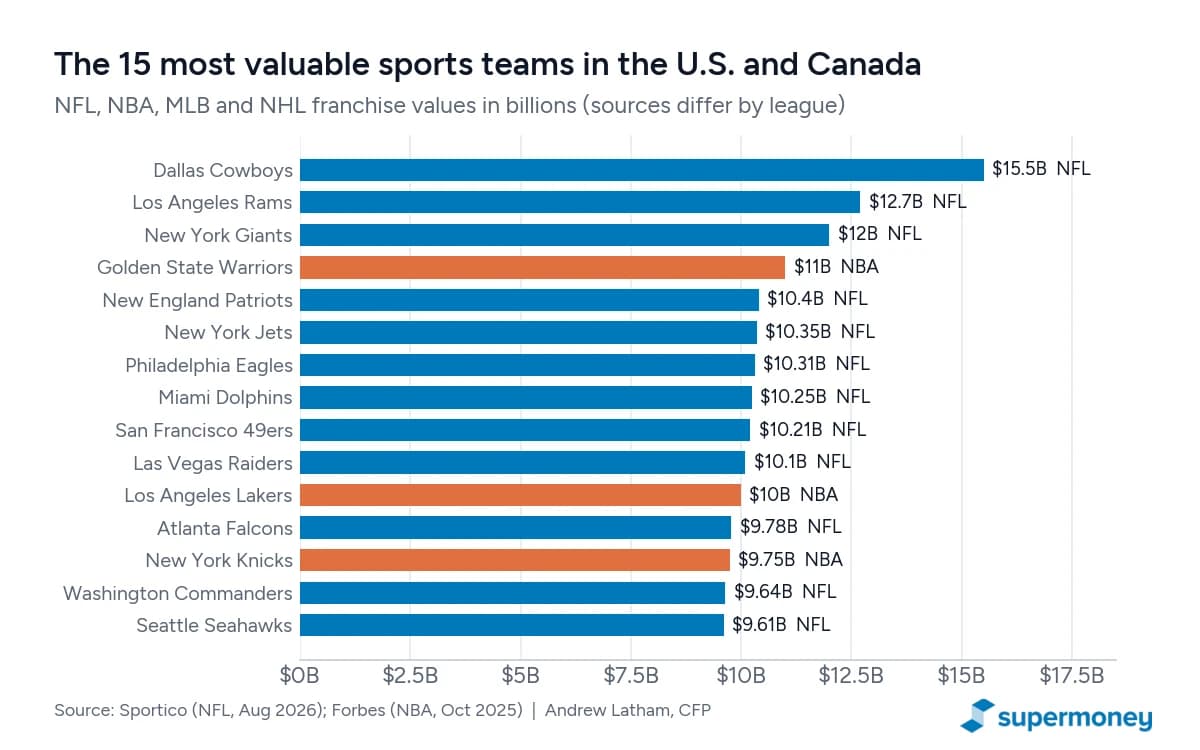
Only three NBA teams crack the top 15 on Forbes’ October 2025 figures: the Golden State Warriors ($11 billion), Los Angeles Lakers ($10 billion) and New York Knicks ($9.75 billion). Sportico’s newer NBA list, released in October 2026, is much richer. It values the Warriors at $14.5 billion, the Knicks at $12.8 billion and the Lakers at $12.5 billion. On those numbers, the Warriors would rank second overall, behind only the Cowboys.
The gap between leagues is huge. The least valuable NFL team, the Cincinnati Bengals at $7.4 billion, is worth about 1.7 times the most valuable NHL team, the Toronto Maple Leafs at $4.4 billion. Even the New York Yankees, baseball’s richest club at $8.5 billion, would rank only 23rd in the NFL.
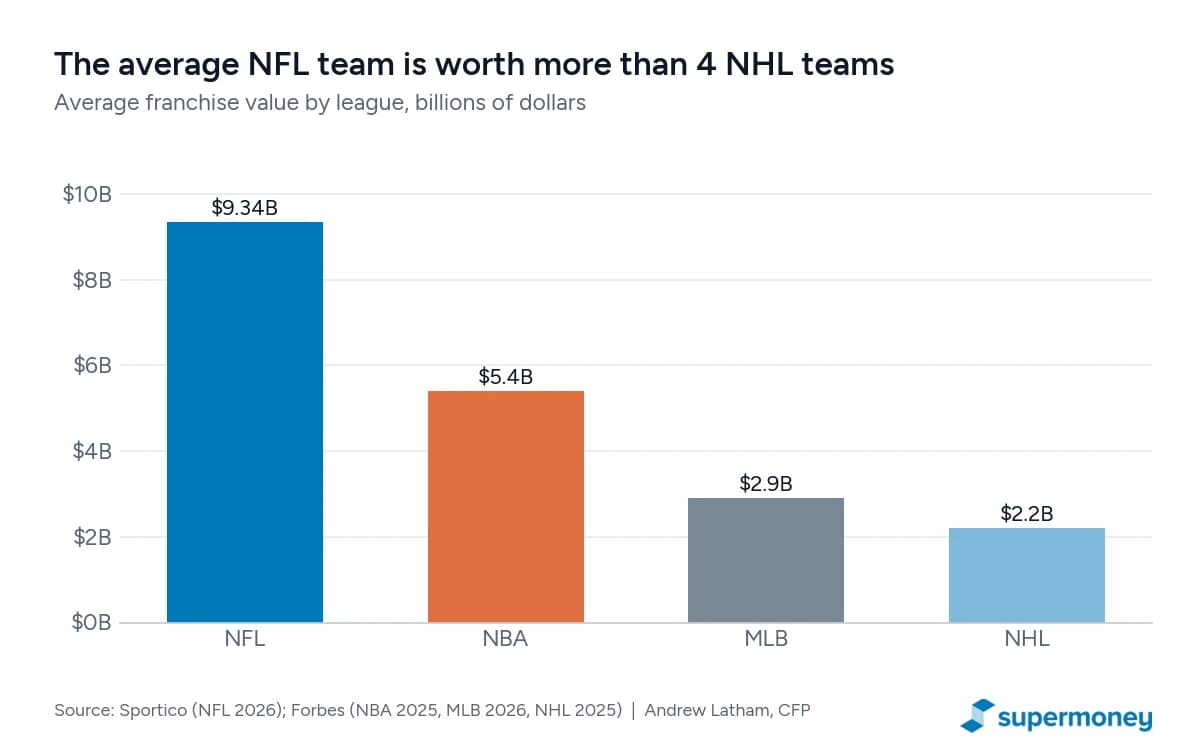
Sportico’s average NFL value jumped from $7.13 billion to $9.34 billion in a single year, a 31% gain. That’s the kind of growth team ETF buyers might imagine they’re getting. They aren’t. Owners get that growth. Fund holders get a stats scoreboard.
Most valuable NFL teams
Every NFL team gained value this year, with 1-year increases from 17% (Giants) to 46% (Seahawks). Sportico counts both the team itself and related businesses like stadiums and real estate.
Source: Sportico, NFL team values 2026 (published August 12, 2026), as reported by CBS Sports.
| Rank | Team | Value | 1-year change |
|---|---|---|---|
| 1 | Dallas Cowboys | $15.5 billion | +21% |
| 2 | Los Angeles Rams | $12.7 billion | +22% |
| 3 | New York Giants | $12 billion | +17% |
| 4 | New England Patriots | $10.4 billion | +19% |
| 5 | New York Jets | $10.35 billion | +28% |
| 6 | Philadelphia Eagles | $10.31 billion | +22% |
| 7 | Miami Dolphins | $10.25 billion | +24% |
| 8 | San Francisco 49ers | $10.21 billion | +19% |
| 9 | Las Vegas Raiders | $10.1 billion | +28% |
| 10 | Atlanta Falcons | $9.78 billion | +39% |
| 11 | Washington Commanders | $9.64 billion | +30% |
| 12 | Seattle Seahawks | $9.61 billion | +46% |
| 13 | Houston Texans | $9.52 billion | +33% |
| 14 | Chicago Bears | $9.45 billion | +27% |
| 15 | Denver Broncos | $9.18 billion | +40% |
| 16 | Kansas City Chiefs | $8.74 billion | +34% |
| 17 | Pittsburgh Steelers | $8.7 billion | +34% |
| 18 | Tampa Bay Buccaneers | $8.68 billion | +34% |
| 19 | Los Angeles Chargers | $8.65 billion | +39% |
| 20 | Tennessee Titans | $8.62 billion | +39% |
| 21 | Cleveland Browns | $8.6 billion | +40% |
| 22 | Green Bay Packers | $8.59 billion | +33% |
| 23 | Minnesota Vikings | $8.26 billion | +32% |
| 24 | Baltimore Ravens | $8.2 billion | +37% |
| 25 | Buffalo Bills | $8.13 billion | +39% |
| 26 | Carolina Panthers | $8.07 billion | +40% |
| 27 | Detroit Lions | $8.02 billion | +36% |
| 28 | Arizona Cardinals | $8 billion | +41% |
| 29 | Jacksonville Jaguars | $7.91 billion | +42% |
| 30 | Indianapolis Colts | $7.77 billion | +36% |
| 31 | New Orleans Saints | $7.59 billion | +35% |
| 32 | Cincinnati Bengals | $7.4 billion | +35% |
Most valuable NBA teams
These are Forbes’ figures from October 2025, the latest full NBA list I could verify. As noted above, Sportico’s October 2026 list is higher across the top, with the Warriors at $14.5 billion.
Source: Forbes, NBA team values for the 2025 to 2026 season (published October 2025).
| Rank | Team | Value | 1-year change |
|---|---|---|---|
| 1 | Golden State Warriors | $11 billion | +25% |
| 2 | Los Angeles Lakers | $10 billion | +41% |
| 3 | New York Knicks | $9.75 billion | +30% |
| 4 | Los Angeles Clippers | $7.5 billion | +36% |
| 5 | Boston Celtics | $6.7 billion | +12% |
| 6 | Chicago Bulls | $6 billion | +20% |
| 7 | Houston Rockets | $5.9 billion | +20% |
| 8 | Miami Heat | $5.7 billion | +34% |
| 9 | Brooklyn Nets | $5.6 billion | +17% |
| 10 | Philadelphia 76ers | $5.45 billion | +18% |
| 11 | Phoenix Suns | $5.425 billion | +26% |
| 12 | Toronto Raptors | $5.4 billion | +23% |
| 13 | Dallas Mavericks | $5.1 billion | +9% |
| 14 | Atlanta Hawks | $5 billion | +32% |
| 15 | Cleveland Cavaliers | $4.8 billion | +22% |
| 16 | Washington Wizards | $4.7 billion | +15% |
| 17 | Denver Nuggets | $4.6 billion | +18% |
| 18 | Sacramento Kings | $4.45 billion | +20% |
| 19 | San Antonio Spurs | $4.4 billion | +14% |
| 20 | Oklahoma City Thunder | $4.35 billion | +19% |
| 21 | Milwaukee Bucks | $4.3 billion | +8% |
| 22 | Portland Trail Blazers | $4.25 billion | +21% |
| 23 | Indiana Pacers | $4.2 billion | +17% |
| 24 | Utah Jazz | $4.1 billion | +15% |
| 25 | Orlando Magic | $3.9 billion | +22% |
| 26 | Charlotte Hornets | $3.8 billion | +15% |
| 27 | Detroit Pistons | $3.65 billion | +7% |
| 28 | Minnesota Timberwolves | $3.6 billion | +16% |
| 29 | New Orleans Pelicans | $3.55 billion | +16% |
| 30 | Memphis Grizzlies | $3.5 billion | +17% |
Most valuable MLB teams
Baseball matters here because it’s one of the two leagues with team ETFs on file. The Yankees have topped Forbes’ list every year since it started in 1998, but the Dodgers are closing in: $7.8 billion against the Yankees’ $8.5 billion. The San Diego Padres posted the biggest jump, up 59%.
Source: Forbes, MLB team values 2026 (published March 2026). The 1-year change column is from Wikipedia’s summary of the Forbes list.
| Rank | Team | Value | 1-year change |
|---|---|---|---|
| 1 | New York Yankees | $8.5 billion | +4% |
| 2 | Los Angeles Dodgers | $7.8 billion | +15% |
| 3 | Boston Red Sox | $5.25 billion | +9% |
| 4 | Chicago Cubs | $5 billion | +9% |
| 5 | San Francisco Giants | $4.05 billion | +1% |
| 6 | New York Mets | $3.5 billion | +9% |
| 7 | Philadelphia Phillies | $3.4 billion | +10% |
| 8 | Atlanta Braves | $3.35 billion | +12% |
| 9 | Houston Astros | $3.2 billion | +14% |
| 10 | San Diego Padres | $3.1 billion | +59% |
| 11 | Los Angeles Angels | $2.8 billion | +2% |
| 12 | St. Louis Cardinals | $2.75 billion | +8% |
| 13 | Texas Rangers | $2.7 billion | +10% |
| 14 | Toronto Blue Jays | $2.5 billion | +16% |
| 15 | Seattle Mariners | $2.35 billion | +7% |
| 16 | Washington Nationals | $2.15 billion | +2% |
| 17 | Baltimore Orioles | $2.1 billion | +11% |
| 18 | Athletics | $2 billion | +11% |
| 19 | Arizona Diamondbacks | $1.96 billion | +23% |
| 20 | Chicago White Sox | $1.94 billion | -3% |
| 21 | Milwaukee Brewers | $1.9 billion | +12% |
| 22 | Detroit Tigers | $1.8 billion | +16% |
| 23 | Minnesota Twins | $1.71 billion | +14% |
| 24 | Tampa Bay Rays | $1.7 billion | +36% |
| 25 | Colorado Rockies | $1.68 billion | +14% |
| 26 | Cleveland Guardians | $1.68 billion | +14% |
| 27 | Kansas City Royals | $1.64 billion | +26% |
| 28 | Pittsburgh Pirates | $1.62 billion | +20% |
| 29 | Cincinnati Reds | $1.6 billion | +21% |
| 30 | Miami Marlins | $1.5 billion | +43% |
Most valuable NHL teams
Hockey is where the team ETF story started. The Maple Leafs lead at $4.4 billion, and the average NHL team is worth $2.2 billion, according to Forbes. The Carolina Hurricanes’ value rose 60% in a year, the most in the league.
Source: Forbes, NHL team values (published December 11, 2025).
| Rank | Team | Value | 1-year change |
|---|---|---|---|
| 1 | Toronto Maple Leafs | $4.4 billion | +16% |
| 2 | New York Rangers | $4 billion | +14% |
| 3 | Montreal Canadiens | $3.4 billion | +13% |
| 4 | Edmonton Oilers | $3.2 billion | +21% |
| 5 | Los Angeles Kings | $3.1 billion | +7% |
| 6 | Boston Bruins | $2.9 billion | +7% |
| 7 | Chicago Blackhawks | $2.8 billion | +14% |
| 8 | Philadelphia Flyers | $2.7 billion | +17% |
| 9 | Washington Capitals | $2.55 billion | +19% |
| 10 | Detroit Red Wings | $2.5 billion | +18% |
| 11 | New Jersey Devils | $2.4 billion | +14% |
| 12 | Dallas Stars | $2.3 billion | +15% |
| 13 | Vegas Golden Knights | $2.2 billion | +19% |
| 14 | Vancouver Canucks | $2.15 billion | +10% |
| 15 | New York Islanders | $2.1 billion | +11% |
| 16 | Tampa Bay Lightning | $2.05 billion | +14% |
| 17 | Carolina Hurricanes | $2 billion | +60% |
| 18 | Colorado Avalanche | $1.95 billion | +15% |
| 19 | Calgary Flames | $1.9 billion | +15% |
| 20 | Seattle Kraken | $1.85 billion | +16% |
| 21 | Minnesota Wild | $1.8 billion | +16% |
| 22 | Pittsburgh Penguins | $1.75 billion | 0% |
| 23 | Florida Panthers | $1.7 billion | +21% |
| 24 | Nashville Predators | $1.6 billion | +7% |
| 25 | St. Louis Blues | $1.55 billion | +7% |
| 26 | San Jose Sharks | $1.5 billion | +11% |
| 27 | Utah Mammoth | $1.45 billion | +21% |
| 28 | Anaheim Ducks | $1.4 billion | +8% |
| 29 | Ottawa Senators | $1.375 billion | +20% |
| 30 | Winnipeg Jets | $1.35 billion | +29% |
| 31 | Buffalo Sabres | $1.325 billion | +20% |
| 32 | Columbus Blue Jackets | $1.3 billion | +30% |
Frequently asked questions
Can you invest in a sports team?
Not directly in most cases. Proposed NHL and MLB team ETFs would track stats-based futures, not team ownership, and none are trading yet. Today you can buy shares of a few public sports companies, such as Manchester United (MANU), Atlanta Braves Holdings (BATRA, BATRK) and Madison Square Garden Sports (MSGS).
How much of my portfolio should go into themed or gimmick investments?
I’d cap all of them combined at about 1% of your portfolio. On a $20,000 portfolio, that’s $200. Keep the rest in diversified, low-cost funds, and make sure you’re getting any 401(k) match first.
Are sports team ETFs trading yet?
No. As of October 13, 2026, the NHL and MLB team ETFs are still filings under SEC review, with no fees or launch dates disclosed. The underlying CME hockey futures were scheduled to start trading on September 28.
How much are the Dallas Cowboys worth?
Sportico values the Cowboys at $15.5 billion in 2026, up 21% from a year earlier. Forbes puts them at $17 billion, up 31%. Either way, they’re the most valuable sports team in North America.
How much are the Yankees and Dodgers worth?
Forbes’ 2026 MLB list values the New York Yankees at $8.5 billion and the Los Angeles Dodgers at $7.8 billion. The Yankees have been No. 1 every year since Forbes began ranking baseball teams in 1998.
What is the most valuable sports team in the world?
It’s the Dallas Cowboys, at $15.5 billion on Sportico’s numbers or $17 billion on Forbes’. Sportico says only the Cowboys rank above the Golden State Warriors ($14.5 billion) among sports franchises worldwide. For context on where the money goes inside the NFL, see how much NFL cheerleaders make.
Key takeaways
- Fund companies have filed for well over 100 NHL and MLB team ETFs, but none are trading yet and none have disclosed a fee.
- The funds would hold futures on a stats index that starts at 7,500 and resets every season. They wouldn’t own any part of a team.
- Treat team funds and other gimmick investments as fun money, and keep them to 1% of your portfolio or less combined.
- Investing in what you value is appealing, but the bigger win is a personalized plan for your spending, saving and debt.
- The Dallas Cowboys are the most valuable sports team at $15.5 billion (Sportico). Average values: NFL $9.34 billion, NBA $5.4 billion, MLB $2.9 billion, NHL $2.2 billion.
Share this post:
Add as a preferred source on Google
Table of Contents