
SuperMoney App and the Rise of Personal Finance – New York Post

Last updated 09/09/2026 by
SuperMoney Team
Edited by
Andrew Latham
Summary:
The New York Post covered SuperMoney this morning in a piece on how AI is reshaping personal finance. Commerce Editor Will Kenton interviewed our founder and CEO, Miron Lulic, about why traditional financial advice has priced out most Americans and what changes when a model can see your whole financial picture. The article also reports that Sense AI scored a median of 99.4% on a 1,000-question benchmark we built on the CFP Board’s published Principal Knowledge Topics. Worth a read if you want the short version of where this category is headed.
The New York Post ran a story this morning about AI and personal finance, and the SuperMoney App is the case study.
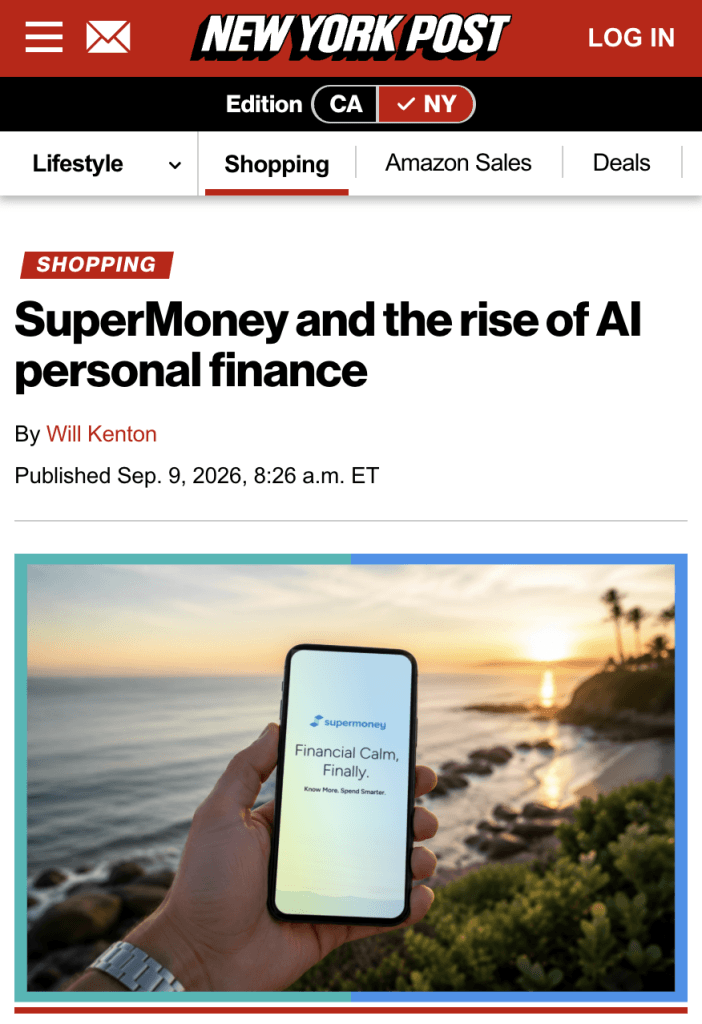
The part this article gets right is what matters most in the rise of agentic personal finance tools. “Legacy tools are good at tracking. They are close to useless at telling you what to do next.”
That’s the whole problem. I’ve sat with people who had four years of perfectly categorized transactions in a budgeting app and still had no idea whether to attack the car loan or the credit card first. Tracking is not advice. A tidy pie chart of last month’s spending tells you what already happened, which is the one thing you can no longer change.
Why this gap exists in the first place
Miron put it plainly to the Post: “95% of Americans are just trying to deal with basic questions, like, ‘how do I get out of debt?’ How do I even start investing? We’re trying to create a low-cost option for everybody else.”
He’s right about the math on who gets served. Most human advisors work on a percentage of assets, which means the people with the least margin for error get the least help. And the questions they’re asking are not exotic. Should I refinance? Snowball or avalanche? Can I afford this?
Those are answerable questions. They just require someone to look at your actual accounts, and until recently that someone had to be a person billing by the hour.
Where the real money is
The three capabilities the Post highlights are the ones that show up in dollars, so let me put numbers on two of them.
Proactive refinancing. The app watches your existing loan terms against market data and flags it when something better shows up. Say you’re carrying $25,000 on a five-year auto loan at 12%. The Fed’s latest G.19 release puts the average 60-month new car loan at commercial banks at 7.14%. Move that loan, and your payment drops from about $556 to about $497, and you keep roughly $3,570 in interest you were going to hand over. Nobody sends you a letter when that window opens. That’s the point of having software watch it.
Debt strategy simulation.Snowball versus avalanche is the most common question I get, and the honest answer is that it depends on your cash flow and your temperament. What the app can do is run both against your real numbers and show you the payoff dates side by side. Context matters here: the average rate on credit card accounts that actually accrue interest is 22.15%. Sit on a $6,000 balance for a year at that rate, and it costs you about $1,330 for nothing.
Credit monitoring is the third, and it’s tied to the first two. Your score determines which of those refinance offers you can actually get, so tracking it in real time is less about the number and more about the timing.
The part I’m most interested in
Miron told the Post where he thinks this goes: “What will be absolutely disruptive is agentic AI around actually executing on money decisions. We can say, ‘this is what you should do. Do you want us to do it?’ Yes or no? And then just execute on the movement of money.”
That’s a bigger deal than it sounds. The distance between knowing the right move and making it is where most financial plans die. Not because people are lazy. Because refinancing a car means a form, a phone call, and forty minutes you don’t have on a Tuesday.
Closing that gap responsibly is hard, and it should be. Anything that moves your money needs your explicit yes every single time. But that’s the direction, and Kenton’s read on it is that the whole category is racing there.
Key takeaways
- Sense AI scored a median of 99.4% on a 1,000-question benchmark built on the CFP Board’s published Principal Knowledge Topics.
- 37% of U.S. adults could not cover a $400 emergency expense with cash or its equivalent, and 12% could not cover it by any means, per the Federal Reserve’s latest household survey.
- The average rate on credit card accounts assessed interest is 22.15%, so a $6,000 balance carried for a year costs roughly $1,330.
- Average 60-month new car loan rates at commercial banks are 7.14%. Refinancing $25,000 from 12% saves about $59 a month and roughly $3,570 over the term.
- CEO Miron Lulic on the mission, quoted in the Post: “Our mission is to relieve financial stress.”
Go find out what your own numbers say
Your actual loan terms, balances, and rates are sitting in your accounts right now, and you can have the answer in a few minutes.
Link your accounts and the app reads the real numbers, then tells you whether there’s $59 a month buried in your car payment or $1,330 a year leaking out of a credit card. It costs nothing to look. Get the SuperMoney App for iPhone or Android.
Share this post:
Add as a preferred source on Google
Table of Contents