
Savings Accounts Pay 4.20% While the Average Pays 0.38%. Move Your Cash Before the Fed Meets

Last updated 10/21/2026 by
SuperMoney Team
Edited by
Andrew Latham
Summary:
The best high-yield savings accounts pay around 4.20% to 4.50% APY while the FDIC’s national average sits at 0.38%. The Fed meets Oct. 27-28 after raising rates in September, so savings rates could still tick up, but CD rates you lock in are fixed. If your emergency fund is in a big-bank savings account, moving it this week is one of the easiest raises you’ll ever give yourself.
Most people don’t shop for savings accounts. They open one at the same bank that holds their checking account, and then they forget about it for a decade.
That habit is expensive right now.
Compare Savings Accounts
Compare savings accounts. Discover your best option.
The gap is huge
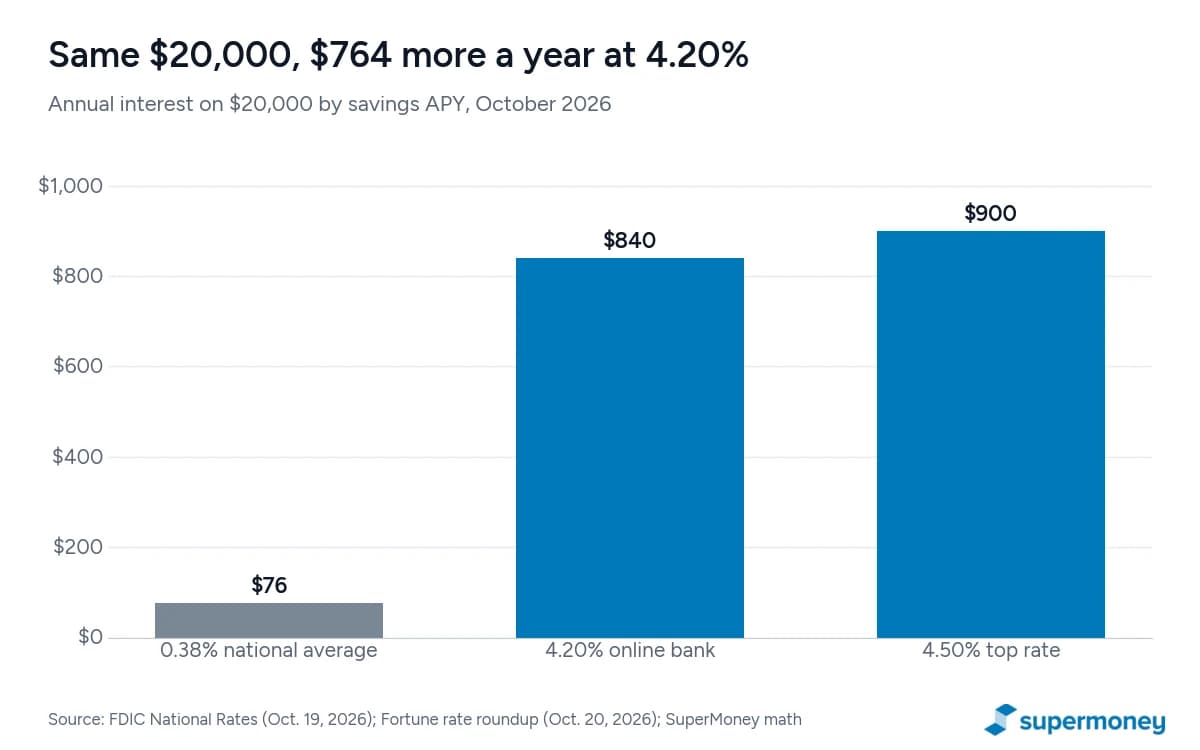
The FDIC’s recorded national average savings rate is 0.38%. The top high-yield savings accounts are paying up to 4.50% APY, according to Fortune’s Oct. 20 rate roundup. Plenty of online banks sit around 4.20%, and SoFi advertises up to 4.40% (a 3.30% base plus a 1.10% boost that requires an eligible direct deposit or $5,000 in qualifying deposits, and the boost lasts up to 6 months).
Put numbers on it. Say you have a $20,000 emergency fund.
At 0.38%, you earn about $76 in a year. At 4.20%, you earn about $840. That’s a $764 difference for doing nothing except filling out an application. On $50,000, the gap is roughly $1,910.
That’s not a rounding error. It’s a free month or two of groceries.
Why this is happening now
The Fed raised its federal funds rate to 3.75%-4.00% at its September meeting, its first hike since 2023. Officials’ median projection points to one more quarter-point hike by year-end, though market odds of an October hike dropped from about 27% to below 15% after Chair Kevin Warsh’s Oct. 16 comments, and CME FedWatch still showed only about a 16% chance as of Oct. 21. Goldman Sachs economists expect a pause in October and a final hike in December.
Inflation is the reason. Consumer prices rose 3.4% year over year through August and 3.7% in September, with energy doing most of the damage. Savers are being paid more because borrowing costs are being pushed up to fight it.
Here’s the catch. If your money is earning 4.20% and inflation is running 3.7%, you’re only barely ahead. If it’s earning 0.38%, you’re losing about 3.3 points of purchasing power a year. On $20,000, that’s roughly $660 of buying power evaporating.
High-yield savings or a CD?
It depends on when you’ll need the money.
A high-yield savings account has a variable rate. If the Fed hikes again, your rate will probably rise. If the Fed eventually cuts, your rate will fall too. You can pull money out anytime, so this is the right home for your emergency fund and any cash you might need in the next year.
A CD locks the rate. As of late September, Kiplinger cited a 6-month CD at 4.25% APY and a 3-year CD at 4.40% APY from specific institutions. Fortune’s Oct. 20 CD roundup notes that typical 5-year rates run 3.00% to 4.00%, with a few brokered outliers above that. Rates vary a lot from bank to bank, so check current offers before you commit.
My take: keep your emergency fund in the savings account. If you have extra cash you know you won’t touch for a year or more, a CD can make sense, especially if you think rates have peaked. But with another hike still possible, shorter terms like 6 months give you a chance to reinvest at higher rates without gambling on the rest of the cycle.
Don’t put emergency cash in a CD you can’t break without a penalty. That’s how people end up on a credit card at 22% to avoid losing three months of interest.
Read the fine print on bonus rates
That SoFi example is a good lesson. The 4.40% includes a 1.10% boost that lasts up to 6 months and requires an eligible direct deposit or $5,000 in qualifying deposits, kept up every 31 days (the offer runs through Dec. 31, 2027). After the boost ends, the rate drops to the base of 3.30%. That’s still very good compared to 0.38%, but it isn’t the headline number forever.
Check three things before you open an account. Is the rate a base rate or a promo? Are there minimum balances or monthly fees? And is the bank FDIC-insured (or the credit union NCUA-insured)? If any of those answers is fuzzy, move on.
A simple four-step plan
First, find out what your current account pays. Log in and look for the APY. If it’s under 1%, you’ve found your first move.
Second, open a high-yield account at an insured online bank. Link it to your checking account. It takes about 15 minutes.
Third, move your emergency fund over. Aim for three to six months of essential expenses. If you spend $4,000 a month on the basics, that’s $12,000 to $24,000.
Fourth, set up an automatic transfer so the account keeps growing. Even $200 a month adds up to $2,400 a year, plus interest.
Checking your rate isn’t a one-time thing. Rates move, and a bank that’s competitive today may not be in six months. The SuperMoney app can show your balances across accounts in one place, which makes it easier to see how much idle cash you have and set a savings goal to fill the gap.
Key takeaways
- The FDIC national average savings rate is 0.38%, while top high-yield accounts pay up to 4.50% APY.
- On $20,000, 0.38% earns about $76 a year and 4.20% earns about $840.
- The Fed funds rate is 3.75%-4.00%, and the next Fed meeting is Oct. 27-28.
- Inflation ran 3.7% in September, so a sub-1% savings rate is a real loss of buying power.
- Keep emergency money in savings and use CDs only for cash you won’t need for the term.
Share this post:
Add as a preferred source on Google
Table of Contents