
Pay Yourself First: What It Means & How To Do It

Last updated 03/06/2026 by
Erin Gobler
Fact checked by
Andrew Latham
Summary:
Paying yourself first means automatically directing a portion of every paycheck into savings before spending anything else, treating savings as a fixed bill rather than an afterthought. Someone earning $5,000 a month who moves $1,000 into a high-yield savings account on payday has paid themselves first; they build wealth on whatever remains.
Most people budget backwards. They pay every bill, cover every expense, maybe treat themselves a little, and save whatever’s left. The problem is that nothing is usually left.
Paying yourself first flips that order. It’s a simple shift with a disproportionate impact on how much you actually accumulate over time.
Take control of your financial future
SuperMoney's AI-powered budgeting and personalized financial insights help you reduce financial stress and achieve your goals faster.
What does “pay yourself first” mean?
Paying yourself first means prioritizing savings at the top of your budget before rent, before groceries, before any discretionary spending. The moment your paycheck arrives, a predetermined amount moves automatically into a savings or investment account. You then live on what remains.
The phrase treats savings the way a landlord treats rent: non-negotiable, due first, no exceptions.
What is reverse budgeting?
Reverse budgeting is another name for the pay-yourself-first strategy. It’s called “reverse” because it inverts the traditional budgeting sequence.
In a conventional budget, you subtract expenses from income and save whatever survives. In a reverse budget, you subtract savings from income first and spend whatever survives. The order of operations changes everything — savings becomes guaranteed rather than aspirational.
Why the pay yourself first strategy works
The strategy works because it removes willpower from the equation. When savings leave your checking account automatically on payday, you never decide whether to save — the decision is already made.
A 2023 Bankrate Emergency Savings Report found that only 43% of Americans could cover a $1,000 financial emergency from savings alone. The other 57% would need to borrow, use a credit card, or ask for help. That gap exists almost entirely because people save last rather than first.
Behavioral economists call this “present bias” — our natural tendency to value spending today over saving for tomorrow. The pay-yourself-first system sidesteps present bias by making the right action the default action.
How to pay yourself first
Setting up a pay-yourself-first system takes about an hour the first time. After that, it runs without you.
- Calculate your actual take-home pay. Start with the amount that lands in your bank account each pay period — after taxes, health insurance, and any existing 401(k) contributions. This is your real starting number.
- List your fixed non-negotiables. Rent or mortgage, minimum debt payments, utilities, insurance. These are the expenses you cannot skip. Subtract them from your take-home pay to see what’s genuinely flexible.
- Set your savings target. A common starting point is 20% of take-home pay, following the 50/30/20 framework. If that’s not achievable right now, start at 5–10% and increase it by 1% every two to three months.
- Open a separate savings account. The money should be out of your checking account and out of easy reach. A high-yield online savings account earns meaningful interest and puts enough friction between you and the money that you won’t casually spend it.
- Set up an automatic transfer for the day after payday. Don’t rely on manually moving the money. Automate the transfer for the day after each deposit clears. Some employers will also split direct deposit between accounts — meaning the savings portion never touches your checking account at all.
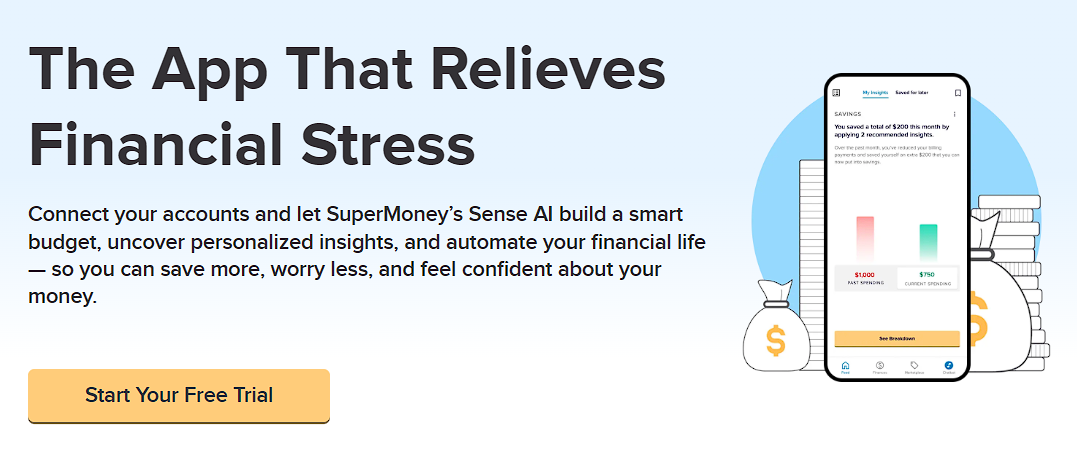
Let SuperMoney automate it for you. The SuperMoney app connects your accounts, tracks your savings rate, and helps you set automated transfers so paying yourself first happens without thinking about it.
How much should you pay yourself first?
The right savings rate depends on your goals, income, and existing obligations — but financial planning generally offers three reference points:
| Savings rate | What it covers | Best for |
|---|---|---|
| 5–10% | Emergency fund baseline, basic cushion | Getting started, tight budgets, high debt load |
| 15–20% | Emergency fund + retirement contributions | Most working adults; aligns with 50/30/20 rule |
| 25–30%+ | Aggressive wealth building, early retirement | High earners, dual-income households, FIRE seekers |
The 50/30/20 rule recommends 20% of take-home pay toward savings and debt repayment combined. If you have no high-interest debt, the full 20% can go to savings. If you’re carrying credit card balances, split it — some to debt payoff, some to savings.
The specific number matters less than the consistency. Saving 10% reliably every month builds more wealth than sporadic 30% months followed by nothing.
Pay yourself first vs. other budgeting methods
Pay yourself first is one of several structured approaches to budgeting. Here’s how it compares to the most common alternatives:
| Method | How it works | Savings priority | Best for |
|---|---|---|---|
| Pay yourself first (reverse budget) | Save first, spend the rest | First | People who struggle to save consistently |
| 50/30/20 | 50% needs, 30% wants, 20% savings | Last — allocated from remaining income | People who want a structured spending breakdown |
| Zero-based budgeting | Every dollar assigned to a category; income minus expenses = $0 | Explicit line item — can be first or last | Detail-oriented budgeters who want full control |
| 80/20 rule | 20% to savings automatically, 80% for everything else | First — functionally identical to pay yourself first | Minimalists who want simplicity over granularity |
The 80/20 rule and pay yourself first are nearly identical in practice. The main difference is framing: the 80/20 rule specifies a fixed savings rate, while pay yourself first is a principle that works with any savings rate you choose.
When pay yourself first doesn’t work
The strategy assumes your income reliably exceeds your fixed expenses. When it doesn’t, problems surface quickly.
If you transfer $500 to savings and then overdraft your checking account to cover rent, you haven’t built savings — you’ve borrowed from yourself at a net loss. Before setting a savings rate, confirm your fixed expenses are covered first.
Three situations that require adjustments:
- Irregular income. Freelancers and gig workers should save a percentage of each deposit rather than a fixed dollar amount — that way, the savings rate stays consistent even when income fluctuates. A variable automation strategy handles this automatically.
- High-interest debt. If you’re carrying credit card debt above 15–20% APR, aggressively paying it down first often produces a better net outcome than building savings. The interest you’re paying almost certainly exceeds what any savings account earns. The debt-vs-savings decision depends on the specific rates involved.
- Very tight margins. Someone budgeting on a low income may not have discretionary slack to redirect. In that case, even $25 per paycheck builds the habit without creating a cash crunch — the amount matters less than the pattern.
The fix in most cases is reducing the savings target, not abandoning the system entirely. Once margins improve, increase the automated transfer amount.
Key takeaways
- Paying yourself first means transferring money to savings before spending anything — savings is treated as the first expense, not the last.
- Also called reverse budgeting, this strategy removes the willpower required to save by making it automatic and non-negotiable.
- A common starting target is 20% of take-home pay, but any consistent rate — even 5% — beats sporadic or no saving.
- Automating the transfer for the day after payday is the most reliable way to stick to the system long-term.
- The strategy works best for people with stable income and manageable fixed expenses; those with irregular income or high-interest debt may need to adapt the approach.
Frequently asked questions
What does it mean to pay yourself first?
Paying yourself first means saving money at the start of each pay period rather than at the end. When your paycheck arrives, a set amount moves automatically to savings before you pay bills, buy groceries, or spend on anything else. The result is that savings accumulate consistently, regardless of how the rest of your budget plays out.
Briefly summarize the pay yourself first strategy.
The pay-yourself-first strategy treats savings as your first financial obligation rather than your last. Instead of spending throughout the month and saving whatever remains, you automatically transfer a fixed amount — typically 10–20% of take-home pay — to a savings or investment account on payday. Everything else gets budgeted from what’s left.
How much should I pay myself first?
The standard benchmark is 20% of take-home pay, based on the 50/30/20 budgeting framework. If that’s not realistic with your current income and expenses, start at 5–10% and increase it gradually. The Federal Reserve’s consumer finance research consistently shows that even small, automated contributions compound meaningfully over time — consistency matters more than the initial amount.
What is an example of paying yourself first?
Someone earning $4,000 per month after taxes sets up an automatic transfer of $800 (20%) to a high-yield savings account on the first of each month, before paying any bills. They then budget rent, groceries, and discretionary spending from the remaining $3,200. At year’s end, $9,600 has accumulated in savings without any active decision-making.
What is the difference between pay yourself first and zero-based budgeting?
Pay yourself first is a principle: save before you spend, and don’t track where the rest goes in detail. Zero-based budgeting is a system: every dollar of income is assigned to a specific category until nothing is unaccounted for. Both can incorporate a savings priority, but zero-based budgeting requires significantly more ongoing tracking and maintenance.
Is paying yourself first the same as the 80/20 rule?
Functionally, yes. The 80/20 budget rule specifies putting 20% of income into savings automatically and spending the remaining 80% however you choose. That’s exactly the mechanics of paying yourself first — the 80/20 rule just adds a specific percentage target to the same underlying principle.
Ready to make paying yourself first automatic? The SuperMoney app connects your accounts and helps you set savings goals, automate transfers, and track your net worth over time — so your savings grow whether or not you’re thinking about it.
Erin Gobler is a Wisconsin-based personal finance writer with experience writing about mortgages, investing, taxes, personal loans, and insurance. Her work has been published in major outlets, such as SuperMoney, Fox Business, and Time.com.
Share this post:
Add as a preferred source on Google
Table of Contents