
Student Loan Defaults Jumped From 5.3 Million to 9.3 Million in a Year. Collectors Could Be Hired as Soon as November

Last updated 10/21/2026 by
SuperMoney Team
Edited by
Andrew Latham
Summary:
Roughly 10 million Americans are in default on federal student loans, and Treasury is reportedly lining up private collectors as soon as November, with wage garnishment and refund seizures more likely to restart in 2027. If you’re in default, the feds can take up to 15% of your paycheck, your tax refund, and part of your Social Security. Rehabilitation (nine on-time payments) is the cleanest way out, and you should start it before a garnishment notice shows up.
If you’ve been ignoring a student loan in default, this is the month to stop. A Washington Sun report, picked up by Forbes, says Treasury (which took over collections on defaulted federal loans from the Education Department in March) could hire private debt collection agencies as soon as November. The sources said nothing is likely to be announced before the midterms, and that wage garnishment and refund seizures would more likely restart in 2027, possibly during tax season.
Nothing here is a surprise to anyone who’s been following the story. Collections on defaulted federal loans were paused during the pandemic, restarted in May 2025 (the Education Department says it collected roughly $500 million before stopping again), and have been paused since January 16, 2026, while the department reworks repayment. As of this week, StudentAid.gov still says wage garnishment and Treasury offset are paused. Now the machinery appears to be warming up again.
So let’s talk about what that actually means for your money, and what you can do this week.
Compare Student Loans
Compare rates from multiple vetted lenders. Discover your lowest eligible rate.
How big is this, really?
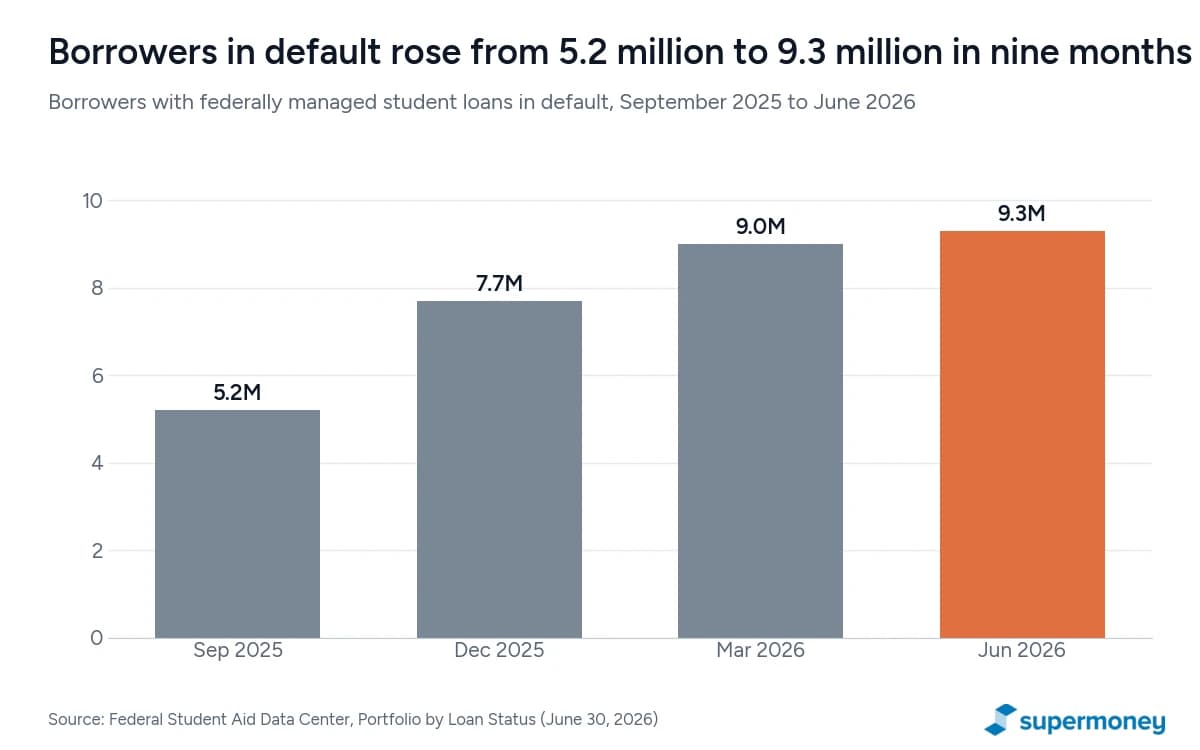
The Roosevelt Institute puts the number of Americans in default on federal student loans at nearly 10 million. The Education Department’s own count was 9.3 million borrowers owing $234 billion as of June 30, 2026, up from 5.3 million a year earlier, and that leaves out roughly 700,000 more whose defaulted FFEL loans are held by guaranty agencies. That’s about the population of Michigan. A federal loan generally lands in default after 270 days of missed payments, which is a lot longer than most people think, but once you’re there the rules change fast.
In default, the entire balance can become due, you lose access to income-driven repayment plans and deferment, and the government gets collection powers most private lenders would kill for. It doesn’t need a court order to touch your paycheck.
What can actually be taken
Three things, mostly.
Your paycheck
Administrative wage garnishment lets the government take up to 15% of your disposable pay (what’s left after taxes and other required deductions) without going to court. Say your disposable pay is $3,200 a month. Up to $480 a month goes to the loan. That’s $5,760 a year, and it keeps coming until the loan is paid or you get out of default.
Your tax refund
Through the Treasury Offset Program, the government can grab some or all of your federal refund. If you’re counting on a $2,800 refund to catch up on car repairs or credit card bills, plan on it being gone. Families who claim refundable credits tend to feel this one the hardest.
Your Social Security
Up to 15% of Social Security retirement or disability benefits can be withheld each month, as long as the remaining benefit stays above $750. On a $1,900 monthly check, that’s $285 off the top. SSI and veterans benefits aren’t supposed to be touched. The $750 floor has not changed since 1996, and Social Security offsets have been on hold since June 2025.
How much warning you get
Less than you’d like, but you do get some. The first notice before a tax refund seizure typically gives you 65 days to respond. Garnishment notices give you 30 days. Social Security is taken through the same Treasury offset process as refunds, so that notice is the 65-day one.
Those windows matter because the options you have shrink once garnishment starts. Borrowers being garnished may not be able to consolidate their way out, and the Education Department has historically denied hardship objections unless the person’s finances are truly dire. In other words, don’t plan to argue your way out after the letter arrives.
Opening your mail matters more than usual right now. Also make sure your address and phone number are current with your loan servicer, because a collector can only reach you if the file is right.
Your three ways out of default
Here’s the honest ranking, from best to worst for most people.
1. Rehabilitation
You agree to a monthly payment the loan holder considers reasonable and affordable, and you make nine of them on time. For lower-income borrowers that payment can be very small (as low as $5 a month in some cases). Finish it and the default is removed from your credit history, which can help your score recover. If garnishment or offset has already started, it keeps going until you’ve made five of the nine payments (and those involuntary payments don’t count toward the nine). Start before the notice window closes and you avoid it entirely, which is the main reason to start early.
One catch: you generally get this once per loan, at least until July 1, 2027, when a second rehabilitation per loan becomes available under last year’s budget law. Don’t burn it and then miss payments again.
2. Consolidation
You roll the defaulted loans into a new Direct Consolidation Loan. It’s faster than rehab, but it doesn’t wipe the default notation from your credit report the way rehabilitation does. You’ll also usually need to commit to an income-driven plan or make a few payments first. If you’re already being garnished, consolidation may be off the table.
3. Paying in full or settling
Nice if you can swing it. Most people can’t, and in practice this is the rare route.
A quick example: Maria’s math
Maria owes $22,000 in federal loans and has been in default for two years. She earns $48,000 a year, with disposable pay of about $3,100 a month.
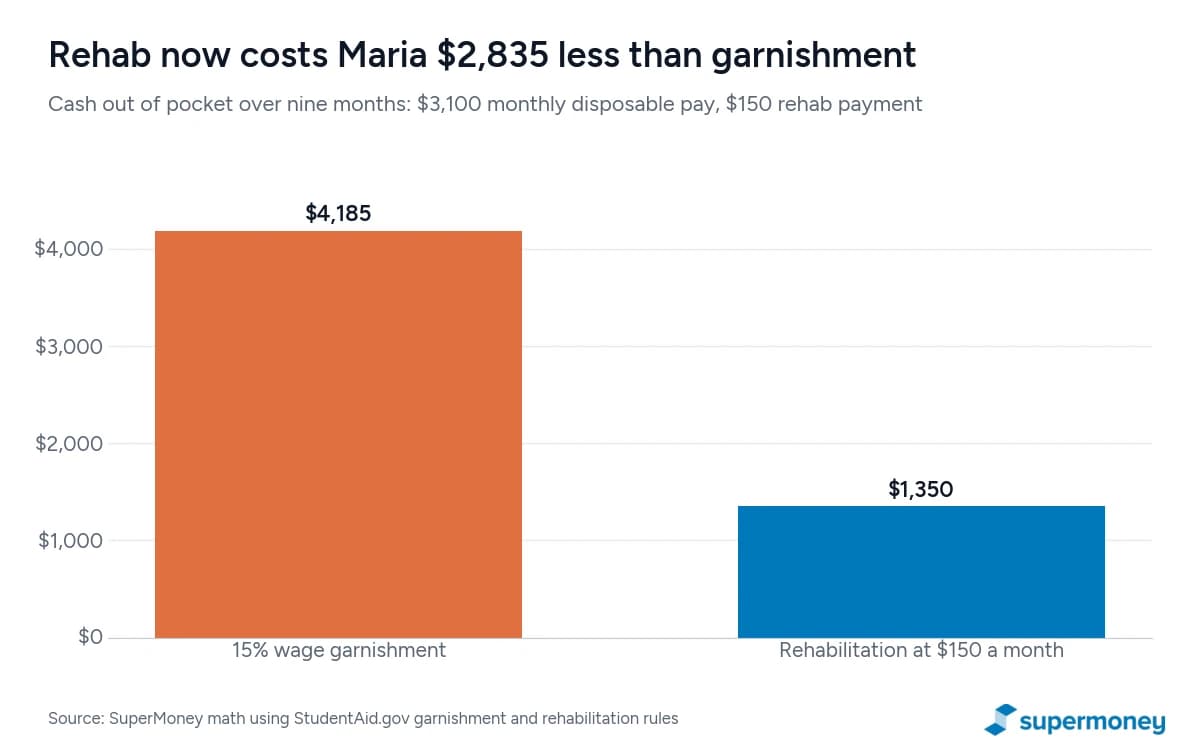
If garnishment starts, up to $465 a month leaves her paycheck. Over the nine months a rehab program takes, that’s $4,185 gone, and she’s still in default afterward.
If she starts rehab now at an affordable payment of, say, $150 a month, she pays $1,350 across nine months, stops the collection risk, and gets the default off her record. That’s a $2,835 difference in cash flow before you count the credit benefits. The numbers will differ for you, but the shape of this comparison rarely changes. Acting early is cheaper.
What to do this week
Log in to StudentAid.gov and check your loan status. If you see “default,” go to the new Defaulted Loans Support Center at StudentAid.gov/defaultsupport (launched September 30), where you can apply for rehabilitation online, or call default support at 1-800-621-3115 and ask for a rehabilitation agreement in writing.
Gather your last two pay stubs or your most recent tax return. They’ll use income to set your payment. If your income has dropped, say so. A lower payment is the whole point.
If you’re not sure whether you’re in default or just delinquent, that’s a different conversation. Delinquent loans still have options like income-driven repayment, and those are easier to use than anything available after default.
And watch for scams. Anyone who calls promising to “erase” your federal student debt for an upfront fee is not helping you. Everything in this article is free to do through the government.
See where it fits in your budget
A garnishment is hard to absorb when you haven’t planned for it. The SuperMoney app can pull your accounts into one view so you can see what’s left each month after your essentials, which helps you pick a rehab payment you can actually keep up with. It’s also a handy place to track your credit score as the default comes off.
Key takeaways
- Nearly 10 million borrowers are in default on federal student loans, per the Roosevelt Institute. The Education Department counted 9.3 million as of June 30, 2026.
- Treasury could hire private collectors as soon as November, with garnishment and refund seizures likely to restart in 2027, according to reports.
- Wage garnishment can take up to 15% of disposable pay with no court order. On $3,200 a month, that’s $480.
- Tax refunds can be seized in full, and Social Security can be cut by up to 15% (benefit must stay above $750).
- Expect about 65 days of notice before a refund offset and 30 days before garnishment.
- Rehabilitation takes nine on-time payments and removes the default from your credit history.
Share this post:
Add as a preferred source on Google
Table of Contents