
Supercharge Your Emergency Fund: Use a Roth IRA to Earn Tax-Free HYSA-Level Returns

Last updated 04/07/2026 by
SuperMoney Team
Edited by
Andrew Latham
Summary:
Discover how using a Roth IRA as an emergency fund can provide tax-free growth and withdrawals, potentially outperforming high-yield savings accounts after taxes. Learn the benefits, considerations, and steps to implement this strategy effectively.
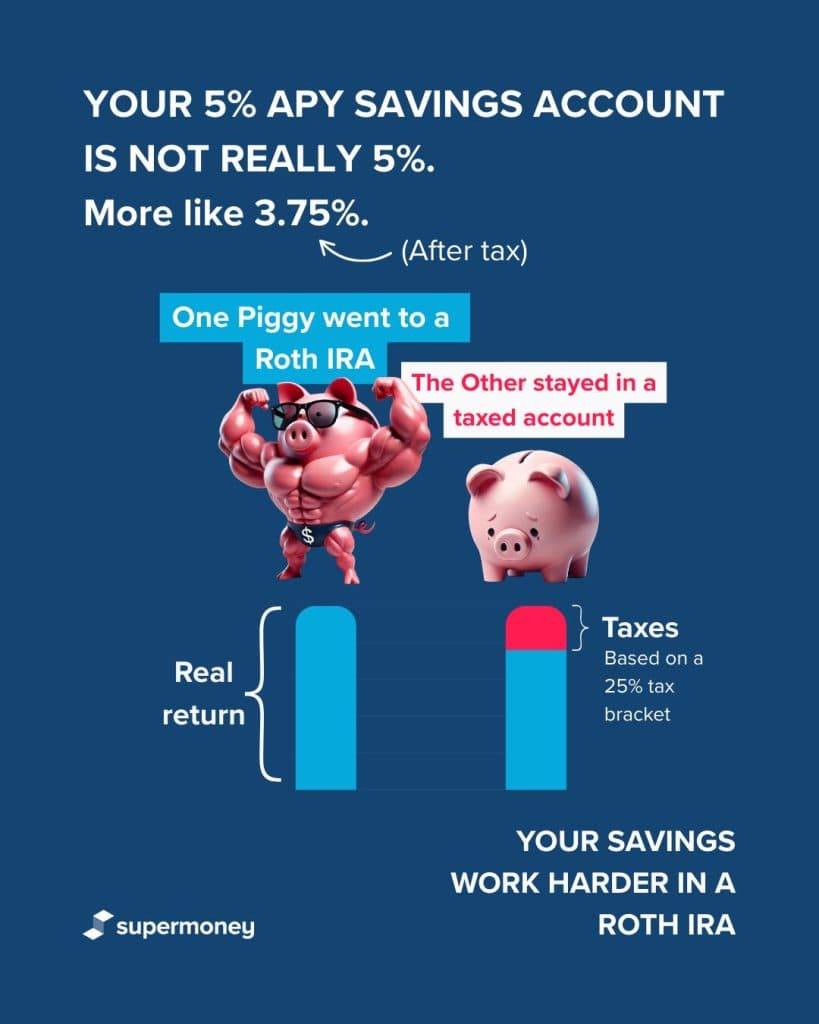
High-yield savings accounts (HYSAs) are a popular spot for stashing emergency funds thanks to their solid APYs. But that interest? It’s taxed. If you’re in a high tax bracket, your “high yield” may not be so high after all. A smarter alternative? Parking your emergency fund inside a Roth IRA and investing it in ultra-safe options like money market funds or ETFs such as SGOV.
HYSAs might advertise juicy yields, but what you actually earn depends on your tax bracket. That’s because all interest from savings accounts is taxed as ordinary income.
How taxes shrink your savings
Let’s say your HYSA offers a 4.5% APY:
- If you’re in the 22% tax bracket, your real return is about 3.51%.
- In the 32% bracket? You’re only keeping around 3.06%.
- At the top 37% tax rate, your after-tax yield is just 2.84%.
What looked like a great return suddenly feels average. And that’s before you start to take into account inflation.
Take control of your financial future
SuperMoney's AI-powered budgeting and personalized financial insights help you reduce financial stress and achieve your goals faster.
Why a Roth IRA makes sense for emergencies
Roth IRAs are often overlooked as a tool for emergency savings, but they come with features that make them surprisingly flexible:
- Tax-free growth: Earnings grow tax-free inside the account.
- Penalty-free access to contributions: You can withdraw your contributions (not the earnings) at any time without taxes or penalties.
- Better yield potential: You can invest in low-risk assets like money market funds or short-term Treasury ETFs (e.g., SGOV) that offer HYSA-like returns—without the tax drag.
How to set it up
Follow these steps to start using your Roth IRA as a backup emergency fund:
- Open a Roth IRA: Choose a brokerage with low fees and access to money market funds or Treasury ETFs.
- Contribute: In 2025, you can contribute up to $6,500 ($7,500 if you’re 50 or older).
- Invest safely: Use funds like SGOV or stable value funds to reduce risk and maintain liquidity.
- Track contributions: Keep tabs on how much you’ve contributed to avoid early withdrawal penalties on earnings.
Frequently asked questions
Can I really use a Roth IRA for emergencies?
Yes! As long as you’re only withdrawing contributions (not earnings), there are no taxes or penalties.
What if I withdraw earnings early?
You’ll likely pay income taxes and a 10% penalty unless you meet a qualified exception or are over age 59½ with a 5-year-old account.
Will this affect my retirement?
Only if you don’t replenish the funds. It’s best to use your Roth IRA for emergencies sparingly and top it back up when possible.
What’s a safe investment inside a Roth IRA?
Money market funds and short-duration Treasury ETFs like SGOV are great low-risk options with HYSA-comparable yields.
Key takeaways
- HYSA interest is taxed as income, reducing your real return.
- Using a Roth IRA for emergency savings offers tax-free growth.
- You can access Roth IRA contributions anytime, penalty-free.
- Investing in SGOV or money market funds offers HYSA-like yields safely.
- Track contributions to avoid accidental early withdrawal of earnings.
Share this post:
Add as a preferred source on Google
Table of Contents