
Work-life Balance Is a Myth – Here’s What to Aim for Instead

Last updated 10/15/2025 by
SuperMoney Team
Edited by
Andrew Latham
Summary:
The idea of work-life balance is a myth that sets us up for guilt, burnout, and unrealistic expectations. Stop chasing an impossible ideal and focus on flexibility, core values, and building alignment in a life rooted in what truly matters.
As Jimmy John once said, “You can’t be messing with work-life balance when you’re trying to squeeze lemonade out of horsesh*t.. You’ve got to squeeze really hard.” Harsh? Sure. But real.
Most of us are handed a chaotic mix of responsibilities, deadlines, distractions, and emotional demands. And yet we’re told we should somehow manage it all in perfect balance—like it’s a yoga pose we’re just not holding correctly.
The result? Chronic guilt, burnout, and the pressure of feeling like we’re never showing up enough—at work, at home, or for ourselves.
Take control of your financial future
SuperMoney's AI-powered budgeting and personalized financial insights help you reduce financial stress and achieve your goals faster.
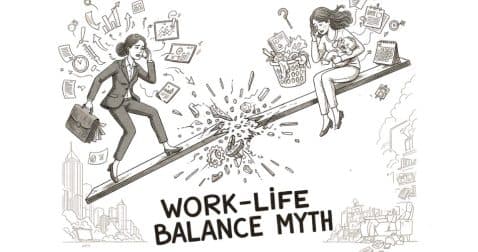
Why the work-life seesaw keeps failing
A 2023 study published in Frontiers in Psychology confirmed what most of us already know: stress at work carries over into our home lives, and family issues affect our ability to focus at work. Source: [Front Psychol. 2023;14:1180703](https://www.ncbi.nlm.nih.gov/pmc/articles/PMC11301195/)
Rigid separation is a myth. Most of us toggle between roles constantly—parent, manager, partner, caregiver, creative. Trying to draw strict lines between them creates more stress than it solves.
Life isn’t a two-sided scale—it’s a rotating wheel
Think of your life as a rotating wheel with seven slices: Work, Health, Family, Personal Growth, Spirituality, Leisure, and Community.
Some weeks, the “Work” slice dominates. Other weeks, “Family” or “Health” needs more of your time. The slices are always shifting—and that’s okay.
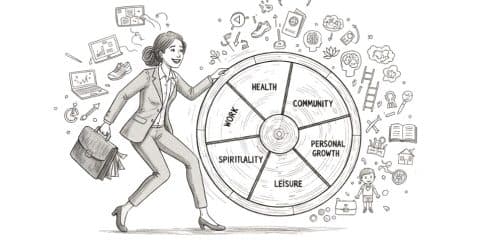
The goal isn’t to give each slice equal time every day. The goal is to be honest about where your energy needs to go and let go of guilt when it changes.
The better approach: alignment over balance
Balance sounds good on paper—but what actually helps people thrive is alignment: building a life that reflects what matters most to you and creating rituals to shift between roles with intention.
1. Start with your non-negotiables
What are your core values?
Whether it’s family dinners, creative time, fitness, or faith—define what matters. A 2014 study in the Journal of Occupational Health Psychology found that values clarity is a powerful stress buffer and predictor of well-being.
Source: J Occup Health Psychol. 2014
Source: J Occup Health Psychol. 2014
Don’t divide time 50/50. Structure your schedule around what you won’t compromise on.
2. Use rituals to shift roles
You don’t need hard boundaries—you need mental cues.
A 2022 study in Applied Psychology found that “boundary work tactics” (like changing clothes, going for a walk, or short reflection exercises) helped people transition between roles more effectively and reduced stress.
Try rituals like:
- A 10-minute walk between work and family time
- Changing into “off-duty” clothes after work
- Silencing notifications and putting your phone in a drawer
- A short journal prompt to reset your mindset
Small signals, big shifts.
3. Don’t track hours—track meaning
It’s not about working less. It’s about doing more of what matters.
Research from The Journal of Positive Psychology shows that people who feel aligned with their purpose report higher fulfillment—even when they work long hours.
Meaning trumps minutes. A packed day aligned with your values feels better than a slow one filled with disconnected tasks.
4. Love what you do—or find the love in it
“Choose a job you love, and you will never have to work a day in your life.”
It’s not just a cliche. A 2019 study in the Journal of Vocational Behavior found that employees who engage in “job crafting”—shaping their roles to better fit their strengths and interests—experience more motivation and less burnout.
Whether you’re doing what you love or learning to love what you do, the result is the same: less emotional friction, smoother transitions, and a sense of personal flow.
Key takeaways
- Work-life balance is an outdated ideal that oversimplifies real life
- Work and life are psychologically connected—separation is a myth
- Burnout risk increases when roles are blurred without intention
- Rituals and value clarity are proven to reduce emotional strain
- Meaning, alignment, and role flexibility matter more than balance
Feeling overwhelmed by money worries?
SuperMoney's AI-powered budgeting tools help you track your money goes, set realistic goals, and reduce financial stress.
Share this post:
Add as a preferred source on Google
Table of Contents