
One in Five New Car Buyers Now Pays $1,000 a Month. Here’s How to Keep Your Payment Under Control

Last updated 10/21/2026 by
SuperMoney Team
Edited by
Andrew Latham
Summary:
The average new car payment hit a record $787 a month in the third quarter, and 21.2% of buyers now pay $1,000 or more. Stretching to an 84-month loan lowers the payment but adds thousands in interest and sets you up to owe more than the car is worth. Shop your loan rate before you visit a dealer, and aim for a term of 60 months or less.
A $1,000 car payment used to sound like a luxury truck problem. Not anymore.
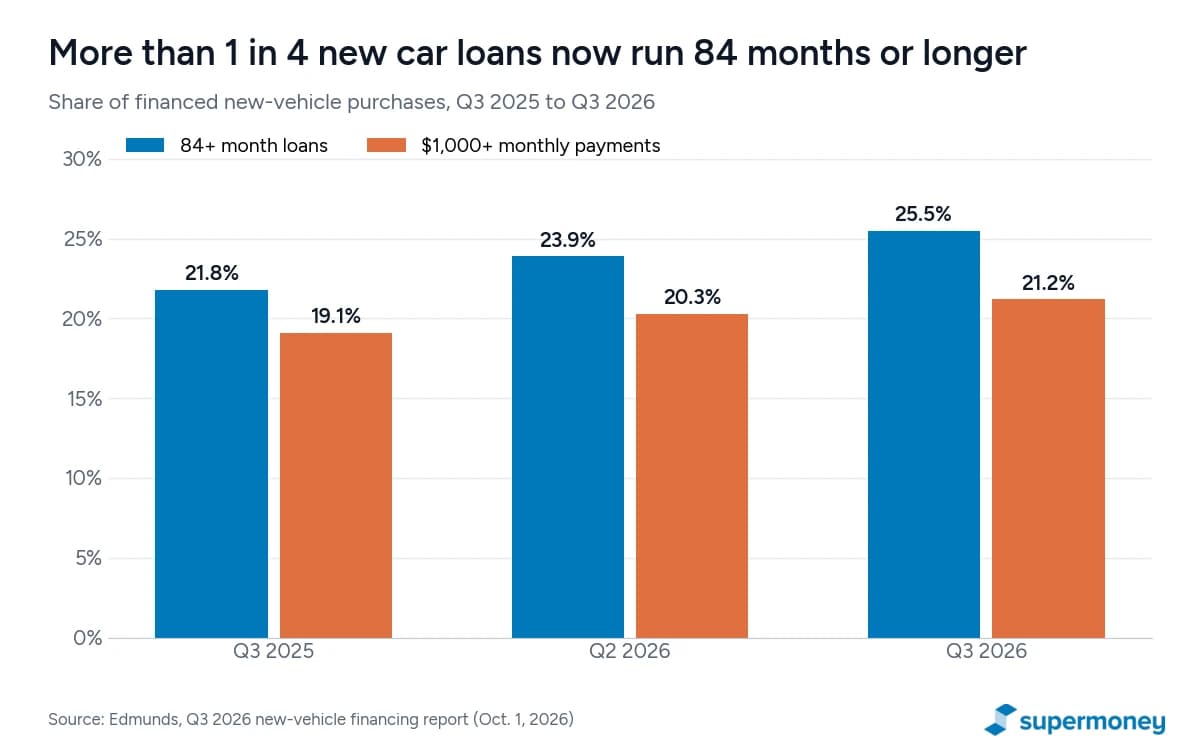
Edmunds data for the third quarter shows 21.2% of financed new car purchases now carry a monthly payment of $1,000 or more, up from 19.1% a year earlier. The average payment set a record at $787. The average amount financed climbed to $44,664 from $42,744 a year ago, and the average new car APR sat at 7%.
That’s a lot of people stretching to make the monthly number work. And the way most of them are doing it is by stretching the loan.
Get Competing Auto Loan Offers In Minutes
Compare rates from multiple vetted lenders. Discover your lowest eligible rate.
It's quick, free and won’t hurt your credit score
The 84-month loan is the new normal, and it’s expensive
About 25.5% of financed new vehicle purchases now have a term of at least 84 months (seven years). That’s a record.
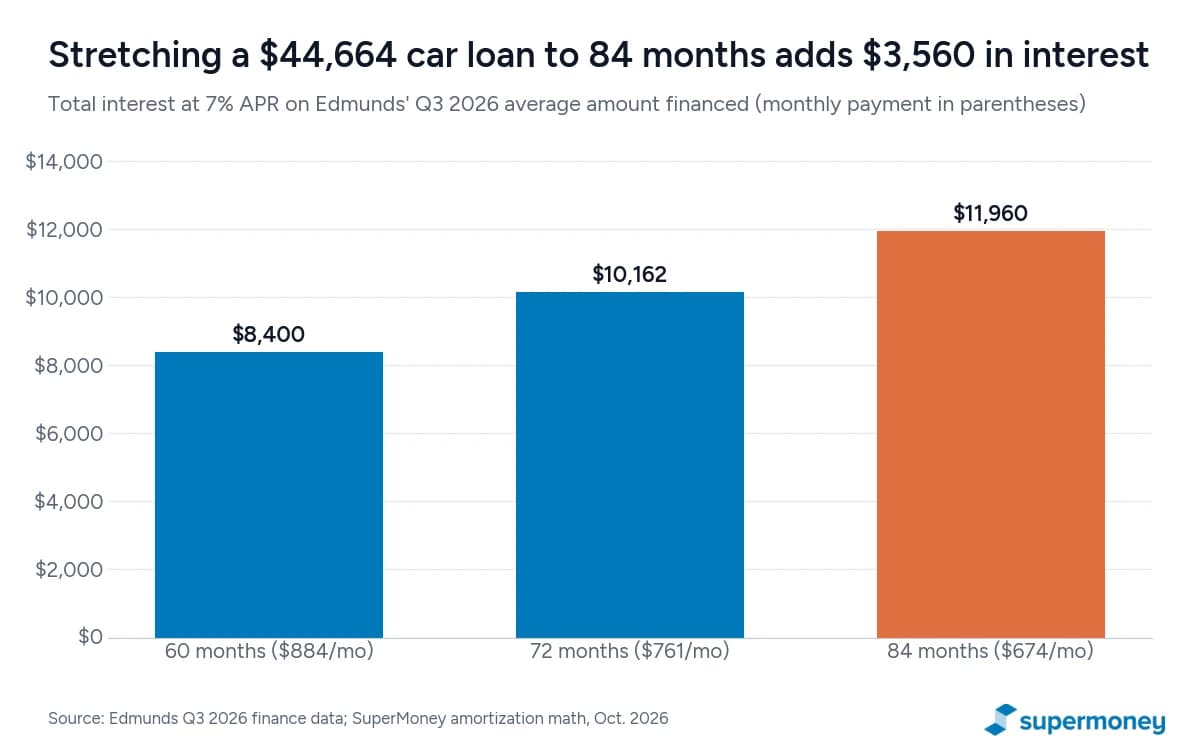
Here’s why dealers love it. A longer term shrinks the payment, so the car feels affordable. Let’s use the average numbers: $44,664 financed at 7%.
- 60 months: about $884 a month, $8,400 in total interest
- 72 months: about $761 a month, $10,162 in total interest
- 84 months: about $674 a month, $11,960 in total interest
Going from 60 to 84 months saves you roughly $210 a month. It also costs you about $3,560 more in interest. And you’ll be paying on that car in year seven, when the warranty is long gone and the repair bills have started.
So the monthly payment goes down while the total cost goes up. That’s the trade, every time.
The trap that catches people on the way out
Long loans are slow to build equity. Cars lose value fast, and a loan that pays down at a crawl can leave you upside down, meaning you owe more than the car is worth.
It’s already happening at scale. Edmunds reports that 29.1% of financed trade-ins toward new cars in the third quarter were underwater, and those owners owed an average of $7,107 more than the trade-in was worth, the highest third-quarter figure in at least a decade.
What do dealers do with that? They roll it into your next loan. Take the same $44,664 car, add $7,107 of old debt, and you’re financing $51,771. At 7% over 72 months, the payment jumps from about $761 to about $883. Edmunds’ real-world numbers for these buyers are worse: they financed $57,235 on average and signed up for a $952 payment. You’re paying more every month for a car that isn’t worth more. Do that twice and it gets ugly.
Interest rates aren’t helping
Cox Automotive’s October figures show the average used prime rate at 12.9%, up 41 basis points from a year ago. New prime rates rose 78 basis points year over year. The 10-year Treasury, which loan rates loosely follow, was around 5.1% in mid-October, down from 5.24% a week earlier.
On a used car, Cox estimates total interest runs about $11,000 on the typical loan, roughly 26% of everything you pay. In 2019 that share was about 19%. You’re handing the lender a bigger slice for the same vehicle.
Rate differences between lenders are big, too. On that same $44,664 for 72 months, 7% costs about $761 a month and 12% costs about $873. That’s $112 a month, or about $8,000 across the loan, depending only on who you borrow from.
What to do before you buy
Get preapproved first. Walk into a dealership with a loan offer from a bank, credit union, or online lender, and you’ll know what rate is fair. If the dealer can beat it, great. If not, you’ve already got your financing. The CFPB says you may get better rates and terms if you get quotes from other lenders before you shop for a car.
Use the 20/4/10 rule as a rough guide: put 20% down, finance for no more than four years, and keep the total car cost (payment, insurance, gas) under about 10% of your gross income. Most people can’t hit all three on a new car at today’s prices. That’s a sign to shop one step down, not to stretch the loan.
Here’s a quick sanity check. If you need an 84-month loan to afford the car, you can’t afford the car. Buy a cheaper one, or a good used one with a rate you’ve shopped around.
If you’re already in an expensive loan, look at refinancing. If your credit has improved or rates have dropped since you signed, even a 2-point cut on a $30,000 balance at 10% over 60 months (about $637 a month) saves real money. That 10% loan costs about $8,245 in interest. Dropping to 8% would cut it to roughly $6,500. Check for prepayment penalties before you apply.
Don’t roll negative equity into the next loan if you can avoid it. Pay down the gap with cash, wait a year, or keep the car. Each one hurts less than adding $7,107 to a new loan.
Put your numbers in front of you
Before you sign anything, see how the payment fits into your actual month. The SuperMoney app shows your income, bills, and debts together, so you can tell whether a $787 payment (or a $1,000 one) leaves room for savings. It also lets you compare loan offers side by side so you can see the real cost, not just the monthly number.
Key takeaways
- The average new car payment is a record $787, and 21.2% of buyers pay $1,000 or more.
- 25.5% of new car loans run at least 84 months, also a record.
- On $44,664 at 7%, moving from 60 to 84 months cuts the payment about $210 but adds roughly $3,560 in interest.
- 29.1% of trade-ins toward new cars carry negative equity, averaging $7,107.
- Lender choice alone can swing a 72-month loan by about $112 a month (7% vs. 12%).
Share this post:
Add as a preferred source on Google
Table of Contents