
Can You Refinance to Get Rid of PMI or FHA Mortgage Insurance?

Last updated 10/08/2026 by
Andrew Latham
Summary:
Yes, refinancing can kill mortgage insurance, but on a conventional loan it’s often not the cheapest way. If your home has gained value, ask your servicer about removing PMI based on a new appraisal first, which can cost far less than $11,000 or more in closing costs. FHA loans are different: if you put down less than 10%, the annual premium usually lasts for the life of the loan, so refinancing into a conventional loan is the main way out.
Mortgage insurance is one of those costs people stop seeing. It’s buried in the payment, it shows up every month, and nobody calls to remind you it might be optional now.
So let’s look at it. If you’re paying PMI on a conventional loan or MIP on an FHA loan, there’s a decent chance you can get rid of it. The question is whether you need a refinance to do it, or whether a phone call and an appraisal will get the job done. If you’re weighing a refinance for other reasons too, start with our bigger guide on should you refinance your mortgage.
Get Competing Personal Loan Offers In Minutes
Compare rates from multiple vetted lenders. Discover your lowest eligible rate.
It's quick, free and won’t hurt your credit score
The rules: when PMI has to come off
Private mortgage insurance (PMI) protects the lender, not you, when you borrow more than 80% of a home’s value on a conventional loan. Federal law, the Homeowners Protection Act, sets two milestones for most loans on a primary home closed on or after July 29, 1999:1
- 80% of original value: you can ask your servicer in writing to cancel PMI. You need a good payment history, no second mortgage or other junior lien, and possibly an appraisal showing the home hasn’t lost value.
- 78% of original value: PMI generally ends automatically, as long as you’re current.
- And a backstop. If you hit the midpoint of the loan first (15 years on a 30-year), PMI ends then.
Here’s the catch. “Original value” means the lower of your purchase price or the appraisal when you bought. Your home could be worth $100,000 more today and the law doesn’t care.1
What does PMI cost? Freddie Mac puts it at roughly $30 to $70 a month for every $100,000 you borrow.2 On a $400,000 loan, that’s $120 to $280 a month. I’ll use $200 a month in the examples below. Treat that as an illustration, since your actual premium depends on your credit score and down payment.
You might not need to refinance at all
This is the part most people miss. If Fannie Mae owns your loan, you can ask to cancel PMI based on your home’s current value, not the original one. Fannie’s Servicing Guide (section B-8.1-04) sets these rules for a one-unit primary home or second home:3
- Loan between 2 and 5 years old? Your balance has to be 75% or less of today’s value.
- Older than 5 years, the bar is 80% or less.
- No payment 30 or more days late in the last 12 months, and none 60 or more days late in the last 24 months.
- The servicer orders the valuation, and it has to include an interior and exterior inspection.
There’s also an exception for big renovations. If improvements raised the value, the 2-year wait can be waived, but you’ll need to be at 80% or less. A new roof that just keeps the house in shape doesn’t count.3
Freddie Mac and portfolio lenders have their own policies. Call your servicer, ask who owns the loan, and ask for their written rules on current-value cancellation. That one call can save you thousands.
What this looks like in real numbers
Take the borrower from our main refinance guide. They bought a $450,000 home in November 2023 with $50,000 down and a $400,000 loan at 7.8%. Principal and interest is about $2,879 a month, plus PMI.
Based on the original value, their balance doesn’t hit 80% until about 8.5 years in. Automatic cancellation at 78% comes at about 9.8 years.
Now add appreciation. I’m assuming 3% a year. For context, FHFA’s House Price Index rose 2.1% in the year through the second quarter of 2026, and 33.4% over the past five years.4 At 3%, the home is worth about $491,700 today, three years in. The balance is about $389,000, so their current loan-to-value ratio (LTV, the balance divided by the home’s value) is about 79%.
That’s under 80%, but not under 75%. Since the loan is less than 5 years old, Fannie wants 75%. They get there at about 4.3 years, in roughly 16 months, without paying an extra dime toward principal.
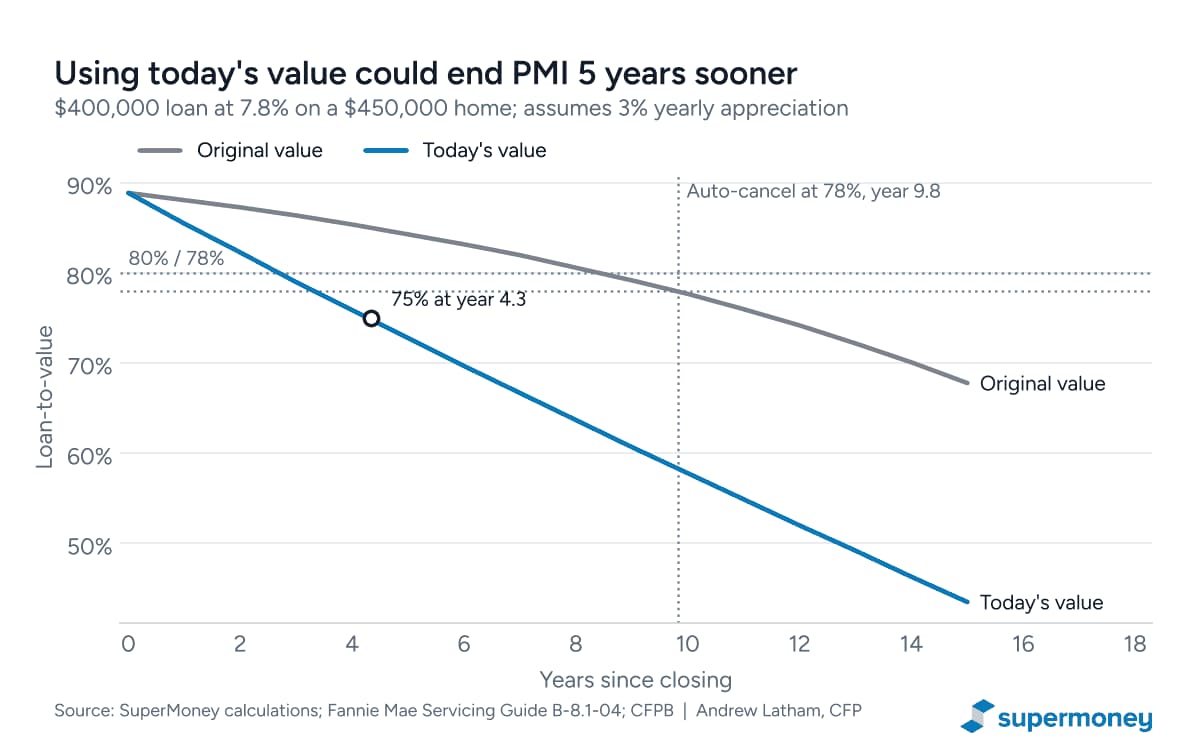
Waiting those 16 months costs about $3,200 in PMI. Compare that to waiting for automatic cancellation at year 9.8, which would mean about $16,400 more in PMI from today. That’s the real prize, and you can claim most of it without refinancing.
When refinancing a conventional loan makes sense
A refinance gets you a new appraisal and resets “original value” to today’s number. If the new loan is at or below 80% LTV, there’s no PMI on it at all.
But you pay for that. Freddie Mac says refinance closing costs typically run 3% to 6% of the loan.5 On $389,000, 3% is $11,670.
Same borrower, refinancing today. The average 30-year fixed rate was 7.40% on October 8, 2026.6 A new 30-year loan for $389,000 at that rate costs about $2,693 a month. Drop the $200 PMI and they save about $386 a month. Break-even is about 30 months.
Looks decent. Look closer, though.
Only $186 of that monthly savings comes from the lower rate. The PMI piece would disappear on its own in about 16 months through the appraisal route. Once you account for that, break-even stretches to roughly 46 months. Almost four years.
And if you take a fresh 30-year loan, you restart the clock. Total interest on the new loan is about $581,000, versus about $544,000 left on the old one. A 27-year term that matches what’s left keeps the payment at about $2,778 and cuts total interest to about $511,000. If you want to run your own version of this, our guide on how to calculate your refinance break-even point walks through it.
My take: refinance a conventional loan to drop PMI only when the rate drop pays for the closing costs on its own, or when your servicer won’t do a current-value cancellation. Otherwise, request the appraisal and keep your money.
FHA loans play by different rules
FHA mortgage insurance premium (MIP) isn’t PMI, and the Homeowners Protection Act doesn’t cover it. You can’t call your servicer and ask to drop it at 80%.
For FHA case numbers assigned on or after June 3, 2013, HUD sets the length of the annual premium by your original LTV:7
- Put down 10% or more (LTV of 90% or less)? You pay annual MIP for 11 years.
- Less than 10% down means you pay it for the life of the loan.
Most FHA buyers put down 3.5%. So most FHA borrowers are in the “forever” bucket.
HUD did cut the price in 2023. Under Mortgagee Letter 2023-05, for loans over 15 years with a base amount of $726,200 or less, the annual premium is 0.55% if your LTV is above 95% and 0.50% if it’s 95% or below. Bigger loans pay 0.70% to 0.75%. The upfront premium is 1.75% of the base loan.8
The FHA worked example
Say you bought a $400,000 home in November 2023 with 3.5% down. Your base loan is $386,000. Add the $6,755 upfront premium and you owe $392,755. I’ll assume a 7.5% rate for this example. Principal and interest is about $2,746, and the annual MIP adds roughly $179 a month in year one.
That MIP never goes away on its own. From today through the end of the loan, it adds up to about $37,300.
The way out is a conventional refinance once you’re at 80% LTV based on a new appraisal. With 3% yearly appreciation, you’re at about 87% today. You hit 80% a little after year 5, when the balance is about $371,000 on a home worth about $465,000.
If rates are still 7.40% then, a conventional loan for the 25 years you have left runs about $2,722. You’d drop the FHA payment plus about $170 in MIP, saving about $194 a month. With closing costs at 3% (about $11,100), break-even is roughly 57 months.
That’s long. But you’d also skip about $33,000 in future MIP. So if you plan to stay at least five years after that refinance, this one pencils out. If rates drop between now and then, it gets a lot better fast.
One more option: you can refinance FHA into a conventional loan before you hit 80%. You’d pay PMI on the new loan, but that PMI can be canceled later, unlike your MIP. Get quotes both ways.
How to decide, step by step
- Pull your latest statement and find your balance. Divide it by a realistic estimate of today’s value.
- If you have a conventional loan, call your servicer before you call a lender. Ask who owns the loan and what it takes to cancel PMI based on current value.
- FHA borrower? Check your original down payment. Under 10% means MIP is likely permanent, so a conventional refinance is the path.
- Compare the monthly mortgage insurance you’d drop, plus any rate savings, against the closing costs. If break-even is past five years, think hard about whether you’ll still be there.
- Don’t pick a no-closing-cost offer without reading the fine print. The cost usually shows up in a higher rate, which we explain in no-closing-cost refinance explained.
If you decide to go ahead, our guide on how to refinance your mortgage covers the steps from application to closing. Then get at least three Loan Estimates and compare them side by side using our mortgage refinance lender reviews.
Key takeaways
- PMI can be canceled at 80% of original value on request and generally ends automatically at 78%.
- Fannie Mae allows cancellation on current value at 75% LTV for loans 2 to 5 years old, or 80% after 5 years.
- In our example, using current value could end PMI at year 4.3 instead of year 9.8.
- FHA MIP lasts for the life of the loan if you put down less than 10%, or 11 years with 10% or more.
- Since HUD’s 2023 cut, most FHA loans carry a 0.50% or 0.55% annual premium.
- On a $389,000 refinance, 3% closing costs are $11,670, so run the break-even math first.
Andrew is the Content Director for SuperMoney, a Certified Financial Planner®, and a Certified Personal Finance Counselor. He loves to geek out on financial data and translate it into actionable insights everyone can understand. His work is often cited by major publications and institutions, such as Forbes, U.S. News, Fox Business, SFGate, Realtor, Deloitte, and Business Insider.
Share this post:
Add as a preferred source on Google
Table of Contents