
How to Stop Impulse Buying: A Simple System That Works

Last updated 03/06/2026 by
Andrew Latham
Edited by
Andrew Latham
Summary:
Impulse buying is an unplanned purchase triggered by emotion, environment, or marketing — not genuine need. The most effective way to stop it is to insert a structured delay between the urge and the purchase: for example, the 72-hour rule requires waiting three days before buying anything non-essential, which eliminates the majority of impulse purchases without requiring ongoing willpower.
The urge to buy something you weren’t planning to buy isn’t a character flaw.
It’s the predictable result of billions of dollars in retail psychology designed to bypass your decision-making process. Understanding what’s happening is the first step to working around it.
Take control of your financial future
SuperMoney's AI-powered budgeting and personalized financial insights help you reduce financial stress and achieve your goals faster.
What is impulse buying?
Impulse buying is an unplanned purchase made in response to an emotional trigger, an environmental cue, or a perceived opportunity — rather than a pre-existing need or intention to buy.
It’s distinct from a spontaneous but considered purchase. If you walk into a bookstore without a specific title in mind and leave with one you’re genuinely excited to read, that’s spontaneous.
If you add three items to your cart at 11 p.m. because a countdown timer says the sale ends in four minutes, that’s an impulse buy — the urgency was manufactured.
The financial cost is significant. A 2023 Slickdeals survey found that the average American spends roughly $314 per month on impulse purchases — over $3,700 per year.
That’s money that could otherwise be directed toward needs or savings before it disappears into the wants category.
What triggers impulse buying?
Impulse purchases almost always trace back to one of four triggers. Recognizing yours is more useful than any tactical list, because it lets you interrupt the pattern at the source.
- Emotional state. Stress, boredom, sadness, and anxiety all increase impulsive spending. Buying something creates a brief dopamine hit that mimics relief — which is why emotional spending is so repetitive. The purchase doesn’t fix the feeling, so the next trigger produces the same urge.
- Scarcity and urgency cues. “Only 3 left,” “sale ends tonight,” “limited edition” — these phrases are engineered to suspend deliberation. Scarcity activates a loss-aversion response: you fear missing out more than you value the money.
- Social comparison and visibility. Seeing what others own — in person or in a social media feed — creates a reference point that makes your current situation feel inadequate. The purchase feels like closing a gap, not creating debt.
- Frictionless payment. Saved card details, one-click checkout, and buy-now-pay-later options remove the pause point that would otherwise create deliberation. The easier it is to pay, the more often impulse purchases complete.
Most impulse buys involve more than one trigger at once. A stressed person scrolling Instagram at midnight who sees something a peer just bought, available with one click and free returns — that’s all four triggers compounding simultaneously.
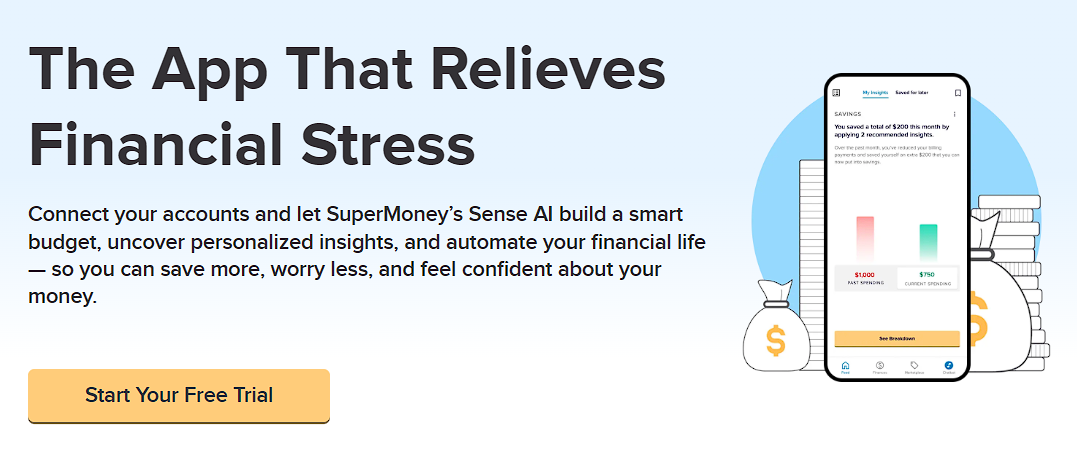
Get a nudge before you overspend
The SuperMoney app sends real-time alerts every time your card is charged — so you see your spending pattern as it happens, not at the end of the month when it’s too late to adjust.
The system: three tools that eliminate most impulse purchases
Willpower alone is unreliable because it’s a finite resource that depletes with use. A better approach replaces the decision with a rule — something you apply automatically without having to re-evaluate each time. Structural rules also outperform good intentions for overall spending control — the same mechanisms that reduce impulse buys are the foundation of any lasting approach to how to stop spending money you didn’t plan to spend.
These three tools address different parts of the impulse cycle. You don’t need all three; pick the one that targets your primary trigger first.
The 72-hour rule
Before buying anything non-essential, wait 72 hours. Add it to a list, set a reminder, and come back to the decision in three days.
This works because most impulse urges are time-specific. The emotional charge that made the item feel necessary dissipates within hours, and 72 hours is long enough for almost any manufactured urgency to expire.
If you still want the item after three days and it fits your budget, you can buy it without regret — because it’s now a deliberate choice, not a reaction.
The 30-day rule is a stricter version of the same principle, effective for higher-cost impulse purchases ($100 or more) where the cooling-off period should be longer.
The 10-10-10 test
Before completing a purchase, ask three questions:
- How will I feel about this in 10 minutes?
- How will I feel about this in 10 months?
- How will I feel about this in 10 years?
The first question captures immediate regret — you often already know. The second and third questions surface whether this purchase aligns with anything you actually value long-term. If the answers diverge sharply (great in 10 minutes, irrelevant in 10 months), the item is an impulse buy dressed as a good idea.
The one-in, one-out rule
For categories you frequently overspend — clothing, electronics, home goods — require yourself to remove one item before adding a new one. Donate, sell, or discard the existing item first.
This rule works differently than the first two: instead of delaying the purchase, it raises the real cost. You’re not just spending $60 on a new jacket; you’re also deciding which jacket leaves your closet. That friction is often enough to reveal that the new item isn’t actually an upgrade.
Pro tip: The easiest way to reduce online impulse buying is to remove saved payment information from every retailer site and app. One-click checkout eliminates the natural pause that comes with manually entering card details. That extra 30 seconds of friction is enough to abort a significant portion of impulse purchases before they complete.
Impulse buying examples
Some purchases are obvious impulse buys. Others aren’t recognized until after the fact. The table below covers common scenarios across categories:
| Impulse Purchase | Category | Common Trigger | Avg. Cost |
|---|---|---|---|
| Fast fashion item seen in a social media ad | Clothing | Social comparison, scarcity (“low stock”) | $30–$80 |
| Takeout ordered because of stress or exhaustion | Food | Emotional state | $15–$40 |
| App or software purchased during a flash sale | Digital | Urgency, perceived deal | $10–$50 |
| Gadget added to cart after watching a review video | Electronics | Social proof, aspiration | $25–$150 |
| Subscription started on a free trial and forgotten | Subscriptions | Low perceived cost, friction to cancel | $10–$20/mo |
| Checkout add-on (“Would you like to add…”) | Retail | Frictionless upsell, low unit price | $5–$25 |
| Clearance rack item bought because it was discounted | Retail | Perceived savings, loss aversion | $10–$60 |
| Home décor bought after seeing an Instagram post | Home | Social comparison, aspiration | $20–$100 |
| Late-night online shopping during insomnia | Varies | Emotional state, boredom | Varies |
| BNPL purchase for something outside the budget | Varies | Frictionless payment, payment deferral | $50–$300 |
How to use a budget to stop impulse spending
The most direct budget-based answer: assign a fixed monthly amount to discretionary purchases and treat it as a hard cap.
Within a 50/30/20 framework, impulse buys come out of the 30% wants allocation. Once that envelope is empty for the month, the money doesn’t exist. This removes the real-time willpower question (“can I afford this?”) and replaces it with a simple factual one (“is there money left in my discretionary budget?”).
A practical setup:
- Calculate 30% of your monthly take-home pay
- Open a separate checking account and transfer that amount on the first of each month
- All discretionary spending — including impulse purchases — comes from that account only
- When the balance hits zero, discretionary spending stops until the next month
This method works for the same reason the envelope system works: it makes the trade-off concrete and immediate. Buying the item tonight means less for everything else in the category this month. That clarity reduces impulse purchases more effectively than abstract intentions to “spend less.”
Understanding what qualifies as a need versus a want is the foundation for making this budget split accurately — it’s hard to cap discretionary spending if you haven’t defined the boundary clearly first.
How to stop impulse buying with ADHD
ADHD and impulsive spending are directly connected. Impulsivity is a core symptom of ADHD — not a personality trait, not a lack of discipline. The brain’s dopamine regulation works differently, making novel purchases more immediately rewarding and the future consequences of spending less salient in the moment of purchase.
Standard advice (“just wait 72 hours”) is harder to apply when the impulsivity itself makes waiting feel almost physically uncomfortable.
These strategies are designed specifically for ADHD brains:
- Remove one-click purchasing everywhere. Delete saved card details from Amazon, PayPal, Apple Pay, Google Pay, and every retail site. Make paying manually the default. The added friction interrupts the impulsive loop before it completes.
- Use a want list — and a waiting period you set in advance. Keep a running list (a notes app works) of things you want to buy. Set a rule before you start the list: items can only be purchased after 7 days, or only on a specific “shopping day” once per week. Externalizing the rule removes the in-the-moment decision.
- Unsubscribe from all retail email and push notifications. Triggers you never see can’t activate the impulse cycle. This is one of the highest-leverage single actions for ADHD shoppers — retail notifications are designed to create urgency, which compounds impulsivity.
- Separate discretionary money physically. Use a prepaid card or a dedicated checking account for non-essential spending. When it’s empty, discretionary spending stops automatically — no ongoing decision required.
- Set real-time spending alerts. A notification every time your card is charged creates a micro-moment of awareness that can interrupt repeat purchases. The SuperMoney app surfaces these alerts automatically so you see your spending pattern in real time rather than at the end of the month when the damage is already done.
If impulsive spending is significantly affecting your finances or causing recurring distress, it’s worth discussing with a mental health professional — especially in the context of an ADHD evaluation.
Addressing the underlying impulsivity directly (often through a combination of behavioral strategies and, for some people, medication) produces better long-term outcomes than spending rules alone. Budgeting with anxiety or ADHD often requires a different toolkit than standard personal finance advice assumes.
Get a nudge before you overspend
The SuperMoney app sends real-time alerts every time your card is charged — so you see your spending pattern as it happens, not at the end of the month when it’s too late to adjust.
Key takeaways
- Impulse buying is triggered by emotional state, scarcity cues, social comparison, and frictionless payment — not spontaneous generosity to yourself.
- The 72-hour rule (wait before buying anything non-essential), the 10-10-10 test, and the one-in-one-out rule are three tools that address different parts of the impulse cycle.
- Removing saved payment information from retail sites is the single highest-leverage friction point for reducing online impulse purchases.
- Using a budget to stop impulse spending works best when you assign a fixed monthly amount to discretionary purchases and treat it as a hard cap — not a suggestion.
- ADHD-related impulse spending benefits from externalized rules and physical separation of discretionary funds, rather than relying on in-the-moment willpower.
- Real-time spending alerts create the awareness moment that monthly bank statement reviews miss entirely.
What is the #1 rule for impulse buys?
The most widely recommended rule is the 72-hour rule: before buying anything non-essential, wait three days. If you still want it after 72 hours and it fits your budget, it’s no longer an impulse buy — it’s a deliberate choice.
The rule works because most impulse urges are time-bound, and manufactured urgency expires well within that window.
What triggers impulse buying behavior?
The four primary triggers are emotional state (stress, boredom, anxiety), scarcity and urgency cues (“only 3 left,” “sale ends tonight”), social comparison (seeing what others own in person or online), and frictionless payment (saved card details, one-click checkout, buy-now-pay-later).
Most impulse purchases involve more than one trigger at the same time.
What is impulse shopping a symptom of?
Occasional impulse shopping is a normal response to retail environments designed to encourage it.
Frequent or compulsive impulse buying can be a symptom of emotional dysregulation, stress, anxiety, depression, or ADHD — conditions where the brain seeks short-term dopamine hits to manage difficult feelings. If impulse spending is recurring and causing financial distress, it’s worth discussing with a mental health professional.
What are the 7 steps of the impulse purchase cycle?
The cycle typically runs: (1) exposure to a trigger (ad, notification, or environmental cue), (2) emotional activation (desire, urgency, or fear of missing out), (3) rationalization (“I need this,” “it’s a good deal”), (4) reduced deliberation (urgency bypasses normal decision-making), (5) purchase completion, (6) brief satisfaction, and (7) post-purchase regret — which may then feed the next emotional trigger and restart the cycle.
How do I stop impulse buying online specifically?
Remove saved payment information from every retailer site and app. Unsubscribe from promotional emails and disable push notifications. Use browser extensions that block shopping sites during designated hours.
Apply the 72-hour rule by adding items to a wish list instead of a cart. Each of these steps adds friction to the point in the purchase process where impulse buys most often complete.
How much does impulse buying cost the average American?
According to a 2023 Slickdeals survey, the average American spends approximately $314 per month on impulse purchases — roughly $3,700 per year.
Common categories include food and drink, clothing, and online purchases made late at night or during emotional low points.
Feeling overwhelmed by money worries?
SuperMoney's AI-powered budgeting tools help you track your money goes, set realistic goals, and reduce financial stress.
Andrew is the Content Director for SuperMoney, a Certified Financial Planner®, and a Certified Personal Finance Counselor. He loves to geek out on financial data and translate it into actionable insights everyone can understand. His work is often cited by major publications and institutions, such as Forbes, U.S. News, Fox Business, SFGate, Realtor, Deloitte, and Business Insider.
Share this post:
Add as a preferred source on Google
Table of Contents