
How to Stop Spending Money (Without Feeling Deprived)

Last updated 03/06/2026 by
Andrew Latham
Edited by
Andrew Latham
Summary:
Stopping overspending requires identifying the trigger behind each spending pattern — emotional, environmental, or habitual — and replacing it with a system that removes the decision point entirely. A spending audit, trigger identification, and automated savings structure work together as a framework; generic lists of tips fail because they address symptoms without changing the underlying pattern.
Most advice on this topic is a list of things to cut. Cut the lattes. Cancel subscriptions. Eat at home.
The advice isn’t wrong, but it skips the part that actually matters: why you’re spending in the first place. Without understanding the trigger, the cut doesn’t stick.
Take control of your financial future
SuperMoney's AI-powered budgeting and personalized financial insights help you reduce financial stress and achieve your goals faster.
Why you keep overspending
Overspending is rarely about math. People who understand they’re spending more than they earn still do it — because the decision to spend isn’t primarily a financial calculation. It’s an emotional one.
Research published in the American Psychological Association’s Stress in America report consistently identifies money as the leading source of stress for Americans, and stress is one of the primary drivers of impulsive spending.
The brain uses purchasing as a short-term regulation tool: buying something produces a brief dopamine response that provides momentary relief from difficult feelings.
The most common psychological reasons for overspending include:
- Emotional spending. Purchasing in response to stress, boredom, loneliness, or anxiety. The emotion drives the buy; the item is incidental.
- Social comparison. Spending to match the visible consumption of people around you — in person or in a social media feed — even when their financial situation is unknown.
- Lifestyle creep. Spending that silently expands to match rising income, leaving savings unchanged even as earnings grow. Each individual upgrade feels earned; collectively they eliminate the margin income growth should have created. The full mechanics of how lifestyle creep works — and how to reverse it are worth understanding separately.
- Avoidance. Not looking at account balances, not tracking spending, not making a budget — because the discomfort of knowing feels worse than not knowing. This keeps the problem invisible until it becomes a crisis.
- Scarcity and urgency response. Manufactured time pressure (“sale ends tonight,” “only 2 left”) triggers a loss-aversion response that bypasses normal deliberation, turning wants into perceived emergencies.
Identifying which of these drives your own spending is the first step — not because naming it fixes it, but because different triggers require different systems to address.
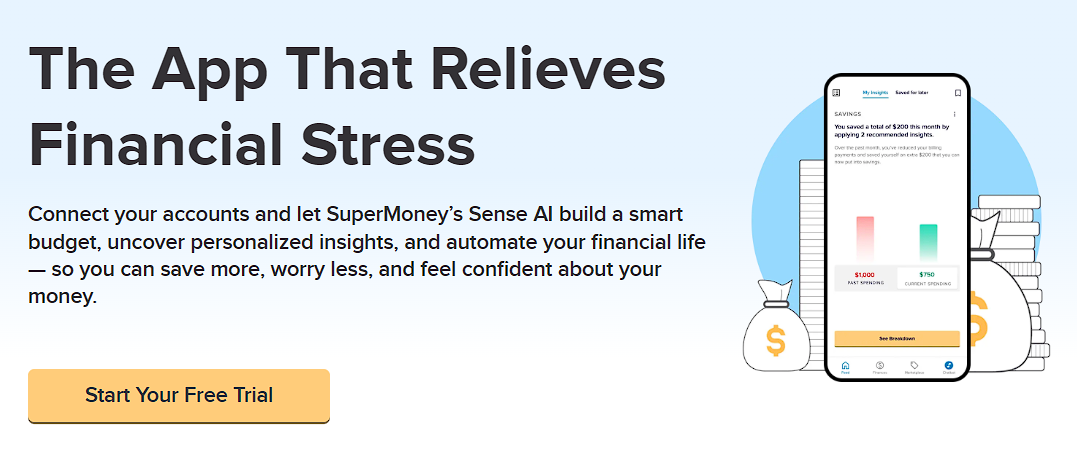
See exactly where your money is going
The SuperMoney app runs your spending audit automatically — categorizing every transaction, splitting grocery from dining, and surfacing recurring charges you’ve forgotten about. Know your actual numbers before you decide what to change.
Step 1: Run a spending audit
A spending audit is a one-time diagnostic: pull the last 60 days of bank and credit card statements and categorize every transaction into needs, wants, and recurring commitments.
The goal isn’t to feel bad about the results. It’s to produce a clear picture of where money is actually going, which is almost always different from where people think it’s going. Most people underestimate discretionary spending by 20–40% because small, frequent purchases don’t register the way large ones do.
During the audit, flag three things specifically:
- Recurring charges you forgot about. Subscriptions, memberships, and auto-renewals that exist in the background. List every one with its monthly cost and a deliberate yes/no decision about whether to keep it.
- Categories where spending is significantly higher than expected. Food and dining is the most common surprise — particularly the split between grocery spending and restaurant/delivery spending. Tracking them separately almost always reveals a larger gap than people estimate.
- Clusters of purchases around specific dates or emotional events. A pattern of purchases on Sunday evenings, after stressful work weeks, or following specific social events is a trigger signature — evidence of emotional or habitual spending that a budget alone won’t fix.
The needs vs. wants framework gives you a reliable filter for categorizing what you find. Anything in the wants column is discretionary and eligible for reduction; anything in the gray zone (expenses that are needs for some people but wants for you specifically) deserves a deliberate decision rather than a default.
Step 2: Identify your spending triggers
Once you have the audit data, look for patterns — not just totals. The question isn’t just “how much did I spend on dining?” but “when and why did I spend it?”
Common trigger signatures and what they indicate:
| Pattern | Likely trigger | What actually addresses it |
|---|---|---|
| Purchases clustered in evenings or on weekends | Boredom, decompression habit | Scheduled alternatives (exercise, social plans, hobby time) |
| Purchases after stressful events or difficult days | Emotional regulation | Alternative stress relief habits; therapy if pattern is persistent |
| Purchases after browsing social media or certain websites | Social comparison, aspiration | Removing retail apps; unfollowing accounts that trigger comparison |
| Purchases in response to sale notifications | Manufactured urgency, loss aversion | Unsubscribing from retail emails; deleting saved payment info |
| Spending that gradually increased after income rose | Lifestyle creep, hedonic adaptation | Automating savings increases with every raise; percentage-based budgeting |
| Frequent small purchases that add up invisibly | Habitual, low-friction spending | Adding friction (cash only, removing saved cards, 72-hour rule) |
Impulse buying operates as its own trigger category — with a specific set of causes and a dedicated system to address them. The full framework for stopping impulse purchases, including the 72-hour rule, the 10-10-10 test, and ADHD-specific strategies, covers this in depth.
Step 3: Replace the trigger with a system
The reason generic tip lists fail is that they address individual purchases rather than the underlying pattern. Deciding not to order takeout on a Tuesday requires willpower. Building a system that makes cooking the default — a meal plan, prepped ingredients, a standing delivery-free rule on weeknights — requires a decision once.
Systems work where intentions don’t because they remove the in-the-moment choice. Match the system to the trigger:
For emotional spending: Identify the feeling that precedes the purchase and build a competing response. This doesn’t require eliminating the emotion — it requires having an alternative that provides relief without spending. Physical activity, calling someone, a specific app-free activity you genuinely enjoy. The alternative needs to be genuinely accessible in the moment, not theoretically ideal.
For habitual or boredom spending: Add friction to the path of least resistance. Remove saved payment information from retail sites. Delete shopping apps from your phone. Install a browser extension that introduces a delay before retail sites load. Each step doesn’t make spending impossible — it introduces enough pause that the habit-loop breaks before completing.
For lifestyle creep: Automate savings increases before any lifestyle upgrade can occur. When income rises, redirect at least half the net increase to savings automatically on payday. What remains is available for discretionary spending; the savings claim is already secured before the temptation to upgrade appears.
For unnecessary or unplanned spending: Define in advance what “unnecessary” means to you. The clearest definition: anything in the wants column that you wouldn’t have bought if you’d waited 72 hours. The 30-day rule formalizes this for higher-value purchases — if you still want something after 30 days, it’s no longer impulse; it’s a considered choice.
For the structural problem: Build a budget framework that makes overspending structurally difficult, not just morally undesirable. The conscious spending plan automates fixed costs, savings, and investments first, then allows guilt-free discretionary spending from whatever remains — making the “available to spend” number accurate rather than theoretical.
How to stop spending money on food
Food is the most common category where spending surprises people during a spending audit. The issue is almost always the grocery-versus-dining split: most households spend significantly more on restaurants and delivery than they realize, while simultaneously overbuying groceries that go to waste.
Three changes that produce the clearest results:
- Track grocery and dining spending separately. Most budgeting apps group them as “food,” which obscures the gap. The moment you see that $180/month going to delivery apps is costing more than your electricity bill, the decision calculus changes.
- Build a weekly meal plan before shopping. Unplanned grocery trips purchase ingredients for meals that don’t get made, producing both waste and the dinner-time decision vacuum that delivery fills. A plan closes both gaps simultaneously.
- Set a designated delivery day, not a delivery ban. A complete ban on takeout tends to fail because it treats the entire category as the problem. A designated day — delivery is allowed on Fridays — maintains the option while dramatically reducing the frequency.
How to stop spending money on unnecessary things
The practical challenge with “unnecessary” spending is that the category is defined in the moment, under whatever emotional conditions exist then — not in advance, under clear-headed conditions. Marketing is specifically designed to make wants feel like needs in the moment of exposure.
Three structural fixes:
- Unsubscribe from all retail marketing. Promotional emails, push notifications, and retargeting ads are engineered to manufacture desire for things you didn’t want before you saw them. Removing them eliminates a significant portion of “unnecessary” purchases before the trigger fires. This single action requires 15 minutes and produces compounding results.
- Separate browsing from buying. Never purchase during a browsing session. Add items to a wish list, close the tab, and return to the purchase decision in 72 hours. This one rule eliminates the majority of impulse purchases without requiring any ongoing discipline.
- Audit your recurring “unnecessary” spending quarterly. Subscriptions and memberships that felt worthwhile when added often don’t withstand quarterly scrutiny. A 15-minute review every three months — checking usage against cost for every recurring charge — typically surfaces two or three cancellations without any feeling of sacrifice.
For tactics that go further — including psychological reframes, cash-based approaches, and longer-term habit replacement — these approaches cover the full range without requiring you to feel deprived.
How to stop overspending without feeling deprived
The deprivation problem is real — and it explains why most budgets fail within 60–90 days. When every spending decision triggers guilt, the system becomes psychologically exhausting and eventually abandoned.
The goal isn’t to spend as little as possible. It’s to spend deliberately — on things that genuinely matter to you — and to stop spending on things that don’t. That reframe changes the experience entirely: you’re not restricting yourself, you’re choosing differently.
Three principles that make this sustainable:
- Define what you actually value, then protect it. Most people cut across the board, which means cutting things they care about alongside things they don’t. If dining with friends matters to you, that belongs in your budget as a deliberate allocation — not a guilt item. Cut the categories that don’t matter to make room for the ones that do.
- Use a guilt-free spending category. A defined amount of discretionary money that you can spend on anything, without tracking or justification, eliminates the psychological cost of every purchase within that allocation. The conscious spending plan’s guilt-free category operationalizes this directly.
- Measure the right thing. Instead of tracking whether you spent less this month, track whether your savings rate grew. Spending slightly more than last month while also saving significantly more is progress — not failure. Net worth and savings rate are the relevant metrics; individual purchase decisions are inputs, not outcomes.
See exactly where your money is going
The SuperMoney app runs your spending audit automatically — categorizing every transaction, splitting grocery from dining, and surfacing recurring charges you’ve forgotten about. Know your actual numbers before you decide what to change.
Key takeaways
- Overspending is driven by emotional, social, and habitual triggers — not just poor math. Identifying your trigger is more effective than making a list of things to cut.
- A spending audit (60 days of transactions, categorized) almost always reveals a different spending picture than people expect — particularly in food and recurring charges.
- Match the system to the trigger: emotional spending requires alternative responses, habitual spending requires friction, lifestyle creep requires automated savings, and unplanned spending requires structured delay.
- Food is the most common audit surprise. Tracking grocery and dining separately, building a meal plan, and designating one delivery day (rather than banning it) produces the clearest results.
- Budgets fail through deprivation. A guilt-free spending category — a defined discretionary amount that requires no tracking — makes the system psychologically sustainable.
- The right metric is savings rate, not spending level. Growing your savings rate while living well is the goal; it’s not about spending as little as possible.
FAQ
How do I train myself to stop spending money?
The most effective approach is behavioral rather than motivational: run a spending audit to identify where money is actually going, map recurring purchases to their triggers (emotional, habitual, or social), and build systems that remove or interrupt those triggers. Relying on willpower alone fails because it requires a decision at every purchase; systems remove the decision point entirely.
Is overspending a mental disorder?
Compulsive buying disorder is a recognized behavioral condition characterized by uncontrollable urges to shop that cause significant financial or psychological distress. It’s distinct from occasional overspending or poor budgeting habits. If spending feels genuinely uncontrollable — repeated despite clear negative consequences and strong intentions to stop — that’s worth discussing with a mental health professional. Most overspending, however, is habitual or emotionally driven rather than compulsive, and responds well to behavioral systems.
How do I stop spending money on unnecessary things?
Unsubscribe from all retail marketing, separate browsing from buying (add to a wish list and return in 72 hours), and audit recurring charges every quarter. These three steps address the three most common mechanisms: exposure to desire, impulse completion, and forgotten commitments. Together they eliminate most unnecessary spending without requiring ongoing willpower.
Why do I keep spending money even when I try not to?
Because the intention to spend less doesn’t change the conditions that produce spending. If stress, boredom, or social comparison drives purchases, deciding to spend less doesn’t remove those triggers — it just adds guilt when they fire. What works is identifying the specific trigger, then building a competing response or adding friction to the path between trigger and purchase.
How do I stop overspending on food?
Track grocery and dining spending separately so the actual numbers are visible. Build a weekly meal plan before shopping to eliminate both food waste and the dinner-time decision vacuum that delivery fills. Set a designated delivery day rather than a ban — this dramatically reduces frequency while maintaining the option. Most households find that one of these three changes alone produces a significant reduction.
What are psychological reasons for overspending?
The most common are emotional regulation (using purchases to manage stress, anxiety, or boredom), social comparison (spending to match the visible consumption of peers), lifestyle creep (spending that expands automatically with income), and avoidance (not monitoring finances because awareness feels uncomfortable). Each has a different trigger profile and requires a different system to address.
How do I avoid overspending without a strict budget?
Automate savings first, then spend what remains freely. The conscious spending plan structures this: fixed costs and savings transfer automatically on payday, and whatever lands in your checking account afterward is genuinely available to spend without tracking. This approach removes the constant decision-making that makes strict budgets exhausting, while ensuring savings happen before discretionary spending can consume them.
Track your savings rate, not just your spending
The SuperMoney app connects all your accounts and tracks your net worth over time — so you can measure what actually matters: whether your wealth is growing, not just whether you spent less this month.
Feeling overwhelmed by money worries?
SuperMoney's AI-powered budgeting tools help you track your money goes, set realistic goals, and reduce financial stress.
Andrew is the Content Director for SuperMoney, a Certified Financial Planner®, and a Certified Personal Finance Counselor. He loves to geek out on financial data and translate it into actionable insights everyone can understand. His work is often cited by major publications and institutions, such as Forbes, U.S. News, Fox Business, SFGate, Realtor, Deloitte, and Business Insider.
Share this post:
Add as a preferred source on Google
Table of Contents