
Renters Are in Serious Trouble. Here Are 5 Ways to Fight Back

Last updated 11/05/2026 by
SuperMoney Team
Edited by
Andrew Latham
Summary:
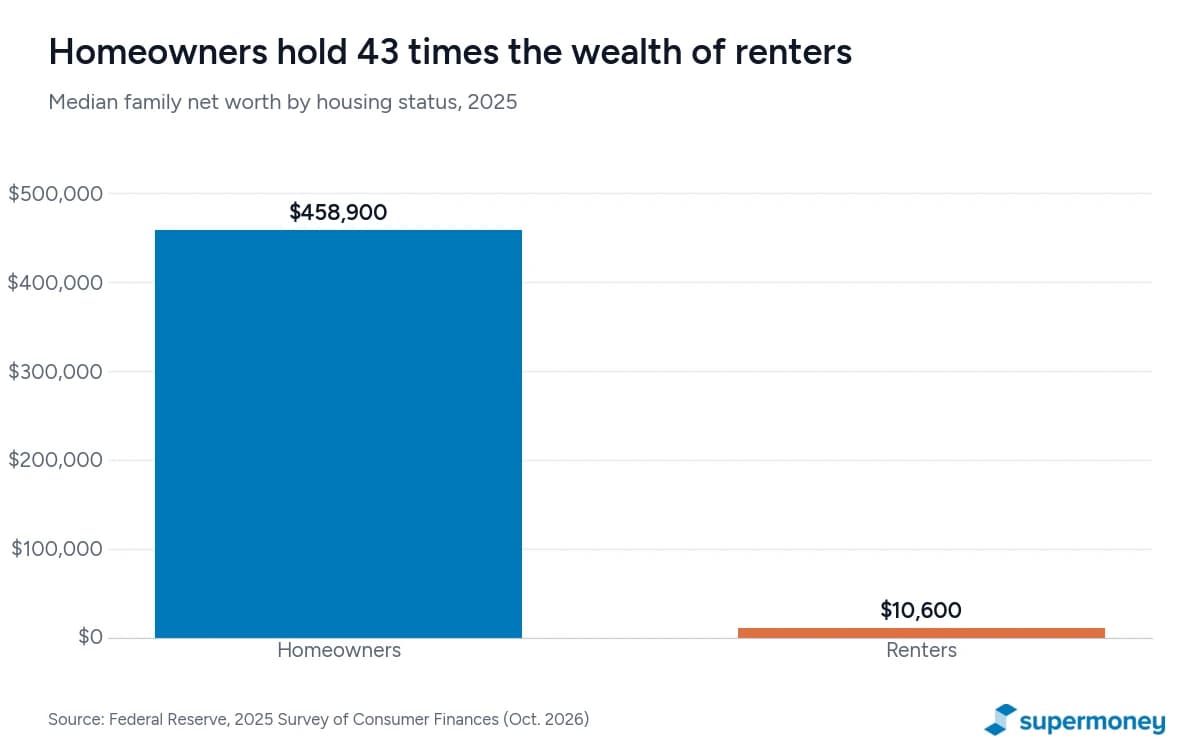
The typical renter family is worth $10,600, while the typical homeowner is worth $458,900, according to the Federal Reserve. A big reason is that every mortgage payment quietly moves money into savings, and rent doesn’t. With vacancies high and nearly 40% of listings offering deals, renters have more bargaining power than they’ve had in years. Use it to free up cash, then build your own version of the savings plan homeowners get by default.
Renters are having a rough stretch. They make up about a third of U.S. households (the homeownership rate was 65.5% in the third quarter of 2026, per the Census Bureau), and The Economist recently warned that tenants are increasingly missing payments and leaning on costly short-term credit while homeowners stay resilient. The data backs that up. A record 22.7 million renter households spent more than 30% of their income on housing in 2024, according to Harvard’s Joint Center for Housing Studies, a university research center that tracks the U.S. housing market. More than one in five middle-income renters couldn’t pay their full rent on time at some point in 2025, up from about one in seven a year earlier.
You’ve probably read that story already. What gets less attention is why the gap between renters and owners keeps widening even when renters earn decent money, and what a renter can actually do about it this month. That’s what this guide covers.
Here’s the short version. A mortgage is a forced savings plan wearing a disguise. Part of every payment pays down the loan, and that money stays the owner’s. Rent buys a year of shelter and nothing else. The fix isn’t necessarily buying a house. It’s building the savings plan yourself and paying for it with money the current rental market is practically handing you.
Key Takeaways
- 12.9% of renter families were 60+ days late on a loan payment in 2025, the highest in 36 years of Fed data. Only 40% of renters could cover a $400 surprise with cash.
- The median renter family’s net worth fell 7% to $10,600 between 2022 and 2025, while the median homeowner’s rose 6% to $458,900 (Federal Reserve).
- On a $350,000 mortgage at today’s 7.18% average rate, about $286 a month goes to principal in year one. That’s savings the owner doesn’t have to think about.
- Rental vacancy is about 7% and 39.7% of Zillow listings offered a concession in June 2026, so renewal season is a good time to ask for a lower rent.
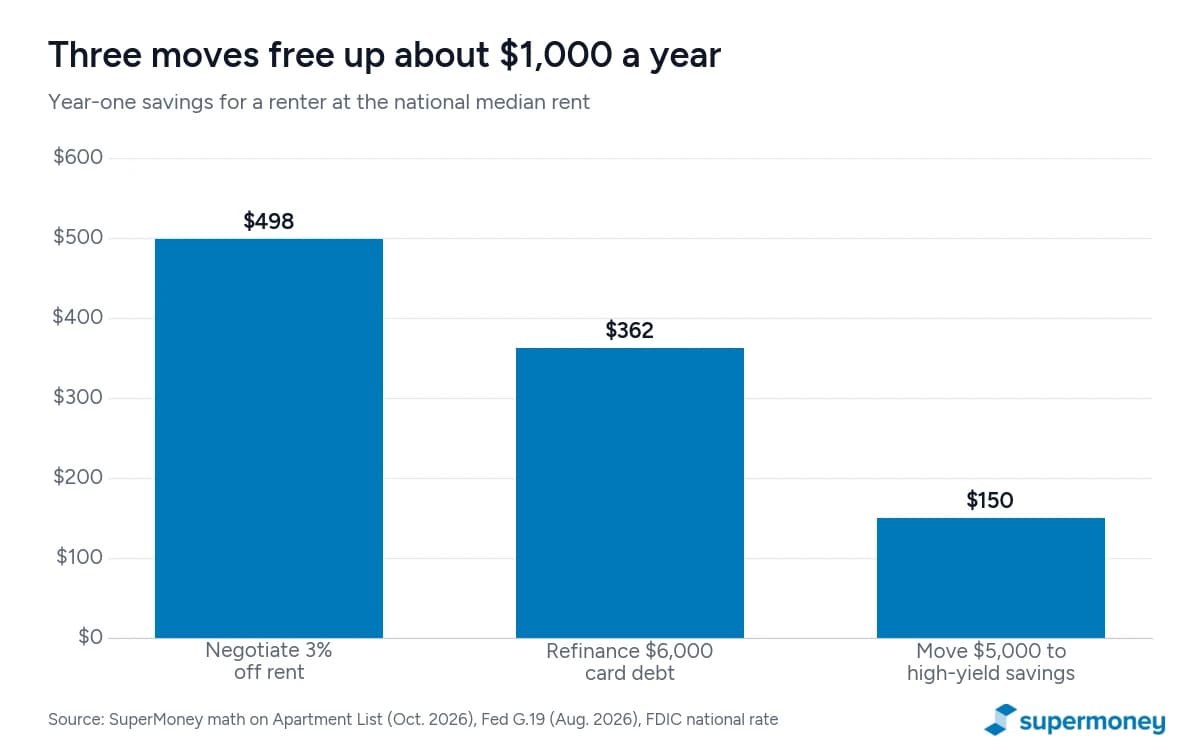
- Negotiating 3% off a median rent, refinancing $6,000 of card debt and moving $5,000 to high-yield savings frees up about $1,000 in year one.
- Saving $286 a month at 3.4% APY gets a renter to $40,808 in 10 years, close to the $48,397 a homeowner pays down on that mortgage.
Get Competing Personal Loan Offers In Minutes
Compare rates from multiple vetted lenders. Discover your lowest eligible rate.
It's quick, free and won’t hurt your credit score
How bad is it for renters, really?
Bad, and in one way worse than most headlines suggest. Here’s what the primary data says.
| Measure | Latest figure | Source |
|---|---|---|
| Renters paying 30%+ of income on housing | 22.7 million households (49%), a record | Harvard JCHS, 2024 data |
| Renters paying 50%+ of income | 12.1 million households (26%) | Harvard JCHS, 2024 data |
| Middle-income renters who couldn’t pay full rent | 21.6% in 2025, up from 14.3% in 2024 | Urban Institute |
| Median renter net worth | $10,600, down 7% since 2022 | Federal Reserve SCF |
| Median homeowner net worth | $458,900, up 6% since 2022 | Federal Reserve SCF |
| Median renter income | $50,300, up 9% since 2022 | Federal Reserve SCF |
| Families behind on a loan payment (all families) | 19.6% in 2025, up from 12.2% in 2022 | Federal Reserve SCF |
| Families carrying a buy now, pay later balance | 12% in 2025, up from 7% in 2022 | Federal Reserve SCF |
Look at the last three rows together. Renters’ incomes rose 9% after inflation, yet their wealth fell 7%. Earning more didn’t translate into owning more. That’s the pattern this guide is about.
Serious late payments are at a record for renters
We went back to the Fed’s raw survey files, which go back to 1989. In 2025, 12.9% of renter families had been 60 or more days late on a loan payment in the past year. That’s the highest share in the 36 years of data, above the previous peak of 11.8% in 2004. Among renters who carry any debt, it’s 19.3%, nearly one in five. Owners with a mortgage were at 6.9%, and owners without one at 4.0%.

The Fed’s separate 2025 survey of household finances (called SHED) shows the same split in day-to-day life. Renters trail people with a mortgage on key measures of financial well-being in that survey. Asked how they’re managing financially, 46% of renters said they’re finding it difficult to get by or just getting by, compared with 19% of people with a mortgage. A quarter of renters didn’t pay all their bills in full last month, and a quarter used buy now, pay later. Only 40% of renters could cover a surprise $400 expense with cash or its equivalent, compared with 73% of adults with a mortgage. And 10% of renters took out a payday loan or advance in the past year, versus 2% of mortgage holders.

The credit data blind spot
Many reports on renter finances use credit bureau data, and credit reports don’t say whether you rent. So researchers often treat anyone without a mortgage as a renter. A May 2026 study by Federal Reserve economists checked that shortcut against people’s own survey answers. Only 42% of these “proxy renters” actually paid rent. About 32% owned their homes free and clear.
That mix-up flatters renters. Among people who said they pay rent, 40.7% had a delinquent account. Among proxy renters, it was 27.6%. In other words, stats built on credit data alone likely understate how much financial stress real renters are under.

Why homeowners pull ahead even when renters earn more
Home prices rising helps owners, but there’s a quieter force too. Take a $350,000 30-year mortgage at 7.18%, Freddie Mac’s average rate for the week of Nov. 5, 2026. The principal and interest payment is $2,371 a month. In the first year, $3,434 of that, about $286 a month, pays down the loan balance.
Nobody has to remember to save that money or resist spending it. It just happens. After 10 years the owner has paid down $48,397, before counting any change in the home’s value. Owners also pay property taxes, insurance and repairs that renters don’t, so owning isn’t automatically the better deal. But that automatic savings is something renters rarely replace.
The good news is that you can copy it. You just need two things: money to fund it and a way to make it automatic.
Step 1: Ask for a lower rent while you have bargaining power
For the first time in years, the market is on your side in a lot of cities. Apartment List, a rental listing site that publishes a monthly rent index, put the national median rent at $1,384 in October 2026, up just 0.1% from a year earlier. Its vacancy index sits at 7.0%, near its highest reading in years, and units take about 36 days to lease. Zillow found that 39.7% of its rental listings offered a concession in June 2026, such as a free month or waived fees, up from 35.2% a year earlier.
Every empty month costs your landlord a full month of rent plus turnover costs. That gives you real bargaining power at renewal. Here’s what asking can be worth on a $1,384 rent.
| What you negotiate | Monthly value | Year-one value |
|---|---|---|
| Keep rent flat instead of a 3% increase | $42 | $498 |
| 3% rent cut | $42 | $498 |
| One free month on a 12-month lease | $115 (averaged) | $1,384 |
| Waived parking or amenity fee | Varies | Varies by building |
Start 60 to 90 days before your lease ends. Look up what comparable units in your building and neighborhood list for, including move-in specials, and bring the numbers. Point to your on-time payment record, then offer something the landlord values, like a longer lease. If the answer on price is no, ask for a concession instead.
How the SuperMoney app helps: link your checking and card accounts, and the app tracks your spending by category, so you can see exactly what share of your take-home pay goes to rent before you walk into that conversation. You can also ask Sense, the app’s AI assistant, questions about your own numbers, like how a $50 increase would change your monthly budget.
Step 2: Pay yourself the “principal” first
This is the heart of the plan. Pick a monthly amount, set an automatic transfer for the day after payday, and treat it like a bill. If you can manage $286, you’d match the principal on that $350,000 mortgage. If you can only do $50 to start, do $50 and raise it with every raise.
Where the money sits matters. The FDIC, the federal agency that insures bank deposits, puts the national average savings rate at 0.38%. Some high-yield accounts pay several times that. Saving $286 a month at 3.4% APY grows to $40,808 in 10 years, close to what the homeowner paid down. Once you have three to six months of expenses set aside, consider sending new money to a retirement account instead, where long-term growth can outrun a savings rate.

You can compare current rates on high-yield savings accounts before you pick one.
How the SuperMoney app helps: set a savings goal in the app and it tracks your progress, and its net worth view shows your balance climbing alongside your accounts and debts. Watching the line go up is half the motivation. See how you compare with others your age in our guide to net worth by age.
Step 3: Make your rent build your credit
Homeowners get credit for paying their mortgage. Most renters get nothing for paying rent on time, because only about 13% had rent reported to the credit bureaus in 2025, according to a TransUnion survey cited by the Kansas City Fed. You can change that. Many landlords and rent-reporting services will send your payments to one or more bureaus.
In a TransUnion analysis, adding rent payments raised scores by nearly 60 points on average, and about 9% of people with no score became scorable. Results vary, and the biggest gains go to people with thin credit files. One caution: some services report late payments too, so only sign up if you pay on time. Here’s how to report your rent payments to the credit bureaus.
Your rent history can help if you do decide to buy later. Fannie Mae’s automated underwriting system can count 12 months of on-time rent payments found in your bank statements when a loan would otherwise fall short.
How the SuperMoney app helps: the app monitors your credit score, so you can see whether rent reporting is moving the needle over the next few months.
Step 4: Shrink your highest-rate debt
Credit card debt is the leak that drains renter budgets fastest. The Fed reports that in August 2026 the average rate on card accounts charged interest was 22.36%, while the average 24-month personal loan rate at banks was 11.90%.
| Paying off $6,000 over 24 months | Monthly payment | Total interest |
|---|---|---|
| Credit card at 22.36% | $312 | $1,496 |
| Personal loan at 11.90% | $282 | $772 |
| Difference | $30 less | $724 saved |
Watch the short-term stuff too. The share of families carrying a buy now, pay later (BNPL) balance jumped from 7% to 12% between 2022 and 2025. Renters lean on these tools more: 25% used BNPL in 2025 and 10% took out a payday loan or advance, a small, short-term loan that often carries triple-digit annual rates. BNPL can be interest-free, but juggling several plans makes it easy to miss a payment, and using it for rent or groceries is a sign the budget needs a reset, not more credit.
Back to the card example: refinancing saves about $362 a year. Your rate depends on your credit, and a consolidation loan only helps if you stop adding new balances to the cards. If the payments themselves are unaffordable, a nonprofit credit counseling agency, like those affiliated with the National Foundation for Credit Counseling, can set up a debt management plan that often lowers card interest rates.
How the SuperMoney app helps: once your accounts are linked, the app looks at the rates on your existing debts. If you prequalify for a lower rate on one of them, it shows you how much interest you could save.
Step 5: Protect the plan
One bad month can undo a year of progress. Two cheap safeguards keep that from happening.
- Renters insurance. Your landlord’s policy covers the building, not your stuff or your liability. A fire or burst pipe can cost thousands to replace belongings. Compare renters insurance quotes, which are usually far cheaper than homeowners coverage.
- A cut-the-leaks review. Forgotten subscriptions and price hikes on streaming, apps and memberships add up quietly. Cancel what you don’t use and send that amount straight to Step 2.
How the SuperMoney app helps: the SuperMoney app spots recurring charges and subscriptions across your linked accounts, so the ones you forgot about stop hiding.
Put it together: about $1,000 a year to start
Here’s what the first three moves can free up in year one for a renter paying the national median rent.
| Move | Assumption | Year-one savings |
|---|---|---|
| Negotiate rent | 3% off a $1,384 rent | $498 |
| Refinance card debt | $6,000 from 22.36% to 11.90% | $362 |
| Move savings | $5,000 from 0.38% to 3.4% APY | $150 |
| Total | $1,010 (about $84 a month) |
That $84 a month is a real start on your own principal plan, and it came from money you were already spending. Add a cancelled subscription or two and a raise, and $286 a month stops looking out of reach.
Renters can’t control the housing market. But they can control whether the gap keeps growing in their own household. Homeowners get their savings plan by accident. You can build yours on purpose.
Share this post:
Add as a preferred source on Google
Table of Contents