
The Scam That Works Because You Were Careful: Callback Scams and Whether Zelle Will Refund You

Last updated 10/13/2026 by
SuperMoney Team
Edited by
Andrew Latham
Summary:
Callback scams skip the link and ask you to call a number, which feels like the safe move. Fake call centers took more than $2.9 billion from Americans in 2025, according to the FBI, and bank impersonators caused the biggest losses of any business imposter tracked by the FTC. Whether you get a Zelle scam refund depends on one question: did a scammer move the money, or did you press send?
You get a text: “Did you attempt a purchase of $1,249.00? If not, call us now.” There’s no link, and you’ve been told a hundred times not to click links. So you do the careful thing. You call. That call is the scam, and if you end up sending money by Zelle, your odds of a Zelle scam refund are a lot worse than most people assume.
These are called callback scams (security teams also call them callback phishing). Instead of a link, the text, email, or fake invoice gives you a phone number. The number reaches a fake bank or “fraud department” with hold music, a phone menu, and a calm, professional voice. Here’s how it works, what it cost Americans last year, and exactly what your bank and Zelle will and won’t refund.
Get Competing Personal Loan Offers In Minutes
Compare rates from multiple vetted lenders. Discover your lowest eligible rate.
It's quick, free and won’t hurt your credit score
This one almost worked on my family
I spend my days writing about money, so I’d like to tell you my family is immune. We’re not. This very week my mother, who’s 79, got a text saying there was a substantial money transfer the bank was trying to process, and they needed her to call to confirm it.
Here’s what made it convincing: the amount was close to a real transfer we were actually working on at the time. It wasn’t a random “$1,249 purchase” she’d never heard of. It looked like a routine check on something she was expecting. That’s the moment a careful person picks up the phone.
We didn’t call the number. But I’ll admit it was convincing enough that we emailed her banker at her local branch, someone we already knew, just to make sure. It turned out to be a scam, of course. But checking was the right instinct, and it’s the whole lesson of this article in one sentence: when a message asks you to call, reach out through a contact you already have, never the one in the message.
I don’t know whether the scammers got lucky with the amount or knew something. It doesn’t matter. Scammers send millions of these messages, and some of them will land right when you’re expecting a big transaction. That’s when they’re most dangerous. And people 60 and older lost $7.7 billion to online fraud reported to the FBI in 2025, so if you have aging parents, this is worth a phone call to them this week.
The callback scam is growing because people trust the phone
The clearest numbers on this trend come from Australia. Australian phone company Telstra says callback scams rose from about 29% of the email scams reported to it in 2025 to 45% so far in 2026. A YouGov survey Telstra commissioned found 69% of Australians are confident they could never be tricked into calling a scammer, and 85% prefer to sort out an urgent, unexpected charge by phone.
Those are Australian figures, but the same playbook runs here, and it works because people who learned “don’t click” will happily dial.
How a callback scam works, step by step
Australia’s Commonwealth Bank (CommBank) laid out the script, and US regulators describe the same pattern.
- The bait. A text, email, or invoice says something’s wrong: a big charge, a locked account, a subscription renewal. It gives a number to call instead of a link, so your spam filter and your instincts both let it through.
- The call center. You hear hold music and a phone menu (“press 2 for fraud”).
- The trust builder. The “agent” knows your name, maybe your address, and recites the first six digits of your card. Those six digits identify the bank that issued the card and are shared by many cards, so they prove nothing.
- The ask. They want a one-time code “to verify you,” your online banking login, remote access to your computer, or for you to move money to a “safe account.” Some tell you to send money to yourself using Zelle, or to withdraw cash for a courier.
The Federal Communications Commission (FCC), which regulates phone carriers, put it bluntly in a July 2026 alert: “Banks will never call or text and ask you to move your money to protect it.”
Fake fraud alert texts
The fake fraud alert text is the most common opener. The Federal Trade Commission (FTC), the agency that collects consumer fraud reports, says these texts ask you to reply YES or NO about a large purchase or give you a number to call. Either way you end up talking to a fake fraud department that says your money is at risk and needs to be moved. Text scams cost Americans $470 million in 2024, more than five times the 2020 total.
A Bank of America text scam or a Chase fraud text looks convincing because scammers copy the biggest banks. The bank name in a text proves nothing.
PayPal scam emails and Geek Squad scam emails
Fake invoices are the other big opener. A Geek Squad scam email or a Norton “renewal” says you were charged a few hundred dollars and gives a number to dispute it. On the call, the agent offers a refund, asks for remote access to “process” it, then claims they refunded too much and asks you to send the difference back.
A sneakier PayPal scam email showed up this year. KPRC 2 in Houston reported in May 2026 that criminals send one-cent PayPal payments so PayPal itself emails you. The scammer’s note on the payment carries the fake fraud warning and the phone number. The email is genuinely from PayPal. The number isn’t.
What fake call centers cost Americans
The FTC says people reported losing $3.5 billion to imposter scams in 2025, and nearly one in three fraud reports involved an imposter. Business impersonators took nearly $1 billion, and the biggest losses in that group went to people pretending to be from a bank. Government impersonators took about $920 million. The FTC also notes that some of the costliest of these scams start with a fake security alert, often supposedly from your bank.
The FBI’s Internet Crime Complaint Center (IC3), where victims report online and phone fraud, counts two “call center fraud” categories: tech and customer support scams, and government impersonation. Together they drew more than 80,000 complaints and over $2.9 billion in losses in 2025.
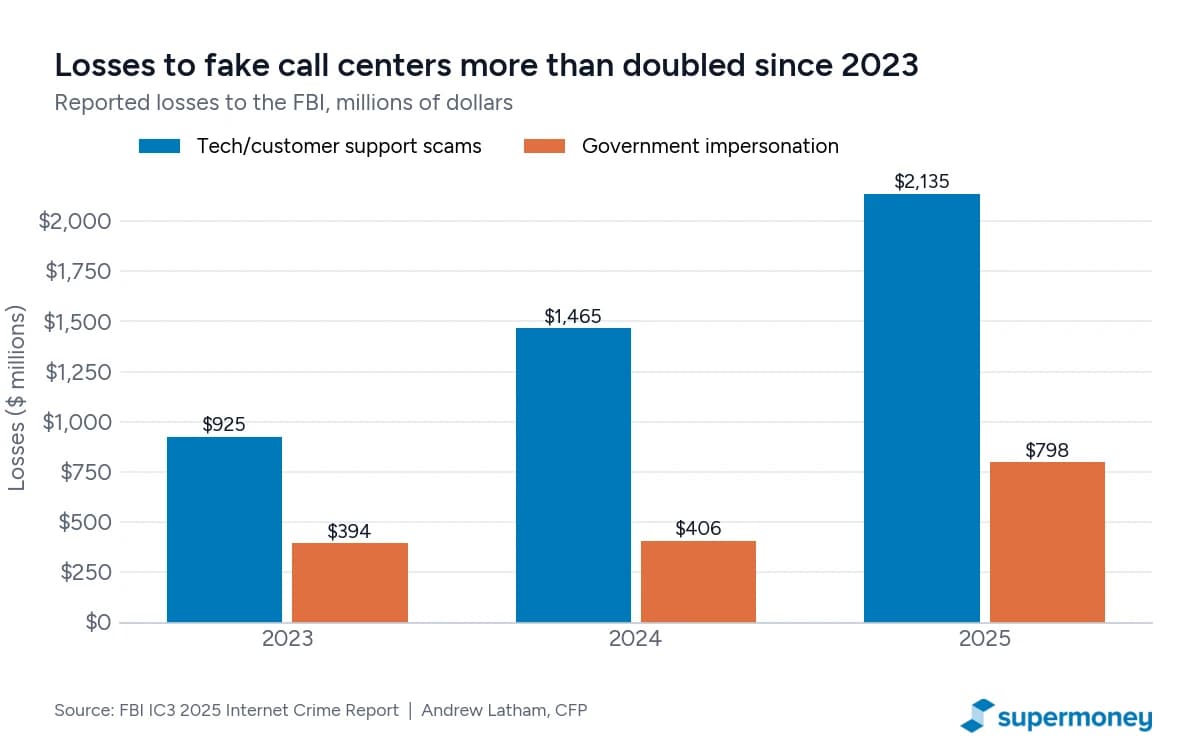
Tech support losses jumped 46% in a year, and government impersonation losses nearly doubled. Divide the 2025 tech support total by its 47,794 complaints and you get about $44,700 in reported losses per complaint.
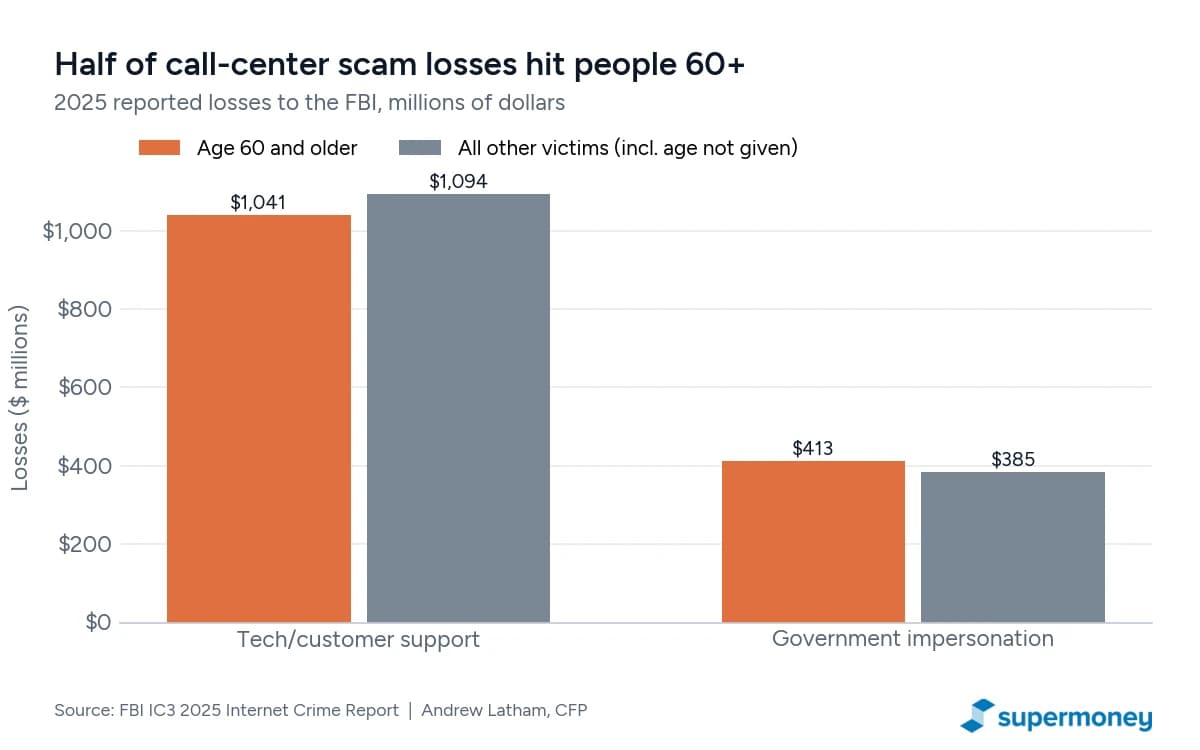
Older adults carry about half of it. People 60 and older reported $1.04 billion of the $2.13 billion lost to tech support scams and $413 million of the $798 million lost to government impersonation.
A real example: in April 2026 the Nevada County Sheriff’s Office in California warned about an elderly Grass Valley woman who lost about $40,000. It started with a text that looked like it came from her bank branch. She replied that she hadn’t made the charges, a “bank” caller told her the account was compromised, and she withdrew cash in several trips for couriers to pick up.
Zelle scam refund: will Zelle refund money if you’re scammed?
It comes down to whether the transfer was authorized. (We covered the same split for AI agents that spend your money.)
Unauthorized: The Electronic Fund Transfer Act’s Regulation E (Reg E), the federal rule that protects bank account transfers, covers transfers you didn’t make. The Consumer Financial Protection Bureau (CFPB) says in its Reg E FAQs that if you were tricked into sharing account access information, like a login or a one-time code, and the scammer used it to move money, that’s still an unauthorized transfer. Your bank has to investigate, and your liability is limited if you report it quickly. I checked: that FAQ is still posted on the CFPB’s site, and it isn’t among the guidance documents the CFPB withdrew in May 2025.
Authorized: If you sent the money yourself, even because a liar told you to, the payment is generally treated as authorized. Zelle’s own site says that if you gave the “ok,” you “may not be able to get your money back.”
The Zelle imposter exception: Zelle says “qualifying imposter scams may be eligible for reimbursement” and tells victims to contact their bank or credit union. Zelle’s operator, Early Warning Services, hasn’t published what qualifies. When the policy took effect in June 2023, Early Warning said it covered imposters posing as “certain trusted entities,” such as banks and well-known companies, and that it was “not carte blanche for all imposter scams.”
Don’t count on Washington to fill the gap. The CFPB dropped its lawsuit against Zelle and three big banks over scam reimbursement in March 2025, with prejudice, so it can’t be refiled.
Will you get your money back? A quick guide
| What happened | Federal protection | Realistic odds |
|---|---|---|
| Scammer used your login or code to move money | Unauthorized transfer under Reg E | Good if you report fast. Bank must investigate. |
| You sent a Zelle payment to a fake bank or agency rep | None required. Zelle’s imposter policy may apply. | Possible. File with your bank right away and say “imposter scam.” |
| You sent Zelle for something that never arrived | None. Treated as authorized. | Low |
| Wire transfer | Generally outside Reg E | Low. Ask your bank for an immediate recall. |
| Cash handed to a courier | None | Very low. Report to police and IC3. |
| Gift cards | None | Very low unless the card company freezes the funds before they’re spent. |
The FBI says time is of the essence: contact your bank immediately, ask it to recall the funds, and file at ic3.gov. Its Recovery Asset Team helped freeze about $507 million in domestic cases in 2025, but that only works while the money is still sitting somewhere.
Six numbers you should never call
- A number in a text asking “Did you make this purchase?”
- A number in an invoice or renewal email from Geek Squad, Norton, McAfee, PayPal, or Amazon, even if the email really came from PayPal.
- A number in a pop-up on your computer.
- A number from a sponsored or “Ad” search result.
- A number a caller gives you so you can “call back and verify.”
- A number left in a voicemail saying your account is locked.
The one rule that beats every version
Only call the number on the back of your card, on your statement, or one you find yourself inside your bank’s app. Every callback scam depends on you using their number.
A banker you already know counts too. When my mom got her fake transfer text, we checked with her branch contact by email instead of dialing the number in the message. If you’re helping an aging parent, save their bank’s real number and their banker’s contact in your phone now, before you need it.
It also helps to check the “charge” without calling anyone. Log in to your bank’s app the way you normally do. If you’d like one place to see every account, the SuperMoney app lets you link your accounts and track spending, so a fake $1,249 charge is easy to rule out in seconds.
What to do if you already called
- Hang up. A real bank never minds you calling back.
- Call your bank on the number on your card. Say “I think I’ve been the victim of an imposter scam,” and ask them to freeze transfers and flag the account. If you sent a wire, ask for a recall right now.
- Change your passwords and turn off any remote access. If you installed an app like AnyDesk or TeamViewer at their request, uninstall it and change passwords from a different device.
- File a dispute in writing. If the scammer moved the money using your code or login, use the word “unauthorized.” If you sent a Zelle payment, ask about Zelle’s imposter scam reimbursement.
- Report it. File at reportfraud.ftc.gov and ic3.gov. Reports feed law enforcement and support your bank claim.
- Watch for round two. Anyone who contacts you offering to recover your money for a fee is another scammer.
If a scam drained your checking account, rebuild a cushion as soon as you can. Our guide to building an emergency fund walks through it, and keeping that money in a separate account makes it harder for one bad phone call to reach everything.
Scammers love anything with a big balance. If you have a home equity line, read up on HELOC scams too. And if you’re picking a payment app, here’s how Zelle and Venmo compare on safety.
Frequently asked questions
Can I get a Zelle scam refund?
Maybe. If a scammer used your login or a code you shared to move the money, Reg E treats it as unauthorized and your bank has to investigate. If you sent the payment yourself, Zelle says only qualifying imposter scams may be reimbursed, and you have to start the claim with your bank or credit union.
Will Zelle refund money if I was scammed by someone pretending to be my bank?
That’s the case Zelle’s imposter policy was designed for, but Zelle doesn’t publish its criteria and reviews each claim. Report it to your bank immediately and use the words “bank imposter scam.”
Is a fake fraud alert text dangerous if I don’t click anything?
Yes. The danger is replying or calling the number. Either one connects you to a fake fraud department. Delete it and check your account in your bank’s app instead.
How do I know if a Chase or Bank of America fraud text is real?
You don’t need to figure it out from the text. Open the bank’s app or call the number on your card. If there’s a real fraud alert, the bank will see it too.
What is a callback scam?
A scam that asks you to call a number instead of clicking a link. The number reaches a fake customer service or fraud line that wants your codes, login, remote access, or a payment.
Key takeaways
- Fake call centers drew more than 80,000 FBI complaints and over $2.9 billion in losses in 2025, and people 60+ lost about half of it.
- Bank impersonators caused the biggest losses among business imposters in the FTC’s 2025 data.
- If a scammer moved money with your login or code, Reg E treats it as unauthorized. If you pressed send, refunds are much harder.
- Zelle says qualifying imposter scams may be reimbursed, but it doesn’t publish the rules.
- Only call the number on the back of your card, on your statement, or inside your bank’s app.
Share this post:
Add as a preferred source on Google
Table of Contents