
How to Build an Emergency Fund (Step-by-Step)

Last updated 03/17/2026 by
Andrew Latham
Edited by
Andrew Latham
Summary:
An emergency fund is a dedicated cash reserve that covers three to six months of essential expenses, protecting you from debt when unexpected costs hit. Building one starts with a specific savings target, a separate high-yield account, and automated transfers that remove willpower from the equation.
Knowing you should have an emergency fund and actually building one are two different problems. The first is a fact you’ve probably heard a hundred times — the second is where most people get stuck.
The gap between knowing and doing is real, and it widens every time an unexpected bill shows up before the savings do. Here’s how to close it.
Compare Savings Accounts
Compare savings accounts. Discover your best option.
What Is an Emergency Fund?
An emergency fund is a cash reserve set aside specifically for unplanned, urgent expenses — job loss, medical bills, major car repairs, or emergency home fixes. The purpose of an emergency fund is to absorb financial shocks without forcing you into credit card debt, personal loans, or borrowing from retirement accounts.
It’s not a vacation fund, not a holiday spending buffer, and not a general savings account. Emergency funds serve a single function: financial insurance against the unpredictable.
A 2025 Bankrate survey found that 59% of Americans can’t cover a $1,000 emergency from savings. That means the majority of U.S. adults are one car breakdown or ER visit away from taking on debt.
The emergency fund changes that math. Even a small buffer — $500 to $1,000 — creates a gap between you and the next financial crisis.
Why Is It Important to Have an Emergency Fund?
An emergency fund prevents a single unexpected expense from cascading into long-term financial damage. Without one, a $1,500 car repair becomes a credit card balance at 22% APR, which becomes a monthly minimum payment that compresses every other budget category for months or years.
The downstream effects compound quickly:
- Debt accumulation. The average credit card interest rate exceeds 20%. A $2,000 emergency on plastic costs $2,400+ if paid over 12 months.
- Stress and health impact. Financial emergencies are a top trigger for chronic financial stress, which the American Psychological Association links to sleep disruption, anxiety, and relationship strain.
- Reduced flexibility. Without savings, you can’t leave a toxic job, take a career risk, or negotiate from a position of strength. The emergency fund buys time, and time buys options.
- Cycle reinforcement. People without emergency savings are more likely to remain stuck in a paycheck-to-paycheck cycle, because every disruption resets their progress.
An emergency fund doesn’t just protect your bank account — it protects your ability to make decisions from a stable position instead of a desperate one.
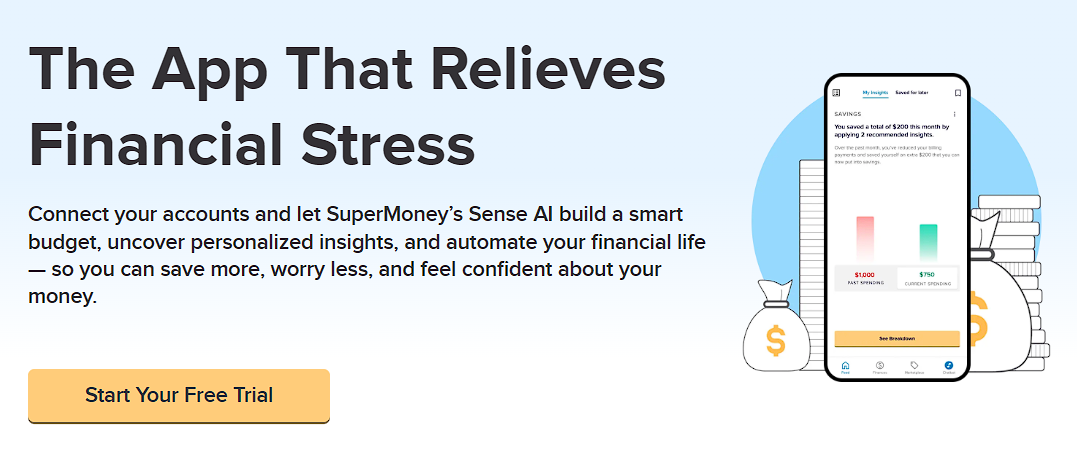
Automate your emergency fund savings. The SuperMoney app tracks your spending, flags savings opportunities, and helps you build toward your emergency fund target without manual budgeting.
How Much Should Your Emergency Fund Be?
Most financial experts recommend saving three to six months of essential living expenses in your emergency fund. The Federal Reserve’s 2024 Survey of Household Economics uses the three-month threshold as a benchmark for financial resilience — and finds that only 55% of U.S. adults meet it.
Why three to six months specifically? Because that range covers the two most common emergency scenarios: a single large expense ($1,000–$5,000) and a period of lost income. The median job search in the U.S. takes roughly three months, which is why three months is the floor and six months is the ceiling for most households.
Your specific target depends on your situation:
| Your Situation | Recommended Target | Why |
|---|---|---|
| Dual-income household, stable jobs | 3 months of expenses | Two income streams reduce risk |
| Single income, steady employment | 4–5 months of expenses | No backup income if job is lost |
| Freelancer or irregular income | 6+ months of expenses | Income gaps are part of the model |
| Single parent | 6 months of expenses | Higher fixed costs, less flexibility |
| Nearing retirement | 6–12 months of expenses | Longer re-employment timeline |
To calculate your number: add up your monthly non-negotiable expenses (rent/mortgage, utilities, groceries, insurance, minimum debt payments, transportation), then multiply by your target month count. For a deeper walkthrough with age-based benchmarks, see how to calculate your emergency savings target.
Start with $500, not perfection. A 2025 Empower study found that the median American emergency savings balance is just $500. That’s not a failure — it’s a meaningful first milestone. A $500 buffer covers most minor emergencies (car repair, appliance replacement, urgent copay) and keeps them off a credit card. Build to $500 first, then scale toward three months.
Where to Keep Your Emergency Fund
The only place you should keep your emergency fund is in a liquid, FDIC-insured account that you can access within one to two business days — typically a high-yield savings account or money market account. The goal is immediate accessibility without market risk. Your money stays safe in an FDIC-insured account even if the bank fails — every dollar up to $250,000 per depositor is federally guaranteed.
This is where many people make costly mistakes. Keeping your emergency fund in a checking account makes it too easy to spend. Investing it in stocks or crypto introduces the risk that your fund loses value precisely when you need it most.
| Account Type | Good for Emergency Fund? | Why |
|---|---|---|
| High-yield savings account (HYSA) | ✅ Best option | 4–5% APY, FDIC-insured, 1–2 day access |
| Money market account | ✅ Strong option | Comparable rates, sometimes check-writing access |
| Regular savings account | ⚠️ Acceptable | Safe and liquid, but earns near-zero interest |
| Checking account | ❌ Avoid | Too accessible — blurs with spending money |
| CDs or bonds | ❌ Avoid | Early withdrawal penalties defeat the purpose |
| Stocks, crypto, brokerage | ❌ Avoid | Market volatility can reduce value when you need it most |
The critical principle: separation. Your emergency fund should live in a different account — ideally at a different bank — from your daily checking. That physical separation creates a psychological barrier against casual withdrawals.
Keep your emergency fund in a dedicated savings account — not mixed with spending money in your main checking account, where the temptation to dip into it is highest.
Compare high-yield savings accounts to find an FDIC-insured option with competitive rates and no monthly fees.
How to Build an Emergency Fund in 6 Steps
Building an emergency fund doesn’t require a high income or aggressive budgeting — it requires a system. These six steps work whether you’re starting from $0 or rebuilding after a withdrawal.
- Set your first target at $500. A full three-to-six-month fund is the goal, but $500 is the milestone that creates momentum. It covers most common emergencies and moves you ahead of roughly half of American adults.
- Open a separate high-yield savings account. Choose an FDIC-insured account with no monthly fees and no minimum balance requirements. Keep it at a different institution than your checking account to reduce the temptation to transfer money back. Online savings accounts typically offer the highest APY.
- Calculate your monthly savings amount. Review your income and expenses, then identify a fixed amount you can redirect each pay period — even $25 per week ($100/month) reaches $500 in five months and $1,200 in a year.
- Automate the transfer on payday. Set up an automatic transfer from checking to savings timed to your paycheck deposit. The money moves before you see it, which eliminates the decision to save and makes it the default.
- Redirect windfalls. Tax refunds, bonuses, cash gifts, side-hustle income — route at least 50% of any unexpected income directly to your emergency fund. The average U.S. tax refund exceeds $3,000, which alone can jump-start a solid buffer.
- Scale up after $500. Once you hit $500, increase your automatic transfer amount or add a second funding source. The gap between $500 and a full three-month fund feels large, but the habit is already built — you’re just adjusting the number.
Dave Ramsey’s “Baby Steps” framework recommends a $1,000 starter emergency fund (Baby Step 1) before aggressively paying down debt, then expanding to three to six months (Baby Step 3) after debt is eliminated. Whether you follow that sequence or build savings and pay debt simultaneously depends on your interest rates and risk tolerance — the key is that automated, consistent contributions matter more than the exact strategy.
Emergency Fund vs. Rainy Day Fund vs. Sinking Fund
An emergency fund, a rainy day fund, and a sinking fund serve three distinct purposes — confusing them leads to either over-saving in one category or under-saving in another.
| Feature | Emergency Fund | Rainy Day Fund | Sinking Fund |
|---|---|---|---|
| Purpose | Major, unplanned crises | Small, unexpected costs | Known, planned future expenses |
| Typical size | 3–6 months of expenses | $500–$2,000 | Varies by goal |
| Examples | Job loss, ER visit, major home repair | Car repair, vet bill, appliance fix | Holiday gifts, annual insurance, vacation |
| Replenish after use? | Yes — immediately restart contributions | Yes — treat it like a revolving buffer | No — it’s spent on the planned goal |
| Where to keep it | HYSA or money market | Separate savings account | Separate savings account |
The most effective savings system uses all three in combination. The sinking fund handles predictable irregular expenses so they don’t raid your emergency fund. The rainy day fund absorbs minor surprises so your emergency fund stays intact for genuine crises.
For a full breakdown of how these three accounts work together — including when to tap each one — see the complete emergency fund vs. savings vs. sinking fund comparison.
When to Use Your Emergency Fund (and When Not To)
An emergency fund should only be used for expenses that are urgent, necessary, and unexpected — all three conditions must be true simultaneously. A sale on a new laptop is unexpected but not necessary. Car insurance is necessary but not unexpected. A burst pipe is all three.
Before making a withdrawal, ask three questions:
- Is it urgent? Does this need to be resolved within days, not weeks or months?
- Is it necessary? Will not paying cause real harm — to your health, housing, transportation, or income?
- Is it unexpected? Could you have reasonably predicted and planned for this expense?
If the answer to all three is yes, use your emergency fund — that’s exactly what it’s for. If any answer is no, explore other options first: your rainy day fund, a sinking fund, or a revised monthly budget.
For a deeper framework including real-world scenarios and edge cases, see when to use your emergency fund (3 questions to ask first).
What If You Can’t Save Right Now?
Building an emergency fund on a tight budget requires smaller steps, not a different strategy. The mechanics are the same — automate, separate, and be consistent — but the amounts start much lower.
- Start with $5–$10 per week. That’s $260–$520 per year, which covers most minor emergencies and builds the savings habit.
- Use round-up savings. Apps and bank features that round purchases to the nearest dollar and deposit the difference can generate $20–$50/month without any conscious effort.
- Redirect one recurring expense. Cancel a subscription you rarely use and reroute that exact amount to your emergency fund via automatic transfer.
- Save windfalls, not paychecks. If your regular income barely covers expenses, commit to saving 100% of any irregular income — tax refunds, cash gifts, overtime, side gigs.
The biggest barrier isn’t income level — it’s the belief that small amounts don’t matter. They do. A $500 emergency fund kept in a separate account prevents more credit card debt than a $5,000 goal that never gets started.
Budgeting on a low income is difficult, but it doesn’t require waiting until income increases to build a buffer. It requires starting where you are.
Key takeaways
- An emergency fund covers three to six months of essential expenses and protects you from debt when unplanned costs hit.
- Keep it in a high-yield savings account or money market account — never in checking, CDs, or investment accounts.
- Start with a $500 target. The median American emergency savings balance is $500, which is enough to cover most common emergencies.
- Automate transfers on payday so saving happens before spending. The system matters more than the amount.
- Use the three-question test before withdrawing: Is it urgent? Necessary? Unexpected? All three must be true.
- An emergency fund works best alongside a rainy day fund (small surprises) and sinking funds (planned expenses) — each serves a different role.
FAQ
What is the 3-6-9 rule for emergency funds?
The 3-6-9 rule is a tiered framework: save three months of expenses as a baseline, six months if you’re single-income or self-employed, and nine months if you have dependents or work in a volatile industry. Most financial planners consider three months the minimum and six months the standard target for most households.
Why is it recommended that you save 3–6 months of expenses in your emergency fund?
Three to six months covers the two most likely emergency scenarios: a single large expense ($1,000–$5,000) and a period of lost income. The median U.S. job search takes roughly three months, which is why three months is the floor. Six months provides a wider margin for longer unemployment, medical recovery, or compounding crises.
Is $20,000 enough for an emergency fund?
$20,000 is enough for most households. If your monthly essential expenses total $3,000–$4,000, a $20,000 fund covers five to six months — well above the standard three-month recommendation. The right target is based on your actual monthly expenses, not an arbitrary dollar amount.
Should I pay off debt or build an emergency fund first?
Build a small emergency fund ($500–$1,000) first, then prioritize high-interest debt. Without even a minimal buffer, any unexpected expense goes straight onto a credit card — adding to the very debt you’re trying to eliminate. Once the starter fund is in place, you can shift focus to paying off debt while maintaining your savings baseline.
Can I invest my emergency fund?
Investing your emergency fund defeats its purpose. Stocks, crypto, and other market-based assets can lose value precisely when you need them most — during a recession, market downturn, or personal financial crisis. Keep your emergency fund in a liquid, FDIC-insured account (HYSA or money market) and invest separately in accounts with longer time horizons.
Build your emergency fund on autopilot. The SuperMoney app analyzes your spending, identifies savings opportunities, and helps you build your emergency buffer automatically — no spreadsheets required.
Andrew is the Content Director for SuperMoney, a Certified Financial Planner®, and a Certified Personal Finance Counselor. He loves to geek out on financial data and translate it into actionable insights everyone can understand. His work is often cited by major publications and institutions, such as Forbes, U.S. News, Fox Business, SFGate, Realtor, Deloitte, and Business Insider.
Share this post:
Add as a preferred source on Google
Table of Contents