
ARMs Hit 11% of Mortgage Locks at 7.3% Rates. When a 7/1 Saves Money and When It Bites

Last updated 10/21/2026 by
SuperMoney Team
Edited by
Andrew Latham
Summary:
With 30-year fixed rates sitting between 7.3% and 7.4%, adjustable-rate mortgages made up over 11% of rate locks in September, the biggest share in nearly four years. An ARM can cut your payment by a couple hundred dollars a month today, but only if you’re confident you’ll sell, refinance, or pay down the loan before the rate resets. If you can’t say that out loud with a straight face, take the fixed rate.
Mortgage shoppers are doing something they haven’t done in years. They’re looking at adjustable-rate mortgages (ARMs) again.
It makes sense. As of Oct. 19, the average 30-year conventional rate was 7.297% and the 15-year was 6.505%, according to Mortgage Research Center data reported by Fortune. Freddie Mac’s weekly survey tells the same story: 7.40% on Oct. 15, versus 6.27% a year earlier. On a $350,000 loan, that gap is real money every month, and ARMs are the obvious way to claw some of it back.
But an ARM is a bet. Let’s look at what you’re actually betting on.
Compare Home Loans
Compare rates from multiple vetted lenders. Discover your lowest eligible rate.
What an ARM is, in plain English
An ARM has a fixed rate for a set period, then the rate changes on a schedule. A 7/1 ARM stays fixed for 7 years, then adjusts once a year after that. A 5/1 is fixed for 5 years. The new rate is tied to a market index plus a margin the lender sets, and the loan has caps that limit how far the rate can jump at the first reset, at each reset after that, and over the whole life of the loan. Ask your lender for those three cap numbers in writing. They matter more than the teaser rate.
The appeal is the introductory rate, which is usually lower than what you’d get on a 30-year fixed. The risk is everything that happens after it ends.
Why ARMs are suddenly popular
According to ICE’s October Mortgage Monitor, ARMs were over 11% of mortgage rate locks in September. The Mortgage Bankers Association puts them at 10.5% of applications in the week ended Oct. 16, the second straight week at that level and the highest share since October 2025, with the average 5/1 ARM rate almost a full point below the 30-year fixed. ARMs were also 17.5% of refinance locks in mid-September, the highest since weekly tracking began in 2019.
Buyers aren’t being reckless, necessarily. Affordability is brutal. The payment on a median-priced home now eats 31.7% of median household income, up from 27.6% in January. When the fixed rate won’t fit your budget, a lower starting payment can be the difference between buying and waiting.
The math on a $350,000 loan
ARM discounts vary by lender and by day, so treat these as an illustration, not a quote. Say a 7/1 ARM comes in at 6.50% while the 30-year fixed is 7.30%.
The 30-year fixed payment (principal and interest) is about $2,399 a month. The 7/1 ARM payment is about $2,212. That’s roughly $187 a month in savings, or about $15,700 over the 7 fixed years.
Now the part people skip. After 7 years of payments, you’d still owe about $316,500 on the ARM. If the rate resets to 7.5%, your payment goes to about $2,409. At 8.5%, about $2,614, which is $402 more per month than you started with. At 9.5%, about $2,826, a jump of $614.
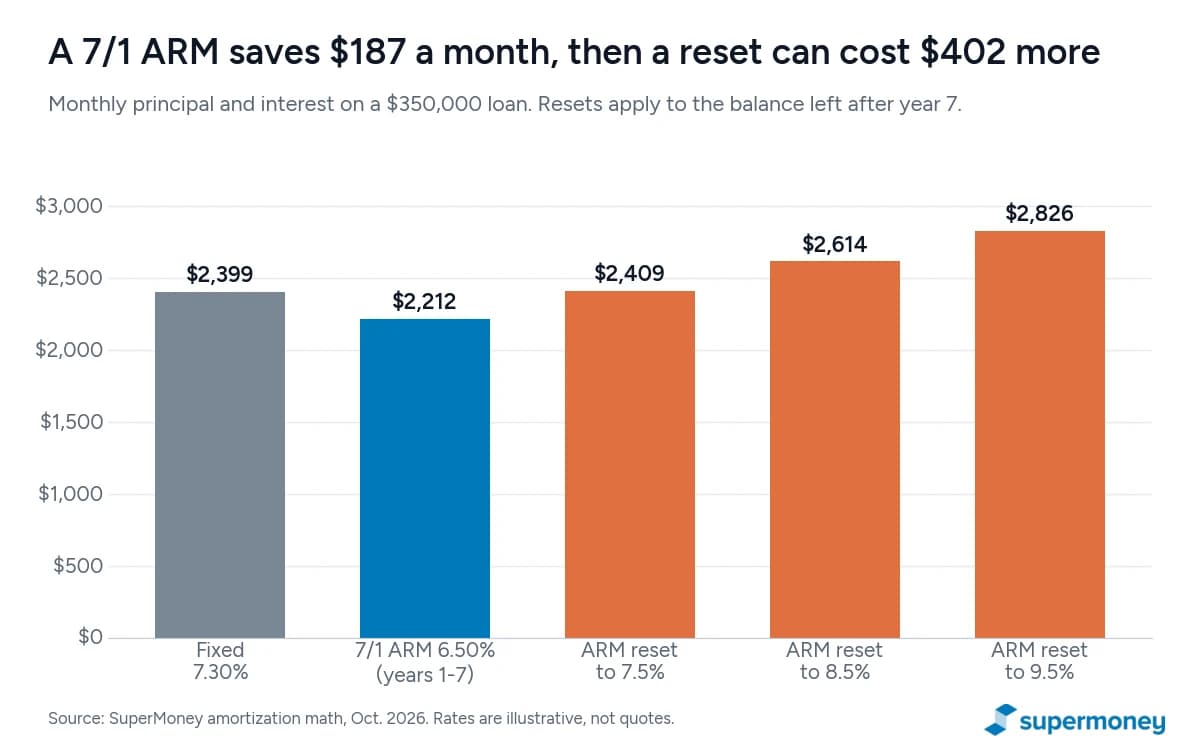
So the ARM wins if rates are flat or lower when the reset hits, or if you’re gone by then. It loses badly if rates are higher and you’re stuck. Here’s the thing, though: you can’t know which one you’ll get. You can only decide how much damage you can absorb.
The 2027 reset cliff is a real warning
Look at what’s about to happen to people who made this bet in 2020. About 74,000 borrowers with 7-year ARMs from 2020 will hit their first reset in 2027. Their median rate goes from 2.75% to 5.79%, and their median payment rises about $1,066 a month, or 36%. Those borrowers got a great deal for seven years. Now they’re facing the other half of the contract.
The bigger picture is less scary than the headline. There are 3.1 million active ARMs, the most in about 5.5 years, but that’s only 5.6% of the roughly 55.4 million active mortgages. Over 90% of ARMs originated since 2022 are still in their fixed periods. And the Fed’s September quarter-point hike adds a median of just $14 a month for borrowers already adjusting. The system isn’t in trouble. Individual households can still be.
When an ARM makes sense
Pick an ARM if you have a specific, believable exit. You’re relocating for work in four years. It’s a starter home and you know you’ll outgrow it. You’re buying now and plan to refinance if rates fall, and you’ve checked that you could still afford the reset payment if they don’t.
That last condition is the one that matters. Run the payment at the lifetime cap, not the starting rate. If a lender’s cap is 5 points above the start rate, that 6.50% ARM can legally reach 11.50%. On our $350,000 example, that’s about $3,268 a month, more than $1,000 above where you started. If you could survive that payment, great. If you couldn’t, the ARM is a gamble with your house.
When to skip it
Skip the ARM if this is your forever home, if your income is tight, or if the savings from the lower rate are the only thing making the purchase work. A payment that only works at the teaser rate is a warning sign that you’re buying too much house.
Also skip it if you’re counting on a refinance as your plan. Refinancing isn’t guaranteed. Rates might be higher, your credit might change, or home values might dip. Treat a future refinance as a bonus, not the plan.
How to shop for one without getting burned
Get at least three quotes. A 2023 Freddie Mac study found that buyers who collected two to four rate quotes during the high-rate months of late 2022 could have saved $600 to $1,200 a year, and the same logic applies to ARMs. Ask each lender for the initial rate, the index and margin, the three caps, the first reset date, and the payment at the lifetime cap. Then compare the 7/1 or 10/1 against a 30-year fixed using the same loan amount and the same points.
Longer fixed periods cost a bit more upfront but give you more time. If you think you might stay 8 years, a 7/1 is cutting it close. A 10/1 is safer.
It’s also worth asking whether buying points to lower a fixed rate beats an ARM. About half of borrowers paid upfront points in August, the highest share since early 2025. Sometimes paying for a lower fixed rate is the calmer choice.
The SuperMoney app can show you how a mortgage payment fits against your real income and spending once you link your accounts. If the ARM only works when you ignore your other bills, that’s the answer you needed.
Key takeaways
- ARMs were over 11% of mortgage rate locks in September, the highest share in nearly four years.
- The average 30-year conventional rate was 7.297% on Oct. 19, with the 15-year at 6.505%, per Mortgage Research Center data reported by Fortune. Freddie Mac’s weekly survey had the 30-year at 7.40%.
- In our example, a 6.50% ARM saves about $187 a month on $350,000, but a reset to 8.5% pushes the payment about $402 above the starting amount.
- About 74,000 borrowers with 2020 7-year ARMs face a median payment jump of $1,066 a month in 2027.
- Always calculate your payment at the lifetime cap before signing.
Share this post:
Add as a preferred source on Google
Table of Contents