
Electrician Salary in 2026: Hourly Pay, Take-Home and Pay by State

Last updated 10/31/2026 by
SuperMoney Team
Edited by
Andrew Latham
Summary:
The median electrician earns $63,190 a year ($30.38 an hour), according to May 2025 BLS data. After 2026 federal taxes, that’s about $4,413 a month for a single filer. Pay ranges from a median of $49,070 in Arkansas to $101,310 in Oregon.
Data as of: U.S. Bureau of Labor Statistics, Occupational Employment and Wage Statistics (OEWS), May 2025 estimates, the most recent release. Take-home figures use 2026 federal tax rules. Updated October 2026.
In Oregon, the median electrician earns $101,310 a year. In Illinois it’s $99,560. That’s roughly double the $50,980 median for all U.S. workers, and most of those electricians got there through a paid apprenticeship instead of a four-year degree and student loans.
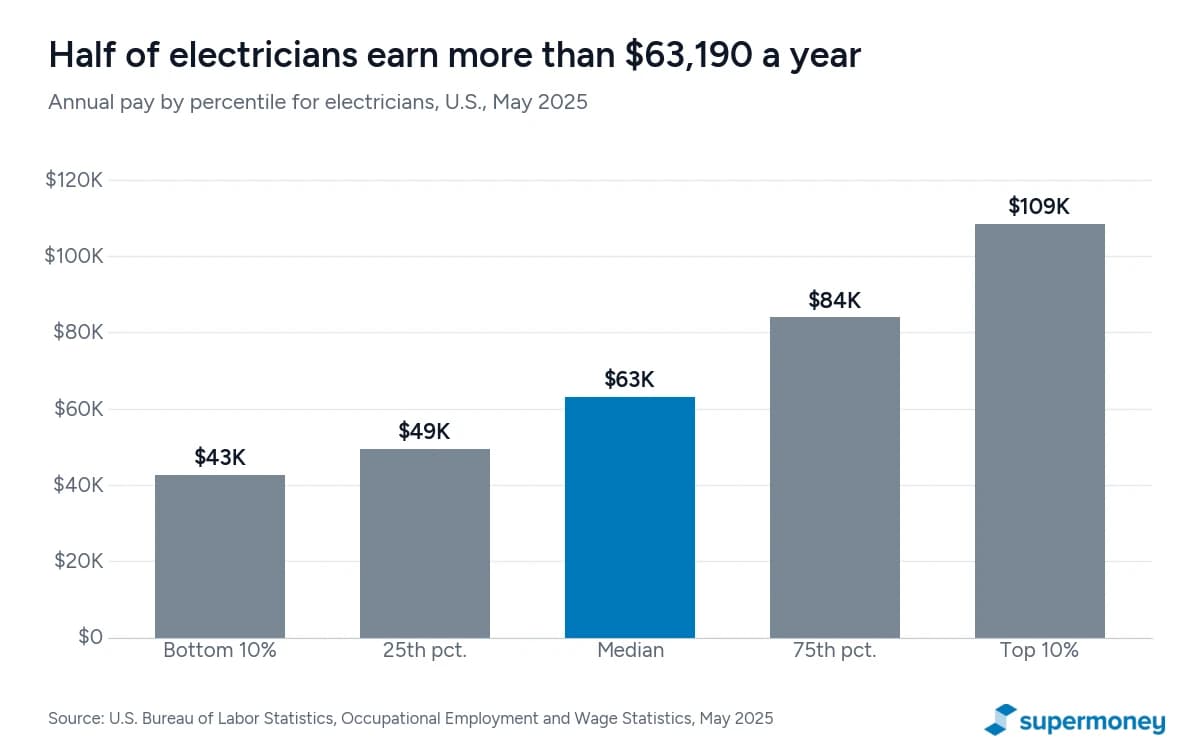
Nationally, the median electrician earns $63,190 a year, or $30.38 an hour, according to the U.S. Bureau of Labor Statistics (BLS). The top 10% earn more than $108,510. Where you land depends mostly on your state, your employer and how much overtime you work.
How much does a electrician make?
| Pay period | Median | Average (mean) |
|---|---|---|
| Hourly | $30.38 | $34.37 |
| Weekly | $1,215 | $1,375 |
| Every two weeks | $2,430 | $2,750 |
| Monthly | $5,266 | $5,958 |
| Yearly | $63,190 | $71,490 |
The median is the middle: half of electricians earn more and half earn less. The average is higher because top earners pull it up. Figures are for wage and salary workers and don’t include self-employed electricians, tips, overtime premiums or benefits. About 757,220 electricians were on payrolls in May 2025.
Want to see the same math for any pay rate? Our hourly to salary chart converts every rate from $7.25 to $100 an hour, and $30 an hour a year and $63,000 a year an hour break down the numbers closest to this job.
Electrician pay range: entry level to top earners
| Percentile | Annual pay | Hourly pay |
|---|---|---|
| Bottom 10% | $42,640 | $20.50 |
| 25th percentile | $49,430 | $23.76 |
| Median (50th) | $63,190 | $30.38 |
| 75th percentile | $83,940 | $40.36 |
| Top 10% | $108,510 | $52.17 |
Apprentice, journeyman, master: how pay climbs
Most electricians learn the trade in a paid 4- or 5-year apprenticeship, according to the BLS. Apprentices earn less than fully trained electricians, and their pay rises as they learn to do more. After the apprenticeship and a state licensing exam, you’re a journeyman. With more experience and another exam in many states, you can become a master electrician and pull permits or run your own shop.
The BLS doesn’t publish separate pay for journeymen, masters or union members. Its percentiles give you a rough ladder instead: the bottom 10%, which includes many apprentices, earn under $42,640, the middle earns $63,190 and the top 10% earn over $108,510.
Overtime adds up fast. At the median $30.38, five overtime hours a week at time and a half is about $11,392 extra over a 50-week year. That’s why two electricians with the same base rate can have very different W-2s.
Electrician take-home pay in 2026
A $63,190 salary doesn’t land in your checking account as $63,190. Here’s what a single filer at the median keeps after federal income tax, Social Security and Medicare, using 2026 tax brackets and the $16,100 standard deduction.
| Line | Amount |
|---|---|
| Gross pay | $63,190 |
| Federal income tax | -$5,403 |
| Social Security and Medicare (FICA) | -$4,834 |
| Take-home pay, yearly | $52,953 |
| Take-home pay, monthly | $4,413 |
| Take-home pay, every two weeks | $2,037 |
That’s an all-in federal rate of about 16.2%, with each extra dollar taxed at 12% plus 7.65% FICA. State income tax comes out on top of this, from 0% in states like Texas, Florida and Washington to more than 5% of income in high-tax states. Pre-tax 401(k) and health insurance contributions lower your tax bill but also your paycheck.
Electrician salary by state
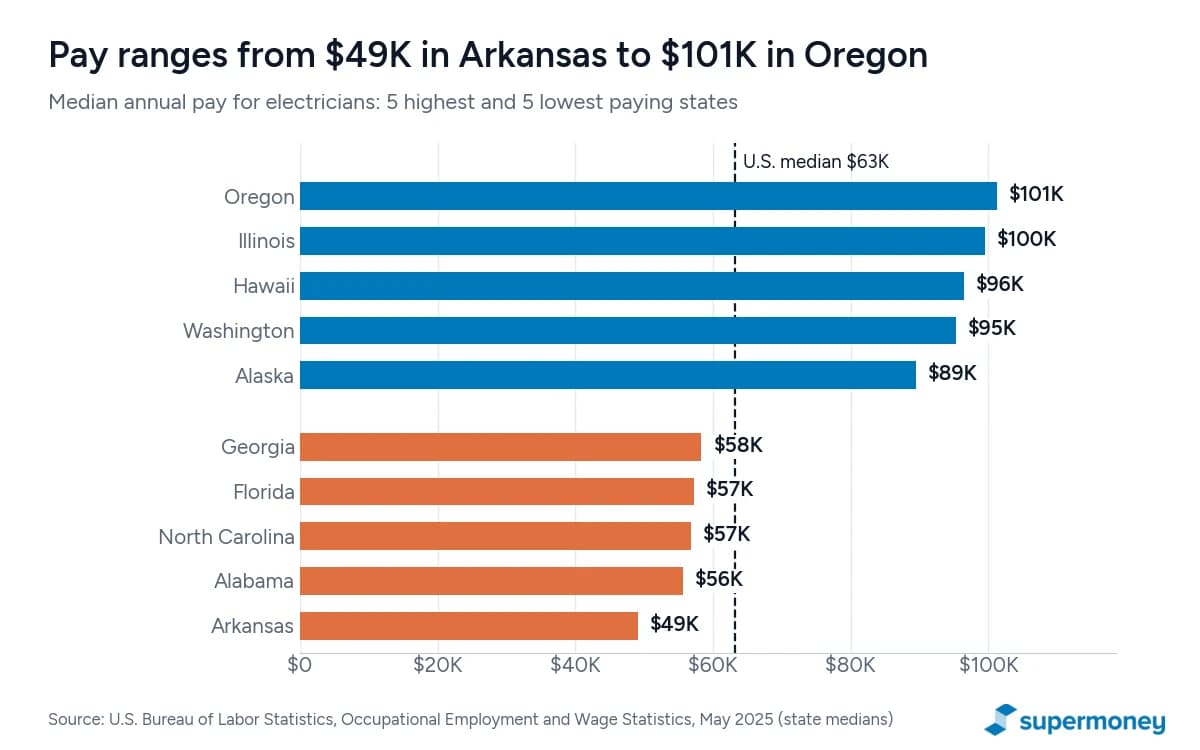
Median pay by state, highest to lowest. State medians reflect local demand and cost of living, so a higher number doesn’t always mean more money left over.
| State | Median annual pay | Approx. hourly | vs. U.S. median |
|---|---|---|---|
| Oregon | $101,310 | $48.71 | +60% |
| Illinois | $99,560 | $47.87 | +58% |
| Hawaii | $96,460 | $46.38 | +53% |
| Washington | $95,220 | $45.78 | +51% |
| Alaska | $89,440 | $43.00 | +42% |
| Massachusetts | $79,420 | $38.18 | +26% |
| Washington, D.C. | $78,970 | $37.97 | +25% |
| New York | $78,750 | $37.86 | +25% |
| Minnesota | $78,160 | $37.58 | +24% |
| Connecticut | $77,540 | $37.28 | +23% |
| New Jersey | $77,250 | $37.14 | +22% |
| Montana | $76,760 | $36.90 | +21% |
| Wisconsin | $76,540 | $36.80 | +21% |
| Michigan | $76,270 | $36.67 | +21% |
| California | $76,160 | $36.62 | +21% |
| Wyoming | $76,120 | $36.60 | +20% |
| Maine | $75,380 | $36.24 | +19% |
| Rhode Island | $74,090 | $35.62 | +17% |
| Nevada | $73,570 | $35.37 | +16% |
| Maryland | $73,490 | $35.33 | +16% |
| Indiana | $68,490 | $32.93 | +8% |
| Pennsylvania | $67,600 | $32.50 | +7% |
| Kansas | $65,860 | $31.66 | +4% |
| North Dakota | $65,710 | $31.59 | +4% |
| Missouri | $65,410 | $31.45 | +4% |
| West Virginia | $64,810 | $31.16 | +3% |
| Ohio | $64,700 | $31.11 | +2% |
| Delaware | $63,700 | $30.62 | +1% |
| Vermont | $63,430 | $30.50 | +0% |
| Idaho | $63,000 | $30.29 | -0% |
| Virginia | $62,900 | $30.24 | -0% |
| New Hampshire | $62,840 | $30.21 | -1% |
| Colorado | $62,230 | $29.92 | -2% |
| Utah | $62,000 | $29.81 | -2% |
| Louisiana | $61,540 | $29.59 | -3% |
| South Dakota | $61,390 | $29.51 | -3% |
| Tennessee | $61,090 | $29.37 | -3% |
| Arizona | $61,060 | $29.36 | -3% |
| Oklahoma | $61,010 | $29.33 | -3% |
| Iowa | $60,860 | $29.26 | -4% |
| Mississippi | $60,860 | $29.26 | -4% |
| Nebraska | $60,820 | $29.24 | -4% |
| Kentucky | $59,720 | $28.71 | -5% |
| South Carolina | $58,740 | $28.24 | -7% |
| Texas | $58,570 | $28.16 | -7% |
| New Mexico | $58,390 | $28.07 | -8% |
| Georgia | $58,320 | $28.04 | -8% |
| Florida | $57,250 | $27.52 | -9% |
| North Carolina | $56,800 | $27.31 | -10% |
| Alabama | $55,690 | $26.77 | -12% |
| Arkansas | $49,070 | $23.59 | -22% |
Where electricians earn the most
| Industry | Median annual pay |
|---|---|
| Government | $79,820 |
| Manufacturing | $74,550 |
| Electrical contractors | $61,570 |
| Employment services (staffing) | $57,760 |
Source: BLS Occupational Outlook Handbook, median pay in the top industries employing electricians, May 2025.
How to budget on a electrician salary
Start with the take-home number, not the salary. At the median, that’s about $4,413 a month. A simple 50/30/20 split looks like this:
| Bucket | Share | Monthly amount |
|---|---|---|
| Needs (rent, utilities, groceries, insurance, minimum debt payments) | 50% | $2,206 |
| Wants (eating out, travel, subscriptions) | 30% | $1,324 |
| Savings and extra debt payoff | 20% | $883 |
If rent alone eats most of the $2,206 needs bucket, that’s the signal to trim wants or find a roommate, not to stop saving. The SuperMoney app makes this easier: link your checking, credit cards and loans, and it sorts your spending into categories so you can see which bucket is overflowing. It flags subscriptions you forgot about and tracks your net worth month to month. You can also ask Sense AI, the app’s built-in money coach, questions like “Can I afford a $2,000 apartment on my pay?” Get it on the App Store or Google Play.
Saving that 20% is what turns a good salary into wealth. To see where you stand, compare yourself with the median net worth by age and check how much you should have in your 401(k).
More salary guides:dental hygienist salary, radiology tech salary, flight attendant salary, sonographer salary, actuary salary, and what counts as a good salary.
Frequently asked questions
How much does a electrician make an hour?
The median electrician earns $30.38 an hour, based on May 2025 BLS data. The middle half earn between $23.76 and $40.36 an hour.
What is the starting salary for a electrician?
The BLS doesn’t track starting pay directly. The bottom 10% of electricians earn under $42,640 and the bottom 25% earn under $49,430, which is a reasonable range for new electricians.
Which state pays electricians the most?
Oregon has the highest median at $101,310, followed by Illinois ($99,560) and Hawaii ($96,460). Arkansas has the lowest at $49,070. High-paying states often have a higher cost of living, so compare pay to rent before you move.
How much does a electrician take home after taxes?
A single filer earning the $63,190 median takes home about $52,953 a year, or $4,413 a month, after federal income tax and FICA in 2026, before any state income tax or pre-tax deductions.
Do electricians make good money?
Yes, especially for a job you can learn in a paid apprenticeship. The median electrician earns $63,190, about 24% more than the median for all workers, and the top 10% earn over $108,510.
Is the job outlook good for electricians?
The BLS projects employment of electricians to grow 9% from 2025 to 2035, compared with 3% for all occupations. That’s about 72,700 openings a year.
Make your paycheck go further. SuperMoney shows every account in one place, tracks your spending against your budget and gives you personalized tips to save more each month.
Get the app: App Store | Google Play
Feeling overwhelmed by money worries?
SuperMoney's AI-powered budgeting tools help you track your money goes, set realistic goals, and reduce financial stress.
Share this post:
Add as a preferred source on Google
Table of Contents