
How Much Should I Have in My 401(k)? Targets at 30, 40 and 50

Last updated 10/29/2026 by
SuperMoney Team
Edited by
Andrew Latham
Summary:
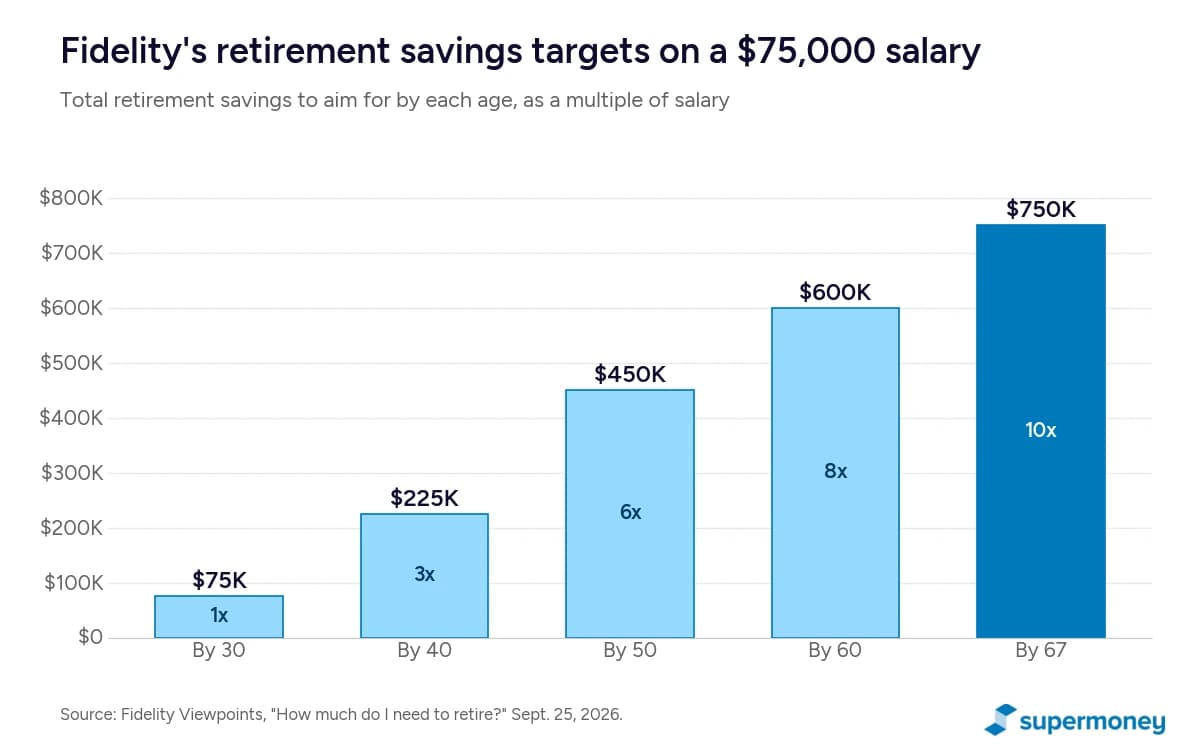
Fidelity’s rule of thumb is to have 1x your salary saved for retirement by 30, 3x by 40, 6x by 50, 8x by 60 and 10x by 67. On a $75,000 salary, that’s $75,000 at 30, $225,000 at 40 and $450,000 at 50. If you’re behind, the fix is usually a higher savings rate, a few more working years, or both, and the gap is smaller than it looks.
Here’s the short answer. Fidelity, which runs the largest 401(k) business in the country, says to aim for a multiple of your salary at each age: 1x by 30, 3x by 40, 6x by 50, 8x by 60 and 10x by 67. Here’s what that looks like on three common salaries.
| By age | Fidelity target | On $52,000 ($25/hour) | On $75,000 | On $100,000 |
|---|---|---|---|---|
| 30 | 1x salary | $52,000 | $75,000 | $100,000 |
| 40 | 3x salary | $156,000 | $225,000 | $300,000 |
| 50 | 6x salary | $312,000 | $450,000 | $600,000 |
| 60 | 8x salary | $416,000 | $600,000 | $800,000 |
| 67 | 10x salary | $520,000 | $750,000 | $1,000,000 |
Source: Fidelity Viewpoints, “How much do I need to retire?” (September 25, 2026).
Want to see how real people compare? Our guide to the average and median 401(k) balance by age has the full Vanguard breakdown. This article is about a different question: not what other people have, but what you should be aiming for.
Compare Investment Advisors
Compare the services, fees, and features of the leading investment advisors. Find the best firm for your portfolio.
What Fidelity’s targets assume
A salary multiple is fairer than a single dollar figure. Someone earning $52,000 and someone earning $150,000 need very different amounts, because they’ll need very different incomes in retirement. But the multiples rest on a few assumptions you should know before you grade yourself:
- It counts all your retirement savings, not just one 401(k). Old 401(k)s, IRAs and Roth IRAs all go in the total. If you rolled a past plan into an IRA, add it back.
- You started at 25 and saved 15% a year, including your employer’s match. If you started at 30, you’ll trail the early milestones for a while. That’s arithmetic, not failure.
- You retire at 67. Fidelity says 12x if you retire at 65 and 8x if you wait until 70. Every year you keep working lowers the number you need.
- Your savings replace about 45% of your pre-retirement income. Social Security is meant to cover much of the rest. If you’ll have a pension, you need less.
- It plans for bad markets. Fidelity builds the targets to work even if returns are poor, so hitting them gives you a margin of safety.
Fidelity calls these milestones “aspirational” and says plainly that most people won’t hit all of them. Treat them as a compass, not a pass/fail test.
How much should I have in my 401(k) at 30?
Target: about 1x your salary. On a $25-an-hour job, which pays about $52,000 a year, that’s $52,000 across all your retirement accounts.
Most 30-year-olds aren’t there, and that’s normal. The median 401(k) for savers 25 to 34 is $18,732, per Vanguard’s 2026 data. Many people spend their twenties paying off student loans, changing jobs, or earning entry-level pay, and the 1x target assumes 15% saved every year since 25.
Here’s a real-number version. Say you’re 30, earn $52,000 and have $15,000 saved (about 0.3x). To reach 10x by 67, you’d need to save about 17% of pay from here, counting your employer’s match. If your employer puts in 4%, that’s 13% from you. Plan to work until 70 instead, and the number drops to about 12% total.
At 30, your savings rate matters far more than your balance. You have 37 years of growth ahead, so a few percentage points now does more than a big lump sum later.
How much should I have in my 401(k) at 35?
Fidelity doesn’t publish a 35 milestone. Halfway between 1x at 30 and 3x at 40 is about 2x your salary, so $150,000 on a $75,000 salary. If you’re under that, the 40 section below shows what to save to catch up.
How much should I have in my 401(k) at 40?
Target: 3x your salary. On a $75,000 salary, about $36 an hour, that’s $225,000. On $100,000, it’s $300,000.
That’s a big jump from 1x at 30, and it’s where a lot of people start to feel behind. The median 401(k) for 35- to 44-year-olds is $46,919, according to Vanguard. That’s well under 3x on almost any salary. Remember, though, that it counts only one account at one employer, so many people have more saved than that number shows.
So what if you’re 40 and below 3x? Here’s how much you’d need to save each year, as a share of pay including any match, to reach Fidelity’s 10x by 67, or its 8x target if you work until 70.
| Saved at 40 | On a $75,000 salary | Save per year to retire at 67 | Save per year to retire at 70 |
|---|---|---|---|
| 0.5x salary | $37,500 | 25.5% | 17.1% |
| 1x salary | $75,000 | 23.0% | 14.8% |
| 2x salary | $150,000 | 18.0% | 10.2% |
| 3x salary (on track) | $225,000 | 12.9% | 5.5% |
SuperMoney calculation. Savings rate includes employer contributions. Assumes pay grows 1.5% a year faster than inflation (Fidelity’s assumption) and a return of about 3.7% a year after inflation, the rate at which saving 15% from age 25 lands on exactly 10x by 67. Illustrative, not a guarantee.
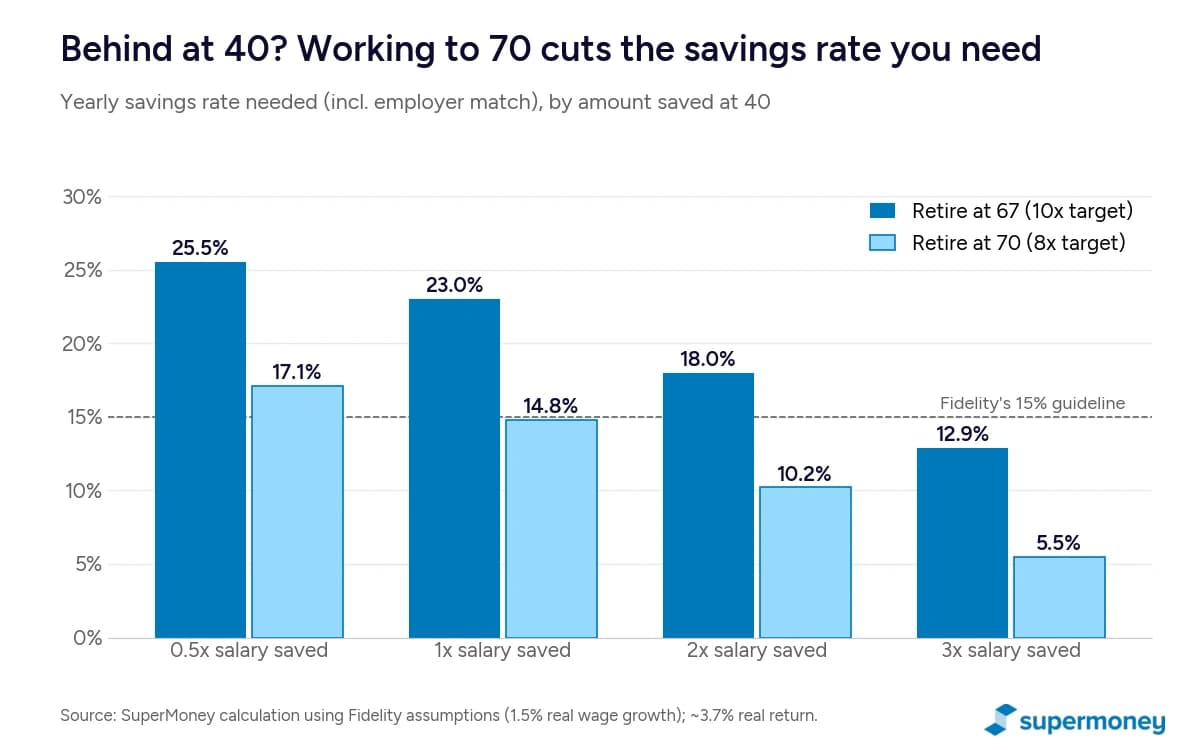
Look at the second row. Maya is 40, earns $75,000 and has $75,000 saved. Retiring at 67 means saving 23% of her pay, which is hard on $75,000. But if she plans to work until 70, she needs 14.8%, right around the 15% Fidelity recommends for everyone. Three more working years turn a stretch into a normal plan, partly because her Social Security check also grows about 8% for each year she waits past full retirement age.
Is $100,000 in a 401(k) at 40 good? On a $75,000 salary, $100,000 is 1.3x, short of 3x but more than double the $46,919 median for your age group. On a $52,000 salary, it’s almost 2x. You’re ahead of most of your peers and behind Fidelity’s target, which is where a lot of people are. Saving 15% to 20% from here gets you most of the way.
Is $500,000 in a 401(k) at 40 good? Yes, for nearly everyone. It’s 3x a $166,667 salary, so unless you earn more than that, you’re at or ahead of Fidelity’s 40 milestone. Your next question isn’t “am I on track,” it’s whether a Roth IRA or HSA should get some of your next dollars.
How much should I have in my 401(k) at 45?
Fidelity skips 45 too. Halfway between 3x at 40 and 6x at 50 is about 4.5x your salary, or $337,500 on $75,000. If you’re 45 with 2x saved, you’d need to save about 25% of pay to retire at 67, or about 14% to retire at 70.
How much should I have in my 401(k) at 50?
Target: 6x your salary. On a $100,000 salary, about $48 an hour, that’s $600,000.
The median 401(k) for 45- to 54-year-olds is $78,730, per Vanguard. If you’re at 2x or 3x at 50, you’re not alone. Say you earn $100,000 and have $200,000 saved. Retiring at 67 would take saving about 35% of pay from here. That’s close to the most the IRS allows: in 2026 you can put in $24,500, plus an extra $8,000 catch-up contribution once you’re 50, for $32,500 a year. Add a 4% match and you’d be at 36.5%.
Work until 70, though, and the same person needs about 20%. That’s the biggest lever at 50: not a hot stock or a perfect fund, but time. From 60 to 63, the catch-up limit rises to $11,250, so you get one more boost right when you need it.
How much should I have in my 401(k) at 60?
Target: 8x your salary, or $600,000 on $75,000. At 60, the most useful number isn’t a multiple. It’s a plan: when you’ll claim Social Security, what you’ll spend, and how much of that your savings need to cover. This is a good time to pay for a one-time review. You can compare financial advisors on SuperMoney, including fee-only planners who charge by the hour.
How to catch up if you’re behind
You don’t need to fix everything this year. You need the next right move, in this order:
- Get the full employer match. It’s an instant 50% or 100% return on the money you put in. Nothing else on this list comes close.
- Raise your rate 1% a year. Most plans let you schedule automatic increases. Time them with raises and you won’t feel it. On $75,000, each 1% is $750 a year, about $29 a paycheck before tax.
- Count every account. Old 401(k)s and IRAs count toward Fidelity’s targets. You may be further along than you think. For the full picture, including home equity and debt, see your net worth percentile by age.
- Know your limits. In 2026, that’s $24,500 in a 401(k) and $7,500 in an IRA, plus catch-up room at 50. Here’s how 401(k) contribution limits work.
- Put the next dollar in the right place. Once you have the match, a Roth IRA or HSA can beat more 401(k) money. See where to save after the 401(k) match.
- Consider working a little longer. As the tables above show, retiring at 70 instead of 67 cuts the savings rate you need by a third or more. Even part-time work in your late 60s helps.
- Over 50? Use the extra room. These ways to catch up on retirement savings after 50 start with the biggest levers.
To see where you actually stand, link your 401(k), IRAs and bank accounts in the free SuperMoney app. You’ll see every retirement balance in one place next to your net worth, and you can ask Sense AI, the app’s money coach, what to change first.
It’s not a race
I’ve given you a lot of targets. Here’s the part I most want you to remember: the only comparison that matters is between you and your own plan.
Fidelity’s chart assumes a person who started saving 15% at 25 and never stopped. Almost nobody lives that life. People pay off student loans first, take time off for kids or sick parents, start businesses, move, get laid off. Being “behind” a straight line drawn by a computer model says very little about whether you’ll be OK.
So skip the question “am I behind for my age?” and ask better ones. Am I saving more than I was last year? Am I getting the full match? Do I know roughly when I want to retire and what I’ll spend? If the answers are yes, you’re doing the work. If not, pick one thing from the list above and do it this month. That’s how people actually get there: steadily, not perfectly.
Frequently asked questions
How much should I have in my 401(k)?
Fidelity’s guideline is 1x your salary by 30, 3x by 40, 6x by 50, 8x by 60 and 10x by 67, counting all retirement accounts. On a $75,000 salary, that’s $75,000, $225,000, $450,000, $600,000 and $750,000.
How much should I have in my 401(k) at 30?
About 1x your annual salary, so $52,000 if you earn $52,000. The median 401(k) for ages 25 to 34 is $18,732, so most people are below that at 30. A savings rate of 15% or more is what matters most at this age.
How much should I have in my 401(k) at 40?
About 3x your salary, or $225,000 on a $75,000 salary. If you have 1x saved at 40, saving about 23% of pay (including the match) gets you to 10x by 67, or about 15% if you work until 70.
How much should I have in my 401(k) at 50?
About 6x your salary, or $600,000 on $100,000. At 50 you can add an $8,000 catch-up contribution on top of the $24,500 limit in 2026.
Do Fidelity’s targets include IRAs?
Yes. The multiples count everything you’ve saved for retirement, including old 401(k)s, IRAs and Roth IRAs, not just your current workplace plan.
What if I’m way behind?
Get the full match, raise your savings rate 1% a year and consider working a few years longer. Retiring at 70 instead of 67 lowers Fidelity’s target from 10x to 8x and gives your savings more time to grow.
Key takeaways
- Fidelity’s targets: 1x your salary by 30, 3x by 40, 6x by 50, 8x by 60 and 10x by 67.
- The targets count all retirement accounts and assume you saved 15% a year from 25 and retire at 67.
- A 40-year-old with 1x saved needs to save about 23% of pay to reach 10x by 67, or about 15% to retire at 70.
- In 2026 you can put $24,500 into a 401(k), plus $8,000 more at 50 and older and $11,250 at 60 to 63.
- The milestones are a compass, not a scorecard. Compare yourself to your own plan, not to strangers.
Share this post:
Add as a preferred source on Google
Table of Contents