
How Much Equity Can I Have In My Home And Still File Chapter 13

Last updated 12/13/2024 by
Benjamin Locke
Edited by
Andrew Latham
Summary:
Chapter 13 bankruptcy allows you to retain your home even if it has significant equity, but if your equity exceeds the protection allowed by your state’s homestead exemption, you’ll need to include it in your repayment plan. This article provides a clear guide on how much equity you can have in your home and still file for Chapter 13 bankruptcy, the role of the homestead exemption, and what you need to consider for your repayment plan.
Having equity in your home is generally a good thing, but can you stil file Chapter 13? Let´s break it down below.
Compare Home Loans
Compare rates from multiple vetted lenders. Discover your lowest eligible rate.
Understanding Chapter 13 Bankruptcy
Chapter 13 bankruptcy is a type of bankruptcy designed to help individuals with significant debt regain control of their finances. Unlike Chapter 7 bankruptcy, which may require liquidation of assets to pay off creditors, Chapter 13 allows individuals to keep their property while making payments under a court-approved repayment plan. This repayment plan lasts 3 to 5 years, depending on the individual’s income and the debts owed.
How Chapter 13 Bankruptcy works
In Chapter 13, the debtor agrees to repay all or a portion of their debts over a set period. The amount of repayment is based on the debtor’s disposable income, and creditors are paid through a bankruptcy trustee. At the end of the repayment period, the remaining eligible debts are discharged.
What is home equity?
Home equity refers to the difference between your home’s market value and the amount you owe on the mortgage. For example, if your home is worth $300,000 and you owe $200,000, your equity is $100,000. This equity is important in bankruptcy cases, as it determines whether or not you can retain your home.
How home equity affects Chapter 13 Bankruptcy
One of the main concerns in Chapter 13 bankruptcy is whether you can keep your home if you have significant equity. In this case, the homestead exemption plays a crucial role. The homestead exemption allows you to protect a certain amount of equity in your home from creditors. If your equity exceeds the exemption amount, you will need to pay that excess amount to creditors through your repayment plan.
The homestead exemption in Chapter 13 Bankruptcy
The homestead exemption varies from state to state and determines how much equity you can protect in your home during bankruptcy. Each state sets its exemption limits, and some states allow a generous amount of equity to be shielded, while others are more restrictive. It’s important to understand how much equity in your home is protected based on the exemption laws in your state.
State-by-state exemption limits
The amount of equity you can protect depends on your state’s laws. Some states, like Texas and Florida, have unlimited homestead exemptions, which means you can protect all the equity in your home regardless of its value. However, most states have a cap on the amount of equity you can shield.
Here is an overview of the homestead exemptions in several states:
| State | Homestead Exemption Limit |
|---|---|
| Texas | Unlimited for homes up to 10 acres (urban) or 100 acres (rural) for a single person |
| Florida | Unlimited for primary residence |
| California | $75,000 – $175,000 depending on age and disability |
| New York | $85,500 – $170,000 (varies by county) |
| Georgia | $21,500 (individual), $43,000 (married couples) |
How to determine if you can keep your home
If the value of your home exceeds the homestead exemption, you may still be able to keep it by including the nonexempt portion of your equity in your Chapter 13 repayment plan. Your bankruptcy attorney will help you determine whether your home equity exceeds the exemption and how it will impact your bankruptcy case.
Example of home equity and repayment plan
Let’s look at two real-life scenarios that show how home equity and state homestead exemptions affect Chapter 13 bankruptcy repayment plans.
Scenario 1: Scenario with home equity exceeding the exemption
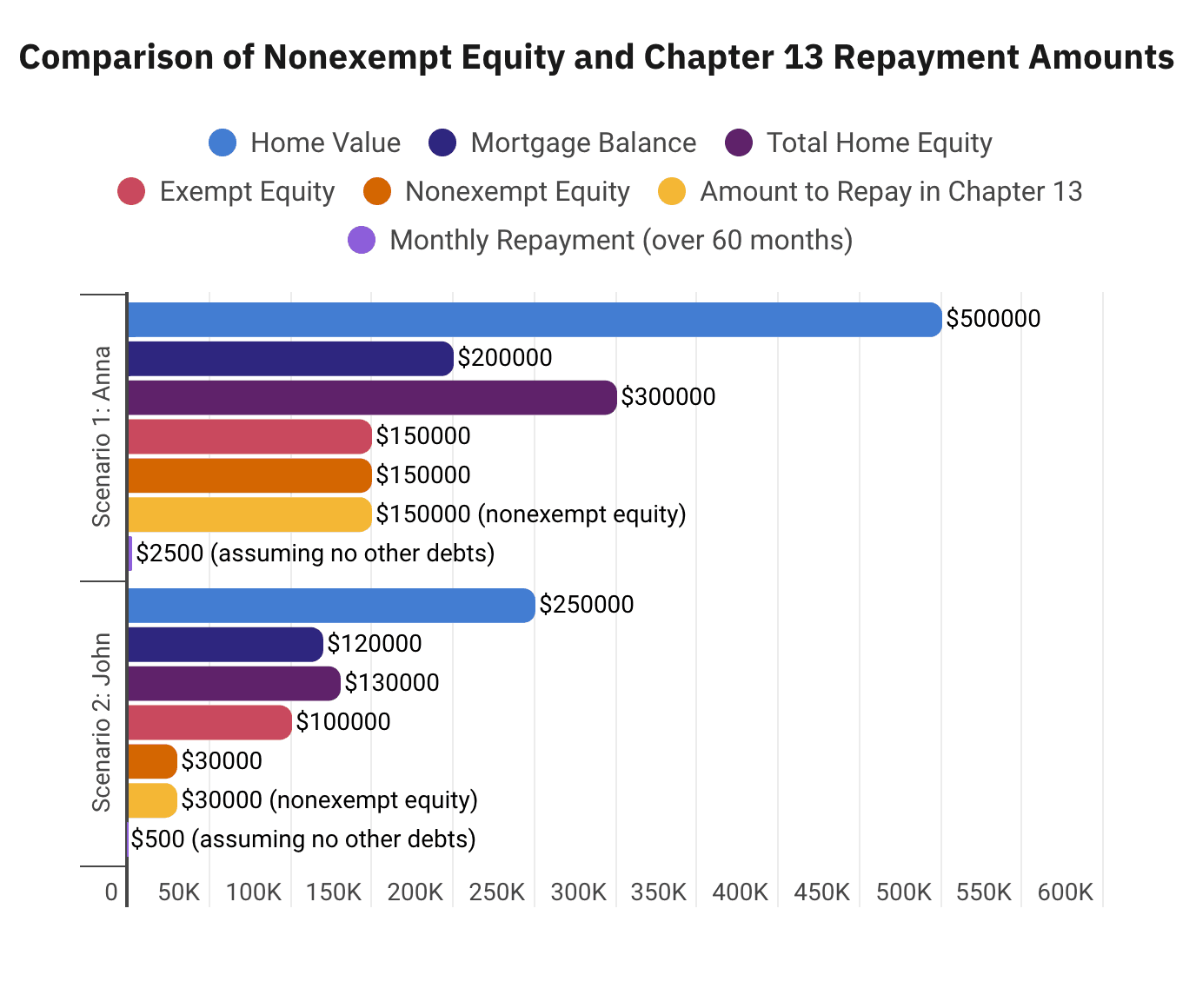
Anna owns a home in a state where the homestead exemption protects up to $150,000 of equity in her primary residence. Sarah’s home is appraised at $500,000, and she owes $200,000 on her mortgage, leaving her with $300,000 in home equity.
In this case, her state’s exemption protects only $150,000, meaning she has $150,000 in nonexempt equity. Since Anna is filing for Chapter 13 bankruptcy, this $150,000 must be included in her repayment plan to creditors, in addition to her other unsecured debts like credit card balances and medical bills.
| Calculation | Amount |
|---|---|
| Home Value | $500,000 |
| Mortgage Balance | $200,000 |
| Home Equity | $500,000 – $200,000 = $300,000 |
| Exempt Equity (protected by homestead exemption) | $150,000 |
| Nonexempt Equity (must be repaid to creditors) | $300,000 – $150,000 = $150,000 |
As Anna’s repayment plan lasts 5 years, she would need to repay this $150,000 over the 60 months, which would increase her monthly repayment amount.
Scenario 2: Scenario with home equity below the exemption limit
John, a homeowner in a state with a homestead exemption of $100,000, has a home appraised at $250,000. He owes $120,000 on his mortgage, leaving him with $130,000 in equity. Since his state’s homestead exemption is $100,000, $100,000 of his equity is protected, leaving John with $30,000 in nonexempt equity.
John’s Chapter 13 repayment plan must include the $30,000 of nonexempt equity, but the remaining $100,000 is exempt, meaning John won’t need to repay that amount to creditors.
| Calculation | Amount |
|---|---|
| Home Value | $250,000 |
| Mortgage Balance | $120,000 |
| Home Equity | $250,000 – $120,000 = $130,000 |
| Exempt Equity (protected by homestead exemption) | $100,000 |
| Nonexempt Equity (must be repaid to creditors) | $130,000 – $100,000 = $30,000 |
In this case, John would include the $30,000 nonexempt equity in his Chapter 13 repayment plan, along with his unsecured debts.
Factors that can affect your equity
Several factors can affect the amount of equity you have in your home. These include the market value of your property, the amount you owe on your mortgage, and whether you’ve refinanced or taken out a second mortgage.
Market value of your home
The market value of your home can fluctuate based on market conditions, home improvements, and other factors. If the value of your home decreases, your equity may shrink, potentially reducing the amount you need to repay in your Chapter 13 plan.
Mortgages and liens
The amount you owe on your mortgage or any additional liens on your property will affect your home equity. If you have multiple liens, such as a second mortgage, this will reduce the amount of equity you have in your home.
Repayment plan and nonexempt equity
If you have nonexempt equity in your home, you must include that amount in your Chapter 13 repayment plan. The repayment plan will typically last 3 to 5 years, depending on your income, and you will need to make monthly payments to the bankruptcy trustee. Your creditors will receive payments from the trustee, and the nonexempt equity will be paid out over the life of the plan.
How the repayment plan rorks
In the repayment plan, your secured debts, such as your mortgage, are treated differently than unsecured debts. Secured debts, including the nonexempt portion of your home equity, must be paid off in full during the repayment period. Unsecured debts, such as credit card debt and medical bills, may be paid off at a lower rate or even forgiven at the end of the plan.
Can you keep your home with significant equity?
Yes, it is possible to keep your home with significant equity in Chapter 13 bankruptcy, but only if you can include the nonexempt portion of the equity in your repayment plan. If the nonexempt equity is too high, it could lead to higher monthly payments, but you can still keep your home as long as you adhere to the repayment plan.
Working with a bankruptcy attorney
It’s highly recommended to work with an experienced bankruptcy attorney when filing for Chapter 13 bankruptcy, especially if you have substantial home equity. An attorney can help you navigate the complexities of exemption laws and repayment plans and ensure that your interests are protected throughout the process.
FAQ
How does Chapter 13 bankruptcy affect my mortgage payments?
Chapter 13 bankruptcy does not eliminate your mortgage but restructures your payments. If you are behind on your mortgage, Chapter 13 will allow you to catch up on missed payments over the course of your repayment plan. You must continue to make regular mortgage payments as usual during the plan.
Can I keep my home if I have a second mortgage in Chapter 13?
Yes, you can keep your home even if you have a second mortgage, as long as you can include the nonexempt equity in your repayment plan. However, if the value of your home is less than the amount owed on the first mortgage, you may be able to “strip off” the second mortgage in a Chapter 13 plan, making it unsecured.
What happens if I can’t afford to repay the nonexempt equity?
If you cannot afford to repay the nonexempt equity, you may need to explore options such as renegotiating your mortgage, extending the repayment plan, or considering a different bankruptcy option, such as Chapter 7. It’s important to consult with a bankruptcy attorney to understand your best options.
Is the homestead exemption the same in every state?
No, the homestead exemption varies by state. Some states, like Texas and Florida, have unlimited homestead exemptions, while others, like California and New York, have capped exemptions. It’s crucial to understand your state’s specific exemption laws before filing for bankruptcy.
Can I modify my Chapter 13 plan if my financial situation changes?
Yes, you can modify your Chapter 13 plan if your financial situation changes. If you experience a change in income or unexpected expenses, you can request a modification to your plan. However, this requires court approval, and it’s important to work with your bankruptcy attorney to navigate this process.
Key takeaways
- Chapter 13 bankruptcy allows you to keep your home, but nonexempt equity must be repaid to creditors.
- The homestead exemption protects a portion of your home equity, but the amount varies by state.
- If your home equity exceeds the exemption limit, you must include the excess equity in your repayment plan.
- Working with a bankruptcy attorney ensures that your home and financial interests are protected throughout the Chapter 13 process.
Share this post:
Add as a preferred source on Google
Table of Contents