Instant Payday Loans Online With Guaranteed Approval

Last updated 05/12/2026 by
Benjamin Locke
Edited by
Andrew Latham
Summary:
Instant payday loans with online guaranteed approval offer fast financial relief for urgent expenses. This guide covers the essentials of payday loans, including application requirements, costs, risks, and alternatives, helping readers make informed decisions. We explore terms, approval steps, costs, and comparisons with personal loans.
Sometimes, life doesn’t wait for payday. Whether it’s an unexpected medical bill, an overdue utility payment, or a car repair that just can’t be put off, payday loans offer a quick way to get cash when you need it most. But while these loans can be a lifeline in tough moments, they also come with high costs and short repayment times that can make them a little tricky to manage.
Get Competing Personal Loan Offers In Minutes
Compare rates from multiple vetted lenders. Discover your lowest eligible rate.
It's quick, free and won’t hurt your credit score
What is an instant payday loan?
Instant payday loans are short-term, high-interest loans that provide immediate access to cash. Unlike traditional loans, they are designed for fast online applications, quick approval, and small amounts—typically between $100 and $1,500. Payday lenders often approve borrowers with low credit scores by focusing on proof of income and active bank accounts, making them accessible to those who may not qualify for standard credit options.
How payday loans work
Payday loans offer quick solutions to cover unexpected expenses, but they come with high costs. Here are some key characteristics:
- Short loan term: Payday loans have terms of 2-4 weeks, meaning the balance is due with interest by the borrower’s next payday.
- High interest rates: Due to the short repayment periods and lender risk, APRs can reach up to 400% or more.
- Immediate access to cash: Funds are often deposited within 24 hours of approval, meeting urgent needs quickly.
- Minimal credit checks: Payday lenders focus on income and employment status rather than credit scores, allowing access even with poor credit.
Who can access payday loans?
Payday loans are designed for individuals who need quick financial solutions, especially in situations where access to traditional loans is limited. Here are some common situations where people might turn to payday loans:
- Limited access to credit options: Individuals with less access to credit may use payday loans as an alternative when traditional financing is not available.
- Urgent, unexpected expenses: Payday loans can help cover emergency costs like medical bills, car repairs, or urgent home expenses.
- Short-term income gaps: Households relying on a single income or facing temporary income gaps may turn to payday loans to manage essential expenses.
- Immediate cash needs: For those who need immediate access to funds, payday loans provide a fast option for covering necessary costs.
Common uses for payday loans
Unexpected expenses can make payday loans a practical choice for many. From car repairs to essential bills, people rely on these short-term loans to handle urgent costs when funds are tight. The chart below shows the most common reasons borrowers turn to payday loans.
How to get an instant payday loan online
Applying for a payday loan online is straightforward. The following steps outline the process to ensure timely approval and quick access to funds:
- Select a lender: It’s important to research payday lenders, selecting one with clear terms, favorable reviews, and reasonable fees.
- Complete the application: Borrowers need to submit personal information, proof of income, banking details, and identification. The application process is designed to be fast and easy.
- Submit the application for review: Payday lenders usually respond quickly—often within minutes, confirming loan eligibility.
- Receive funds: Once approved, funds are deposited into the borrower’s bank account, generally within 24 hours or sometimes on the same day if the application is completed early.
Eligibility requirements for payday loan approval
While specific eligibility criteria can vary from lender to lender, most payday loan providers have basic requirements that applicants must meet. These criteria are generally more accessible than traditional loans, making payday loans a common option for people facing short-term financial needs. Here’s a breakdown of the typical requirements for payday loan approval:
- Age requirement: Borrowers must be at least 18 years old to legally qualify for a payday loan. This ensures applicants are of legal age to enter into a loan contract.
- Proof of steady income: Most lenders require proof of a consistent income source, which could come from employment, social security, or other verified sources. This is essential as it reassures the lender that the borrower has a means to repay the loan by the due date.
- Active checking account: An active checking account is typically required, as lenders use it to deposit the loan and for automatic repayment on the due date. This is why borrowers need a valid account in good standing to qualify.
- Valid identification: Government-issued identification, such as a driver’s license, state ID, or passport, is necessary for verifying the borrower’s identity. Some lenders may also ask for proof of residence, like a utility bill, to confirm address details.
Pro Tip
Beyond these requirements, lenders may sometimes ask for additional documentation, such as recent bank statements, pay stubs, or contact information for employment verification. Meeting these criteria doesn’t guarantee approval, but it ensures the borrower has met the lender’s basic requirements, making the process faster and easier.
Alternatives to payday loans
Exploring alternatives to payday loans can help borrowers avoid high fees and interest. Consider these alternatives for financial assistance:
- Personal loans: Many banks and online lenders offer personal loans with lower interest rates and more manageable repayment terms.
- Credit union loans: Credit unions often provide affordable short-term loans to members with flexible repayment terms and lower rates.
- Credit card cash advances: Cash advances on credit cards still carry high rates but are generally less costly than payday loans.
- Borrowing from family or friends: This option avoids high fees and interest, offering flexible repayment terms that align with your needs.
Comparing payday loans and personal loans
When unexpected expenses arise or planned projects need financing, payday loans and personal loans both offer solutions—yet with vastly different terms, costs, and repayment structures. Understanding the differences between these two types of loans is crucial for choosing the one that best fits your financial needs and goals. Below, we’ll break down the core aspects of each, from loan amounts and interest rates to credit requirements, to give you a clear view of what each option offers.
| Feature | Payday Loan | Personal Loan |
|---|---|---|
| Loan Amount | $100 – $1,500 | $1,000 – $50,000 |
| Interest Rate | 200-400% APR | 6-36% APR |
| Repayment Term | 2-4 weeks | 1-5 years |
| Credit Requirement | Low emphasis on credit score | Higher credit requirements |
Real-life scenarios for payday loans and personal loans
To see how payday loans and personal loans work in action, let’s look at two real-life scenarios. Each example demonstrates when a payday loan might provide a quick financial fix and when a personal loan could be the better choice for long-term planning. By examining these situations, you’ll get a clearer sense of the costs, terms, and benefits each loan type offers—and when each one makes the most sense.
Alex’s car repair emergency
Alex’s car suddenly breaks down, and he learns that repairs will cost $600. Because Alex lives paycheck to paycheck, he doesn’t have the extra cash on hand and still needs his car to get to work every day. With no savings and limited credit options, Alex decides to take a payday loan.
Loan Amount: $600
Interest Rate (APR): 300% (typical for payday loans)
Repayment Term: 2 weeks (next payday)
Interest Rate (APR): 300% (typical for payday loans)
Repayment Term: 2 weeks (next payday)
To understand the cost, let’s calculate how much Alex would owe at the end of the two-week term.
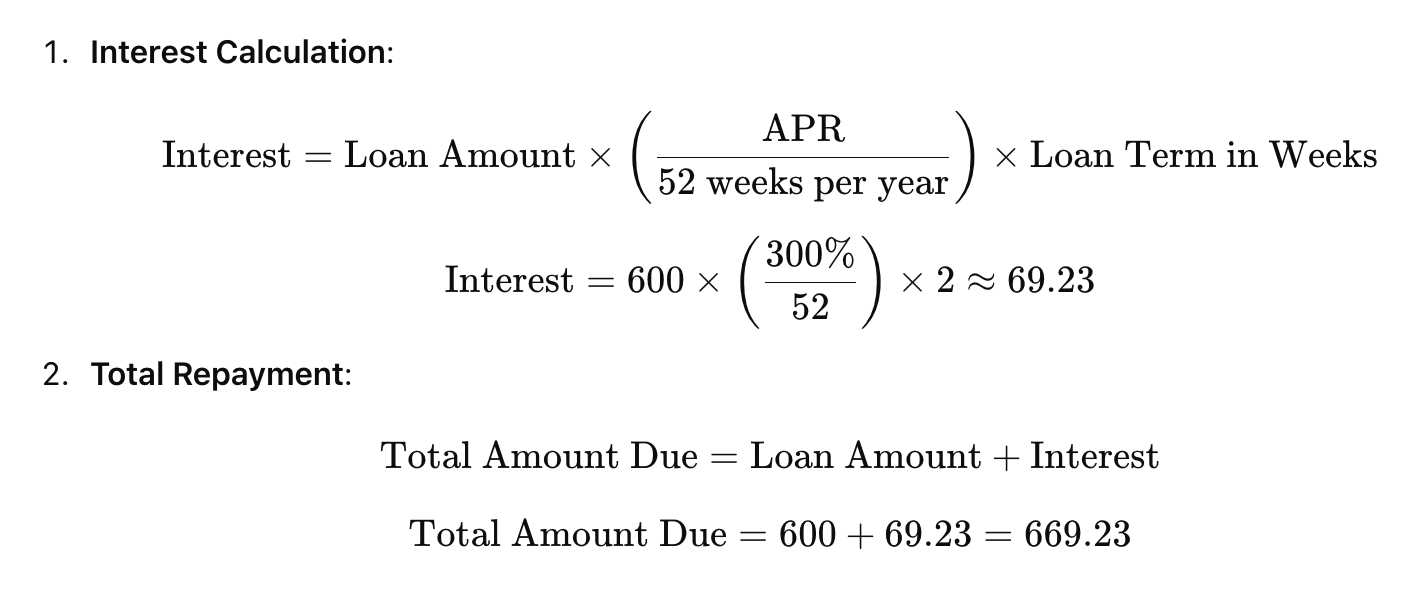
At the end of two weeks, Alex owes $669.23. The high interest rate means he’ll pay $69.23 just for a short-term loan, highlighting the cost of convenience that comes with payday loans.
Maria’s home improvement project
Maria wants to remodel her kitchen to increase her home’s value. She estimates the project will cost $15,000. With a steady income and good credit, she decides to take a personal loan.
- Loan Amount: $15,000
- Interest Rate (APR): 8%
- Repayment Term: 3 years (36 months)
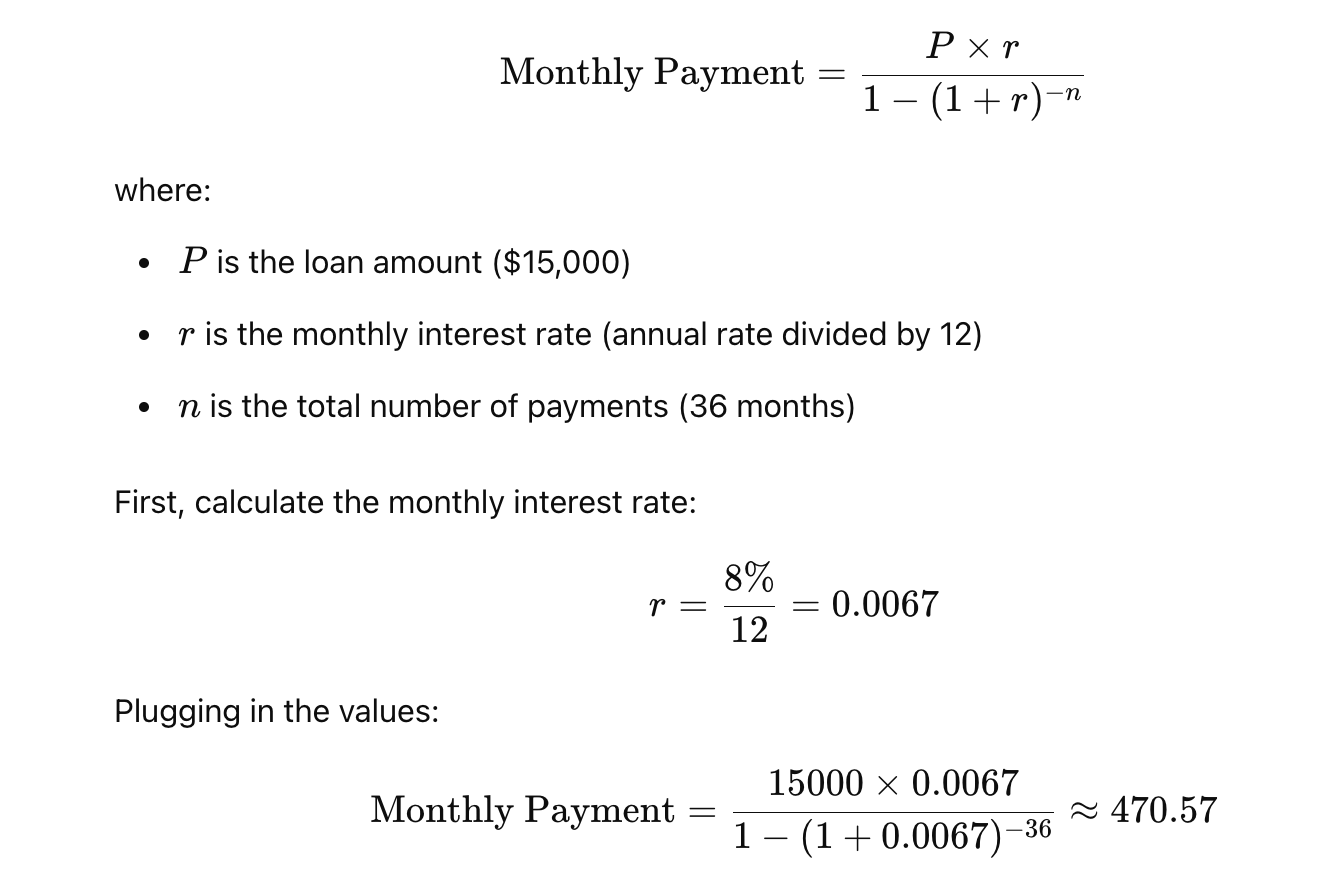
To determine Maria’s monthly payment and total interest over the loan term, we’ll calculate using the formula for monthly loan payments.
- Monthly Payment Calculation:
The formula for monthly payments on an installment loan is:
Total interest:
Multiply the monthly payment by the number of months, then subtract the loan principal:
Multiply the monthly payment by the number of months, then subtract the loan principal:

Maria’s monthly payment will be approximately $470.57, and she will pay $1,940.52 in interest over the three years. The structured, lower-interest repayment plan of a personal loan makes it a cost-effective choice for her planned project.
The costs and risks of instant payday loans
Payday loans offer fast cash, but they come with substantial financial risks. Here are some potential costs and risks associated with payday loans:
- Interest rates: Payday loans can reach APRs of 400% or more, making them one of the most expensive loan types.
- Short repayment periods: Most payday loans are due within 2-4 weeks, which can be difficult for some borrowers to manage.
- Additional fees: Payday lenders may charge late fees, renewal fees, and other charges if the loan is not paid back on time.
- Risk of debt cycle: If borrowers are unable to repay the loan, they may need to renew it, incurring further fees and creating a debt cycle that’s hard to break.
- Credit impact: While some payday lenders don’t report to credit bureaus, defaulting on a payday loan can still result in collection actions, damaging credit scores.
| Cost Type | Description |
|---|---|
| APR | Interest rates of up to 400% or more |
| Repayment term | Typically between 2-4 weeks |
| Fees | Late fees, renewal fees, and insufficient funds fees |
| Credit impact | Potentially harmful if the loan goes unpaid and reaches collections |
FAQ
Are payday loans available in all states?
Payday loan availability varies by state. Some states have restrictions on payday lending or have banned it entirely. It’s important to check your state’s laws before applying, as they determine interest caps, loan limits, and other terms.
Can I apply for multiple payday loans at once?
While it’s technically possible to apply for multiple payday loans, many states and lenders limit the number of active loans a borrower can have. Taking on multiple payday loans can also increase financial risk and make repayment more challenging.
What happens if I can’t repay my payday loan on time?
If a payday loan isn’t repaid by the due date, additional fees or interest may be applied. Some lenders may offer an extension or a rollover option, though this can lead to a cycle of debt with higher costs over time.
Will a payday loan impact my credit score?
Some payday lenders report to credit bureaus, meaning missed payments can affect your credit score. However, many payday lenders do not report loans to the credit bureaus, so it varies based on the lender’s policy.
Are there any alternatives to payday loans for bad credit?
Yes, there are alternatives to payday loans, such as credit union loans, personal loans from online lenders specializing in bad credit, or cash advances from certain credit cards. These options may offer lower rates and more manageable terms.
Key takeaways
- Instant payday loans provide quick cash for urgent needs, but come with high fees and short repayment terms.
- Most payday loans are short-term, with APRs reaching up to 400%, making them a costly option.
- Payday loans are typically accessible without a credit check, focusing on income and active bank accounts for approval.
- Alternatives like personal loans, credit union loans, or credit card cash advances offer lower costs and more manageable terms.
Share this post:
Add as a preferred source on Google
Table of Contents